
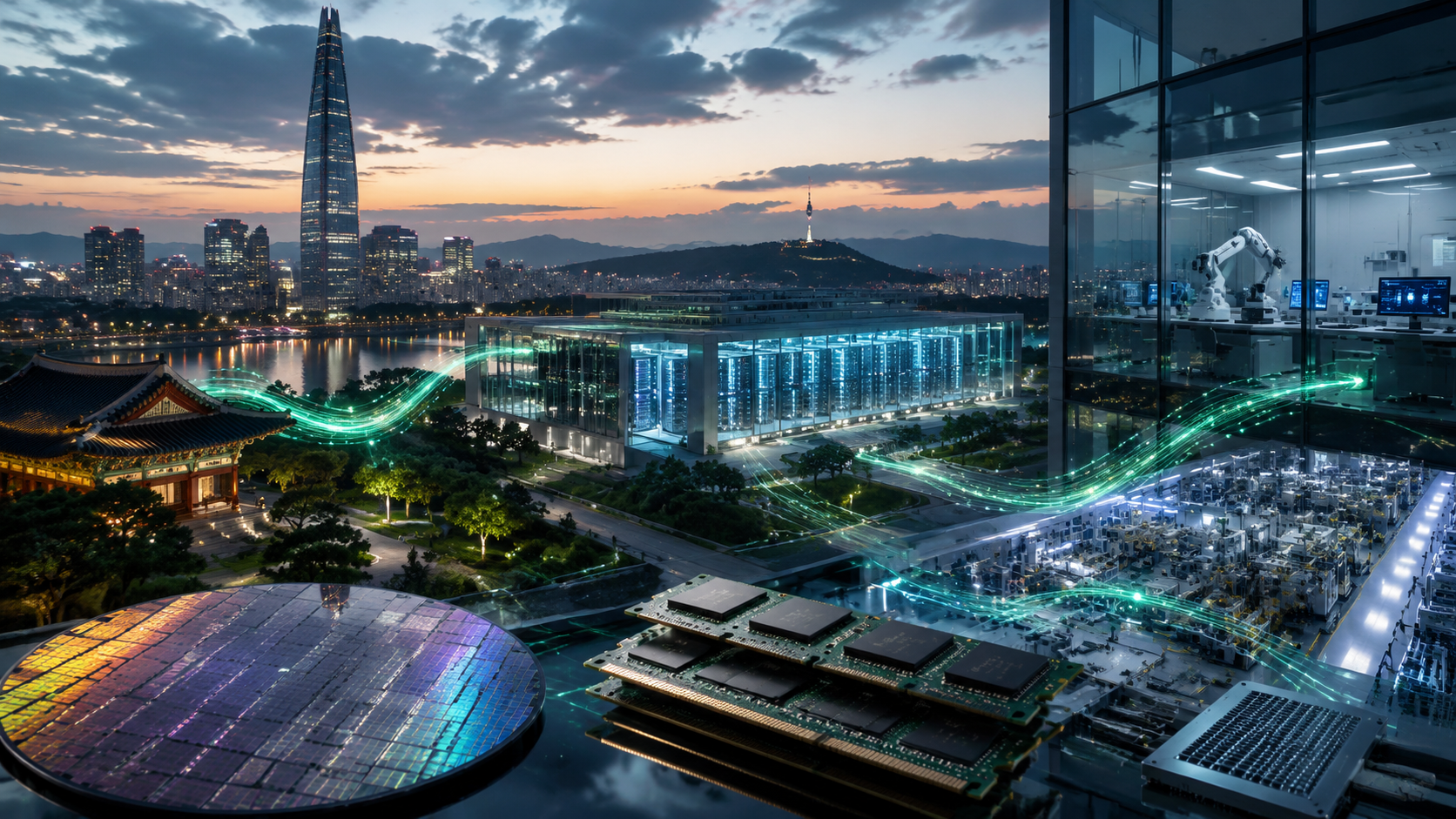
South Korea is making one of its strongest moves yet to become a global artificial intelligence power.
The new South Korea AI strategy with NVIDIA brings together government policy, university research, advanced memory chips, AI data centres and industrial applications. It includes a joint NVIDIA–KAIST research laboratory, major infrastructure projects involving NAVER and SK Group, and new plans for physical AI, robotics and Korean-language models.
President Lee Jae Myung presented the wider vision during an AI summit in San Francisco attended by NVIDIA CEO Jensen Huang, OpenAI CEO Sam Altman, Anthropic CEO Dario Amodei and Broadcom CEO Hock Tan. Leaders from Samsung Electronics, SK Group, Hyundai Motor Group and NAVER were also present.
The announcements are important because South Korea is no longer positioning itself only as a supplier of memory chips. It wants to control more layers of the AI economy, from semiconductor production and computing capacity to research, model development and real-world deployment.
Here is what was announced, how the projects fit together and what still needs to be confirmed.
What Did South Korea Announce at the AI Summit?
President Lee used the San Francisco summit to introduce what he called the San Francisco AI Declaration.
The declaration outlined South Korea’s ambition to become a central participant in the global AI supply chain. That means expanding the country’s role beyond semiconductors into AI infrastructure, model development, industrial applications, education and public services.
Around 150 executives, researchers, investors and startup founders reportedly attended the summit. The event placed South Korean business leaders alongside executives from some of the world’s most influential AI companies.
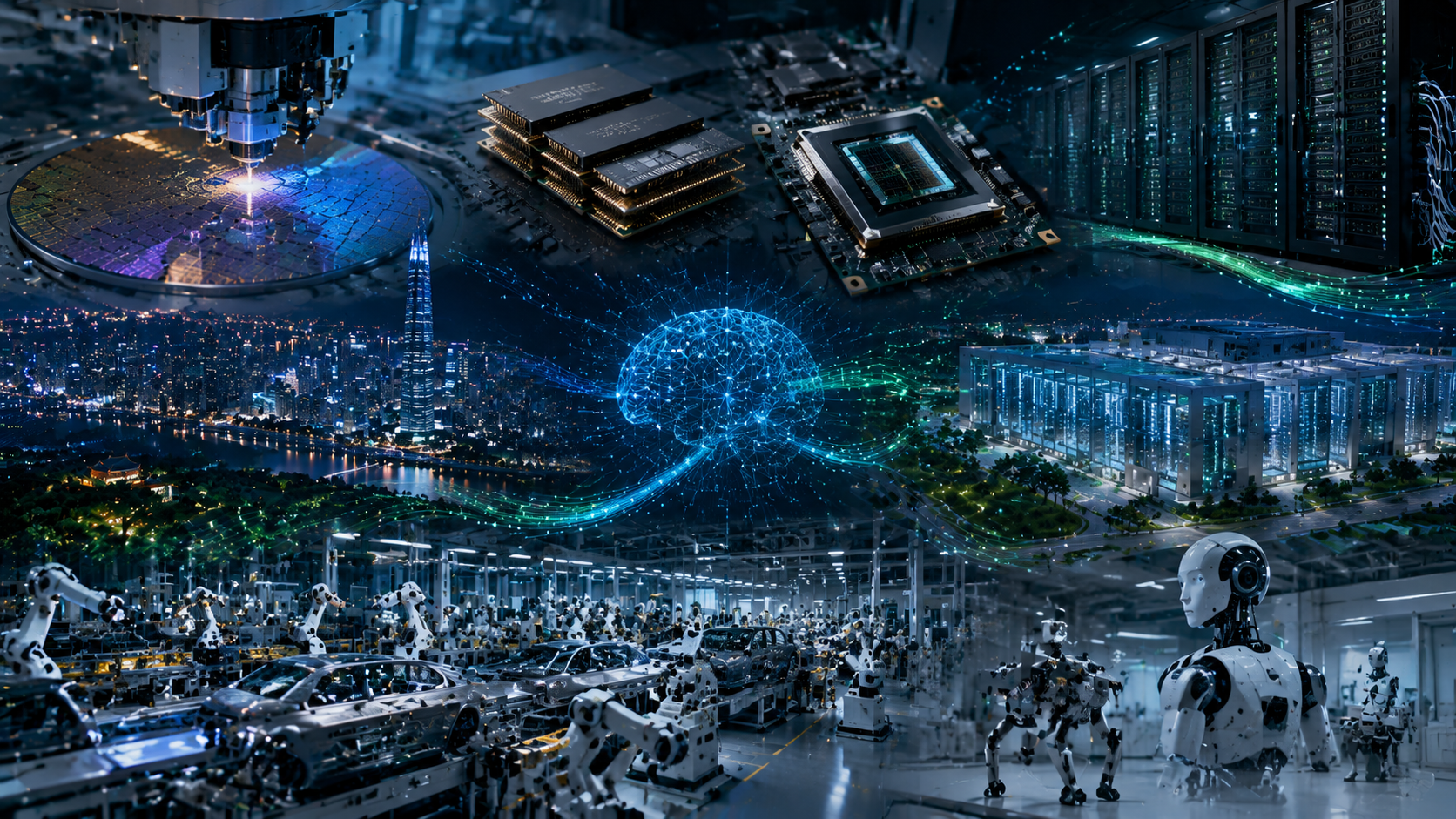
The central idea was a “full-stack” national AI strategy.
In practical terms, South Korea wants to connect:
- Advanced semiconductor manufacturing
- High-bandwidth memory production
- NVIDIA GPUs and computing systems
- Large AI data centres
- Korean-language foundation models
- Agentic AI systems
- Robotics and autonomous vehicles
- Academic research and training
- Enterprise and government adoption
This is broader than a single investment agreement. It is a collection of separate research, computing, memory, data-centre and industrial partnerships.
That distinction matters because some of the figures attached to the summit are extremely large. They should not be combined or described as one immediate investment without examining the terms of each project.
NVIDIA and KAIST Launch a $300 Million AI Research Lab
One of the clearest confirmed announcements is a new joint research laboratory created by NVIDIA and the Korea Advanced Institute of Science and Technology.
The laboratory will operate at the KAIST Kim Jaechul Graduate School of AI in Seoul. It will focus on agentic AI models and systems designed around South Korea’s language, industries and technical requirements.
NVIDIA described it as the first joint AI laboratory established between a Korean university and a global technology company.
What will the KAIST laboratory develop?
The laboratory’s research will focus on AI systems that can do more than generate an answer.
Agentic AI systems can plan tasks, select tools, access information, make decisions and complete multi-stage work with less direct human supervision.
Possible applications include:
- Industrial process automation
- Manufacturing optimisation
- Korean-language business agents
- Scientific research assistants
- Public-sector services
- Robotics control systems
- Logistics planning
- Enterprise knowledge management
The teams will use NVIDIA Nemotron open models and computing resources supplied through local NVIDIA Cloud Partners.
The local focus is important. A model built mainly for English-language markets may not fully understand Korean business terminology, cultural context, legal documents or specialised industrial data.
The laboratory is therefore expected to work on models optimised for Korean-language tasks and local industries.
How much is the collaboration worth?
NVIDIA says the collaboration is expected to be worth $300 million.
That figure includes planned computing contributions of $50 million per year over an initial five-year period. The company also plans to fund at least 10 KAIST researchers each year.
Researchers supported by the programme will receive opportunities for internships at NVIDIA. The company also intends to create possible full-time employment routes for exceptional Korean researchers.
However, the $300 million figure should not be described as a direct cash payment to KAIST.
A significant part of the announced value comes through computing access. That distinction is important because access to modern AI infrastructure can be extremely valuable, but it is not the same as unrestricted research funding.
What Full-Stack AI Means for South Korea
The phrase “full-stack AI” appears frequently in company announcements, but it can sound vague.
For South Korea, it describes a strategy that connects almost every part of the AI production chain.
1. Semiconductors and memory
Samsung Electronics and SK Hynix are major suppliers of memory used in advanced computing systems.
High-bandwidth memory, or HBM, is especially important because AI accelerators must move huge amounts of data quickly between memory and processors.
NVIDIA has emphasised that Korean-developed HBM played an essential role in making modern AI supercomputers possible. During the summit, Jensen Huang described the current period as “the golden age for Korea.”
South Korea’s strong position in memory gives it influence that many countries seeking sovereign AI infrastructure do not have.
Readers who want more context on the pressure facing modern AI hardware can also explore Aitoza’s coverage of NVIDIA Blackwell GPU cooling and infrastructure challenges.
2. GPUs and accelerated computing
Memory alone cannot create an AI ecosystem.
South Korea also needs large clusters of GPUs capable of training, adapting and operating advanced models. NVIDIA is supplying or supporting much of this infrastructure through its Blackwell and Vera Rubin platforms.
The country previously secured plans for more than 260,000 NVIDIA Blackwell chips across government infrastructure and major corporations, including Samsung, SK, Hyundai and NAVER.
These systems can support model training, AI inference, industrial simulation, robotics and scientific research.
3. AI factories and data centres
NVIDIA uses the term “AI factory” for infrastructure that turns electricity, data and computing resources into trained models, predictions, agents and other forms of machine-generated intelligence.
These facilities require more than GPUs. They also need:
- High-capacity power connections
- Cooling systems
- Networking
- Storage
- Security
- Management software
- Reliable memory supplies
- Skilled operators
This is why Aitoza’s reporting on legacy infrastructure limiting AI agents is relevant. Better models cannot deliver their full value when the systems around them remain fragmented or outdated.
4. Models and applications
South Korea wants local companies and researchers to build models suited to its language and industries.
This includes foundation models, enterprise agents, world models and physical AI systems. It also reduces dependence on foreign platforms for every layer of AI deployment.
The strategy resembles the wider sovereign AI movement, in which countries seek greater control over computing infrastructure, sensitive data and strategically important models.
5. Talent and academic research
The KAIST laboratory adds a research and talent layer to the plan.
South Korea must retain top scientists while attracting researchers who might otherwise move to laboratories in the United States or other major technology markets.
The NVIDIA internships, research funding and potential employment pathways are intended to connect academic training with global AI development.
NAVER Plans a 100,000-GPU AI Factory Expansion
A separate announcement involves NAVER, NVIDIA and global investment company Brookfield.
The companies plan to expand NAVER’s AI factory at its GAK Sejong data centre from 55 megawatts to 200 megawatts by 2028.
NVIDIA estimates that the expanded system could contain roughly 100,000 GPUs and use its Vera Rubin platform. NAVER’s longer-term ambition is to move towards one gigawatt of AI infrastructure.
Under the proposed financing structure:
- NVIDIA plans to invest $1 billion in NAVER.
- Brookfield has entered a non-binding term sheet to provide up to $9 billion.
- NAVER would fund the remaining project costs.
- NVIDIA’s investment depends on closing conditions and NAVER securing the required financing.
These conditions should not be overlooked.
The announcement represents a serious infrastructure plan, but parts of the financing remain proposed rather than completed.
The expanded system is intended to provide production-scale computing for Korean and US companies developing models, AI agents and digital services.
NAVER is also working on HyperCLOVA X models based on NVIDIA Nemotron technology. It plans to launch an AI agent platform in Korea and is developing a Seoul-focused world model using urban street-view and spatial data.
SK Group and NVIDIA Announce a $500 Billion-Plus Initiative
SK Group and NVIDIA announced another major initiative covering AI factories and next-generation memory.
The companies described the plan as a $500 billion-plus comprehensive partnership. It includes letters of intent related to infrastructure construction, memory development and long-term supply.
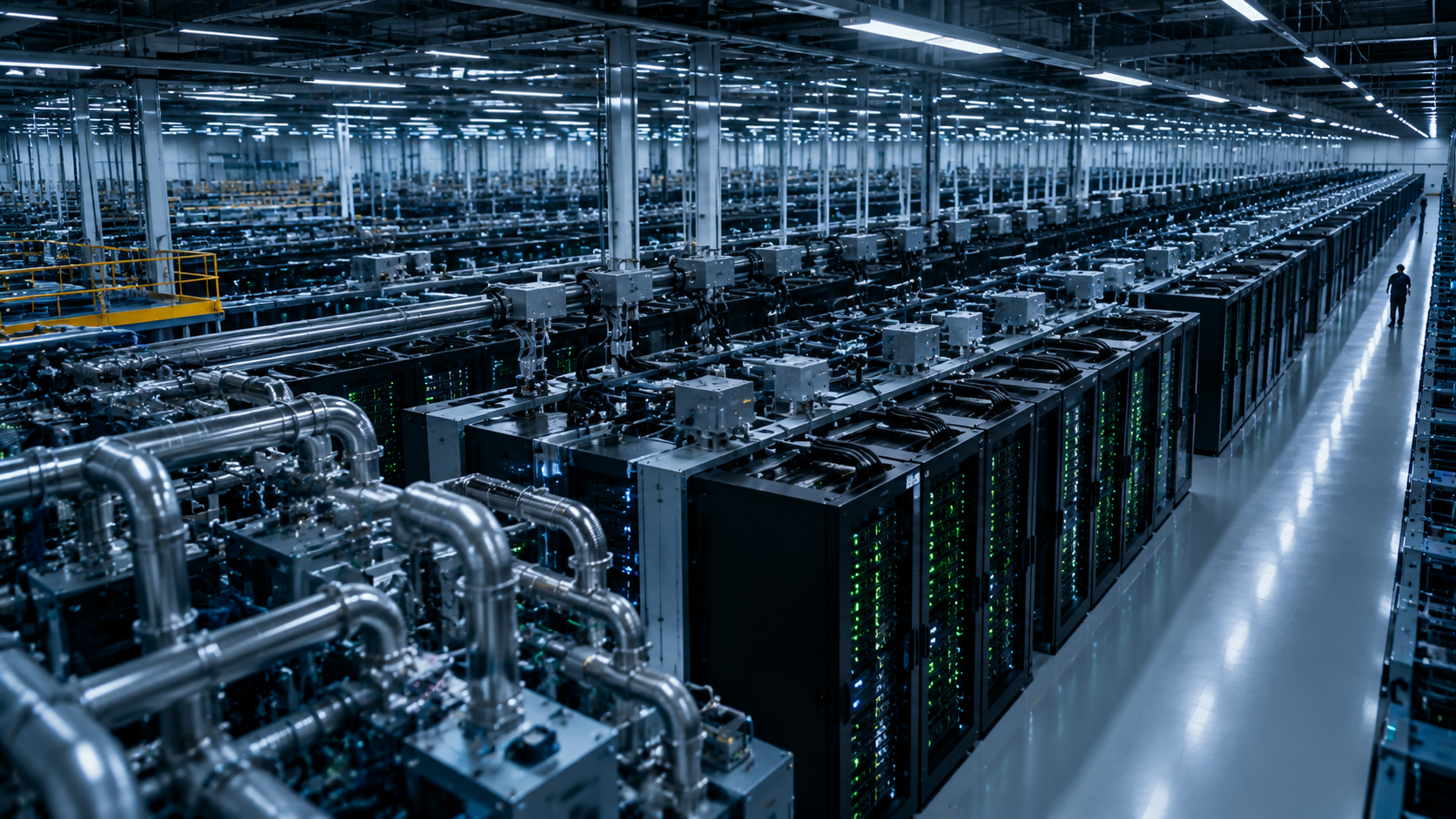
SK Telecom’s planned two-gigawatt AI factory
SK Telecom plans to develop an AI factory with capacity of up to two gigawatts.
The infrastructure is expected to use:
- NVIDIA Vera Rubin accelerated computing
- NVIDIA DSX architecture
- SK Hynix HBM4 memory
- Software for enterprise, agentic and physical AI
The first AI factory is planned to begin operating in 2027.
A two-gigawatt project would be enormous. However, readers should understand that the figure refers to planned maximum capacity, not necessarily a fully operational two-gigawatt facility on launch day.
Large AI facilities are normally developed in phases.
SK Hynix and next-generation memory
SK Hynix will work with NVIDIA to develop and optimise future AI memory, including HBM.
The partnership aims to give NVIDIA a more reliable long-term memory supply while helping SK Hynix remain closely connected to the design requirements of future AI platforms.
This relationship is strategically important because AI accelerators depend on both computing chips and advanced memory. A shortage or technical delay in either component can slow the delivery of entire systems.
Hyundai, Robotics and Physical AI
Hyundai Motor Group presented a physical AI strategy linked to NVIDIA technology.
Physical AI refers to models that understand and act in the physical world. Instead of operating only through text or digital interfaces, these systems can support robots, vehicles, factories and other machines.
Hyundai’s strategy includes a robot reference platform developed with NVIDIA and an infrastructure programme involving 50,000 Blackwell GPUs. The companies are also working around NVIDIA DRIVE Hyperion for autonomous-vehicle development.
Potential applications include:
- Factory robots
- Autonomous driving
- Warehouse systems
- Digital twins
- Industrial inspection
- Humanoid robotics
- Predictive maintenance
Aitoza’s report on Xiaomi’s open-source robotics AI models provides useful additional context on how technology companies are building models that connect AI reasoning with machines and real-world movement.
NVIDIA Expands Its Relationships With Korean Universities
The KAIST agentic AI laboratory is not the only academic initiative.
NVIDIA and KAIST’s Department of Mechanical Engineering are also planning an NVIDIA AI Technology Center focused on physical AI, research, talent development and technical knowledge exchange.
NVIDIA and Seoul National University are planning another centre covering:
- Foundation models
- Accelerated computing
- Physical AI
- AI for science
- Education
- Potential infrastructure cooperation
The work may use NVIDIA Nemotron and NVIDIA Cosmos world foundation models.
These university relationships give the national strategy greater depth.
Building data centres without producing skilled researchers would leave South Korea dependent on outside companies. Research centres can help local teams learn how to adapt models, design new systems and publish original work.
Why South Korea Matters to the Global AI Industry
South Korea holds an unusual position in the AI economy.
It combines advanced manufacturing, semiconductor expertise, major consumer technology companies, strong research universities and a large industrial base.
Most countries trying to build national AI capacity must import nearly every major component. South Korea already produces some of the memory needed for the world’s most advanced AI systems.
It is also an attractive testing ground for physical AI because it has major automotive, electronics, shipbuilding, manufacturing and robotics industries.
For NVIDIA, deeper Korean partnerships offer several advantages:
- Access to advanced HBM expertise
- Stable relationships with memory suppliers
- Demand for large GPU installations
- Industrial customers for physical AI
- Strong universities and researchers
- Local partners capable of operating hyperscale infrastructure
For South Korea, NVIDIA provides accelerated computing, networking, software, open models and access to a global technology ecosystem.
The relationship is therefore not one-sided. Each participant controls capabilities the other side needs.
South Korea’s wider corporate strategy also extends beyond NVIDIA. Samsung, for example, has pursued deeper relationships with model developers and European AI companies. Aitoza has covered the company’s reported interest in a major investment in Mistral AI.
What the Strategy Means for Researchers and Startups
The clearest immediate benefits may go to researchers.
Modern AI research is often limited by access to computing infrastructure. A team can have a strong idea but still struggle to train or test it without enough GPU capacity.
The KAIST laboratory could provide researchers with:
- Advanced computing access
- Funding
- NVIDIA internships
- International collaboration
- Industry data and use cases
- Possible long-term career opportunities
For startups, the NAVER and SK infrastructure could eventually make more local computing capacity available.
That could help Korean companies build language models, business agents, industrial tools and robotics systems without relying entirely on overseas cloud regions.
However, access is not guaranteed simply because the infrastructure exists.
Important unanswered questions include:
- Who will qualify for access?
- How much will computing cost?
- Will startups receive subsidised capacity?
- What data-residency rules will apply?
- Will researchers retain intellectual-property rights?
- Which models or tools must be open-sourced?
These details will determine whether the projects benefit a broad ecosystem or mainly serve large corporations.
Developers building autonomous systems should also consider the need for continuous testing. Aitoza’s guide to AI agent evaluation and monitoring explains why autonomous systems require stronger oversight than ordinary chatbots.
What Is Confirmed and What Remains Unclear?
Several commitments have been publicly announced in detail.
Confirmed or formally announced
- NVIDIA and KAIST are establishing a joint AI research laboratory.
- The collaboration is expected to have a value of $300 million.
- NVIDIA plans to provide $50 million per year in computing contributions for five years.
- At least 10 KAIST researchers are expected to receive annual support.
- NAVER, NVIDIA and Brookfield plan a 200-megawatt AI factory expansion.
- NVIDIA plans a $1 billion investment in NAVER, subject to conditions.
- SK Group and NVIDIA signed letters of intent for a $500 billion-plus initiative.
- SK Telecom plans an AI factory with capacity of up to two gigawatts.
- The first SK AI factory is targeted for 2027.
- Hyundai is expanding physical AI work involving 50,000 Blackwell GPUs.
Still unclear or conditional
- The precise opening date of the KAIST laboratory
- How the $300 million valuation is calculated beyond compute contributions
- Final researcher-selection rules
- Intellectual-property ownership
- Complete GPU delivery schedules
- Final financing for the NAVER project
- Construction phases for the two-gigawatt SK plan
- Whether all letters of intent become binding contracts
- How the $500 billion-plus figure is distributed over time
- Whether government support includes subsidies or guarantees
- Public access rules for the infrastructure
These distinctions are essential for accurate reporting.
Announcements can signal direction and attract investment, but an announced project is not the same as a completed facility.
Challenges South Korea Must Address
The strategy is ambitious, but implementation will be difficult.
Power demand
AI data centres consume vast amounts of electricity.
South Korea must secure generation capacity, grid connections and transmission infrastructure without creating unacceptable pressure on other users.
A planned two-gigawatt AI facility would require energy planning on a national scale.
Cooling and water
High-density AI systems generate intense heat.
Facilities using Blackwell and Vera Rubin infrastructure require advanced cooling designs. Depending on the technology used, cooling can also create significant water demand.
Construction and permitting
Large data centres require land, power agreements, environmental reviews, networking and specialised construction.
Delays in any one area can affect the entire timeline.
Supply-chain concentration
South Korea’s strategy depends heavily on NVIDIA architecture.
That provides access to a mature software ecosystem, but it may also create pricing, supply and vendor-dependence risks.
Talent competition
Funding laboratories does not automatically guarantee that researchers will remain in South Korea.
Universities and companies must offer strong career paths, research freedom and competitive compensation.
Governance and safety
Agentic and physical AI systems can take actions that affect businesses, machines and people.
South Korea will need rules covering testing, accountability, security, privacy and human oversight.
Timeline of the South Korea–NVIDIA AI Expansion
The current announcement builds on earlier partnerships rather than starting from zero.
- October 2025: NVIDIA announced plans to supply more than 260,000 Blackwell chips to South Korean government and corporate projects.
- June 2026: Jensen Huang visited South Korea and met major industrial and technology partners.
- June 2026: NAVER, SK Telecom and NVIDIA announced initial AI infrastructure plans.
- July 23, 2026: NVIDIA and KAIST announced their joint agentic AI research laboratory.
- July 24, 2026: President Lee presented the San Francisco AI Declaration.
- July 24, 2026: NAVER, NVIDIA and Brookfield announced the proposed 200-megawatt expansion.
- July 24, 2026: SK Group and NVIDIA announced their $500 billion-plus initiative.
- 2027: SK Telecom expects its first AI factory to begin operating.
- 2028: NAVER’s 200-megawatt expansion is targeted for completion.
What Happens Next?
The next stage will be less about summit speeches and more about execution.
Important developments to watch include:
- The official opening of the KAIST laboratory
- Selection of the first funded researchers
- Details of NVIDIA computing access
- Final financing for the NAVER expansion
- Construction of SK Telecom’s first AI factory
- HBM4 supply and development milestones
- New Korean-language AI models
- Physical AI projects from Hyundai
- Infrastructure access for startups
- Government progress reports
The projects will be judged by working data centres, installed computing capacity, published research, successful models and commercial deployment—not only by the size of the figures announced.
Conclusion
The South Korea AI strategy with NVIDIA represents a serious attempt to connect memory production, accelerated computing, data centres, model development, academic research and industrial AI.
The $300 million KAIST collaboration gives the plan a research foundation. NAVER’s proposed 100,000-GPU expansion and the $500 billion-plus SK initiative add massive infrastructure ambitions. Hyundai and Korean universities extend the strategy into robotics, physical AI and scientific work.
South Korea already has many of the ingredients needed to become a major AI hub. Its success will now depend on financing, construction, energy availability, research output and whether smaller companies can access the infrastructure being built.
AI News & Updates for continuing coverage of NVIDIA, AI infrastructure, agentic systems and the global race to build sovereign AI capacity.