

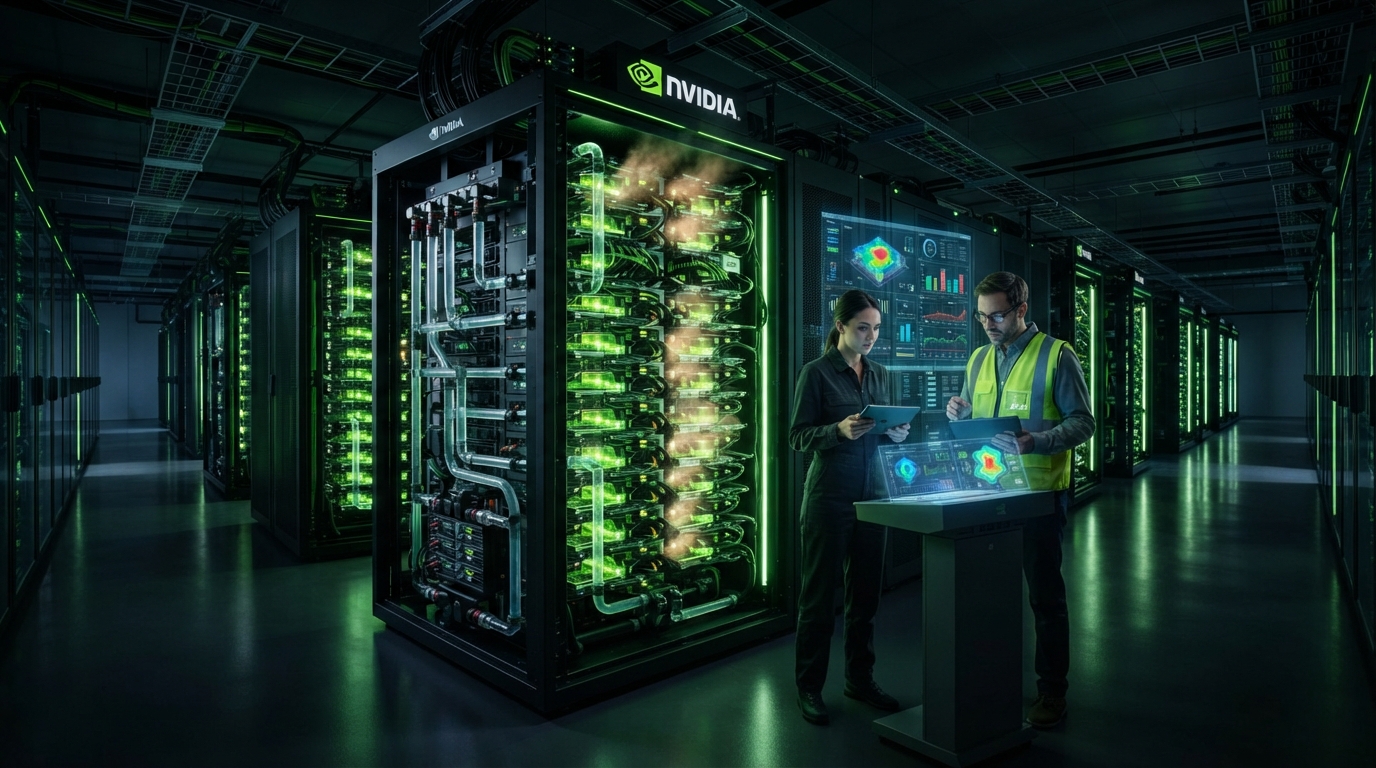
NVIDIA’s highly anticipated Blackwell AI GPU platform has reportedly run into thermal problems during early server deployments, raising concerns among the companies building next-generation AI data centers. According to industry reports, high-density GB200 NVL72 systems experienced overheating when dozens of Blackwell GPUs were packed together inside large-scale server racks.
The issue isn’t a simple graphics card failure. It points to a much bigger challenge facing the entire AI hardware industry: managing the enormous power and heat that modern AI accelerators generate. NVIDIA built Blackwell to deliver a major leap in AI performance, but that extra performance comes with cooling demands that push data center infrastructure to its limits.
What Happened With NVIDIA Blackwell GPUs?
Reports surfacing in late 2024 claimed that NVIDIA’s Blackwell-based GB200 systems ran into overheating issues in high-density rack configurations. The systems in question were GB200 NVL72 racks, which combine dozens of Blackwell GPUs with Grace CPUs into a single large-scale AI computing platform.
Unlike a traditional GPU server, the GB200 NVL72 is designed as a rack-scale system rather than an individual component. It links 72 Blackwell GPUs through NVIDIA’s NVLink interconnect and relies on liquid cooling to handle the workload.
The reported thermal problems trace back to a simple engineering reality: packing more accelerators into a smaller footprint increases power density, and that density generates more heat than can always be removed efficiently especially at scale.
Which Blackwell Systems Were Affected?
The reports centered specifically on:
- GB200 — the base Grace-Blackwell superchip configuration
- GB200 NVL72 — the full rack-scale system connecting 72 GPUs and 36 Grace CPUs
- Early large-scale AI data center deployments built around these racks
Why Are Blackwell GPUs Facing Cooling Challenges?
AI Workloads Are Pushing Hardware to Its Limits
Modern AI models demand far more computing power than earlier generations. Training and running large language models, generative AI systems, and enterprise AI applications requires thousands of GPUs operating in tandem.
NVIDIA designed Blackwell specifically for these workloads, positioning it as a major step up from Hopper-based systems through a combination of improved GPU architecture, faster networking, and rack-scale processing.
But greater performance introduces its own set of engineering problems:
- Higher electricity consumption
- More heat generation per rack
- Increased cooling requirements
- More complex data center design
Building faster chips is no longer the whole equation. Companies now also have to build infrastructure capable of supporting them.
Power Density and the Cooling Problem
The GB200 NVL72 represents a new category of AI infrastructure, where an entire rack functions as one massive computing unit rather than a collection of individual servers.
According to NVIDIA’s own documentation, a full GB200 NVL72 system includes:
| Component | Specification |
|---|---|
| GPUs | 72 Blackwell GPUs |
| CPUs | 36 Grace CPUs |
| Interconnect | NVLink |
| Cooling | Liquid cooling architecture |
Reports indicated these racks could reach power levels in the range of roughly 120kW per rack — far beyond what traditional air-cooled data centers were built to handle. That’s the core of the problem: air cooling, long the industry standard, is becoming less viable as AI racks approach these power densities. It’s why the industry is shifting toward direct liquid cooling and more advanced thermal management systems.
Were NVIDIA Blackwell Deployments Delayed?
The overheating reports raised real concerns about deployment timelines for customers waiting on Blackwell systems. Some reports suggested NVIDIA and its manufacturing partners needed to adjust rack designs before rolling the systems out at scale.
Server manufacturers including Dell, Foxconn, and Quanta were named in connection with GB200 production, and reports at the time indicated their shipment schedules remained largely on track despite the overheating concerns.
Major cloud providers investing heavily in AI infrastructure including Microsoft, Google, and Meta were reportedly watching the situation closely, given how central Blackwell is expected to be to their future AI compute plans.
NVIDIA, for its part, continued moving forward with Blackwell production and deployment, continuing to promote GB200 systems as the foundation for large-scale AI computing.
NVIDIA Blackwell vs. Hopper: What’s Different?
| Feature | Hopper | Blackwell |
|---|---|---|
| Generation | Previous AI GPU platform | Next-generation AI platform |
| Main products | H100, H200 | B200, GB200 |
| Target use | AI training and inference | Advanced, large-scale AI workloads |
| Architecture focus | Large-scale AI acceleration | Rack-scale AI computing |
| Cooling needs | Advanced air/liquid cooling | More demanding liquid cooling |
Blackwell marks NVIDIA’s shift from selling individual GPUs to selling complete AI infrastructure platforms. The GB200 NVL72 design allows dozens of GPUs to function as a single connected system, which is what lets companies train and run today’s largest AI models.
Why Blackwell Matters for the AI Industry
Cloud Providers Are Betting Big on Next-Gen AI Hardware
Microsoft, Google, Amazon, and Meta are collectively investing billions of dollars into AI infrastructure. That hardware supports:
- Large language models
- AI assistants and copilots
- Enterprise automation
- Scientific computing
- Cloud-based AI services
Any delay in advanced GPU availability has the potential to slow how quickly these companies can scale their AI offerings.
Competition in AI Hardware Is Heating Up
NVIDIA still dominates the AI accelerator market, but it isn’t alone. Competitors working on alternatives include:
- AMD, with its Instinct accelerator line
- Google, with custom Tensor Processing Units (TPUs)
- Cloud providers, several of which are developing their own custom AI silicon
Any stumble with Blackwell could hand competitors an opening though NVIDIA’s software ecosystem (CUDA and its surrounding tools) remains a significant moat that’s hard for rivals to replicate.
What Has NVIDIA Said About the Issue?
NVIDIA has continued to present Blackwell as central to its AI roadmap, highlighting GB200’s capabilities rather than addressing the overheating reports point by point. The company has also contributed elements of the GB200 NVL72 design to the Open Compute Project, an industry effort aimed at encouraging broader, standardized adoption across data centers.
That move signals something important: building the next generation of AI infrastructure isn’t a job NVIDIA can do alone. It increasingly requires close cooperation between chip designers, server manufacturers, and data center operators.
The Future of AI Cooling After Blackwell
The Blackwell overheating story is really a preview of a much larger industry trend — AI performance gains are increasingly bottlenecked by power and thermal management, not just chip design.
Going forward, AI data centers will likely need:
Advanced liquid cooling. Liquid removes heat far more efficiently than air, and it’s quickly becoming a requirement rather than an option for high-density AI racks.
Smarter data center design. That means higher-capacity power infrastructure, improved cooling layouts, more efficient server arrangements, and tighter energy management overall.
More efficient AI chips. Future accelerators will need to balance raw performance against power draw, cooling demands, and operating cost because none of those factors can keep scaling independently forever.
Your Asked Questions
Why are NVIDIA Blackwell GPUs overheating? Reports point to the extreme power density of high-performance GB200 rack systems, which makes thermal management significantly more difficult than in previous GPU generations.
What is NVIDIA GB200 NVL72? It’s a rack-scale AI system combining 72 Blackwell GPUs and 36 Grace CPUs, connected via NVLink, and designed for large-scale AI training and inference workloads.
Did NVIDIA delay Blackwell GPUs? Reports raised concerns about deployment timelines and prompted rack redesign discussions, but NVIDIA has continued advancing Blackwell production and customer rollouts.
Are Blackwell GPUs replacing Hopper? Yes. Blackwell is NVIDIA’s next-generation AI platform, succeeding Hopper-based systems like the H100 and H200.
Why does AI hardware need liquid cooling? Modern AI chips generate substantial heat because they run enormous numbers of calculations simultaneously. Liquid cooling removes that heat more effectively than air, helping maintain performance and long-term reliability.
Will AMD benefit from Blackwell’s problems? Competitors may pick up some attention as a result, but NVIDIA’s software ecosystem and existing customer relationships remain a significant competitive advantage.
How powerful is Blackwell compared with Hopper? Blackwell is designed to deliver a substantial performance improvement over Hopper for large-scale, advanced AI workloads, particularly at the rack-scale level enabled by NVLink.
NVIDIA’s Blackwell overheating reports highlight one of the defining challenges of the AI era: building infrastructure capable of supporting increasingly demanding AI models. This isn’t simply a chip problem it reflects a broader shift toward extremely dense AI computing systems, where cooling, energy, and data center design now matter just as much as raw processing power.
Blackwell remains central to NVIDIA’s future, but the challenges surrounding its early deployment make one thing clear: the next phase of AI growth will depend not just on faster chips, but on smarter infrastructure built to keep them running.