
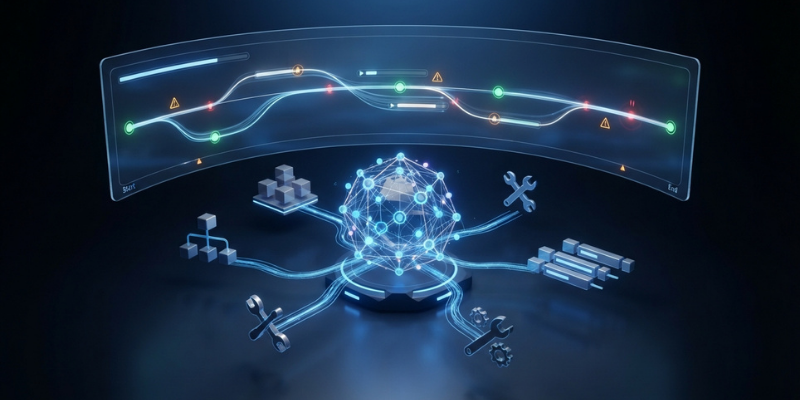
Artificial intelligence agents are becoming a major part of modern enterprise technology, helping organizations automate customer support, software development, data analysis, research, and complex business workflows. However, as AI systems become more autonomous, a new challenge is emerging: organizations cannot judge an AI agent’s performance only by looking at its final response.
An AI agent can provide an accurate-looking answer while making incorrect decisions during the process. It may use inefficient reasoning, select the wrong tools, retrieve unreliable information, or lose important context before completing a task.
This is why AI agent evaluation is becoming a critical focus for businesses adopting autonomous AI systems. Companies increasingly need deeper visibility into how AI agents work internally, including their decision-making process, tool usage, execution steps, and overall reliability.
As enterprise AI adoption accelerates, monitoring and continuous evaluation are becoming essential for building trustworthy and scalable AI solutions.
AI Evaluation Is Moving Beyond Final Responses
Traditional software testing usually focuses on whether an application produces the expected result. AI agents require a different approach because they do not always follow predictable workflows.
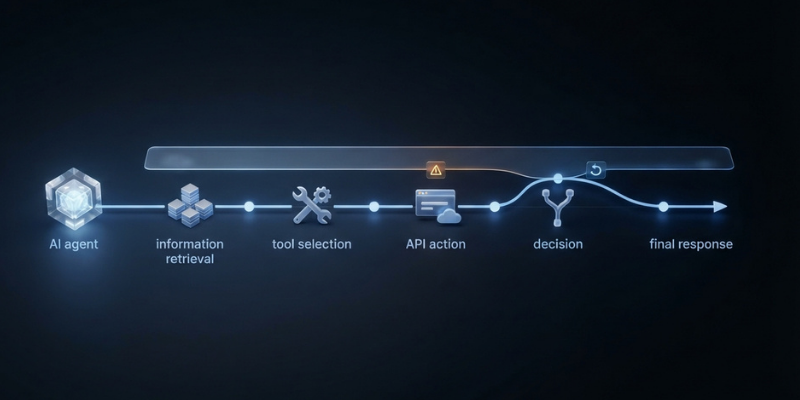
Modern AI agents can perform multiple actions before generating a response. These actions may include collecting information, analyzing data, selecting external tools, executing tasks, and maintaining conversation history.
A successful-looking answer does not always indicate a successful process.
For example, an AI agent might:
- Use outdated information but accidentally reach the correct conclusion.
- Choose an inefficient method to complete a task.
- Call unnecessary tools, increasing processing costs.
- Lose important context during a conversation.
- Make internal reasoning mistakes that users never see.
Although the final output may appear correct, these hidden issues can create reliability problems as organizations scale AI systems across thousands of workflows.
This makes it increasingly important for businesses to evaluate not only what an AI agent produces, but also how it reaches that outcome.
Why AI Agent Responses Can Hide Critical Problems
Large language models are designed to generate human-like responses, which can sometimes make AI systems appear more reliable than they actually are.
A user typically sees only the final answer, not the complex sequence of actions that happened behind the scenes.
An AI agent may experience problems such as:
Incorrect Information Retrieval
Many AI systems depend on external databases and knowledge sources. If the retrieved information is incomplete, outdated, or irrelevant, the agent may build its response on inaccurate data.
Poor Tool Selection
AI agents often interact with external tools, APIs, and software systems. Selecting the wrong tool or using it incorrectly can affect the quality and accuracy of results.
Inefficient Reasoning
An AI agent may complete a task but take unnecessary steps, increasing processing time and operational costs.
Context Management Issues
Long conversations require AI systems to maintain relevant information. Losing important context can lead to inconsistent responses.
These challenges demonstrate why businesses need stronger monitoring systems that analyze AI behavior throughout the entire workflow.
What Is AI Observability?
AI observability refers to the ability to monitor, analyze, and understand how an AI system operates internally.
Instead of asking only:
“Did the AI provide the correct answer?”
AI observability examines questions such as:
- What steps did the AI agent take?
- Which tools did it use?
- How did it make decisions?
- Did it retrieve accurate information?
- Where did delays or failures occur?
- Did the system recover from mistakes?
This approach provides developers and businesses with a clearer understanding of AI performance.
For traditional software, monitoring systems track errors, performance, and usage patterns. AI observability extends this idea by analyzing the behavior of intelligent systems that can make decisions dynamically.
As AI agents become more advanced, observability is expected to become a fundamental requirement for reliable deployment.
Why Enterprise AI Needs Continuous Monitoring
Businesses are moving beyond simple chatbots and adopting AI agents capable of completing complex, multi-step operations.
Common applications include:
- Customer service automation
- Software development assistants
- Financial analysis
- Healthcare documentation
- Internal business research
- IT support automation
- Data processing workflows
These systems often handle important business tasks and interact with sensitive information.
A small hidden error can create major consequences when repeated at scale.
Continuous monitoring helps organizations:
- Identify failures earlier
- Improve AI accuracy
- Reduce operational costs
- Increase customer trust
- Improve compliance
- Optimize AI performance
For enterprises, AI reliability is becoming just as important as AI capability.
The Role of AI Agent Evaluation in Development
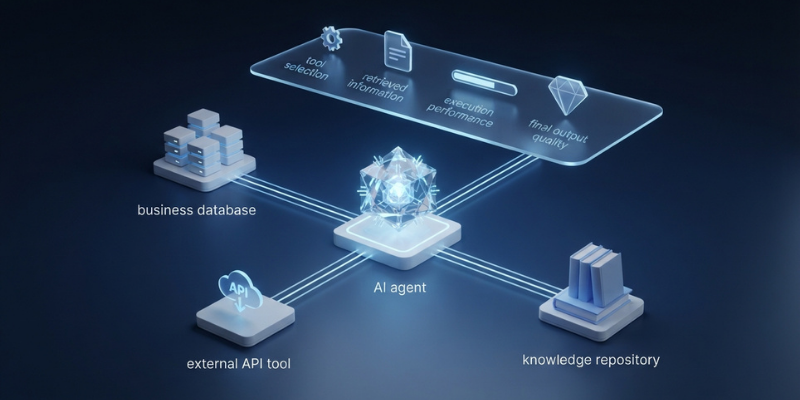
AI agent evaluation focuses on measuring how effectively an AI system performs across different situations.
Unlike traditional testing, which may check whether a single answer is correct, AI evaluation examines the entire workflow.
Important evaluation areas include:
Accuracy
Does the AI provide correct and useful information?
Reliability
Can the AI perform consistently across repeated tasks?
Efficiency
Does the system complete tasks without unnecessary actions or resource usage?
Safety
Does the AI avoid harmful, incorrect, or risky decisions?
User Experience
Does the interaction feel natural, fast, and helpful?
By measuring these factors, organizations can improve AI systems before deploying them at a larger scale.
Why Trace-Level Monitoring Matters
One of the most important developments in AI evaluation is the ability to analyze complete execution traces.
A trace shows the different steps an AI agent takes while completing a task.
This can reveal:
- Decision patterns
- Tool interactions
- Information sources
- Errors
- Recovery actions
- Performance bottlenecks
Trace-level monitoring allows developers to understand why an AI agent produced a specific result.
This is especially valuable for complex systems where failures are not always obvious from the final response.
AI Infrastructure and Reliability Challenges
As AI systems become larger and more complex, infrastructure also plays an important role in reliability.
Enterprise AI applications require:
- Powerful computing resources
- Efficient model execution
- Scalable systems
- Real-time monitoring
- Stable performance
Poor infrastructure management can create slow responses, increased costs, and inconsistent AI behavior.
Combining application-level monitoring with infrastructure analysis helps organizations create more dependable AI solutions.
How Businesses Can Improve AI Reliability
Organizations adopting AI agents should consider several best practices:
Establish Clear Evaluation Metrics
Businesses should define what success means before deploying AI systems.
Metrics may include accuracy, response quality, speed, cost, and user satisfaction.
Monitor Real-World Performance
AI systems should be continuously evaluated after deployment because real-world usage often reveals problems that testing environments miss.
Analyze AI Workflows
Understanding how an AI agent reaches decisions helps developers identify weaknesses and improve performance.
Maintain Human Oversight
Human review remains important for high-risk applications where mistakes can have serious consequences.
Improve Systems Through Feedback
Continuous feedback allows AI applications to become more effective over time.
The Future of AI Agent Monitoring
The future of enterprise AI will depend not only on creating more powerful models but also on ensuring those systems operate safely and efficiently.
As AI agents become capable of managing increasingly complex responsibilities, organizations will need advanced monitoring solutions that provide deeper visibility into their behavior.
Future AI evaluation may include:
- Automated quality scoring
- Real-time error detection
- Advanced workflow analysis
- Self-improving monitoring systems
- More transparent AI decision tracking
The companies that successfully scale AI will likely be those that invest equally in capability, reliability, and accountability.
What is AI agent evaluation?
AI agent evaluation is the process of measuring an AI system’s accuracy, reliability, efficiency, safety, and overall performance across different tasks.
Why do AI agents need monitoring?
AI agents can make hidden mistakes during reasoning, tool usage, or information retrieval. Monitoring helps identify these problems before they affect users.
What is AI observability?
AI observability is the practice of tracking and analyzing an AI system’s internal operations, including decisions, execution steps, and performance.
Why is evaluating only the final answer not enough?
A final answer may appear correct even if the AI used inefficient methods, incorrect information, or flawed reasoning during the process.
Which industries benefit from AI agent monitoring?
Industries such as healthcare, finance, customer service, software development, cybersecurity, and enterprise technology can benefit from reliable AI monitoring.
Will AI observability become a standard practice?
As organizations deploy more autonomous AI systems, observability is expected to become an important part of enterprise AI management.
Conclusion
The growth of autonomous AI systems is changing how organizations think about technology reliability. A convincing AI response does not always mean the system is operating correctly behind the scenes.
AI agent evaluation, observability, and continuous monitoring are becoming essential tools for businesses that want to deploy AI responsibly.
As enterprises continue integrating AI into critical workflows, understanding how these systems make decisions will be just as important as the results they produce.