
Artificial intelligence is changing how HR teams handle everyday work. From finding candidates and scheduling interviews to supporting employees and analyzing workforce data, AI can take care of many repetitive tasks.
But not every HR team needs the same type of AI software. Some tools are built for recruitment, while others focus on employee engagement, performance, learning, analytics, or HR automation.
In this guide, we look at 20 of the best AI tools for HR in 2026 and explain what each one can do in simple terms.
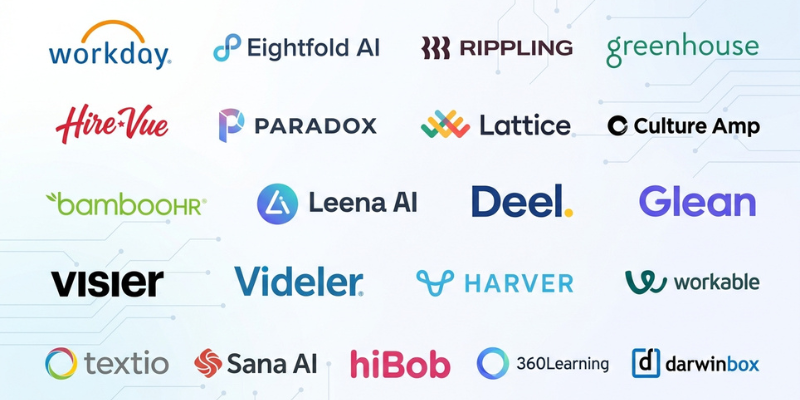
20 Best AI Tools for HR
| # | AI Tool | Best For |
|---|---|---|
| 1 | Workday | Enterprise HR |
| 2 | Eightfold AI | Talent intelligence |
| 3 | Rippling | HR automation |
| 4 | Greenhouse | Recruitment |
| 5 | HireVue | Interviews and assessments |
| 6 | Paradox | Conversational recruiting |
| 7 | Lattice | Performance management |
| 8 | Culture Amp | Employee engagement |
| 9 | BambooHR | Small and growing businesses |
| 10 | Leena AI | Employee support |
| 11 | Deel | Global HR |
| 12 | Glean | Workplace knowledge |
| 13 | Visier | People analytics |
| 14 | Harver | Talent assessment |
| 15 | Workable | Recruiting |
| 16 | Textio | Job descriptions |
| 17 | Sana AI | Learning and knowledge |
| 18 | HiBob | People operations |
| 19 | 360Learning | Employee training |
| 20 | Darwinbox | Enterprise HR management |
1. Workday
Best for: Enterprise HR
Workday is a large HR platform designed for organizations that need to manage employees, recruitment, talent, workforce data, and other HR operations in one place.
Its AI capabilities can help HR teams work with employee data, automate processes, support recruitment, and generate workforce insights.
Key features:
- Human capital management
- AI-powered HR workflows
- Recruitment
- Workforce analytics
- Talent management
Workday is a strong option for larger organizations that need an HR platform capable of handling complex workforce operations. Current 2026 comparisons place Workday among the major enterprise HR platforms with embedded AI.
2. Eightfold AI
Eightfold AI — Official Website
Best for: Talent intelligence
Eightfold AI takes a skills-based approach to hiring and talent management. Instead of looking only at job titles or keywords on a resume, it can help organizations understand candidates through their skills and experience.
HR teams can also use it for internal mobility, workforce planning, and identifying skill gaps.
Key features:
- Talent intelligence
- Candidate matching
- Skills analysis
- Internal mobility
- Workforce planning
Eightfold is particularly useful for companies that want to move toward skills-based hiring and workforce planning.
3. Rippling
Best for: HR automation
Rippling combines HR, payroll, benefits, IT, and employee management in one platform.
Its automation capabilities can reduce manual work around onboarding, employee information, workflows, and other HR processes.
Key features:
- HR management
- Payroll
- Employee onboarding
- Workflow automation
- IT management
For growing companies, its biggest advantage is bringing several employee-related processes together instead of managing them separately.
4. Greenhouse
Best for: Recruitment
Greenhouse is a well-known applicant tracking and hiring platform. It helps recruiting teams organize candidates and manage different stages of the hiring process.
Its AI features can assist with recruiting tasks while keeping hiring teams involved in important decisions.
Key features:
- Applicant tracking
- Candidate management
- Interview management
- Recruiting workflows
- AI-assisted hiring
Greenhouse is a good fit for companies that want a structured recruitment process rather than relying on spreadsheets and disconnected tools.
5. HireVue
Best for: Interviews and assessments
HireVue focuses on candidate interviews and assessments. It can help companies manage hiring at scale when recruiters have many candidates to evaluate.
The platform combines interviewing and assessment technology to make the recruitment process more structured.
Key features:
- Video interviews
- Candidate assessments
- Interview automation
- Candidate engagement
- Skills assessment
It is particularly relevant to larger organizations with high-volume recruitment needs. Current HR software comparisons continue to identify HireVue as a specialist in AI-supported interviewing and assessment.
6. Paradox
Best for: Conversational recruiting
Paradox uses conversational AI to communicate with job candidates. Its AI assistant can help answer questions, support applications, and schedule interviews.
This can be useful for recruiters who spend a lot of time answering basic candidate questions.
Key features:
- Candidate communication
- Interview scheduling
- Candidate screening
- Recruiting automation
- Conversational AI
For companies hiring at high volume, automating routine candidate communication can save recruiters considerable time.
7. Lattice
Best for: Performance management
Lattice focuses on the employee side of HR. It helps companies manage goals, feedback, performance reviews, and employee development.
Its AI features can help managers work with performance information and make review-related tasks easier.
Key features:
- Performance reviews
- Goals
- Employee feedback
- Career development
- Engagement
If your biggest HR challenge is managing employee performance rather than finding candidates, Lattice is worth considering.
8. Culture Amp
Culture Amp — Official Website
Best for: Employee engagement
Culture Amp helps organizations understand employee sentiment and workplace engagement.
HR teams can use surveys and analytics to understand what employees think about their workplace and identify areas that need attention.
Key features:
- Employee surveys
- Engagement analytics
- Employee feedback
- People analytics
- Performance insights
This makes Culture Amp especially useful for HR teams that want to make employee experience decisions using workforce feedback.
9. BambooHR
Best for: Small and growing businesses
BambooHR provides tools for managing everyday HR operations. It can help companies organize employee information, onboarding, hiring, time off, performance, and other HR tasks.
Its relatively straightforward approach makes it a popular option for smaller HR teams.
Key features:
- HR management
- Employee records
- Hiring
- Onboarding
- Performance management
BambooHR is a practical choice when a company needs a centralized HR system without the complexity of a large enterprise platform.
10. Leena AI
Best for: Employee support
Leena AI works as an AI-powered employee support assistant. Employees can ask questions about HR policies, processes, and workplace information.
This reduces the number of repetitive questions HR professionals have to answer manually.
Key features:
- AI HR assistant
- Employee self-service
- HR helpdesk
- Policy support
- Employee queries
It is a good fit for organizations where HR teams spend too much time answering the same basic questions.
11. Deel
Best for: Global HR
Deel is designed for companies that employ people across different countries. It supports global workforce management, hiring, payroll, and contractor administration.
Key features:
- Global hiring
- Payroll
- Contractor management
- Employee management
- Global workforce operations
For distributed companies, Deel can simplify HR processes that become complicated when employees work across multiple countries.
12. Glean
Best for: Workplace knowledge
Glean is an AI-powered workplace search and knowledge platform. It helps employees find information across the company’s different applications and systems.
For HR teams, this can make policies, benefits information, onboarding resources, and internal documents easier to find.
Key features:
- AI workplace search
- Knowledge management
- Employee assistance
- Internal information discovery
It is especially useful for organizations where important information is spread across many different workplace tools.
13. Visier
Best for: People analytics
Visier specializes in workforce and people analytics. HR leaders can use it to understand trends around hiring, retention, employee movement, and workforce planning.
Key features:
- People analytics
- Workforce planning
- Employee insights
- Talent analytics
- Workforce trends
Instead of simply showing HR data, people analytics tools like Visier are designed to help HR leaders turn workforce information into useful business insights.
14. Harver
Best for: Talent assessment
Harver focuses on candidate assessments. It can help companies evaluate applicants using structured assessments during recruitment.
This can be useful for organizations that receive hundreds or thousands of applications and need a consistent assessment process.
Key features:
- Talent assessment
- Candidate evaluation
- Pre-employment testing
- Hiring analytics
15. Workable
Best for: Recruiting teams
Workable helps companies manage the recruitment process from job posting to candidate management.
Its AI-powered recruiting capabilities can assist with tasks such as creating job posts, sourcing candidates, and managing recruitment workflows.
Key features:
- Applicant tracking
- Job posting
- Candidate sourcing
- AI recruiting
- Recruitment management
It can be a practical option for small and medium-sized businesses that want recruitment software without building a complicated HR technology stack.
16. Textio
Best for: Job descriptions
Textio focuses on improving workplace and recruitment language.
HR teams can use it to review job descriptions and make their language clearer and more inclusive.
Key features:
- Job description optimization
- Inclusive language
- AI writing assistance
- Recruitment content
A better job description can help candidates understand the role more clearly and create a stronger first impression of the employer.
17. Sana AI
Best for: Learning and knowledge
Sana AI focuses on workplace learning and knowledge. Employees can use AI to find information and learn new topics, while companies can use it to make internal knowledge more accessible.
Key features:
- AI learning
- Knowledge management
- Employee training
- Workplace search
It can be particularly useful for organizations that want employees to learn and find information without depending entirely on traditional training sessions.
18. HiBob
Best for: People operations
HiBob is an HR platform focused on employee management and people operations.
It can help companies manage onboarding, employee information, performance, engagement, and other HR workflows.
Key features:
- Employee management
- Onboarding
- Performance management
- People analytics
- HR workflows
HiBob is a good fit for growing and distributed organizations looking for a modern HR platform.
19. 360Learning
360Learning — Official Website
Best for: Employee training
360Learning focuses on learning and development. HR and learning teams can use it to create and manage employee training programs.
Its AI features can make it easier to turn existing information into learning materials.
Key features:
- Learning management
- AI course creation
- Employee training
- Learning content
- Skills development
It is useful for organizations that want to make employee learning faster and easier to manage.
20. Darwinbox
Best for: Enterprise HR management
Darwinbox is an enterprise HR platform covering different parts of the employee lifecycle.
Its AI capabilities can support HR workflows across recruitment, employee management, performance, helpdesk, and analytics.
Key features:
- Human capital management
- Recruitment
- Employee experience
- HR automation
- Workforce analytics
Darwinbox is one of the platforms currently positioning AI directly inside the HCM environment rather than treating it as a separate tool.
How to Choose the Best AI Tool for HR
The best AI HR tool depends on the problem your HR team is trying to solve.
For recruitment
Consider Greenhouse, Eightfold AI, HireVue, Paradox, Workable, or Harver.
For employee engagement
Culture Amp and Lattice are strong options.
For HR automation
Look at Workday, Rippling, BambooHR, HiBob, or Darwinbox.
For people analytics
Visier is a specialist option for workforce and people analytics.
For employee support
Leena AI and Glean can help employees find answers and information faster.
For global teams
Deel is designed around international workforce management.
For learning and development
Consider Sana AI or 360Learning.
Benefits of Using AI in HR
AI can help HR teams in several practical ways:
- Save time: Automate repetitive administrative tasks.
- Hire faster: Speed up candidate sourcing and screening.
- Improve employee support: Give employees quick answers to common questions.
- Understand workforce data: Find trends that may be difficult to spot manually.
- Improve training: Create and organize learning content more efficiently.
- Reduce manual work: Automate routine workflows and processes.
However, HR teams should not treat AI recommendations as automatically correct. Current HR guidance increasingly emphasizes human oversight, data protection, transparency, and careful evaluation of AI-assisted employment decisions.
Final Thoughts
AI is becoming a practical part of modern HR rather than simply a technology trend. The right tool can help a team hire more efficiently, support employees, understand workforce data, and reduce repetitive work.
But there is no single best AI tool for HR. A recruitment team may need Eightfold or Greenhouse, while an organization focused on employee engagement may get more value from Culture Amp or Lattice.
The smartest approach is simple: identify the HR problem first, then choose the AI tool that solves it.