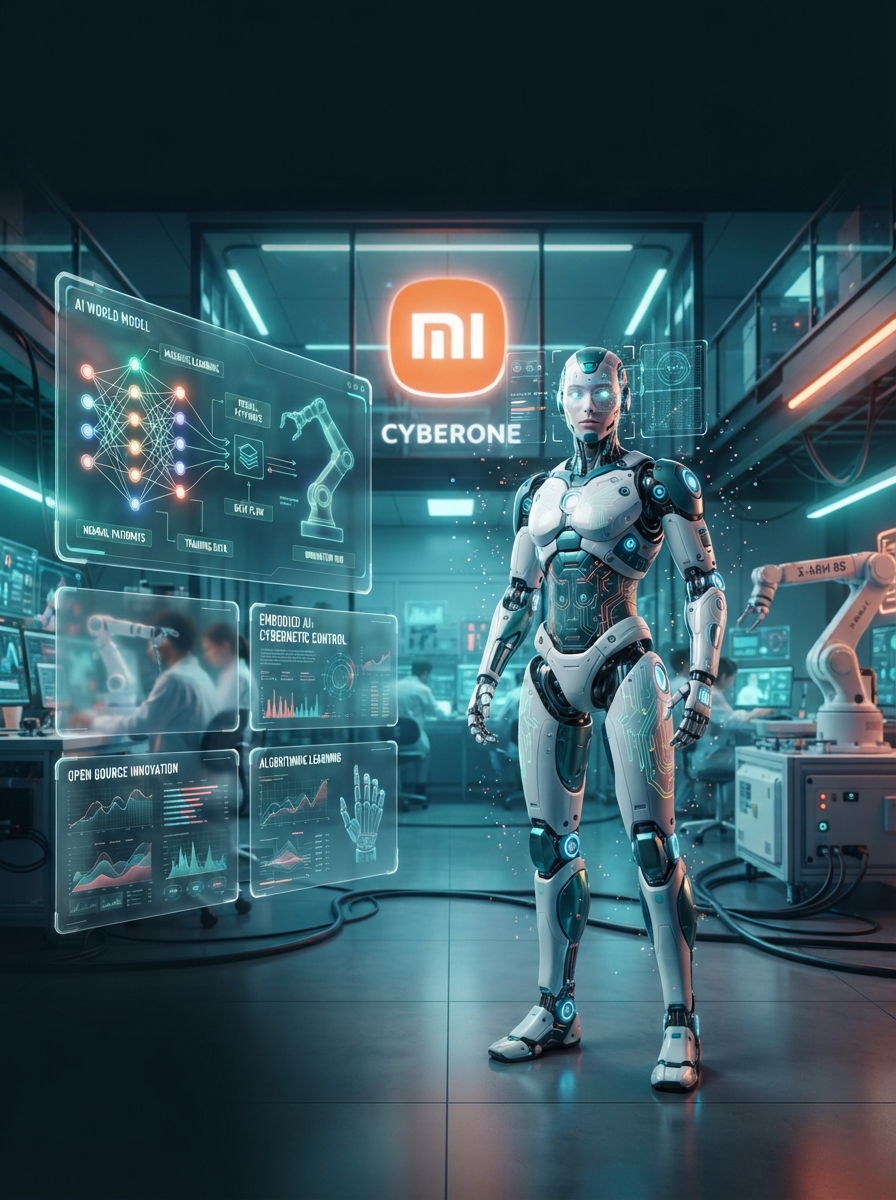
Xiaomi’s robotics division unveiled its most ambitious AI initiative to date: a family of open-source foundation models designed specifically for embodied intelligence. The announcement centers on two complementary systems released simultaneously:
Xiaomi-Robotics-1
Xiaomi-Robotics-1 is a Vision-Language-Action (VLA) foundation model capable of following diverse natural language instructions to perform mobile manipulation tasks in unseen environments straight out of the box. It was trained on over 100,000 hours of real-world manipulation trajectories collected via UMI (Universal Manipulation Interface) devices across more than 1,700 scenarios spanning household, commercial, industrial, and outdoor environments.
The model uses a two-stage training recipe: a large-scale pre-training phase on embodiment-free UMI data to learn generalizable action generation, followed by a post-training phase that aligns these capabilities with real robot embodiments and human instruction patterns. A key innovation is Xiaomi’s scalable auto-labeling pipeline, which divides trajectory clips into segments and annotates each with natural language descriptions of scene state transitions providing rich conditioning for action learning without manual labeling.
Robotics-U0 (World Model)
Alongside Robotics-1, Xiaomi introduced Robotics-U0, a world model designed to generate synthetic training data for robotics. World models act as internal simulators that capture environment dynamics, enabling robots to anticipate how actions reshape future world states. Robotics-U0 generates embodied scenes, multi-view consistent images, and video sequences that can dramatically expand the diversity of training data available to robotics researchers.
Open-Source Release
Both models are being released as open source, with code and model checkpoints made available to the research community. This follows Xiaomi’s broader strategy of building open AI infrastructure previously demonstrated with its MiMo reasoning models and positions the company as a major contributor to the global open-source robotics ecosystem.
What Is Embodied AI?
Embodied AI represents a paradigm shift from traditional AI systems that process information passively to agents that perceive, act, and learn within physical environments. Unlike large language models (LLMs) that operate purely in the digital realm, embodied AI systems must bridge the gap between visual perception, language understanding, and physical action.
Vision-Language-Action Models Explained
A VLA model is the robotic equivalent of a multimodal LLM. It takes three inputs:
-
Vision: Camera feeds showing the robot’s environment
-
Language: Natural language instructions (e.g., “put the red cup in the dishwasher”)
-
Action: Outputs motor commands that control the robot’s physical movements
Xiaomi-Robotics-1 processes these inputs to generate action sequences that drive the physical scene toward the state described by the language instruction. This is fundamentally different from an LLM like ChatGPT, which generates text tokens; a VLA model generates action tokens that control robotic joints, grippers, and mobile bases.
World Models Explained
World models serve as an internal simulator—an AI’s “mental model” of how the physical world works. They enable robots to:
-
Predict the consequences of actions before executing them
-
Generate synthetic training scenarios that would be dangerous or expensive to collect in reality
-
Plan multi-step tasks by simulating future states
Robotics-U0 generates photorealistic embodied scenes with multi-view consistency, meaning the generated images maintain spatial coherence when viewed from different camera angles—a critical capability for training robust robot policies.
Why Robots Need Them
Traditional robotics relied on hand-coded rules and narrow task-specific training. Foundation models like Robotics-1 and world models like U0 enable generalization: the same model can adapt to new tasks, new environments, and even new robot embodiments with minimal additional data. This is the difference between a robot that can only sort one type of object in one lab setting, and a robot that can enter an unfamiliar kitchen and figure out how to load a dishwasher.
Key Features of Xiaomi-Robotics-1
100,000+ Hours of Training Data
The pre-training dataset is unprecedented in scale for robotics. It includes:
-
100,000+ hours of real-world manipulation trajectories
-
1,700+ scenarios across household, office, industrial, restaurant, commercial, and outdoor environments
-
2.4 million episodes covering 260+ distinct tasks
-
Data collected from both mobile manipulators and dual-arm robots
This diversity matters because robots trained on narrow datasets fail when confronted with unfamiliar objects, lighting conditions, or spatial layouts. Xiaomi’s data spans the messy variability of real-world environments.
Natural Language Command Following
Xiaomi-Robotics-1 understands imperative instructions that humans naturally use to prompt robots. Through the auto-labeling pipeline, each trajectory segment is paired with language descriptions of state transitions—teaching the model not just what actions to take, but why those actions change the scene in specific ways.
Mobile Manipulation Capabilities
The model supports both mobile manipulators (robots that can navigate and interact) and dual-arm robots, enabling complex bimanual tasks. Post-training data includes over 7,200 hours of in-house real-robot data collected in actual homes, covering tasks like tidying sofas, sorting shoe cabinets, and putting away kitchenware.
Fine-Tuning and Data Efficiency
One of Robotics-1’s most impressive capabilities is its few-shot adaptation. After pre-training, the model can be specialized to brand-new, highly complex real-robot tasks with minimal additional data:
| Task |
<10 hrs/task |
<40 hrs/task |
| Phone Packing |
70% |
— |
| Printer Refilling |
70% |
— |
| Laundry Loading |
80% |
— |
| Box Packing |
80% |
— |
| Overall |
75% |
85% |
At under 10 hours of demonstrations per task, Xiaomi-Robotics-1 achieves a 75% overall success rate, nearly doubling the π0.5 baseline (40%) at the same data budget. Raising the budget to under 40 hours lifts success to 85%.
Xiaomi Robotics-U0 Explained
While Robotics-1 handles action generation, Robotics-U0 addresses the data bottleneck from the generation side. Robotics-U0 is a world model specifically designed for embodied scene understanding and synthetic data creation.
Image and Video Generation
Robotics-U0 can generate photorealistic images and video sequences of robotic manipulation scenarios. This enables researchers to create unlimited training variations—different lighting, object arrangements, and backgrounds—without collecting physical data.
Multi-View Consistency
A critical challenge in synthetic data is maintaining spatial consistency across camera perspectives. Robotics-U0 generates multi-view consistent scenes, meaning a generated object looks physically correct from any angle. This prevents robots from learning spurious visual correlations that break when camera positions change.
Embodied Scene Generation
The model generates entire embodied scenes complete with physical context—objects, surfaces, lighting, and spatial relationships. This allows researchers to test policies in thousands of procedurally generated environments before deploying to real robots.
Benchmarks and Performance
Xiaomi-Robotics-1 was evaluated on four mainstream simulation benchmarks and achieved state-of-the-art results across all four:
| Benchmark |
Xiaomi-Robotics-1 |
2nd Best |
Relative Gain |
| RoboCasa |
74.5% |
72.6% |
+2.6% |
| RoboCasa365 |
57.4% |
46.6% |
+23.2% |
| VLABench |
59.1% |
53.2% |
+11.1% |
| RoboDojo |
13.93 |
8.80 |
+58.3% |
All metrics report average success rate (%). XR-1 = Xiaomi-Robotics-1.
RoboCasa and RoboCasa365
RoboCasa is a benchmark for everyday household manipulation tasks in simulated environments. The RoboCasa365 variant expands this to 365 diverse tasks, testing generalization across a wide range of domestic scenarios. Xiaomi-Robotics-1’s 57.4% success rate on RoboCasa365 represents a 23.2% relative improvement over the previous best, demonstrating exceptional generalization across hundreds of unseen tasks.
RoboDojo
RoboDojo is a unified sim-and-real benchmark designed to comprehensively evaluate generalist robot manipulation policies across five capability dimensions: Generalization, Precision, Long-Horizon tasks, Memory, and Open-ended tasks.
On RoboDojo, Xiaomi-Robotics-1 achieved an average score of 13.93 (success rate) compared to the previous state-of-the-art of 8.80%—a 58.3% relative gain. This benchmark is particularly demanding because it tests whether policies can handle partial observability, multi-step reasoning, and fine-grained manipulation under visual distraction.
How Xiaomi Compares with Competitors
The robotics foundation model landscape is heating up, with major tech companies and startups racing to build generalist robot brains. Here’s how Xiaomi’s offering stacks up:
| Company |
Model |
Type |
Open Source |
Key Strength |
Scale |
| Xiaomi |
Robotics-1 |
VLA |
Yes |
Data efficiency, 100K+ hrs real-world data |
100K+ hrs pre-training |
| NVIDIA |
GR00T-N1.7 |
VLA |
Partial |
Industrial robot deployment, sim-to-real |
Large-scale synthetic |
| Google DeepMind |
RT-2 |
VLA |
No |
Reasoning, vision-language grounding |
Web-scale VLM backbone |
| Physical Intelligence |
π0 / π0.5 |
VLA |
Partial |
General manipulation, flow matching |
Large multi-robot data |
| Tesla |
Optimus AI |
End-to-end |
No |
Humanoid embodiment, factory deployment |
Proprietary, vehicle-scale |
| Figure AI |
Helix |
VLA |
No |
Industrial automation, humanoid |
Task-specific fine-tuning |
Key differentiators for Xiaomi:
-
Open source: Unlike Google RT-2, Tesla Optimus, and Figure AI Helix, Xiaomi-Robotics-1 is fully open-source, enabling researchers worldwide to build upon and verify the work.
- The robotics foundation model landscape is heating up, with major tech companies like SpaceXAI shipping Grok 4.5 for coding and agentic workloads and startups racing to build generalist robot brains.
-
Real-world data scale: The 100,000+ hours of real-world UMI data exceeds most competitors’ reliance on simulation or smaller real-world datasets.
-
Data efficiency: The model’s ability to reach 75% success on new tasks with under 10 hours of task-specific data is a significant practical advantage for commercial deployment.
-
Scaling laws: Xiaomi demonstrated clean scaling behavior—both data scaling (more training data reduces error) and model scaling (larger models perform better)—which suggests further improvements are achievable with additional resources.
Why This Matters
For Developers
Xiaomi’s open-source release gives robotics developers access to a state-of-the-art foundation model without the massive data collection infrastructure previously required. Developers can fine-tune Robotics-1 for specific applications using modest amounts of task-specific data, dramatically lowering the barrier to entry for capable robotic systems.
For Robotics Researchers
The release provides a new baseline for the research community. The combination of open weights, detailed training methodology, and strong benchmark performance enables reproducible science. Researchers can now study how scaling laws apply to robotics policy models—a question that has remained largely open due to data scarcity.
For Enterprises and Manufacturing
The data efficiency of Xiaomi-Robotics-1 has immediate commercial implications. Enterprises can deploy capable robotic systems without months of data collection. Tasks like phone packing, printer refilling, and box packing—demonstrated by Xiaomi with under 10 hours of task data each—represent high-value automation opportunities in logistics, manufacturing, and facility management.
For China’s AI Ecosystem
This release strengthens China’s position in frontier AI research, particularly in embodied intelligence—a domain where Western companies like Google DeepMind, NVIDIA, and Tesla have historically dominated. By open-sourcing world-class models, Xiaomi contributes to the global AI commons while demonstrating Chinese technological leadership.
Industry Expert Analysis
The Open-Source Robotics Trend
Xiaomi’s release is part of a broader shift toward open-source robotics foundation models. While proprietary systems from Tesla and Figure AI grab headlines, the open-source ecosystem—led by models like Xiaomi-Robotics-1, NVIDIA’s partially open GR00T, and Physical Intelligence’s π0—is democratizing access to capable robot brains. This mirrors the trajectory of LLMs, where open-source alternatives eventually caught up to and sometimes surpassed proprietary offerings.
The Data Barrier Breakthrough
The central challenge in robotics AI has always been data. Unlike text or images, robotic manipulation data requires physical execution, making it orders of magnitude harder to collect at scale. Xiaomi’s 100,000-hour dataset—collected via affordable UMI devices rather than expensive robot fleets—represents a methodological breakthrough. As the Xiaomi team notes: “What robots can do under genuinely large-scale training remained largely an open question. We take a step toward answering it.”
Scaling Laws in Robotics
Xiaomi’s experiments reveal clean scaling behavior: as training data increases from 12.5% to 100% of the dataset, validation action error steadily decreases. Similarly, scaling model size from 2B to 10B parameters yields consistent improvements. This confirms that robotics policy models follow the same empirical scaling laws that have driven progress in language and vision—suggesting that future iterations with even more data and parameters will achieve substantially better performance.
This release strengthens China’s position in frontier AI research, joining the aggressive pricing pressure from
DeepSeek V4-Pro in the LLM space, and now pushing into embodied intelligence—a domain where Western companies like Google DeepMind, NVIDIA, and Tesla have historically dominated. By open-sourcing world-class models, Xiaomi contributes to the global AI commons while demonstrating Chinese technological leadership.
Conclusion
Xiaomi’s release of Robotics-1 and Robotics-U0 represents a watershed moment for open-source embodied AI. By combining unprecedented real-world training data, state-of-the-art benchmark performance, and full open-source availability, Xiaomi has positioned itself at the forefront of the global robotics race.
The 100,000-hour dataset proves that robotics policy models follow the same scaling laws that transformed language and vision AI. The 58.3% improvement on RoboDojo and 23.2% gain on RoboCasa365 demonstrate that scale translates directly to capability. And the few-shot adaptation results—75% success with under 10 hours of task data—suggest these models are ready for real-world deployment.
For developers, researchers, and enterprises, Xiaomi’s open-source release removes the data barrier that has long constrained robotics AI. The question is no longer whether capable generalist robots are possible, but how quickly the community can build on this foundation to bring them into the physical world.