
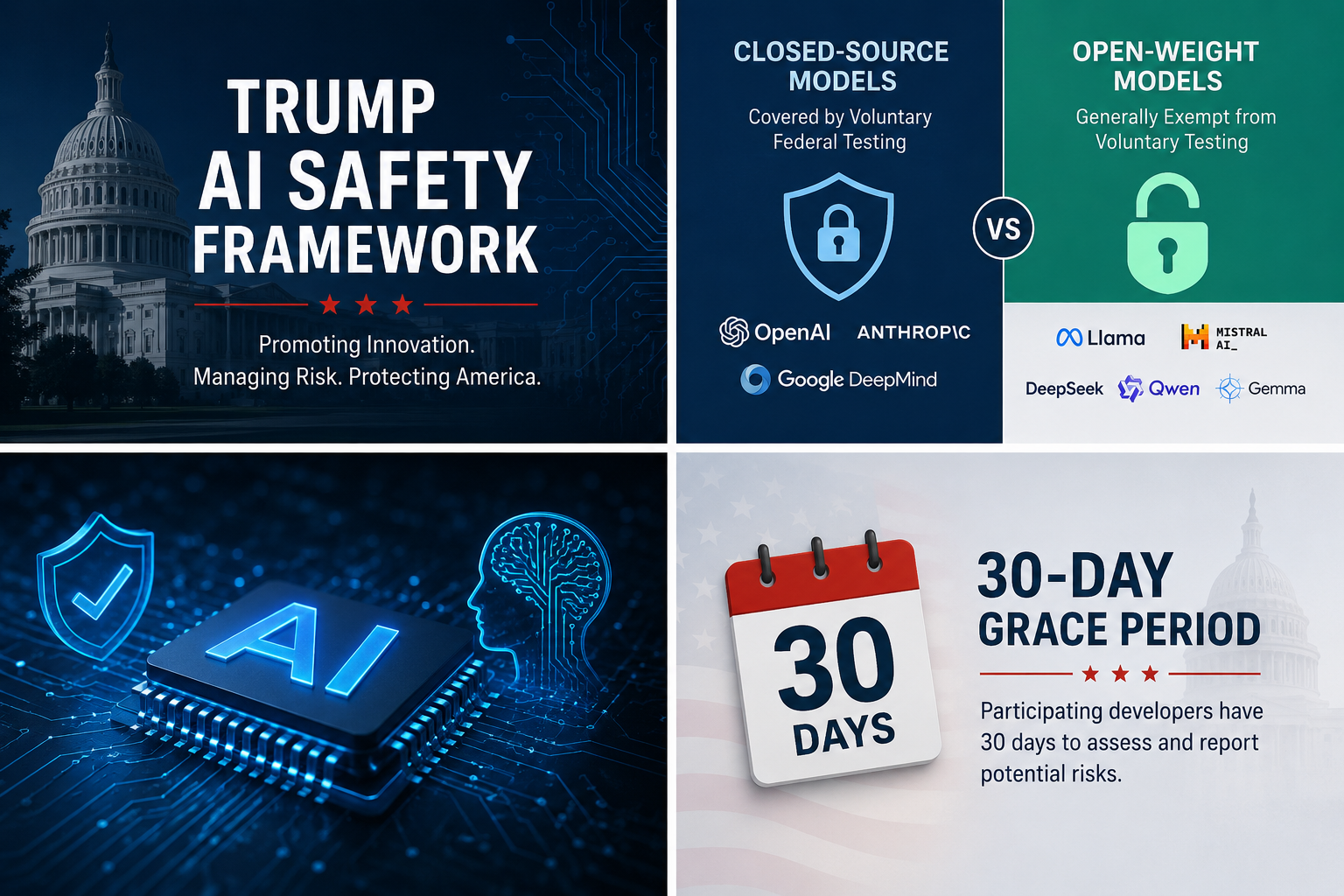
The Trump AI Safety Framework marks a major change in how the United States approaches artificial intelligence governance. Instead of introducing broad mandatory rules, the framework relies on voluntary testing and reporting from developers of the most advanced closed-source AI systems.
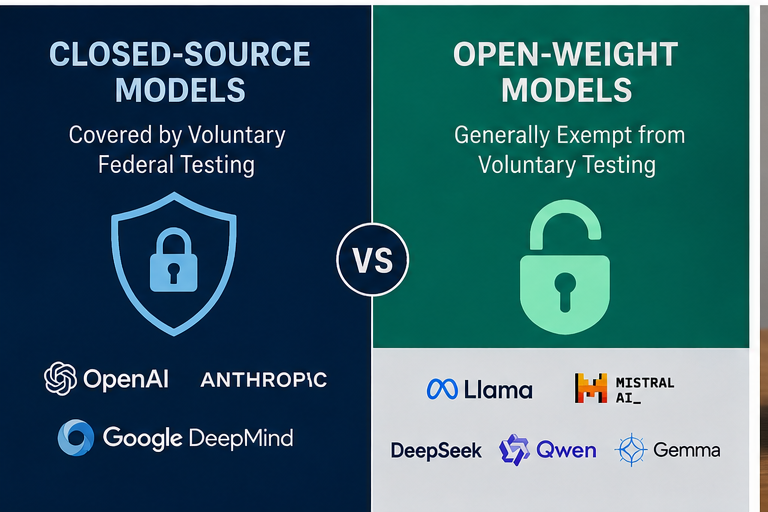
Its most debated feature is the different treatment of proprietary and open-weight models. Companies behind frontier systems such as OpenAI, Anthropic, and Google DeepMind are expected to cooperate with federal safety evaluations. Open-weight models, including Meta’s Llama, Mistral, DeepSeek, Qwen, and Gemma, are generally excluded from the same process.
Supporters say this approach protects innovation, gives startups more room to compete, and helps the United States move quickly in the global AI race. Critics argue that powerful open models may create serious cybersecurity and national security risks because anyone can download, modify, and redistribute them.
Key Takeaways
- The framework focuses mainly on advanced closed-source AI models.
- Open-weight models are generally exempt from voluntary federal testing.
- A 30-day grace period gives participating developers time to assess and report risks.
- Important terms such as “state-of-the-art” and “national security risk” remain unclear.
- The policy favors industry cooperation over legally binding enforcement.
What Is the Trump AI Safety Framework?
The Trump AI Safety Framework is a voluntary system for testing and reporting risks linked to advanced artificial intelligence models. It encourages developers of frontier AI systems to share safety information with the federal government before major public deployment.
The framework is designed to identify cybersecurity, national security, dangerous-misuse, autonomy, and social-impact risks. Rather than placing the government in direct control, it asks companies to evaluate their systems, document findings, and cooperate with federal agencies.
It therefore aims to promote safety testing without turning every expectation into a legal obligation.
Why Was the Framework Introduced?
Artificial intelligence systems can write software, generate realistic media, support research, analyze data, and perform complex reasoning. These abilities create economic value but can also be misused. The framework addresses four priorities.
Balancing Innovation and Safety
A voluntary process lets companies test for risks without facing the full burden of a mandatory approval system.
Supporters believe this gives developers enough flexibility to improve their products while still encouraging them to examine potentially dangerous capabilities.
Protecting National Security
Highly capable models could support cyberattacks, malware, sensitive research, or military and intelligence operations. Early testing may help reduce these risks.
The government is particularly concerned about models that could make harmful activities faster, cheaper, or easier for people without advanced technical knowledge.
Maintaining Global Competitiveness
Supporters believe lighter regulation will help American companies compete with China and other AI powers.
They argue that overly restrictive rules could delay model releases, increase development costs, and encourage AI companies to move research or infrastructure outside the United States.
Preserving Private-Sector Leadership
The policy places responsibility on developers rather than creating a government-led approval system.
This approach assumes that companies building advanced models are often best placed to understand their systems’ technical capabilities, limitations, and potential risks.
Which AI Models Are Covered?
The framework mainly targets closed-source frontier AI models. Their weights remain private, and access is usually provided through APIs, subscriptions, or commercial products. Examples include systems from OpenAI, Anthropic, and Google DeepMind.
Participating developers may be expected to evaluate risks related to:
- Offensive cyber capabilities
- Dangerous or deceptive use
- National security threats
- Advanced autonomous behavior
- Biological or chemical research assistance
- Large-scale misinformation
- Broader social disruption
Closed-source providers retain control over distribution, updates, and access, making direct pre-release cooperation more practical.
A government agency can communicate with the company responsible for the model, review its safety findings, and discuss possible safeguards before the system becomes widely available.
Which AI Models Are Exempt?
Open-weight AI models are generally exempt from the framework’s voluntary testing expectations.
An open-weight model makes its trained parameters available for download or research use. Developers can run the model on their own hardware, fine-tune it, modify its behavior, and distribute new versions.
Models commonly associated with this category include Meta’s Llama, Mistral, DeepSeek, Alibaba’s Qwen, and Google’s Gemma.
The practical reason is control. Once weights are public, no single provider can manage every copy, fine-tune, or downstream use.
Supporters say the exemption:
- Encourages open research
- Reduces costs for startups
- Supports academic access
- Promotes competition
- Accelerates product development
- Strengthens open AI ecosystems
Critics say the same openness can make misuse by cybercriminals or hostile governments harder to prevent.
Open-Weight vs. Closed-Source AI Models
The distinction between these two categories explains much of the policy.
| Feature | Closed-Source Models | Open-Weight Models |
| Model weights | Private | Publicly available |
| Access | API or subscription | Downloadable |
| Provider control | High | Limited after release |
| Customization | Controlled by provider | Users can modify |
| Federal testing | Expected voluntarily | Generally exempt |
| Examples | GPT, Claude, Gemini | Llama, Mistral, DeepSeek, Qwen |
Closed-source companies can change access rules and update safeguards. Open-weight developers lose much of that control after release.
However, greater accessibility also allows independent researchers and smaller businesses to study, customize, and build on capable AI systems without paying for access to proprietary platforms.
What Are Model Weights?
Model weights are the numerical parameters an AI system learns during training. They shape how the model interprets information and generates outputs.
When a company keeps those weights private, users interact with the model through a controlled service. The provider can monitor usage, update safeguards, and limit access.
When weights are released publicly, developers can run the system independently. They can fine-tune it for a specific industry, remove restrictions, change its behavior, or redistribute altered versions.
This supports research and innovation but makes centralized oversight harder.
Even when the original developer applies extensive safeguards, another user may modify the model in ways the original company cannot predict or control.
What Is the 30-Day Grace Period?
The framework includes a 30-day grace period for participating developers. This window is intended to give companies time to prepare safety information before deploying certain advanced AI systems.
During the period, a developer may:
- Notify the government about a qualifying model
- Conduct internal safety evaluations
- Run red-team tests
- Assess cybersecurity and national security risks
- Document mitigation measures
- Share relevant findings with federal agencies
The aim is early communication rather than an open-ended approval process. Because participation is voluntary, success depends on consistent cooperation and meaningful disclosure.
The period does not necessarily mean that every AI launch must be delayed for 30 days. It is better understood as a structured window during which qualifying developers can complete evaluations and communicate with the government.
Why Are Undefined Terms Controversial?
Several important expressions in the framework are not clearly defined. Two of the most debated are “state-of-the-art” and “national security risk.”
What Counts as State-of-the-Art?
AI capabilities improve rapidly, and without measurable thresholds companies may disagree about which systems qualify.
Possible benchmarks include computing power, reasoning ability, autonomy, or dangerous-capability tests, but the framework does not clearly prioritize them.
A model may perform exceptionally well at software development but offer only average performance in scientific research. This makes it difficult to determine whether a single definition of advanced capability can apply across every model.
What Is a National Security Risk?
The phrase could cover cyber operations, critical infrastructure attacks, biological research, military use, intelligence gathering, or disinformation. Without precision, developers may report risks inconsistently.
One company might classify a capability as a serious threat, while another might view the same capability as ordinary commercial functionality.
Supporters argue that flexible language allows the policy to adapt. Critics say unclear terms weaken accountability and make oversight uneven.
Why Exempting Open Models Is So Controversial
The exemption reflects a real practical challenge. A closed-source company can delay a release, restrict access, or update safeguards. An open-weight developer cannot fully control a model after the files are published.
Supporters argue that applying identical rules would be unrealistic and costly for universities, researchers, and startups. Critics focus on capability, warning that a powerful downloadable model may present equal or greater risk because it can be modified and used without monitoring.
The central policy question is whether oversight should depend on how a model is distributed or on what the model can actually do.
Some AI safety researchers believe capability should be the deciding factor. Under this approach, any model that reaches a dangerous technical threshold would face evaluation, regardless of whether its weights are public or private.
Open-model advocates respond that strict requirements could concentrate AI development in a small number of wealthy companies capable of handling extensive compliance costs.
Benefits of the Framework
The voluntary model offers several potential advantages.
It may reduce compliance costs, encourage cooperation without a licensing regime, and adapt faster than legislation. The open-weight exemption can support research and competition, while lighter regulation may strengthen U.S. competitiveness.
The approach may also allow federal agencies and AI companies to build working relationships before more formal regulation is introduced.
By sharing evaluation methods and risk information voluntarily, developers could help policymakers understand which technical standards may be useful in future legislation.
Startups may particularly benefit. Smaller companies often lack the legal teams, policy departments, and financial resources available to major technology corporations.

Main Criticisms
The framework also has clear weaknesses.
Uneven Oversight
Closed-source companies may face greater expectations even when open models offer similar capabilities.
This could create an imbalance in which the most transparent or cooperative companies accept additional responsibilities while other developers avoid equivalent scrutiny.
Limited Enforcement
Because participation is voluntary, companies may choose how much information to share. There are few direct consequences for limited cooperation.
A voluntary framework is only effective when companies believe participation benefits them or protects the wider industry.
Security Gaps
Open-weight models may be adapted for harmful use after release, and developers may have little ability to stop it.
Once a modified version is distributed through third-party platforms, identifying its creator or controlling its use can become extremely difficult.
Regulatory Uncertainty
Undefined thresholds make it difficult for companies to know whether the framework applies to them.
This uncertainty may also complicate launch planning, investment decisions, and long-term compliance strategies.
Dependence on Industry Self-Assessment
The system relies heavily on developers to identify and report their own risks. Critics question whether commercial incentives could influence those assessments.
Companies may face pressure to release products quickly, especially when competitors are preparing similar systems.
How Major AI Companies May Be Affected
OpenAI, Anthropic, and Google DeepMind develop proprietary frontier models, so they are the companies most likely to participate in voluntary testing and reporting.
These companies already maintain significant control over how users access their models. They can introduce usage limits, monitor activity, update safety systems, and withdraw particular features.
Meta is treated differently because Llama is distributed as open-weight. Mistral, DeepSeek, Qwen, and Gemma also benefit from the exemption.
Startups building on these models may gain the most immediate advantage because they can use capable systems without the compliance burden associated with developing a closed frontier model.
However, companies using open models in sensitive areas may still introduce their own safety testing, access restrictions, and internal governance policies.
National Security Implications
National security is one of the strongest arguments for AI safety testing.
Advanced models may help users write malicious code, automate reconnaissance, create convincing misinformation, analyze sensitive data, or support dangerous scientific work. Even when a model is not designed for harmful purposes, its capabilities may be repurposed.
Supporters believe voluntary evaluations can identify risks before deployment. Critics say the open-weight exemption creates a blind spot because models can be modified after release and transferred across borders quickly.
This international dimension makes enforcement especially difficult. A model released legally in one jurisdiction may be downloaded, fine-tuned, and used in another country with completely different safety standards.
How It Compares With Other AI Policies
The Trump framework emphasizes voluntary cooperation and reduced regulatory burden.
Earlier U.S. policy under the Biden administration relied more heavily on executive oversight and broader reporting expectations. The European Union’s AI Act uses a risk-based legal framework with binding obligations for many AI systems.
These approaches reflect different priorities.
The Trump framework prioritizes innovation and industry leadership. The Biden approach emphasized federal oversight, while the EU model focuses on documented risk management and enforceable compliance.
No approach completely resolves the challenge. Strict rules may improve accountability but slow development, while voluntary policies may encourage innovation without providing consistent protection.
Common Questions About the Framework
Does the Framework Apply to Llama and Mistral?
Generally, no. The supplied framework description places open-weight models such as Meta’s Llama and Mistral outside the main voluntary federal testing process.
Their developers may still perform internal safety testing, but they are not treated in the same way as companies releasing closed-source frontier systems.
Does Voluntary Testing Mean Companies Face No Safety Expectations?
Not exactly. Participating developers are still encouraged to notify the government, run evaluations, assess national security and cybersecurity concerns, and document safeguards.
The difference is that these actions are based on cooperation rather than a legally binding approval process.
Why Does the 30-Day Period Matter?
The 30-day window creates a predictable time for participating companies to evaluate a qualifying model and communicate relevant risks before broad deployment.
It is intended to support early review without causing an indefinite launch delay.
Could Open-Weight Models Be Included Later?
Yes. Policymakers could revise the framework, create capability thresholds, or introduce separate rules for highly capable open models.
Future changes may depend on how powerful these systems become, whether voluntary cooperation works, and whether serious misuse incidents expose gaps in the current approach.
Conclusion
The Trump AI Safety Framework represents a shift toward voluntary, industry-led AI governance. It asks developers of advanced closed-source models to share safety information while generally exempting open-weight systems such as Llama, Mistral, DeepSeek, Qwen, and Gemma.
Supporters see the policy as a practical way to encourage innovation, support startups, and maintain U.S. competitiveness. Critics believe it creates uneven oversight and leaves open models outside an important safety process.
The unresolved issue is not simply whether AI should be regulated. It is how regulation should account for capability, distribution, control, and misuse.
As frontier AI continues to advance, the distinction between open and closed models will remain central to the policy debate. The framework may be an important step, but it is unlikely to be the final answer.
For developers, investors, and the public, clearer definitions will be essential for understanding who is responsible when AI systems cause harm.