

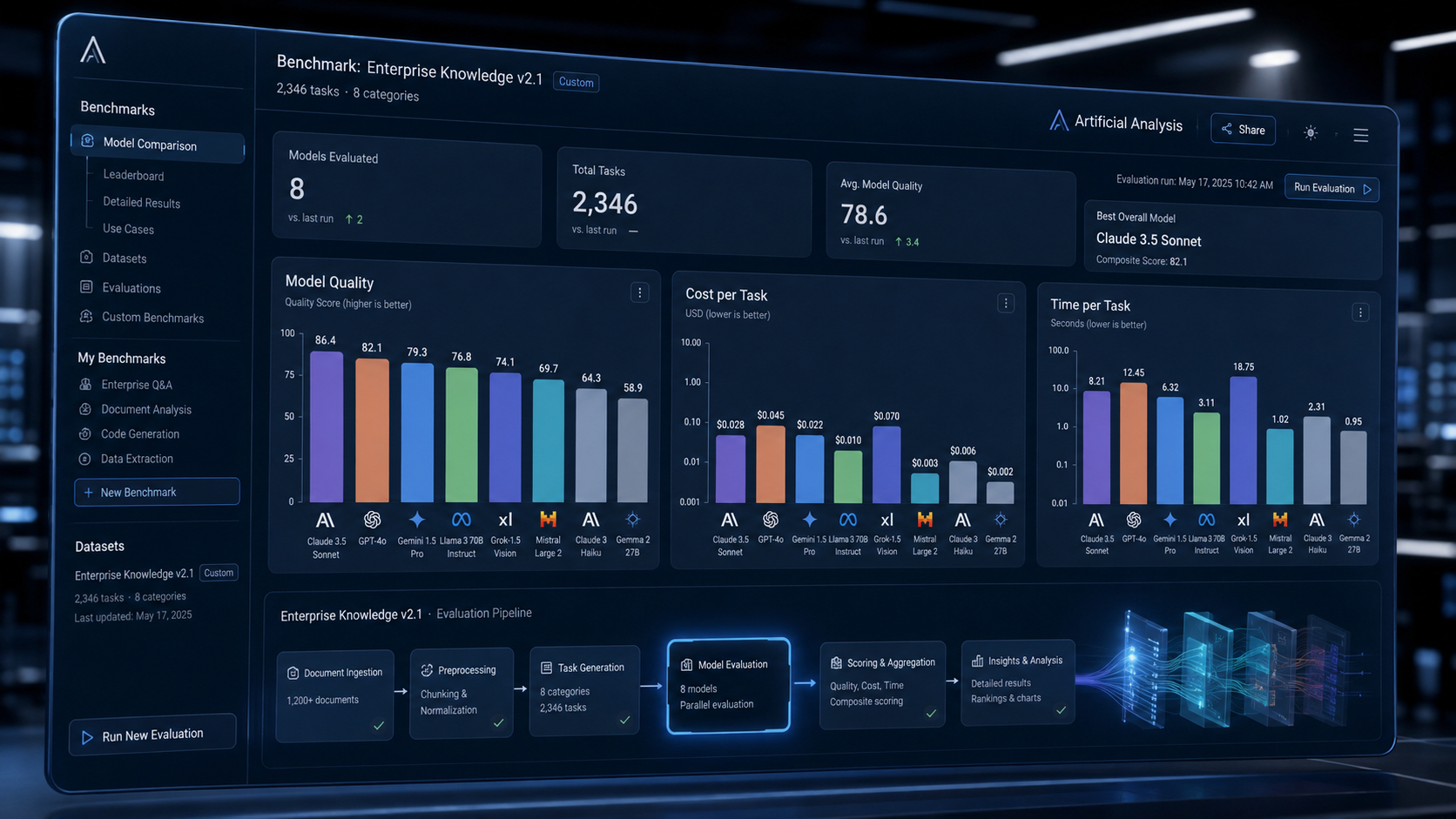
AI benchmarks have become one of the most common ways to compare artificial intelligence models. They help researchers, developers, and businesses understand how different models perform across areas such as reasoning, coding, knowledge, mathematics, vision, and agentic tasks.
However, benchmark scores do not always answer the question businesses actually need to solve.
A model can rank highly on a public benchmark but still perform poorly on a company’s specific workflow. A coding model that excels at standardized programming tests may struggle with a company’s internal codebase. A reasoning model with a strong general score may not be the most cost-effective option for a financial workflow.
This is the problem the Optima AI benchmark is designed to address.
Created by Artificial Analysis, Optima allows users to build custom evaluations around their own data, workflows, and use cases. Instead of relying exclusively on standardized benchmark scores, teams can test multiple AI models against tasks that are directly relevant to their applications.
Optima also expands evaluation beyond a simple quality score. Users can compare Model Quality, Cost per Task, and Time per Task, giving organizations a more practical way to evaluate AI systems for real-world deployment.
What Is the Optima AI Benchmark?
The Optima AI benchmark is a custom AI model evaluation platform developed by Artificial Analysis. Its goal is to make AI benchmarking more relevant to the tasks organizations actually need AI systems to perform.
Traditional benchmarks usually provide a fixed set of questions, datasets, or tasks. Every model receives the same evaluation, which makes the results easier to compare.
That approach is valuable, but it has a major limitation: real businesses rarely operate using standardized benchmark questions.
A company building an accounting AI agent may need to process financial documents, follow internal instructions, calculate information correctly, and complete a multi-step workflow. A legal company may want to test contract analysis and legal writing. A software company may care about debugging, coding, file manipulation, and repository-level tasks.
A general benchmark cannot fully represent all of these requirements.
Optima takes a different approach by allowing users to create evaluations around their own workloads.
According to the source material, users can work with their own evaluation files, Hugging Face datasets, AI agent traces, coding environments, or descriptions of particular use cases. They can also provide sample inputs and outputs when they do not already have a formal evaluation dataset.
This changes the central question from:
“Which AI model has the highest benchmark score?”
to:
“Which AI model works best for my task?”
That distinction can be extremely important when an AI model is being selected for production.
Why Traditional AI Benchmarks Have Limitations
Standardized benchmarks remain important because they create a common testing environment.
One well-known example is MMLU, or Massive Multitask Language Understanding. It was designed to evaluate language models across a broad collection of academic and professional subjects.
Benchmarks such as MMLU help researchers compare models using the same questions and evaluation methodology. This makes them useful for tracking general model capabilities.
However, standardized tests cannot represent every real-world workflow.
Imagine a company developing an AI accounting agent. The company may care about whether the model can:
- Read financial documents accurately
- Follow company-specific instructions
- Produce reliable calculations
- Complete multiple workflow steps
- Recover from errors
- Avoid unnecessary retries
- Keep the cost of each completed task low
- Finish work within an acceptable time
A general knowledge benchmark can provide information about the model’s broad capabilities, but it cannot fully measure all of these requirements.
Artificial Analysis has increasingly moved toward more realistic and agentic evaluations as AI systems have become more capable. Its broader benchmarking work includes evaluations designed around longer and more realistic agentic scenarios.
Optima extends this philosophy by allowing organizations to create benchmarks based on their own needs.
Optima vs MMLU: What Is the Difference?
The biggest difference between Optima and MMLU is customization.
MMLU is a standardized benchmark designed to measure broad knowledge and reasoning across predefined subjects.
Optima is designed to let users evaluate AI models against their own workloads.
In simple terms:
MMLU asks:
“Which model performs best on this standardized test?”
Optima asks:
“Which model performs best on the tasks my organization actually needs?”
The two approaches can therefore complement each other rather than completely replace one another.
A business could use public benchmarks to identify promising AI models and then use a custom benchmark to determine which model is most suitable for its own application.
This distinction becomes even more important when companies compare models that have different strengths.
One model might deliver the highest overall intelligence score. Another might be slightly less capable but considerably cheaper. A third could provide similar quality while responding much faster.
For a real production application, the highest benchmark score is not necessarily the most important result.
Artificial Analysis already provides broader model comparisons involving intelligence, pricing, speed, latency, and other performance factors, reflecting the industry’s growing focus on evaluating AI systems across multiple dimensions.
How Does Optima Work?
Optima supports several ways to create and run custom AI evaluations.
1. Use Your Own Data
The first approach is to provide an existing evaluation dataset.
Organizations may already have examples of real tasks, expected outputs, successful responses, or historical AI interactions. These can potentially become part of a repeatable evaluation process.
The source material also identifies Hugging Face datasets and agent traces from platforms such as Arize, Braintrust, and Langfuse as possible sources for evaluations.
This can be particularly useful for teams that have already deployed an AI system and collected examples of where it succeeds or fails.
Instead of creating an entirely new benchmark, teams can use existing data to build a test that reflects their actual environment.
2. Describe Your Use Case
Not every organization has a ready-made benchmark dataset.
Optima can also work from a description of what an AI system is supposed to accomplish.
Users can provide information about the task along with sample inputs and outputs. Optima can then suggest test inputs, evaluation criteria, and example tasks that users can review and refine.
This makes custom benchmarking more accessible to teams that understand their AI requirements but do not have a formal evaluation framework.
3. Select the Models
Once a benchmark has been created, users can run the same evaluation across different AI models.
This provides a direct comparison because each model is tested against the same workload.
Instead of comparing unrelated public scores, teams can examine how different models perform on identical business tasks.
4. Evaluate Model Responses
Optima supports different approaches for evaluating outputs.
The source describes rubric-based evaluation, where responses are assessed according to defined criteria, and pairwise comparison, where users compare two model responses and indicate which one they prefer.
This flexibility matters because the definition of quality varies between applications.
For coding, correctness may be the most important factor. For legal writing, accuracy, completeness, and instruction-following may matter more. For customer support, helpfulness and consistency could be critical.
A custom evaluation allows the organization to define quality around its own objectives.
5. Compare the Results
After the models have been evaluated, users can compare the results across several dimensions.
This is one of Optima’s most important differences from a simple benchmark leaderboard.
Instead of seeing only a quality score, teams can consider:
- Model Quality
- Cost per Task
- Time per Task
This provides a broader picture of how a model may perform in a production environment.
What Metrics Does Optima Measure?
The Optima AI benchmark focuses on more than model accuracy.
Model Quality
Quality remains the foundation of any AI evaluation.
A model needs to produce useful, accurate, and relevant results. A cheap model has little value if its responses require extensive human correction.
Custom evaluations allow organizations to define what good performance means for their particular workload.
This is especially useful when a generic benchmark does not reflect the details of the application.
Cost per Task
Cost per Task is one of the most useful concepts in Optima.
AI providers generally advertise pricing based on input and output tokens. Token pricing is important, but it does not always represent the actual cost of completing a workflow.
An AI agent may need multiple model calls before successfully completing one task. It may also generate additional output, retry failed actions, call tools, or perform several reasoning steps.
Therefore, the cost of the entire task can be significantly different from the cost of a single model response.
The source specifically highlights Cost per Task as one of Optima’s core comparison dimensions.
For businesses, this can provide a more realistic view of AI economics.
Time per Task
Speed is another important consideration.
A model can produce excellent answers but still be unsuitable for a particular application if it takes too long to complete a workflow.
Time per Task can affect:
- Customer experience
- Employee productivity
- AI agent responsiveness
- Workflow throughput
- Operational efficiency
The fastest model is not necessarily the best model, either.
A business may accept a slower model if it produces substantially better results. Another company may prioritize speed because its customers expect immediate responses.
The correct balance depends on the use case.
Why Cost Per Task Matters for AI Model Testing
Token pricing alone does not tell the complete story.
Consider two AI models completing the same business workflow.
Model A has a low token price but frequently needs several attempts to finish the task.
Model B costs more per token but successfully completes the task on its first attempt.
Model A appears cheaper when looking only at token pricing.
But after including retries, additional model calls, longer outputs, and other workflow costs, Model B could actually have a lower cost per completed task.
This is particularly important for AI agents.
Agents do not always answer a question in one step. They can reason, call tools, inspect results, correct mistakes, and continue working until a task is completed.
The source notes that early Optima users created finance and accounting benchmarks to identify models capable of reducing costs without sacrificing significant quality. Other examples included legal writing and proprietary image evaluation.
This illustrates why evaluating the economics of the entire task can be more useful than comparing API token prices alone.
Why Time Per Task Matters for AI Agents
Cost is only one part of production AI performance.
Time also matters.
An internal research agent that takes several minutes to complete a complex analysis might be perfectly acceptable for an occasional task. The same response time could be unacceptable for a customer-facing application.
For AI agents, time can accumulate across multiple steps.
A workflow may involve:
- Understanding the user’s request
- Planning the task
- Calling a tool
- Processing the result
- Generating another action
- Verifying the output
- Completing the workflow
Even small delays at individual stages can add up.
That is why Time per Task provides useful context alongside quality and cost.
The goal should not necessarily be to find the fastest model. Instead, organizations should identify the model that provides the best combination of quality, cost, and speed for their specific workload.
Who Created Optima?
Optima was created by Artificial Analysis, an independent AI benchmarking and analysis provider.
Artificial Analysis has developed a broader evaluation ecosystem covering AI models and multiple modalities. Its platform provides comparisons across areas including model intelligence, pricing, speed, latency, and other performance characteristics.
Its work has also expanded into agentic evaluations.
The source identifies AA-Briefcase as an example of an agentic benchmark focused on realistic knowledge-work tasks involving deliverables such as spreadsheets, presentations, and research reports.
This broader focus is important because AI is increasingly being used to perform tasks rather than simply answer questions.
For readers exploring the wider AI ecosystem, AiToza also covers AI automation platforms such as ServiceNow AI and UiPath AI, which demonstrate how AI is moving toward workflow execution and agentic automation.
Optima vs AI Leaderboards
A conventional AI leaderboard usually answers one broad question:
Which model performs best on a predefined evaluation?
Optima is designed to answer a different question:
Which model performs best on my workload?
That distinction becomes increasingly important as AI moves from experimentation into production.
A company may not need the model with the highest overall intelligence score.
It may need a model that:
- Meets its quality requirements
- Fits its budget
- Responds quickly enough
- Completes tasks reliably
- Works effectively within its existing workflow
For example, imagine three models being tested on a company’s customer-support workflow.
Model A delivers the highest quality but has a high cost.
Model B provides slightly lower quality but completes tasks significantly faster.
Model C provides adequate quality at a much lower cost.
There is no universally correct answer.
The best model depends on what the business values most.
This is why custom AI benchmarking can complement public leaderboards rather than simply replace them.
Who Can Benefit From Custom AI Benchmarking?
Custom AI benchmarking can be useful for several types of organizations.
AI Developers
Developers can compare multiple models before selecting one for an application.
Businesses
Companies can test whether an AI model actually performs well on internal workflows.
AI Agent Teams
Agent developers can measure complete task performance instead of evaluating isolated responses.
Enterprises
Large organizations can use custom benchmarks to assess quality, cost, and speed before deploying AI at scale.
AI Researchers
Researchers can supplement standardized benchmarks with task-specific evaluations that reflect real-world scenarios.
For companies already exploring AI tools, AiToza’s broader AI tools directory can also help with discovering different AI solutions before evaluating which ones fit a particular workflow.
Limitations of Custom AI Benchmarking
Optima does not eliminate every challenge associated with AI evaluation.
A custom benchmark is only as useful as the methodology behind it.
If the test cases do not accurately represent real users or production workloads, the results may be misleading.
Organizations should consider:
- Whether the dataset represents real users
- Whether the evaluation criteria are objective
- Whether the benchmark contains enough task diversity
- How frequently models change
- Whether human verification is required
- Whether retries are included in cost calculations
- Whether additional workflow steps are included
- Whether the benchmark remains relevant over time
The source makes this limitation clear: custom benchmarking improves relevance, but benchmark quality still depends on methodology.
Organizations should therefore avoid treating any single benchmark as an absolute measure of AI capability.
A strong evaluation should reflect realistic tasks, meaningful success criteria, and the economics of the actual workflow.
The Future of AI Model Evaluation
AI evaluation is changing as models become more capable.
Earlier generations of AI benchmarking often focused heavily on answering questions correctly. Modern AI systems increasingly perform longer tasks involving reasoning, tools, files, applications, and multiple steps.
That creates a need for more practical evaluation methods.
The question is no longer simply:
“How intelligent is this model?”
It is increasingly:
“How effectively can this model complete the work I need?”
This shift makes task-based benchmarking especially relevant for AI agents and enterprise applications.
Optima’s approach reflects that broader movement by allowing organizations to evaluate models using their own data and workflows rather than relying exclusively on standardized tests.
For businesses, this can make model selection more evidence-based.
Instead of selecting a model because it has the highest public benchmark score, teams can test it against representative tasks and examine the trade-offs between quality, cost, and speed.
Final Verdict
The Optima AI benchmark represents a shift toward more practical AI model evaluation.
Traditional benchmarks such as MMLU remain valuable because they provide standardized measurements of general knowledge and reasoning. They help researchers and developers compare models using common evaluation criteria.
But standardized benchmarks cannot represent every real-world business workflow.
Optima addresses this gap by allowing users to create custom evaluations around their own data, use cases, and tasks. Its focus on Model Quality, Cost per Task, and Time per Task provides a broader view of what matters when selecting an AI model for production.
For organizations developing AI agents, coding systems, financial applications, research workflows, customer-support solutions, or other specialized AI products, this approach can provide more relevant insights than relying on a single leaderboard score.
The future of AI benchmarking may therefore be less about identifying one universally “best” model and more about identifying the best model for a particular task.
The most useful AI model is ultimately the one that delivers the right combination of quality, cost, and speed for the work an organization actually needs to accomplish.