

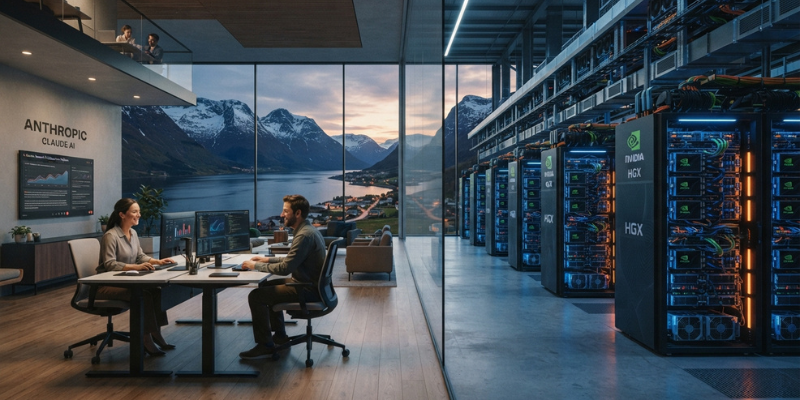
Anthropic has reportedly signed a $10 billion, six-year computing agreement with AI infrastructure company Volta, adding another major source of compute capacity as demand for Claude and other AI workloads continues to rise.
The agreement is reportedly connected to a 133-megawatt AI data center in Norway that Volta is developing with Bitdeer. The facility is planned to use NVIDIA Vera Rubin systems for large-scale AI workloads.
There is an important caveat, however. Volta has officially confirmed a $10 billion partnership with an unnamed AI lab, but it has not publicly named Anthropic as the customer. Bloomberg’s reporting identified Anthropic as the company behind the agreement, and other publications subsequently reported the connection.
That makes the deal significant for two reasons. Anthropic is securing another large source of computing capacity, while Volta is emerging as a major new player in the rapidly expanding AI infrastructure market.
Anthropic’s $10 Billion Volta Deal: What We Know
The reported agreement would give Anthropic access to large-scale computing capacity from Volta over six years.
| Deal detail | Information |
|---|---|
| AI company | Anthropic, according to Bloomberg’s reporting |
| Infrastructure provider | Volta |
| Reported value | $10 billion |
| Reported duration | Six years |
| Project location | Tydal, Norway |
| Gross capacity | Approximately 133 MW |
| IT capacity | 121 MW |
| AI hardware | NVIDIA Vera Rubin |
| Infrastructure partner | Bitdeer |
| Official customer confirmation | Not publicly named by Volta |
The deal comes as AI companies increasingly compete not only for GPUs but also for electricity, data-center capacity, networking infrastructure and long-term computing contracts.
That shift is already visible across the industry. The growing power and cooling requirements of modern AI systems have made data-center infrastructure a critical part of the AI race, as earlier reporting on NVIDIA’s Blackwell infrastructure and cooling challenges illustrates.
Is the Anthropic-Volta Deal Officially Confirmed?
Not directly.
Volta’s official announcement confirms a $10 billion strategic partnership with an AI lab to develop an AI factory in Europe. The company says the project is located in Norway, will provide 133 MW of capacity and will use NVIDIA Vera Rubin systems. It does not identify the AI lab by name. Volta’s official announcement of the $10 billion AI partnership
Bloomberg reported that the unnamed AI company is Anthropic. Reuters likewise reported that Volta had announced a $10 billion contract with an unnamed AI company while Bloomberg had identified the customer as Anthropic.
For that reason, the most accurate description is:
Anthropic has reportedly signed a six-year, $10 billion computing agreement with Volta.
It would be misleading to describe the deal as an officially announced Anthropic-Volta agreement unless Anthropic or Volta publicly confirms the customer’s identity.
This distinction also helps separate the primary facts from the reported information surrounding the deal.
What Is Being Built in Norway?
The reported agreement is connected to Bitdeer’s Tydal data-center campus in Norway.
Bitdeer’s official announcement says the project will provide 121 IT megawatts, supported by approximately 133 gross megawatts of capacity. The IT capacity is planned to be configured to run NVIDIA GPUs for a leading AI lab. Bitdeer’s official Tydal AI data-center announcement
The facility is expected to use:
- NVIDIA GPU infrastructure
- Dell technology
- renewable energy
- high-density AI computing systems
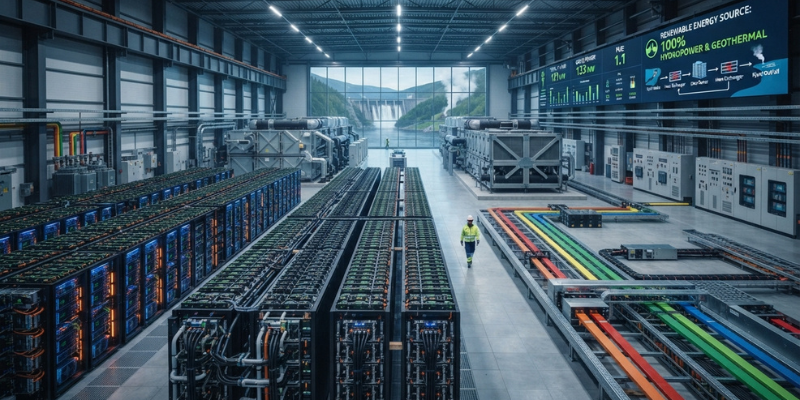
Bitdeer says the facility is expected to operate with a power usage effectiveness, or PUE, of approximately 1.1 and use 100% renewable energy.
The project is therefore about more than adding another data center.
It represents the infrastructure required to run increasingly power-intensive AI workloads at scale.
The $10 Billion Deal Is Different From Bitdeer’s $4.7 Billion Contract
The financial figures surrounding the project can be confusing because they refer to two different agreements.
Anthropic and Volta
The reported Anthropic-Volta agreement is valued at:
$10 billion over six years.
Volta and Bitdeer
Bitdeer’s separate agreement with Volta is worth approximately:
$4.7 billion over an initial 16-year term.
Bitdeer says an eight-year extension could increase the potential contract value to approximately $8 billion over 24 years.
These figures should not be added together.
The basic structure is:
Anthropic → Volta → Bitdeer
Anthropic reportedly commits to purchasing computing capacity from Volta.
Volta then uses infrastructure at Bitdeer’s Tydal campus to deliver that capacity.
This distinction is important because the $10 billion figure refers to the reported AI lab-Volta relationship, while the $4.7 billion figure comes from Bitdeer’s separate infrastructure contract with Volta.
Bitdeer’s Role in the AI Data Center
Bitdeer is providing the physical infrastructure behind the Norwegian project.
The company says its Tydal campus will deliver 121 IT MW of AI/HPC capacity during the initial project, with the infrastructure designed for NVIDIA GPUs.
The commercial structure is also substantial.
Bitdeer expects approximately $4.7 billion in contracted revenue over the initial 16-year term. The agreement includes an eight-year renewal option that could raise the total contract value to approximately $8 billion.
Bitdeer’s investor materials also show an average contractual rate of approximately $202 per kW per month, along with annual rent escalators and anticipated credit support of approximately $1.3 billion through letters of credit.
The financial structure shows why AI data centers are becoming attractive infrastructure assets.
Long-term AI contracts can provide predictable revenue while helping justify the enormous capital required to build power and computing facilities.
Why NVIDIA Vera Rubin Matters
The Norway facility is planned around NVIDIA Vera Rubin, NVIDIA’s next-generation AI computing platform.
The hardware is important because modern AI workloads require enormous amounts of processing power for both model development and deployment.
Large AI infrastructure projects support workloads such as:
- model training
- inference
- AI agents
- coding systems
- enterprise applications
- model evaluation
- research and experimentation
Volta says its 133 MW Norway project will be powered by NVIDIA Vera Rubin systems.
The choice also highlights a broader trend in AI infrastructure.
Data centers are no longer simply buildings filled with servers. Increasingly, they are being designed around the power density, cooling requirements and networking needs of specialized AI accelerators.
That is why the relationship between AI chips and physical infrastructure is becoming increasingly important.
Why Anthropic Needs More Compute
Anthropic’s reported Volta agreement comes as the company continues expanding its computing footprint.
The reason is straightforward: more capable AI models require more compute, while growing user demand requires more capacity to serve those models.
Claude is no longer positioned simply as a chatbot. Anthropic is expanding its products into coding, research, enterprise workflows and other AI applications.
That creates demand at multiple stages.
Anthropic needs computing capacity to train future models, evaluate them, run inference and support users once those models are deployed.
Volta Wants to Build More Than One AI Data Center
The Norway project is only the beginning of Volta’s larger strategy.
The company says its near-term development pipeline exceeds 1 GW of power capacity across North America and Europe. It also plans to develop multiple gigawatts of deployed capacity by 2030.
Volta describes its model as combining:
- infrastructure capital
- powered land
- data centers
- compute
- software
- operations
The company is therefore trying to position itself as an integrated AI infrastructure provider rather than simply another cloud service.
That distinction matters.
Traditional cloud platforms provide computing resources through established data-center networks. Companies such as Volta are increasingly building infrastructure specifically around the requirements of large AI customers.
Volta’s $2.4 Billion Valuation and $5 Billion Infrastructure Program
Volta’s emergence is notable because of the capital behind the company.
The startup was valued at approximately $2.4 billion after raising funding, according to reporting on its launch. It also announced a $5 billion AI Infrastructure Program with Azora to finance future AI facilities.
The company has also attracted major technology and venture investors.
Volta says its financing includes participation from NVIDIA, Andreessen Horowitz, Altimeter, Matter Venture Partners and Michael Dell’s family office.
The financing model is important because building AI infrastructure requires enormous upfront investment.
A data center needs land, power connections, cooling systems, buildings, networking equipment and accelerator hardware before it can generate revenue.
Long-term contracts with AI companies can help infrastructure providers secure financing for those projects.
Why AI Infrastructure Is Becoming a New Market
The Volta deal illustrates a major change in the AI industry.
The competitive advantage is no longer determined only by who develops the best model.
Companies also need access to:
- GPUs
- electricity
- data centers
- cooling
- networking
- storage
- software
- financing
In other words, compute is becoming strategic infrastructure.
That shift is also creating new business models around AI cloud services.
Specialized infrastructure companies are competing to provide AI labs with dedicated capacity, while established cloud providers continue investing billions in their own AI infrastructure.
The result is a growing ecosystem connecting chip manufacturers, data-center operators, cloud providers, infrastructure startups and AI model companies.
AI Data Centers Face Their Own Challenges
The scale of projects such as Tydal also creates significant execution challenges.
AI infrastructure requires substantial capital and complex engineering.
Potential challenges include:
- construction delays
- power availability
- GPU deployment
- networking requirements
- cooling
- financing
- rapidly changing accelerator technology
- long-term demand forecasting
The cooling challenge is particularly important.
As AI accelerators become more powerful, their power density and heat output increase. Earlier-generation infrastructure may not be designed for the requirements of modern rack-scale AI systems.
That is why the development of AI infrastructure increasingly involves more than simply installing faster chips.
The facility itself has to be engineered around those chips.
What Happens Next?
The next major milestone will be the development and deployment of the Tydal facility.
Bitdeer’s latest materials indicate that the first phase is targeted for Q4 2026, while the second phase is targeted for Q1 2027. Bitdeer also lists a third phase involving additional data halls for future AI and HPC workloads.
Volta, meanwhile, says its broader pipeline already exceeds 1 GW of near-term power capacity.
That means the Norway project could become a test case for a much larger infrastructure strategy.
If Volta successfully delivers the project, the company could use the same model to secure additional AI customers and develop more AI factories across Europe and North America.
For Anthropic, the bigger question is how quickly its compute requirements will continue to grow.
The company is operating in an AI market where model capability, inference demand and enterprise adoption are all increasing simultaneously.
What the Volta Deal Means for Anthropic
For Anthropic, securing additional computing capacity could provide greater flexibility as Claude usage expands.
It also reduces the company’s dependence on a single infrastructure source.
That matters because AI workloads can be extremely demanding, and capacity shortages can slow product launches, model training and service expansion.
The reported Volta agreement therefore fits into a larger trend in which leading AI companies are securing infrastructure far ahead of immediate demand.
The strategy is simple:
Build or reserve the infrastructure first, then scale AI products on top of it.
That approach requires billions of dollars, but the cost of not having enough compute could be even greater if demand continues to accelerate.
The Bigger AI Infrastructure Race
The Volta agreement is ultimately bigger than one company or one data center.
It shows how the AI industry is moving toward a model where compute, electricity and infrastructure are strategic resources.
Anthropic needs more compute to scale Claude.
Volta needs long-term AI customers to justify its infrastructure investments.
Bitdeer needs customers for its expanding AI/HPC facilities.
NVIDIA needs a growing ecosystem of data centers capable of deploying its latest accelerators.
Each part of the ecosystem depends on the others.
That is why billion-dollar AI infrastructure agreements are becoming increasingly common.
The same broader trend can be seen across the AI market, from new AI cloud providers to increasingly power-dense GPU deployments.
Final Thoughts
Anthropic has reportedly signed a $10 billion, six-year computing agreement with Volta, according to reporting that identified Anthropic as the unnamed AI lab behind Volta’s newly announced partnership.
Volta itself has officially confirmed the $10 billion AI-lab partnership, along with a 133 MW Norway AI factory powered by NVIDIA Vera Rubin systems.
Bitdeer has separately confirmed a $4.7 billion, 16-year AI/HPC data-center lease with Volta for the Tydal campus. The project will provide approximately 121 IT MW and 133 gross MW of capacity, with potential contract value reaching approximately $8 billion if the renewal option is exercised.
The most important takeaway is not simply the $10 billion headline.
The deal shows that the next phase of the AI race will depend on much more than model quality.
Chips, electricity, data centers, cooling, networking and long-term compute capacity are becoming strategic assets.
For Anthropic, the reported Volta agreement is another step toward securing the infrastructure needed to scale Claude.
For Volta and Bitdeer, it represents an opportunity to build a new business around the world’s rapidly growing demand for AI compute.
And for the broader industry, it is another sign that the AI boom is increasingly becoming an infrastructure race.