
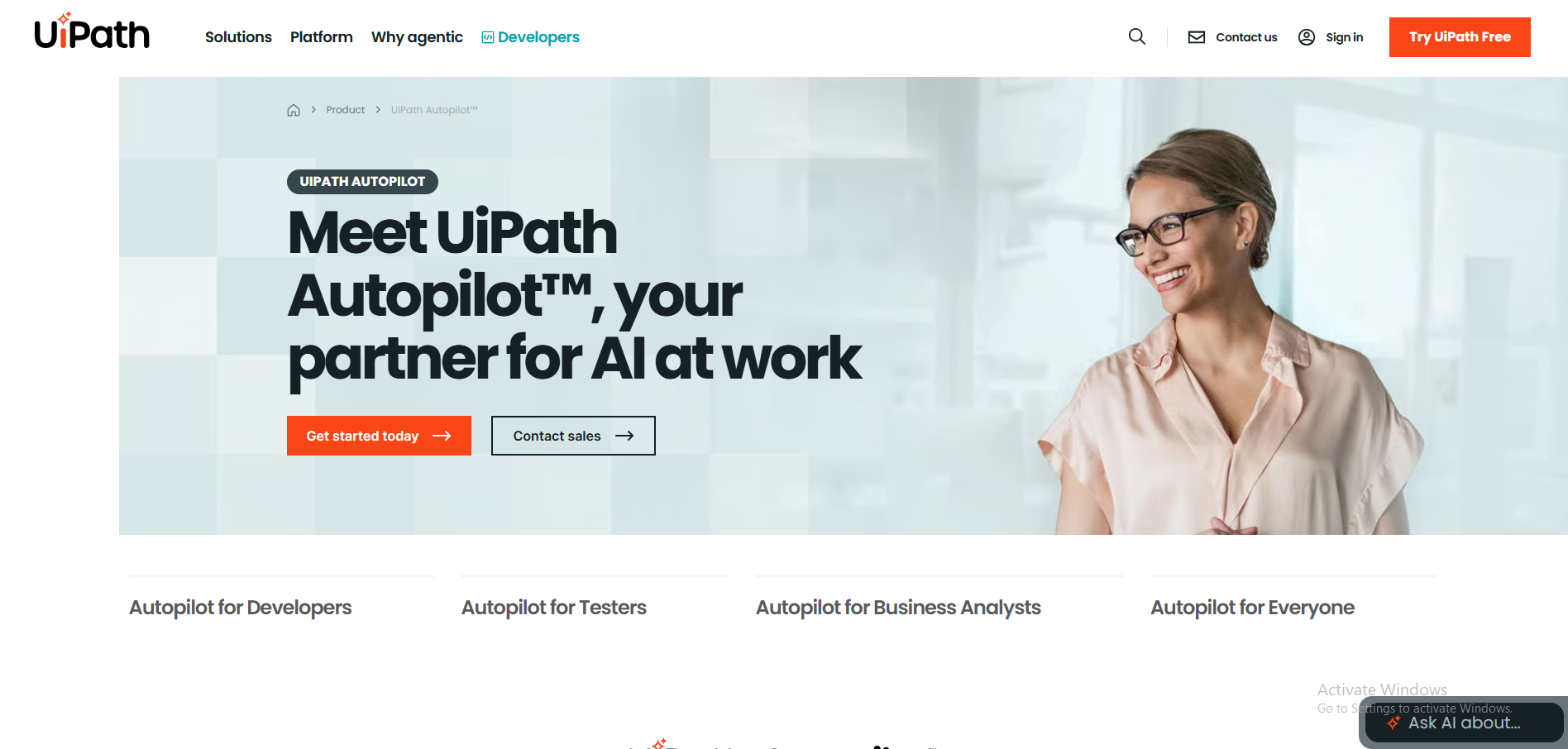

In 2026 UiPath AI stands as one of the most influential and widely adopted enterprise AI automation solutions, not as a standalone consumer product, but as the cornerstone of the UiPath Platform for agentic automation. UiPath’s evolution from robotic process automation (RPA) into agentic AI reflects the broader shift in how organizations use artificial intelligence: from simple task automation to autonomous, context-aware workflows that integrate humans, robots, and AI agents. This article provides a comprehensive, up-to-date analysis of UiPath AI in 2026, grounded in official sources, product documentation, real usage trends, pricing data, corporate ownership, competitive landscape, and real-world implementation insights.
UiPath AI is fundamentally part of the broader UiPath automation ecosystem, designed to tackle the persistent problem of manual, repetitive, and multi-system business processes that drain productivity and increase operational costs. Traditional RPA could mimic user interactions to automate rule-based tasks, but modern enterprises demand systems that can reason, plan, integrate with diverse data sources, and execute complex, end-to-end workflows with minimal human intervention. UiPath AI solves this by embedding artificial intelligence — especially agentic AI — into every layer of its platform, enabling autonomous agents that understand intent, coordinate actions across systems, and drive business outcomes while maintaining governance, security, and scalability. UiPath calls this agentic automation, reflecting its ability to unify AI agents, RPA robots, and people in controlled, adaptable workflows rather than isolated scripts or bots.
UiPath AI is owned and developed by UiPath, Inc. (NYSE: PATH), a publicly traded technology company headquartered in New York with global operations. UiPath has evolved from its early RPA roots into a leader in enterprise automation, now emphasizing agentic AI as a market differentiator and core growth driver. The company publicly reports its fiscal results, strategic initiatives, and product innovations, including the 2025 launch of its next-generation UiPath Platform for agentic automation, which integrates AI agents, robots, and orchestration layers such as UiPath Maestro to manage complex business workflows with embedded controls and monitoring.
Under the leadership of founder and CEO Daniel Dines, UiPath has navigated market volatility, macroeconomic headwinds, and strategic repositioning toward AI-centric solutions. Public financial reporting in 2025 and 2026 underscores the company’s focus on delivering enterprise value through innovation in autonomous and AI-assisted automation while balancing execution challenges in newer markets.
At a practical level, UiPath AI works by combining several technological layers into a unified automation platform. First, agentic AI enables software agents to reason about goals, plan actions, interact with systems through APIs or user interfaces, and adjust behavior based on feedback. This isn’t simply generative content; it’s AI capable of sequencing steps, handling exceptions, and coordinating multi-stage workflows autonomously. These AI agents are often built and customized using UiPath Agent Builder, which gives enterprise teams a visual and low-code environment to define agent behavior, integrate tools, and attach logic for contextual decision-making. The platform’s orchestration engine, UiPath Maestro, coordinates these agents with traditional RPA robots and human tasks, providing oversight, governance, and performance metrics.
A major technical distinction in how UiPath AI works is its support for hybrid execution: some agents perform rule-based tasks like document processing and UI automation, while others use machine learning and natural language understanding to interpret unstructured data, make decisions, or trigger conditional branches in workflows. This combination allows enterprises to automate processes that would previously have required deep human judgment — for example, claims adjudication, compliance investigations, invoice reconciliation, and exception handling in financial services.
In the real world, professionals use UiPath AI across many industries. In healthcare administration, a large provider reduced manual administrative hours by automating the processing of millions of transactions using UI-based AI document understanding, dramatically improving accuracy and throughput. Business process leaders in insurance use AI agents to streamline claims intake, verify documentation, and accelerate adjudication cycles. IT operations teams deploy agentic agents to automate ticket resolution, reducing backlog and freeing technical staff for higher-value work. In banking and finance, compliance and audit teams leverage automated workflows to enforce controls, perform reconciliation, and generate audit trails with minimal human intervention. These examples underscore how real companies move beyond narrow automation to scalable AI-driven workflows that blend autonomy with oversight.
Pricing for UiPath AI in 2026 remains complex and tailored to enterprise needs rather than being a simple per-seat product. The UiPath Automation Platform includes multiple tiers, with basic cloud plans starting as low as around $25 per month for foundational capabilities, scaling to enterprise plans that require custom quotes and can run into six figures annually for large deployments with extensive robots and AI units. Licensing models often combine platform units, AI units, and agent units depending on the organization’s scale and architecture choice. Free trials and community editions allow smaller teams and developers to experiment with core capabilities, but full agentic automation capabilities are typically part of higher-tier or enterprise licensing negotiated with UiPath sales.
When compared with key competitors in 2026, UiPath’s pricing and positioning reflect its enterprise-grade feature set. Platforms like Automation Anywhere and Microsoft Power Automate also offer AI-assisted automation and cognitive capabilities, but industry evaluations note that UiPath tends to excel in complex, end-to-end automation with robust orchestration and customization, while competitors might focus more on cloud-native delivery or lower entry-costs. Microsoft Power Automate is frequently cited as a more cost-effective solution for organizations already embedded in the Microsoft ecosystem, but it may lack the comprehensive orchestration and agentic depth that UiPath delivers for large-scale process automation.
UiPath AI is most suitable for medium and large enterprises with complex, multi-system workflows that benefit from AI-driven decision-making, high governance requirements, and the need to integrate humans and digital workers within standardized operational frameworks. Organizations with well-defined processes, large document volumes, or compliance-critical tasks often see the clearest return on investment. Conversely, smaller businesses or teams with simple automation needs may find the costs and implementation complexity of enterprise agentic automation disproportionate to their needs, and may benefit more from lighter-weight automation tools or embedded AI features in existing platforms.
Among strengths, UiPath AI offers powerful orchestration, scalability, and integration with diverse enterprise systems. Its combination of agentic AI with traditional automation allows workflows that span structured and unstructured data, human decisions, and adaptive execution. It supports robust governance and auditing, essential for regulated industries like healthcare and finance. Limitations include the inherent complexity of deploying and managing enterprise automation at scale, the need for specialized skills to design and optimize agentic workflows, and variable pricing that can be challenging to forecast without direct vendor consultation. Some organizations also report that realizing full ROI requires careful change management and ongoing tuning of agents and automations.
In business and team environments, UiPath AI enables new operating models where robotic labor and AI agents handle routine or data-intensive work, while human professionals focus on oversight, exception handling, and strategic tasks. This shift increases throughput, reduces error rates, and accelerates cycle times, but requires cultural adaptation and investment in training, such as through specialized UiPath Academy programs that now include AI and agentic automation curricula.
In the broader 2026 AI landscape, UiPath matters because it represents a practical, enterprise-ready application of autonomous agent technology tied to measurable business value. Unlike narrow generative models or consumer-focused AI assistants, UiPath’s platform operationalizes AI within governed, auditable workflows that align with corporate risk and compliance priorities. As enterprises seek to scale AI beyond prototypes, platforms like UiPath’s agentic automation become essential infrastructure, enabling hybrid human-digital workforces that deliver consistent, governed outcomes across complex process landscapes.
The verdict on UiPath AI in 2026 is that the platform has successfully transitioned from traditional RPA to a comprehensive agentic automation ecosystem. It addresses real enterprise challenges with intelligent, autonomous workflows that balance flexibility and control. However, its strengths come with complexity and cost considerations that make it a better fit for organizations with mature automation strategies rather than small teams or simple use cases. For technology leaders evaluating automation investments, UiPath AI is a robust, scalable choice—particularly when the goal is to automate deep, cross-system processes with an architecture that supports governance, visibility, and continuous optimization. In the evolving AI landscape, UiPath’s model demonstrates that the future of work is not just automated, but orchestrated — with AI agents working alongside humans to deliver measurable business impact.