
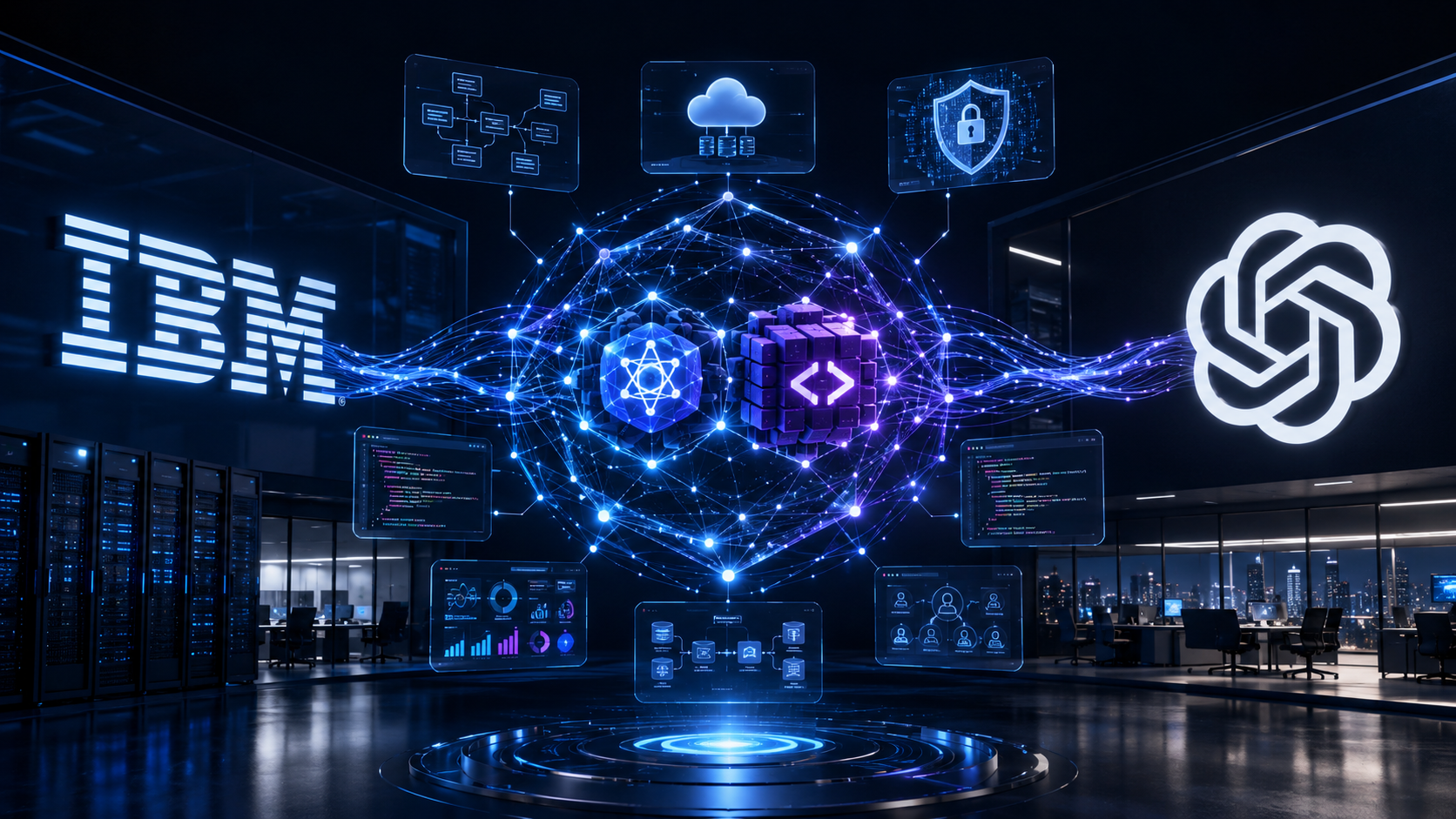
The IBM OpenAI partnership marks a significant step in the enterprise AI market, bringing OpenAI’s latest AI capabilities into IBM’s consulting and implementation ecosystem. Announced on August 13, 2026, the strategic agreement is designed to help large organizations move beyond AI experimentation and deploy artificial intelligence across core business operations, complex workflows, application modernization and cybersecurity.
The partnership combines two different strengths. OpenAI brings frontier AI models and products, including GPT-5.6, Codex and ChatGPT Work, while IBM brings decades of enterprise technology experience, consulting expertise, industry knowledge and implementation capabilities.
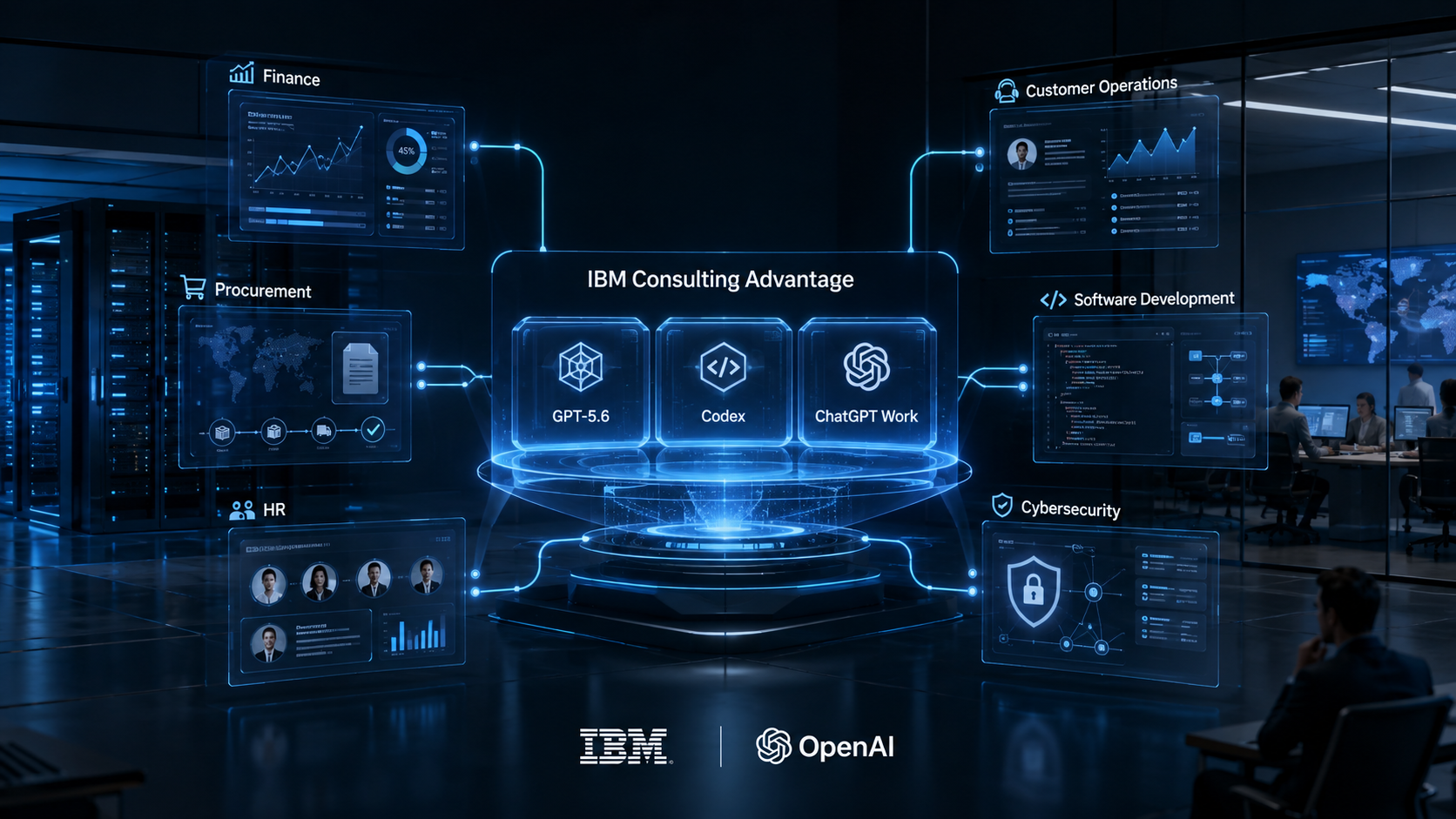
According to IBM, these technologies will be embedded into IBM Consulting Advantage, the company’s AI platform for delivering consulting services. The companies will initially focus on areas such as finance, procurement, customer operations, human resources, software development, application modernization and cyber defense.
The development is important because enterprise AI adoption is increasingly moving away from simple chatbot deployments. Businesses need AI systems that can connect with existing applications, understand organizational processes, operate within governance frameworks and deliver measurable business outcomes.
IBM and OpenAI are positioning their partnership around exactly that challenge.
What Is the IBM OpenAI Partnership?
The IBM OpenAI partnership is a strategic go-to-market collaboration focused on helping enterprises deploy AI across business operations and complex workflows.
Rather than simply giving IBM customers access to another AI model, the agreement combines OpenAI technology with IBM Consulting’s implementation capabilities. IBM says the partnership will help organizations transform fragmented processes and legacy systems into AI-ready operations.
The partnership includes industry-specific solutions for financial services, government, telecommunications and retail, as well as business functions including finance, procurement, customer operations and HR.
IBM will also join OpenAI’s Elite Partner tier and launch a dedicated OpenAI practice. Specialized IBM engineers and consultants will be trained through the OpenAI Partner Network and work directly with clients on AI implementation.
This implementation layer is important. Many companies already have access to generative AI tools, but turning those tools into reliable production systems requires integration with enterprise data, applications, security policies and established workflows.
IBM’s role is therefore less about replacing existing enterprise infrastructure and more about connecting frontier AI to it.
Organizations exploring broader automation can also look at AiToza’s coverage of AI tools for business automation, which illustrates how enterprise software is increasingly moving toward AI-powered workflows.
Which OpenAI Technologies Is IBM Integrating?
The partnership specifically names three major OpenAI technologies: GPT-5.6, Codex and ChatGPT Work. IBM plans to embed these capabilities into IBM Consulting Advantage.
GPT-5.6
GPT-5.6 provides the frontier-model foundation for advanced reasoning and knowledge-intensive enterprise workloads.
Within consulting projects, a model such as GPT-5.6 can support analysis, workflow understanding, document-intensive work and other tasks where enterprises need more than simple text generation.
OpenAI describes GPT-5.6 as the model powering ChatGPT Work, its agent designed for longer, multi-step assignments.
Codex
Codex is particularly important for IBM’s software engineering and modernization ambitions.
Enterprise organizations often operate large portfolios of older applications. Updating those systems can require extensive code analysis, refactoring, testing and documentation.
Codex gives IBM another AI capability for software development, while IBM contributes the enterprise architecture knowledge and consulting expertise needed to work with complicated legacy environments.
OpenAI has also highlighted how Codex has expanded beyond traditional coding assistance into broader workplace tasks, demonstrating the increasing overlap between software agents and general enterprise workflows.
ChatGPT Work
ChatGPT Work is designed for longer, more involved tasks. It can gather information across connected applications and files, perform multi-step work and produce outputs such as documents, spreadsheets, presentations and reports.
That makes it relevant to consulting environments where teams frequently need to combine information from different systems and turn it into decision-ready business materials.
Together, GPT-5.6, Codex and ChatGPT Work give IBM a combination of reasoning, software development and agentic work capabilities.
How IBM Will Use OpenAI for Enterprise Workflows
The central goal of the partnership is to make AI useful inside everyday enterprise processes.
IBM says IBM Consulting Advantage can analyze operating procedures and workflows, identify inefficiencies and help organizations automate or streamline work using AI.
For finance teams, this could mean using AI to analyze large volumes of business information, prepare reports or assist with repetitive operational processes.
Procurement departments could apply AI to document-heavy workflows and supplier-related information. Customer operations teams could use AI to retrieve information, prepare responses and coordinate routine tasks.
HR departments represent another potential use case, particularly for internal knowledge work and processes that require employees to navigate multiple systems.
The important difference is that the AI is being positioned inside the workflow rather than as a standalone chatbot.
This approach is already visible across the enterprise AI market. For example, ServiceNow AI is designed around workflow orchestration and agentic automation, showing why integration with business systems is becoming as important as the underlying model.
Application Modernization and Software Development
Application modernization is one of the most significant parts of the IBM OpenAI agreement.
Large enterprises often rely on software that was developed years or even decades ago. Modernizing these systems can be expensive because engineers must understand existing code, dependencies, business rules and infrastructure before making changes.
IBM and OpenAI plan to combine Codex and ChatGPT Work with IBM’s industry and technology expertise to simplify engineering processes and accelerate the development of new digital products and services.
Codex can assist with software development tasks, while IBM can provide the architecture, integration and transformation expertise required for production environments.
This creates a potentially powerful model for enterprise modernization: AI handles more of the repetitive technical work while consultants and engineers remain responsible for architecture, governance and critical decisions.
The strategy also fits IBM’s existing focus on AI-assisted development. IBM has previously described its approach as a multi-model strategy, with enterprise development tools able to work across models based on factors such as performance, cost and task requirements.
IBM and OpenAI Expand Their Cybersecurity Focus
Cybersecurity is another major pillar of the partnership.
IBM and OpenAI plan to combine OpenAI’s frontier AI capabilities with IBM Autonomous Security, IBM’s multi-agent security service. IBM says the collaboration will address both traditional cyber risk and risks associated with AI systems, including application-layer vulnerabilities, governance gaps and operational risks.
The timing is significant because AI is creating a dual cybersecurity challenge.
Organizations can use AI to detect threats, investigate incidents and automate responses. At the same time, attackers can use increasingly capable AI systems to accelerate reconnaissance, exploit development and other malicious activity.
Enterprise customers therefore need AI security strategies that cover both the technology itself and the broader infrastructure surrounding it.
IBM’s participation in the OpenAI Daybreak Cyber Partner Program further expands the cybersecurity dimension of the relationship.
IBM Launches a Dedicated OpenAI Practice
IBM is also creating a dedicated OpenAI Practice as part of the agreement.
The company says thousands of consultants and engineers will obtain expert-level certifications through the OpenAI Partner Network. IBM will also deploy specialized teams trained through the partner network to work directly with clients.
This could become one of the partnership’s most important advantages.
Enterprise AI projects frequently fail to scale because organizations lack the expertise required to move from a successful pilot to a production deployment. Training a large consulting workforce gives IBM a way to address that skills gap.
For OpenAI, the benefit is equally significant. Instead of selling AI technology directly to every organization, OpenAI can use IBM’s consulting network as a major implementation channel.
IBM OpenAI vs. IBM Anthropic
The OpenAI partnership does not mean IBM has abandoned its relationship with Anthropic.
IBM and Anthropic announced a strategic partnership in October 2025 to integrate Claude into selected IBM software products, beginning with an AI-first development environment designed for enterprise software development and modernization.
IBM’s earlier strategy already emphasized choice and flexibility. Its enterprise software initiatives have incorporated multiple AI models, including Anthropic Claude, IBM Granite and other models.
The OpenAI agreement therefore appears to strengthen rather than replace IBM’s multi-model strategy.
The distinction is useful. The OpenAI partnership puts strong emphasis on IBM Consulting Advantage, enterprise workflows, application modernization, product development and cybersecurity. The Anthropic relationship has been particularly focused on bringing Claude into IBM software and enterprise development environments.
Rather than selecting one AI provider for every task, IBM can potentially match different models to different workloads.
That approach may become increasingly important as enterprises compare AI systems based on accuracy, reasoning, coding ability, latency, security, cost and governance.
Why IBM Is Taking a Multi-Model Approach
Enterprise AI is becoming too complicated for a single-model strategy.
A company may need one model for advanced reasoning, another for coding, a smaller model for high-volume classification and specialized systems for particular industries or devices.
IBM has already articulated the value of model choice, arguing that organizations should be able to select technologies according to their requirements rather than becoming locked into one provider.
The OpenAI partnership fits this philosophy.
It also reflects a broader trend toward portfolio-based AI spending. Enterprises are increasingly evaluating the complete technology stack rather than asking which model is simply “the best.”
For example, organizations interested in workflow automation may evaluate UiPath AI alongside enterprise AI platforms, while teams working with customer operations may consider specialized AI assistants and automation systems.
The winning enterprise strategy may therefore involve multiple models, agents, automation platforms and infrastructure components operating under a common governance framework.
What Businesses Could Gain
The IBM OpenAI partnership could provide several practical benefits for enterprises.
First, organizations gain access to OpenAI’s latest AI capabilities through an established consulting and implementation organization.
Second, IBM can help connect those models to existing enterprise systems. This is especially important for companies operating complex hybrid-cloud environments or legacy applications.
Third, Codex could help accelerate software development and modernization by assisting engineers with coding and other development tasks.
Fourth, ChatGPT Work could support longer-running business workflows that require information gathering, analysis and production of finished work.
Finally, the cybersecurity component gives enterprises a way to consider AI deployment and AI risk management together.
The overall value proposition is therefore broader than simply adding another chatbot to an organization.
The Challenges Enterprises Still Need to Solve
The partnership does not remove the fundamental challenges associated with enterprise AI.
Organizations still need strong data governance, access controls, compliance processes, security testing and human oversight.
AI-generated outputs also need evaluation. A highly capable model can still produce incorrect information or make inappropriate recommendations, particularly when it is connected to sensitive business processes.
Integration is another challenge. Connecting AI models to legacy applications and fragmented data systems can require substantial engineering work.
There is also a potential trade-off in IBM’s multi-vendor strategy. Using multiple models can reduce dependence on a single provider, but it can also increase governance and integration complexity.
Enterprises will need policies for deciding which model should handle which task, how performance should be measured and when humans must approve AI-generated actions.
Cost is another consideration. As organizations move from pilots to continuous AI workloads, inference costs, infrastructure requirements and implementation expenses can become significant.
The future of enterprise AI will therefore depend not only on model intelligence but also on operational efficiency and governance.
What the IBM OpenAI Deal Means for Enterprise AI
The IBM OpenAI partnership signals a broader shift in the enterprise AI market: AI deployment is becoming an ecosystem business.
OpenAI supplies frontier models and agentic products. IBM contributes consulting expertise, industry knowledge, implementation resources and cybersecurity capabilities.
That combination addresses one of the biggest gaps in enterprise AI today: moving from a promising demonstration to a reliable production system.
The partnership also reinforces IBM’s multi-vendor approach. Rather than replacing Anthropic or its own AI technologies, OpenAI becomes another important component of IBM’s enterprise AI portfolio.
For businesses, the most important question may no longer be which AI company has the strongest model. Instead, enterprises will increasingly ask which combination of models, agents, infrastructure, consulting and governance can produce the best outcome for a particular workflow.
GPT-5.6, Codex and ChatGPT Work give IBM additional tools for that strategy. IBM Consulting Advantage provides the implementation layer.
If the partnership succeeds, the result could be less about AI experimentation and more about AI becoming embedded in everyday enterprise operations.
That is ultimately what makes the IBM OpenAI partnership significant: it connects frontier AI capabilities with the systems, processes and expertise required to make them useful at enterprise scale.
Sources and Further Reading
IBM’s official announcement provides the primary details on the partnership, including GPT-5.6, Codex, ChatGPT Work, IBM Consulting Advantage, cybersecurity initiatives and the dedicated OpenAI Practice.
OpenAI’s overview of ChatGPT Work explains how the agent handles longer-running tasks across apps and files and uses GPT-5.6 as its frontier model.
IBM’s earlier Anthropic partnership provides useful context for understanding the company’s broader multi-model enterprise AI strategy.