

Anthropic is expanding Claude Voice Mode beyond quick conversations. The feature, which previously relied only on Claude Haiku, can now use the company’s more capable Sonnet and Opus models.
The update also extends Claude’s voice capabilities into workplace tools such as Gmail, Slack, and Canva. For people who already use Claude for business planning, writing, research, or daily productivity, the change removes one of Voice Mode’s biggest limitations.
Haiku is designed for speed. It can answer simple questions quickly and keep a spoken conversation moving. However, it is not Anthropic’s strongest model for sustained reasoning or complicated tasks.
Sonnet and Opus are built for more demanding work. Their addition means users can now discuss complex problems by voice without being restricted to Claude’s lightest model.
Anthropic is also allowing users to switch between models and move between voice and text during the same conversation. Together, these changes make Claude Voice Mode more useful for real work rather than only short, hands-free questions.
The update is straightforward, but its wider meaning is more important. Anthropic wants Claude to become part of the tools people already use throughout the working day, rather than remaining a separate chatbot that users must visit when they need help.
What Changed in Claude Voice Mode?
Until this update, Claude Voice Mode worked exclusively with Haiku. Haiku is Anthropic’s fastest and lightest model. Its speed made it a natural choice for early voice interactions because delays are more noticeable in spoken conversations than in text chats. When users type a question, waiting several seconds for a detailed response may not feel unusual. During a voice conversation, however, the same pause can interrupt the flow and make the assistant feel less natural.
Haiku helped Anthropic keep Voice Mode responsive. The trade-off was that users could not access the deeper reasoning abilities available through Sonnet and Opus.
That limitation became more noticeable as people started using Voice Mode for serious tasks.
Instead of asking only simple questions such as checking a definition or generating a short idea, users began talking through business problems, planning projects, drafting content, and handling longer discussions.
Anthropic says this behavior influenced its decision to expand Voice Mode. Users were pushing the feature beyond the type of quick interactions Haiku was originally selected to handle. They wanted the convenience of speaking combined with the reasoning quality of Anthropic’s stronger models.
The updated Voice Mode now supports:
- Claude Haiku
- Claude Sonnet
- Claude Opus
- Model switching during conversations
- Movement between voice and text
- Connections with workplace applications
- More complex spoken workflows
The result is a version of Claude Voice Mode that is better suited to sustained conversations and practical work.
Claude Opus and Sonnet Bring Deeper Reasoning to Voice
The most important part of the announcement is the addition of Sonnet and Opus.
Although all three Claude model families can answer questions and generate content, they are designed for different levels of complexity.
Claude Haiku
Haiku focuses on speed and efficiency.
It is suitable for tasks such as:
- Answering quick questions
- Summarizing short messages
- Generating simple ideas
- Checking basic information
- Handling lightweight conversations
For a fast voice assistant, these abilities are useful. However, the model may be less suitable when a task requires deeper analysis, several steps, or a detailed understanding of business context.
Claude Sonnet
Sonnet provides a stronger balance between speed and reasoning.
It can be useful when a user wants to:
- Plan a marketing campaign
- Review several ideas
- Develop a project outline
- Draft professional content
- Compare possible decisions
- Work through a multi-step problem
Sonnet’s addition makes Voice Mode more practical for users who want stronger answers without always needing Anthropic’s most advanced model.
Claude Opus
Opus is designed for Anthropic’s most difficult reasoning tasks.
Through Voice Mode, it may be useful for discussions involving:
- Complex business strategy
- Detailed research questions
- Long-form planning
- Difficult decision-making
- Advanced analysis
- Complicated writing projects
The ability to use Opus through voice could change how some professionals interact with Claude.
Instead of typing a long prompt, a founder could explain a business problem naturally, add details while speaking, respond to Claude’s questions, and continue refining the solution.
A writer could talk through the structure of an article before asking Claude to turn the discussion into an organized draft.
A developer could describe a product issue and use the conversation to explore possible causes and solutions.
The value is not simply that Claude can speak. The value is that users can now access stronger reasoning while speaking.
Users Can Switch Models During a Conversation
Anthropic is also giving users more control over which model handles a task.
A conversation may begin with Haiku when the user needs a fast answer. If the discussion becomes more complicated, the user can switch to Sonnet or Opus without abandoning the conversation.
This is useful because users do not always know how difficult a task will become when they start.
For example, someone might begin by asking Claude to summarize several recent messages. After hearing the summary, the user may want to compare the messages, identify a disagreement, recommend a solution, and prepare a response.
The original request was simple. The later task requires more reasoning.
Instead of opening a new chat and explaining the entire situation again, the user can select a stronger model and continue.
This creates a more flexible experience. Users can choose speed when speed matters and deeper reasoning when the task demands it.
OpenAI is pursuing a similar workplace strategy with ChatGPT Work, an AI agent designed to work across Slack, calendars, email, documents, and other connected business tools.
Claude Can Move Between Voice and Text
Another important addition is the ability to move between voice and text within the same conversation.
Voice is convenient for explaining ideas, brainstorming, and giving quick instructions. Text is often better for reviewing details, editing sentences, entering exact figures, or copying information.
A user could begin by speaking:
“Help me create a pitch for a productivity application aimed at small businesses.”
Claude could discuss the target audience, value proposition, and possible features by voice.
The user could then switch to text to paste product information or correct a specific number. After reviewing the written response, the user could continue the discussion by voice.
This combination makes Claude more useful for practical work because users are not forced to choose only one method of interaction.
It also makes longer conversations easier to manage. A spoken discussion can produce written information that the user can review, edit, or reuse later.
Claude Voice Mode Extends Into Gmail
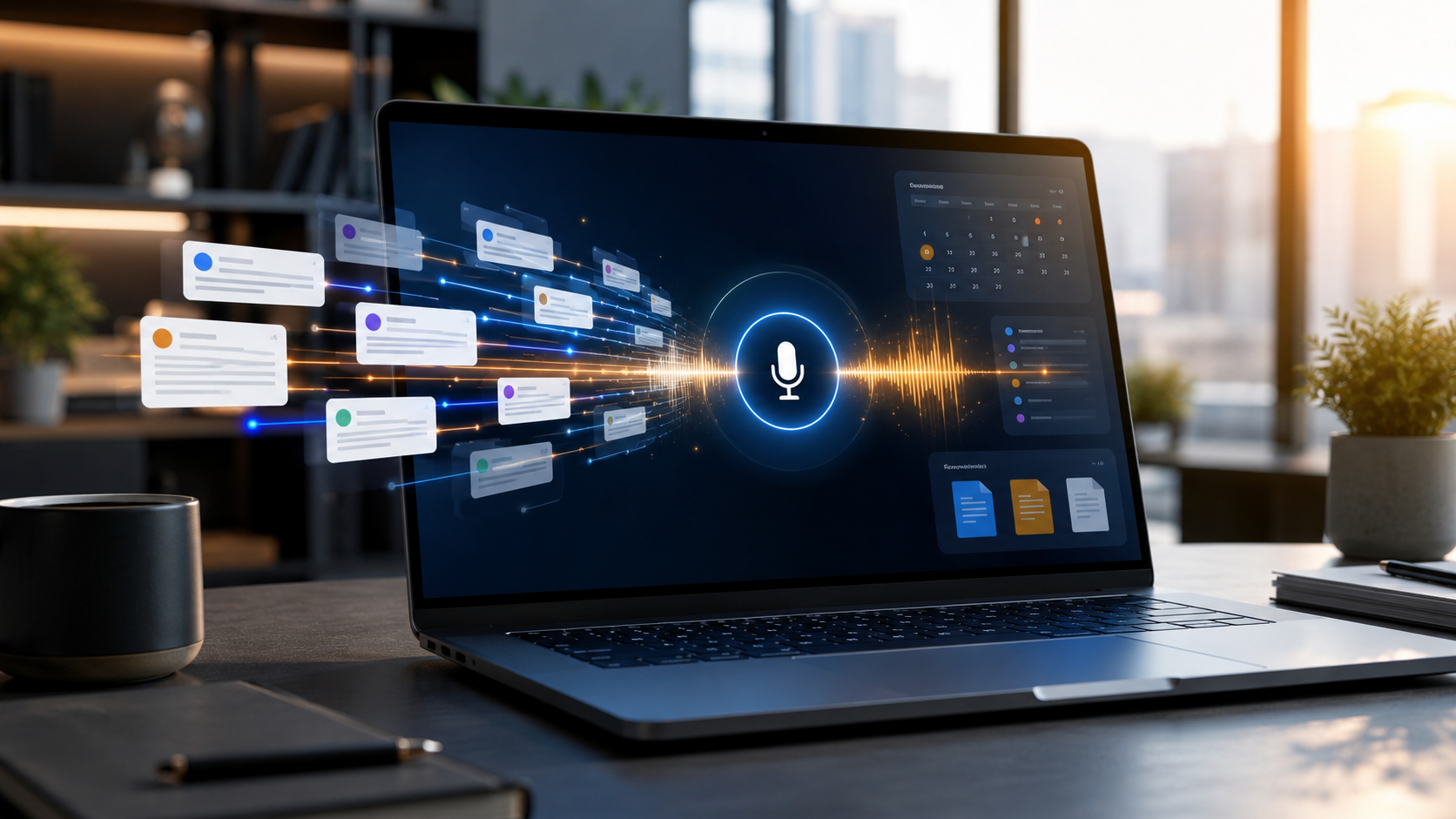
The workplace integrations are another major part of Anthropic’s announcement. Claude Voice Mode is extending its reach into Gmail, allowing users to work with email through spoken instructions. Depending on the available integration and account permissions, a user may be able to ask Claude to:
- Find an email
- Summarize a message
- Explain a long email thread
- Identify urgent requests
- Extract important dates
- List action items
- Help prepare a reply
- Compare information across messages
For example, a user could ask:
“Summarize the latest emails about the product launch.”
Instead of manually opening and reading every message, the user could receive a spoken overview of the main points.
Another request might be:
“Find the client’s latest email and help me prepare a professional response.”
This type of workflow could be useful for founders, managers, freelancers, and employees who receive large amounts of email every day. It could also make Claude more valuable on mobile devices. A user may be able to check important updates while moving between meetings or completing another task.
However, users should understand the wording carefully. The update does not necessarily mean that every Gmail user will see a complete Claude Voice Mode interface directly inside their inbox.
Claude’s workplace access may depend on integrations, connected accounts, permissions, and the version of Claude being used. The central idea is that Claude can use workplace information during a voice-based workflow, reducing the need to move manually between different applications.
Slack Integration Brings Voice to Team Conversations
Slack is another important part of the expansion. Modern teams often use Slack for project updates, quick decisions, internal discussions, and daily communication. Important information can easily become buried in long channels or message threads. Claude Voice Mode could help users understand those discussions more quickly.
Possible requests include:
- “Summarize what happened in the marketing channel today.”
- “What decision did the development team make?”
- “Find the latest update about the delayed feature.”
- “What tasks were assigned to me?”
- “Explain the disagreement in this project thread.”
- “Create a list of the next steps discussed by the team.”
This could be especially useful for employees returning from leave or joining a conversation after many messages have already been posted.
Instead of reading an entire thread, the user could ask Claude for a summary and then request more detail on specific points.
For managers, the integration could make it easier to catch up on several team discussions. For employees, it could reduce the time required to find decisions, deadlines, and responsibilities.
The potential benefit is clear, but so is the sensitivity. Slack conversations often include confidential information, private team discussions, customer details, or internal business decisions. Giving an AI assistant access to those messages raises questions about permissions, data handling, and workplace policies.
Anthropic will need to show that Claude can access useful information without weakening the controls companies already use to protect it.
Canva Extends Claude Voice Mode Into Creative Work
Canva’s inclusion suggests that Anthropic is not limiting Voice Mode to communication tools.
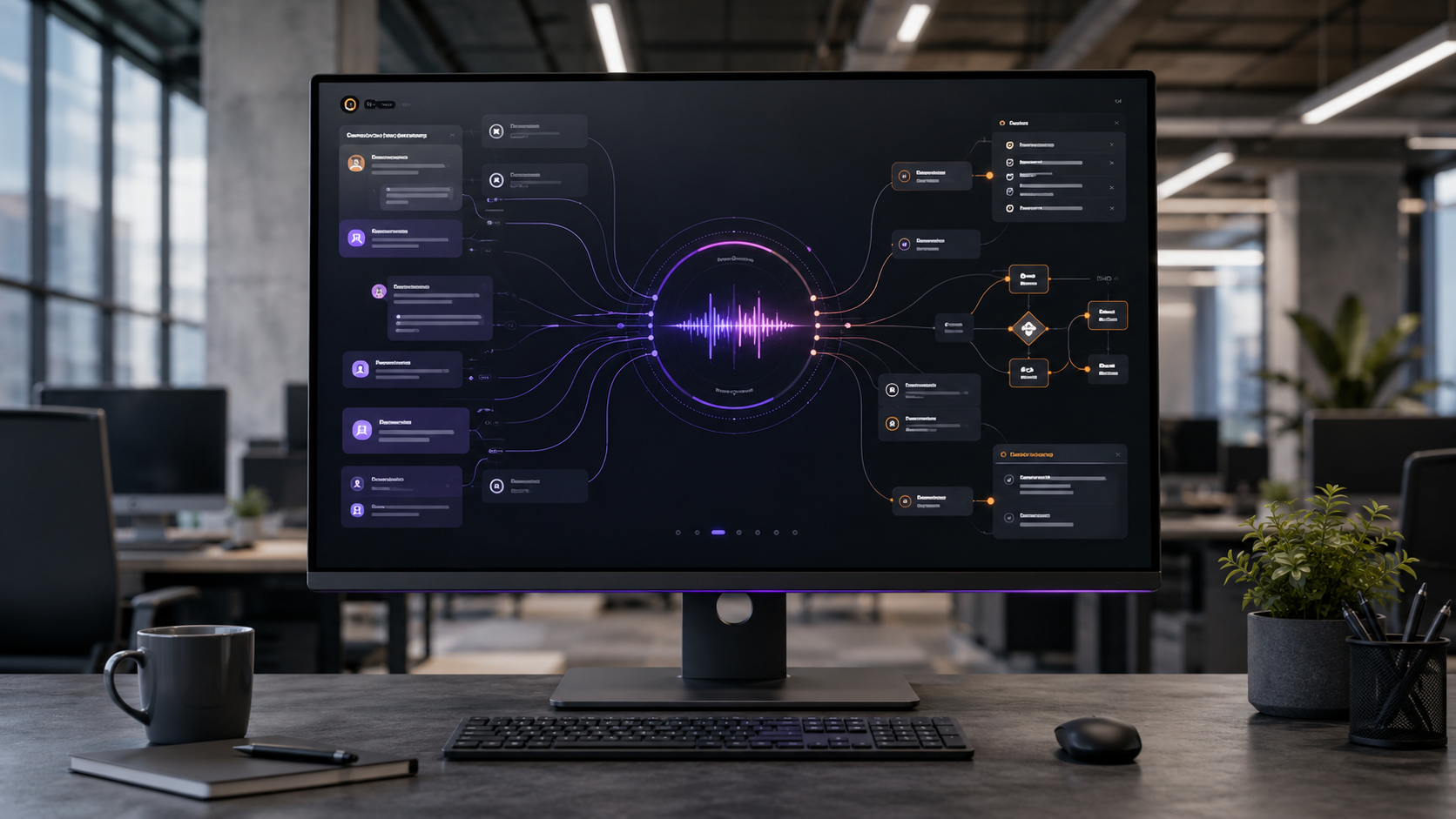
The integration could allow users to bring spoken instructions into creative workflows.
A marketer might describe the purpose of a presentation and ask Claude to help organize the message.
A small business owner could explain an advertising idea and ask for help shaping the content.
A team could talk through a campaign concept before turning the conversation into a draft presentation or design brief.
Possible voice requests could include:
- “Create an outline for a product presentation.”
- “Turn these ideas into a campaign brief.”
- “Suggest a structure for a five-slide pitch deck.”
- “Rewrite this headline for a social media graphic.”
- “Organize these points into a clear presentation.”
The exact capabilities will depend on how the Canva integration works and which actions Anthropic allows Claude to perform.
Still, the direction is important. Anthropic appears to be positioning Claude as an assistant that can move from conversation to action. The user does not only ask for an answer. The assistant helps create something useful inside an existing work process.
Why Anthropic Expanded Voice Mode Beyond Haiku
Anthropic says the update was shaped by how people were already using Voice Mode.
Users were not treating it only as a fast question-and-answer tool. They were trying to use it for deeper tasks. This is a common pattern with AI products. Companies may release a feature for a limited purpose, but users quickly test whether it can handle more complicated work. When the feature falls short, those limitations become clearer. In Claude’s case, Voice Mode offered convenience but restricted users to Haiku. Someone could talk to Claude easily, but they could not always access the same reasoning quality available through Sonnet or Opus in text conversations.
That created an obvious gap.
People who preferred voice had to choose between convenience and capability.
By adding Sonnet and Opus, Anthropic is bringing the voice experience closer to the rest of the Claude platform.
The update also reflects a wider shift in the AI industry. Voice assistants are moving beyond basic commands and casual conversation.
Companies want them to become tools for work, research, planning, communication, and software use.
To support those tasks, speed alone is not enough. The model must understand context, follow long instructions, reason through problems, and work with information from other applications.
Why the Gmail and Slack Expansion Matters
The model upgrade is useful, but the workplace integrations may have a bigger long-term effect.
AI companies are competing to become part of the user’s daily workflow.
A standalone chatbot requires users to stop what they are doing, open a separate application, explain the situation, and sometimes copy information from another service.
Claude’s expansion reflects a wider industry shift toward voice assistants that understand context and take action inside apps, rather than simply answering basic spoken questions. Instead of copying a Slack thread into Claude, the user can ask Claude to find it.
Instead of reading an entire email chain, the user can request a summary. Instead of writing a long design brief, the user can describe the idea by voice. This is what makes the update strategically important. Anthropic is not only improving Voice Mode. It is trying to make Claude more useful throughout the working day.
That approach may increase the value of Claude for professionals who already spend much of their time inside tools such as Gmail, Slack, and Canva. It may also help Anthropic compete with OpenAI, Google, Microsoft, and other companies building AI assistants for work.
The Privacy and Permission Questions
The expansion also creates new concerns. A voice assistant connected to workplace applications may be able to access sensitive information. Emails can contain contracts, financial data, customer details, and private discussions. Slack may include internal company plans, employee information, or unreleased product details. Voice commands can also be misunderstood. A system might hear the wrong name, select the wrong conversation, or interpret an instruction too broadly.
These risks make permission controls essential. As businesses connect assistants to internal systems, enterprise AI data governance becomes just as important as the quality of the underlying model.
Users and businesses will want clear answers to questions such as:
- What information can Claude access?
- Does Claude access data only when requested?
- Can users limit access to specific tools?
- Can administrators disable certain integrations?
- Are voice conversations saved?
- What happens to information retrieved from Gmail or Slack?
- Which actions require human approval?
- Can Claude make changes without confirmation?
Anthropic’s success in workplace AI will depend partly on how clearly it answers these questions.
Convenience may attract users, but trust will determine whether businesses allow Claude to access important systems.
What the Update Means for Claude Users
For regular Claude users, the update removes a frustrating limitation.
People who preferred Voice Mode no longer have to rely only on Haiku for every task. Where their plan allows it, they can use Sonnet or Opus for more detailed conversations.
This could make Voice Mode useful for:
- Business planning
- Content development
- Project management
- Meeting preparation
- Email review
- Team communication
- Creative brainstorming
- Research discussions
- Decision-making
- Presentation planning
The ability to switch models also gives users more control over speed and depth.
Meanwhile, the Gmail, Slack, and Canva integrations reduce the distance between asking Claude for help and applying that help to real work.
The feature may be especially valuable for users who think more naturally through conversation than through written prompts.
Speaking allows people to explain ideas in an informal way, add details as they remember them, and respond immediately to follow-up questions.
With stronger models behind the conversation, that natural input can lead to more useful results.
Challenges Anthropic Still Needs to Address
The update does not solve every problem.
Using Opus or Sonnet may produce stronger answers, but more powerful models can sometimes respond more slowly than Haiku. That creates a challenge for voice interaction, where speed is important. Anthropic will need to balance reasoning quality with response time. The company must also ensure that model switching feels simple. Users should understand which model they are using, why they might change it, and whether switching affects their plan limits.
Workplace integrations must also be reliable. Even powerful models can be held back by legacy infrastructure slowing AI agents, including API delays, outdated authentication systems, and weak data pipelines. A voice assistant becomes less useful if it retrieves the wrong email, misses a key Slack message, or misunderstands the user’s request.
Other challenges include:
- Maintaining conversation context
- Handling interruptions naturally
- Protecting sensitive information
- Explaining permissions clearly
- Supporting different accents and speaking styles
- Avoiding accidental actions
- Managing enterprise security policies
- Keeping the experience fast
The expansion is an important step, but the quality of execution will determine whether users adopt it for everyday work.
What Happens Next?
The next stage will likely focus on broader workplace access and better voice interaction.
Anthropic may expand Claude Voice Mode to additional productivity tools, calendars, customer relationship management platforms, project-management services, and business software. Users will also expect improvements in interruption handling, response speed, language support, and hands-free use. Enterprise customers may ask for more detailed controls over which data Claude can access and which actions it can perform.
Anthropic has not provided a complete roadmap, so future integrations should not be treated as confirmed. Still, the direction is clear. Claude is moving from being a chatbot that users visit toward becoming an assistant that works across the software they already use.