

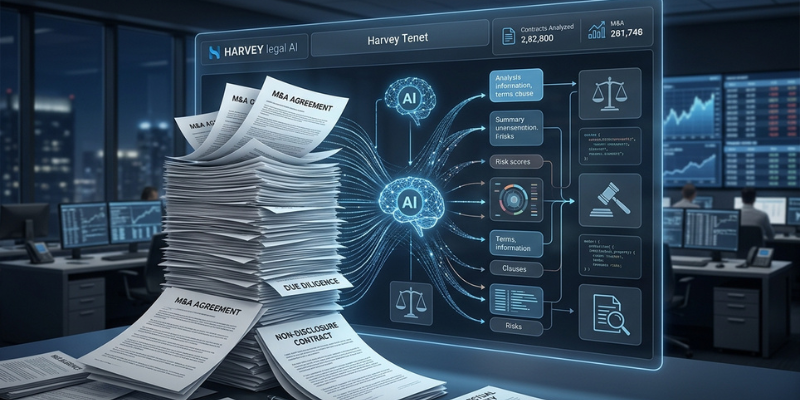
Harvey has introduced Harvey Tenet, its first post-trained open-weight AI model designed for complex, long-horizon legal work.
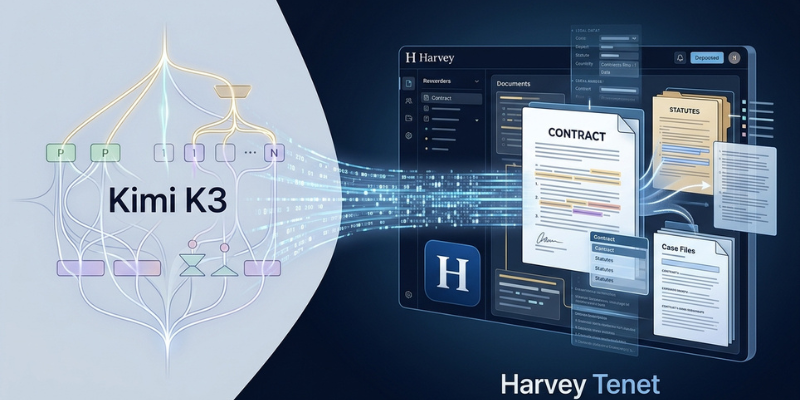
The model uses Kimi K3, an open-weight model developed by Moonshot AI, as its base. Harvey worked with Fireworks Research to post-train Tenet for legal-agent workflows using synthetic data, publicly available legal data and human expert data. Harvey says its early results show substantial improvements over the base Kimi K3 on legal-agent benchmarks.
The announcement marks a significant change in Harvey’s AI strategy. Instead of relying entirely on third-party foundation models, the legal technology company is now developing specialized AI models that it can optimize for legal reasoning, document analysis, agentic workflows and cost efficiency.
What Is Harvey Tenet?
Harvey Tenet is Harvey’s first post-trained open-weight model built specifically for legal AI.
Rather than training a new foundation model from scratch, Harvey started with Kimi K3 and adapted it for long-horizon legal tasks. The company says its broader research program is focused on building advanced legal intelligence with open-weight models and creating systems that allow law firms to develop and control specialized AI models.
This makes Tenet different from a traditional AI chatbot.
A chatbot may answer a question with a single response. A legal AI agent may need to search through a client’s documents, identify evidence, compare contracts, reason across multiple steps and produce a structured legal work product.
That extended process is what Harvey means by long-horizon legal work.
Why Long-Horizon Legal Work Matters
Legal tasks often involve much more than generating text.
For example, an M&A assignment could require an AI agent to:
- Review a large collection of documents.
- Search for relevant clauses and information.
- Connect evidence across different files.
- Identify potential risks.
- Compare provisions.
- Support conclusions with evidence.
- Produce a final work product.
Harvey’s training environments are designed around this type of multi-step workflow. Each environment includes a legal task, a client matter containing relevant documents and an expert rubric used to evaluate the resulting work product.
Harvey Tenet Is Built on Kimi K3
One of the most important details in the announcement is Tenet’s foundation model.
Harvey Tenet is built on Kimi K3, an open-weight model from Moonshot AI. Harvey then post-trained the model for legal work in collaboration with Fireworks Research.
The basic process can be summarized as:
Kimi K3 → Legal post-training → Reinforcement learning → Agent optimization → Harvey Tenet
This approach allows Harvey to focus its research on legal performance without having to develop an entirely new foundation model from the ground up.
It also reflects a broader change in enterprise AI. Companies can increasingly start with capable open-weight models and differentiate them through specialized training, expert feedback, evaluation systems and domain-specific infrastructure.
Why Did Harvey Choose an Open-Weight Model?
Harvey says its Tenet research is focused on both legal AI performance and cost efficiency.
An open-weight model can give developers greater flexibility to customize and post-train the underlying system compared with relying exclusively on a closed model through an API.
That can be especially important for legal AI.
Long-running agents can require substantial compute and token usage. If a specialized model can complete legal tasks effectively while using fewer resources, the economics of deploying AI across large legal workflows could improve.
Harvey Worked With Fireworks to Train Tenet
Harvey developed Tenet with Fireworks Research, using asynchronous reinforcement learning in simulated legal work environments.
The training dataset included:
- Synthetic legal data
- Publicly available legal data
- Human expert data
Harvey also says customer data was not used in the post-training process.
The training environment was designed to resemble real legal work. An agent receives a task, accesses the relevant matter files and tools, performs research and analysis, and then produces a final deliverable.
The resulting work is evaluated against an expert rubric.
Harvey says its training used approximately 1,750 agentic legal task environments, with tasks averaging around 50 rubric criteria. Some of the largest tasks contained hundreds of criteria, while individual rollouts could span more than 1,000 turns and hundreds of thousands of tokens.
This matters because legal AI requires more than fluent writing. A useful legal agent must identify the right issues, use relevant evidence, follow task requirements and produce substantive work that meets professional standards.
Harvey Tenet Shows Strong Early Benchmark Results
Harvey reports substantial improvements over the base Kimi K3 on its legal-agent benchmarks.
According to the company’s initial results, Tenet completes almost twice as many held-out tasks on the Legal Agent Benchmark (LAB) and 20% more tasks on LAB: Contracts than base Kimi K3. Harvey also reports increases of nine percentage points and two percentage points in the respective all-pass rates.
| Benchmark | Harvey-reported result |
|---|---|
| Legal Agent Benchmark | Almost 2× as many held-out tasks |
| LAB: Contracts | 20% more tasks |
| LAB all-pass rate | +9 percentage points |
| LAB: Contracts all-pass rate | +2 percentage points |
| LAB: Contracts | State-of-the-art, according to Harvey |
| LAB | Second place, according to Harvey |
Harvey says the gains also transferred to external agent benchmarks, including Mercor’s APEX Agents and Crosby’s Redline Bench.
These figures should be presented as Harvey-reported results, rather than independent proof of production performance. Independent testing will be important as Tenet moves beyond the research-preview stage.
What Can Harvey Tenet Do?
Harvey is targeting legal workflows that require multiple steps, large document collections and sustained reasoning.
Three areas stand out.
M&A Due Diligence
M&A due diligence is one of the clearest applications for a long-horizon legal AI agent.
A transaction can involve thousands of documents, including:
- Acquisition agreements
- Employment contracts
- Intellectual property agreements
- Customer agreements
- Supplier contracts
- Regulatory documents
- Financial materials
An AI agent needs to locate relevant information, connect findings across documents, identify potential risks and produce useful conclusions.
Harvey’s research environment is designed for precisely these types of complex legal assignments, where an agent must work through a matter rather than answer a single prompt.
AI Contract Review
Contract review is another major use case.
Legal teams can use AI to extract structured information, identify clauses, compare provisions and flag potential issues across large collections of agreements.
That becomes particularly valuable when a legal department needs to review hundreds or thousands of contracts instead of a single document.
Harvey has also been developing specialized Review Table capabilities for high-volume document analysis and structured extraction. Its recent research includes work on training frontier Review Table models for large-scale legal review.
For a broader comparison of solutions in this category, AiToza’s guide to AI tools for contract analysis provides additional context.
Long-Horizon Legal Research
Tenet is also designed for legal tasks that require sustained reasoning.
Instead of:
Question → Answer
the workflow becomes:
Research → Search documents → Analyze evidence → Compare information → Reason → Verify → Produce legal work
That difference is central to the legal-agent approach.
Why M&A Due Diligence Is Important for Legal AI
M&A due diligence demonstrates why specialized legal AI could have significant practical value.
A transaction can involve a large data room containing contracts, corporate records, financial documents and other materials. Lawyers must identify information that could affect the deal while maintaining accuracy and supporting their conclusions with evidence.
The challenge is therefore not simply summarizing documents.
A capable legal AI agent needs to:
- Navigate large document collections.
- Find relevant information.
- Connect information across files.
- Identify potential risks.
- Support findings with evidence.
- Produce structured work product.
That is the type of long-horizon legal workflow Harvey is attempting to optimize with Tenet.
Harvey Tenet Is Part of a Larger AI Strategy
Tenet is not an isolated experiment. It fits into Harvey’s broader push toward legal AI agents, document processing and specialized workflows.
Harvey recently introduced Harvey II, which brings together matter context, history, permissions and agent memory inside its Spaces environment. The company says its legal-specific intelligence is intended to help agents reason across this context at lower cost.
Harvey’s technical work also includes document processing and agent infrastructure, showing that the company is developing several layers of the legal AI stack rather than focusing solely on the underlying model.
The timing is significant.
Harvey announced Harvey II on August 18, shortly before publishing the Tenet research preview on August 20.
Together, these developments point toward a broader strategy in which AI is expected to maintain context, work across documents and complete professional tasks rather than simply answer individual prompts.
Harvey’s latest AI research and product updates provide a broader view of this product and research direction.
Why Is Harvey Building Its Own Legal AI Model?
The Tenet announcement raises an important business question:
Why build a specialized legal model when OpenAI, Anthropic and Google already offer powerful AI models?
There are several strategic reasons.
Lower AI Inference Costs
Long-running AI agents can consume significant amounts of compute and tokens.
If Harvey can achieve strong legal performance with a specialized model, it may have more flexibility to improve the economics of running those workflows at scale.
Harvey explicitly identifies cost efficiency as one of the goals of its Tenet research.
Greater Model Control
Third-party models provide access to advanced capabilities, but the underlying model remains controlled by the external provider.
Post-training its own model gives Harvey greater control over how the system behaves on specific legal tasks.
Better Legal Specialization
General-purpose AI models are designed for many industries and use cases.
Harvey can instead optimize Tenet around requirements such as:
- Legal reasoning
- Contract analysis
- Document review
- Evidence citation
- Long-running agent workflows
This specialization is one of the central ideas behind domain-specific AI.
Less Dependence on External Model Providers
Harvey has historically worked with multiple frontier AI models.
Developing specialized models gives the company another option: it can build more of its own AI stack rather than depending entirely on external model providers.
This direction is also visible in Harvey’s broader technical research, which increasingly focuses on model post-training, agent environments and legal-specific infrastructure.
Why Does Harvey Using Kimi K3 Matter?
Harvey’s choice of Kimi K3 is arguably the most interesting strategic detail in the announcement.
Kimi K3 comes from Moonshot AI and provides the open-weight foundation for Tenet. Harvey then applied additional training specifically for long-horizon legal work.
The broader technology story is the growing importance of open-weight AI models.
A company does not necessarily need to train a frontier foundation model from scratch to create specialized AI.
Instead, it can:
Start with an open-weight model → add domain-specific training → optimize the agent environment → evaluate professional tasks → deploy for a specific industry
For legal technology companies, this could become an increasingly important development model.
Is Harvey Tenet Available?
Harvey currently describes Tenet as a research preview, rather than a general-purpose public chatbot or downloadable model.
The company says it plans to continue scaling its Legal Agent Benchmark across more jurisdictions, practice areas and workflows while using additional compute to develop new generalist models and capabilities.
That means readers should not interpret the announcement as the public release of a new standalone AI chatbot.
For now, Tenet is best understood as a research and product-development milestone that could eventually feed into Harvey’s commercial platform.
Harvey Tenet vs. Kimi K3
| Feature | Harvey Tenet | Kimi K3 |
|---|---|---|
| Developer | Harvey | Moonshot AI |
| Primary focus | Legal AI | General AI |
| Foundation | Kimi K3 | Original foundation model |
| Legal post-training | Yes | No Harvey-specific training |
| Legal-agent optimization | Yes | No Harvey-specific optimization |
| Intended workflow | Long-horizon legal work | Broad AI applications |
| Current status | Research preview | Open-weight model |
The key distinction is simple:
Harvey Tenet is not a foundation model trained from zero.
It is a specialized legal model derived from Kimi K3 through additional training and optimization for legal work.
What Harvey Tenet Means for Legal AI
Harvey Tenet points to a broader shift in enterprise AI.
The next phase of AI development may not require every company to build the largest general-purpose foundation model.
Instead, businesses can take capable foundation models and specialize them for high-value industries.
Legal technology is particularly suited to this approach because legal work involves:
- Large document collections
- Complex workflows
- Expert feedback
- Structured evaluation
- High-value decisions
- Significant amounts of repetitive analysis
Tenet also shows how AI agents are moving beyond simple chatbot interactions.
The emerging model is:
AI model + specialized training + tools + company knowledge + agent workflow
That combination could become more important for enterprise applications than the foundation model alone.
For a broader look at how AI is being applied to professional workflows, explore AiToza’s guide to AI tools for business automation.
Frequently Asked Questions About Harvey Tenet
What is Harvey Tenet?
Harvey Tenet is Harvey’s first post-trained open-weight AI model designed for long-horizon legal-agent work. It is based on Kimi K3 and was developed with Fireworks Research.
What model is Harvey Tenet based on?
Harvey Tenet is based on Kimi K3, an open-weight model developed by Moonshot AI.
What is Harvey Tenet used for?
Tenet is designed for complex legal workflows, including M&A due diligence, contract analysis, document review and other long-running legal-agent tasks.
Can Harvey Tenet perform M&A due diligence?
Harvey is specifically researching AI agents for large-scale M&A due diligence and other long-horizon legal workflows. Tenet is part of that research direction.
Is Harvey Tenet open source?
Harvey describes Tenet as an open-weight model based on Kimi K3, but Tenet itself is currently presented as a research preview rather than a publicly downloadable model.
Is Harvey Tenet available to the public?
Not as a general public AI chatbot or downloadable model. Harvey currently describes Tenet as a research preview.
Who helped Harvey develop Tenet?
Harvey worked with Fireworks Research on Tenet’s post-training using asynchronous reinforcement learning.
How much better is Tenet than Kimi K3?
Harvey reports that Tenet completed almost twice as many held-out tasks on its Legal Agent Benchmark and 20% more tasks on LAB: Contracts than base Kimi K3.
Final Takeaway
Harvey Tenet is more than another legal AI model announcement.
It represents Harvey’s move toward building specialized AI intelligence around professional legal workflows. By starting with Kimi K3 and applying post-training, reinforcement learning and legal-specific evaluation, Harvey is attempting to create a model that can handle complex tasks such as M&A due diligence, contract review and large-scale document analysis more effectively and economically.
The early benchmark results are promising, but they remain company-reported research results. The more meaningful test will come as these capabilities move from controlled research environments into real production workflows.
For the legal AI market, however, the direction is becoming clearer: specialized AI agents, domain-specific post-training and open-weight models are becoming increasingly important in enterprise AI.