

Cybersecurity is entering a new era where artificial intelligence is becoming both a powerful defensive tool and a growing threat. While companies are using AI to improve security monitoring, attackers are also using AI to discover vulnerabilities, automate attacks, and create more advanced cyber campaigns.
Microsoft believes the future of cybersecurity will depend on fighting AI-powered attacks with specialized AI systems.
On July 27, 2026, Microsoft announced Project Perception, a new agentic cybersecurity platform designed to help organizations detect vulnerabilities, analyze security risks, and accelerate remediation. Alongside this platform, Microsoft introduced MAI-Cyber-1-Flash, its first internally developed cybersecurity-focused AI model.
The announcement represents a major shift in Microsoft’s cybersecurity strategy. Instead of relying only on general-purpose AI models, Microsoft is developing specialized systems designed specifically for security operations.
The company claims that MAI-Cyber-1-Flash achieved a 95.95% score on the CyberGym benchmark, a cybersecurity evaluation framework designed to measure AI vulnerability discovery capabilities. However, the result should be viewed carefully because the benchmark was conducted by Microsoft, meaning independent verification is still needed.
So what exactly is Project Perception, how does MAI-Cyber-1-Flash work, and what does Microsoft’s new AI security approach mean for enterprises?
What Is Microsoft Project Perception?
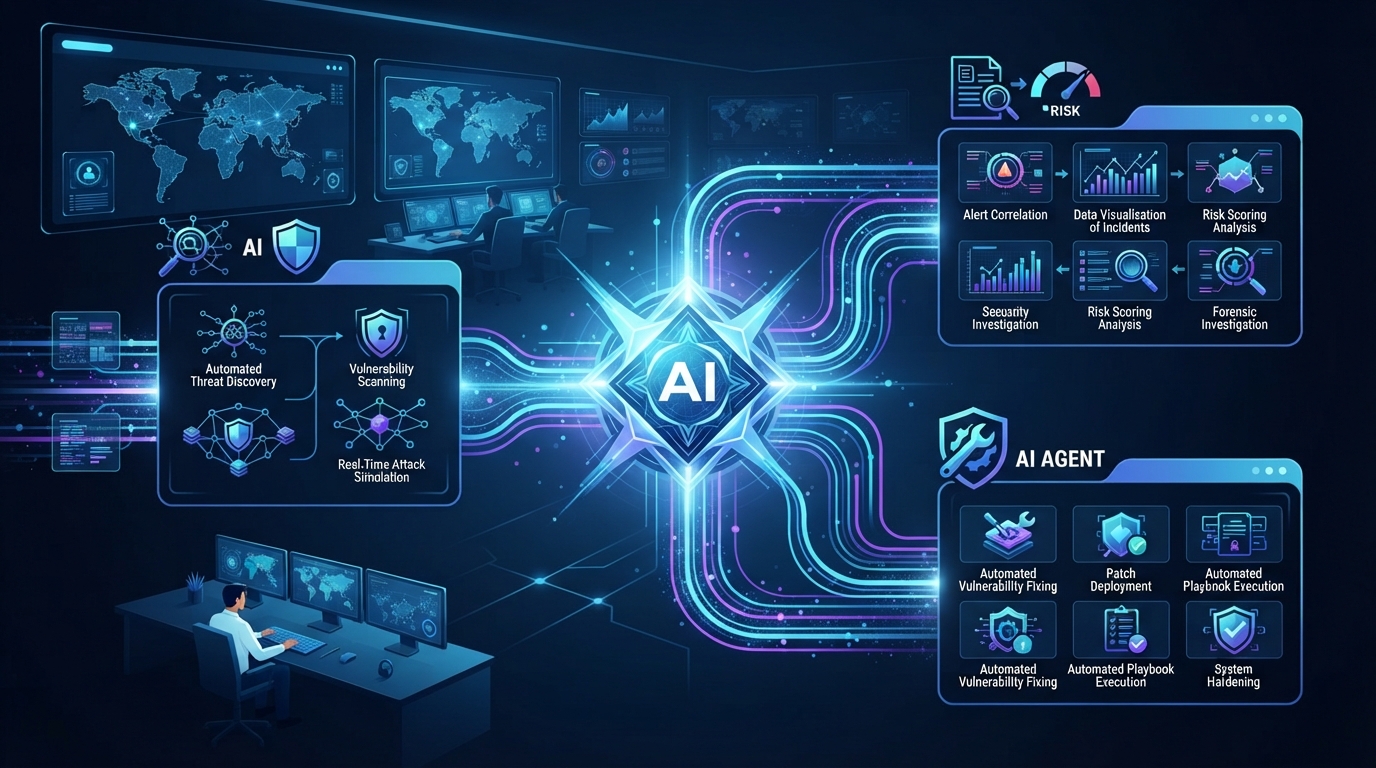
Microsoft Project Perception is an agentic cybersecurity platform that uses multiple AI agents to discover vulnerabilities, investigate threats, and support security fixes.
Unlike traditional security tools that mainly identify problems and send alerts to human teams, Project Perception is designed to actively assist throughout the cybersecurity workflow.
Modern enterprises face a difficult challenge. Large organizations often manage millions of lines of code across cloud services, applications, and internal systems. Security teams must constantly monitor these environments for weaknesses, but manual analysis cannot keep pace with the increasing complexity of technology.
Project Perception aims to reduce this burden by creating AI-powered security agents that can continuously analyze software environments.
The platform focuses on three major cybersecurity tasks:
- Finding vulnerabilities before attackers exploit them
- Understanding the severity of security risks
- Helping developers create solutions faster
Microsoft describes this approach as an example of agentic AI, where autonomous AI systems can complete multi-step tasks instead of only responding to individual questions.
How Project Perception’s Red, Blue, and Green Agents Work
One of the most important parts of Microsoft’s platform is its multi-agent architecture.
Instead of using a single AI model for every security task, Project Perception divides responsibilities between specialized agents.
This approach mirrors real cybersecurity teams, where different experts handle different parts of defense.
Red Agents: AI-Powered Attack Simulation
Red agents are designed to think like attackers.
Their primary role is identifying weaknesses that could potentially be exploited by cybercriminals.
They analyze:
- Software vulnerabilities
- Weak security configurations
- Possible attack paths
- Exploitable code patterns
The purpose is similar to ethical hacking and penetration testing.
By simulating attacker behavior, Red agents can help organizations discover security issues before they become real-world incidents.
This is increasingly important because cybercriminals are also adopting AI tools. Attackers can now automate vulnerability research, making speed a critical factor in cybersecurity.
Blue Agents: Security Analysis and Risk Prioritization
Finding vulnerabilities is only part of the challenge.
Large organizations may discover thousands of security issues, but not all vulnerabilities represent the same level of danger.
Blue agents focus on analyzing discovered issues and determining their importance.
They help answer questions such as:
- How dangerous is this vulnerability?
- Can attackers realistically exploit it?
- Which systems are affected?
- What should security teams fix first?
This prioritization process allows organizations to focus their resources on the highest-risk problems.
For example, a vulnerability affecting a public cloud application may require immediate attention, while a similar issue inside an isolated testing environment may be less urgent.
Green Agents: AI-Assisted Remediation
Green agents focus on fixing security problems.
Their role includes helping developers and security teams create solutions after vulnerabilities are discovered.
They can assist with:
- Generating patch recommendations
- Suggesting safer code changes
- Explaining security issues
- Supporting remediation workflows
However, Microsoft has emphasized that human oversight remains important.
The goal is not to remove cybersecurity professionals but to make them more efficient.
AI can accelerate analysis and recommendations, but final decisions about critical infrastructure still require human judgment.
What Is MAI-Cyber-1-Flash?
MAI-Cyber-1-Flash is Microsoft’s first in-house cybersecurity AI model designed specifically for vulnerability analysis and security operations.
The model is part of Microsoft’s broader MAI model family and represents the company’s move toward specialized AI systems.
Previously, many organizations used large general-purpose AI models for cybersecurity tasks. These models are powerful but can be expensive and may not always be optimized for security-specific problems.
Microsoft’s approach is different.
Instead of using the biggest possible model for every task, the company wants to use a smaller, specialized model for most cybersecurity operations while reserving larger models for complex situations.
This strategy can potentially reduce costs and improve efficiency.
How MAI-Cyber-1-Flash Works With GPT-5.4
Although Microsoft developed its own cybersecurity model, the company is not completely moving away from advanced frontier AI models.
Project Perception uses a model-routing approach.
MAI-Cyber-1-Flash handles the majority of cybersecurity tasks, while more difficult problems can be transferred to OpenAI’s GPT-5.4 model.
The idea is similar to having different specialists handle different jobs.
A smaller cybersecurity model can efficiently complete routine vulnerability analysis, while a larger reasoning model can handle complex security challenges.
Microsoft says this approach allows organizations to balance performance and cost.
The company reported that its new system can reduce costs by approximately 50% compared with previous high-end MDASH configurations.
The Role of MDASH in Microsoft’s AI Security Strategy
Project Perception is not Microsoft’s first step into AI-powered cybersecurity.
The platform builds on MDASH, Microsoft’s multi-model agentic scanning harness.
MDASH was designed to coordinate multiple AI models and agents to discover software vulnerabilities.
The system combines different AI capabilities rather than depending on one model.
This approach allows Microsoft to select the best model for different security tasks.
For example:
- One model may be better at finding vulnerabilities.
- Another may be better at explaining technical risks.
- Another may be better at generating fixes.
This multi-model approach reflects a broader trend in enterprise AI.
Companies are moving away from the idea that one giant AI model will solve every problem.
Instead, specialized systems working together may become the dominant architecture.
Microsoft’s 96% CyberGym Benchmark Claim Explained
One of the biggest headlines from Microsoft’s announcement was the performance claim.
Microsoft reported that MAI-Cyber-1-Flash combined with its security system achieved a 95.95% CyberGym score, which is commonly rounded to 96%.
CyberGym is a cybersecurity benchmark designed to evaluate how effectively AI systems can analyze and exploit software vulnerabilities.
According to Microsoft, the result places its system ahead of several competing cybersecurity AI models.
However, there is an important limitation.
The benchmark result comes from Microsoft’s own evaluation process.
That does not mean the result is inaccurate, but independent researchers have not fully validated the performance claim.
Another discussion point is that Microsoft’s comparison included its complete agent-based system, while some competitors were evaluated based on individual models.
This difference matters because cybersecurity performance depends not only on the AI model itself but also on the surrounding tools, workflows, and testing environment.
A fair evaluation requires comparing similar systems under the same conditions.
Microsoft Project Perception vs Competitors
The AI cybersecurity market is becoming increasingly competitive.
Companies including Anthropic, Google, and OpenAI are also developing AI-powered security solutions.
| Company | Security Initiative | Main Focus |
|---|---|---|
| Microsoft | Project Perception + MAI-Cyber-1-Flash | Multi-agent cybersecurity automation |
| Anthropic | Project Glasswing and cybersecurity models | AI security research and enterprise protection |
| Gemini-based cybersecurity solutions | AI-powered threat detection | |
| OpenAI | Cybersecurity AI initiatives | Advanced AI reasoning for security tasks |
Microsoft’s main argument is that specialized cybersecurity AI can provide better efficiency than using general-purpose models for every task.
The company is also positioning cost efficiency as a major advantage.
When Will Project Perception Be Available?
Microsoft announced that Project Perception will enter public preview on August 3, 2026 inside Microsoft Defender.
MAI-Cyber-1-Flash will become available through Azure AI Foundry.
The platform is expected to follow Microsoft’s enterprise approach, meaning access will likely focus on existing customers and organizations with appropriate security requirements.
The company has also indicated that Project Perception will expand across its wider security ecosystem over time.
Why Microsoft Is Investing Heavily in AI Cybersecurity
The timing of Microsoft’s announcement reflects a larger industry shift.
Cyberattacks are becoming faster and more automated.
Attackers are using AI for:
- Generating convincing phishing campaigns
- Discovering software weaknesses
- Automating attack techniques
- Creating malware variations
Traditional cybersecurity methods are struggling to keep up.
Microsoft’s strategy is based on the idea that defenders need similar AI capabilities.
The company argues that organizations cannot rely only on human analysts when attackers can operate at machine speed.
Benefits and Limitations of AI Cybersecurity Platforms
Benefits
AI cybersecurity platforms can help organizations:
- Detect vulnerabilities faster
- Reduce manual security workload
- Prioritize important threats
- Improve developer productivity
- Monitor complex software environments continuously
For large enterprises, these advantages could significantly improve security operations.
Limitations
However, AI security systems also face challenges.
Important concerns include:
- Accuracy of vulnerability detection
- False positives
- Lack of independent testing
- Human oversight requirements
- Data privacy concerns
Security decisions can have serious consequences, so organizations must carefully evaluate AI recommendations.
What Microsoft’s Announcement Means for the Future of Cybersecurity
Microsoft Project Perception shows how cybersecurity is moving from automated detection toward AI-assisted security operations.
The future may not involve replacing security teams with AI.
Instead, successful organizations will likely combine human expertise with AI systems capable of handling repetitive and complex analysis.
Microsoft’s biggest bet is that specialized cybersecurity models, combined with intelligent agents, can deliver better results than traditional approaches.
The company’s 96% CyberGym claim highlights the potential of the technology, but independent validation will determine how significant the breakthrough truly is.
For enterprises, the message is clear: AI is becoming a central part of cybersecurity strategy, and organizations that ignore this shift may struggle to defend against increasingly intelligent threats.
Frequently Asked Questions
What is Microsoft Project Perception?
Microsoft Project Perception is an AI-powered cybersecurity platform that uses specialized agents to identify vulnerabilities, analyze risks, and support security fixes.
What is MAI-Cyber-1-Flash?
MAI-Cyber-1-Flash is Microsoft’s cybersecurity-focused AI model designed for vulnerability detection and security analysis.
What are Red, Blue, and Green agents?
Red agents find vulnerabilities, Blue agents analyze security risks, and Green agents help create fixes and remediation strategies.
Is Microsoft’s 96% CyberGym score independently verified?
No. The score was reported by Microsoft based on its own evaluation. Independent testing is still needed.
How does Project Perception use GPT-5.4?
Microsoft uses GPT-5.4 for more complex cybersecurity tasks while MAI-Cyber-1-Flash handles most routine operations.
When will Project Perception launch?
Microsoft announced a public preview beginning August 3, 2026, through Microsoft Defender.
Conclusion
Microsoft Project Perception represents a major step toward AI-driven cybersecurity automation.
By combining MAI-Cyber-1-Flash with specialized Red, Blue, and Green agents, Microsoft is attempting to create a security platform capable of finding and fixing vulnerabilities faster than traditional methods.
The technology shows strong potential, especially as cyber threats become more automated. However, questions around independent testing, transparency, and real-world performance remain important.
As businesses continue adopting AI, cybersecurity will likely become one of the most important areas where specialized AI systems compete.
For organizations evaluating future security strategies, Microsoft’s latest announcement is a clear signal: the next generation of cybersecurity will not only defend against AI-powered attacks — it will depend on AI to do so.