

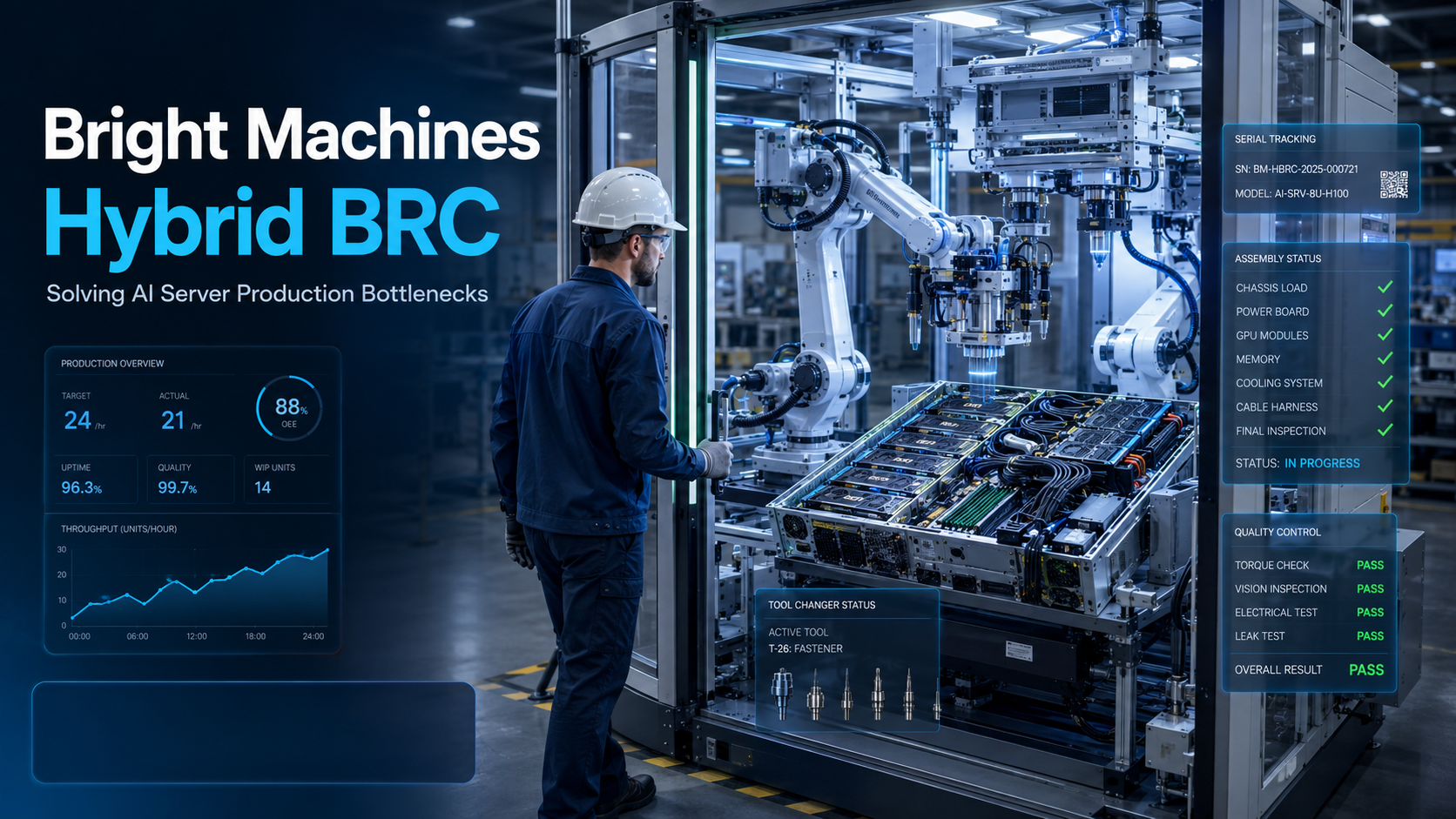
Artificial intelligence is advancing at extraordinary speed, but the factories responsible for building the physical systems behind that progress are under growing pressure. New AI models may be created in software, yet training and operating them still depends on highly complex servers packed with GPUs, CPUs, high-bandwidth memory, networking equipment, cooling hardware, storage, power systems, and thousands of carefully installed connections.
Bright Machines is targeting this less visible part of the AI race with the launch of its Hybrid BRC, an enhancement to the company’s Bright Factory platform. Announced on July 29, 2026, the new cell allows trained operators to enter a sensor-monitored robotic work area and complete prescribed assembly steps without breaking the product’s digital production record.
BRC stands for Bright Robotic Cell, rather than Hybrid Robot Cell. The company’s Hybrid BRC launch announcement describes the system as a way to combine automation, human flexibility, and serial-number-level traceability in one controlled workflow.
The launch addresses a practical manufacturing problem: real-world server assembly still requires human judgment, dexterity, and exception handling. Moving a unit to a separate manual station may keep production moving, but it can create a gap in the data trail showing how the product was built.
Why AI Infrastructure Manufacturing Is Becoming More Difficult
The growth of generative AI has created enormous demand for specialized computing systems used for model training, inference, scientific computing, and high-performance computing. These systems are more complicated than conventional enterprise servers and may include:
- Multiple high-performance GPUs or accelerators
- Advanced CPUs and high-bandwidth memory
- High-speed networking and interconnect hardware
- Liquid-cooling plates, pumps, manifolds, and tubing
- High-capacity storage and memory modules
- Intelligent power distribution and monitoring
- Dense cable routing and precision mechanical assemblies
NVIDIA’s GB200 NVL72 illustrates the scale of the challenge. The official NVIDIA system design connects 36 Grace CPUs and 72 Blackwell GPUs in a liquid-cooled, rack-scale architecture. That density improves computing performance, but it also increases the importance of precise assembly, cooling connections, power delivery, component validation, and cable management.
AiToza has already examined how NVIDIA Blackwell server cooling challenges demonstrate that AI infrastructure is no longer only a chip-design problem. Thermal management, rack integration, manufacturing quality, and data center engineering now have a direct effect on deployment timelines and system reliability.
In a high-value AI server, an incorrect component, missed fastening step, improperly seated module, or cooling mistake can lead to rework, downtime, or a difficult field investigation. Manufacturers therefore need speed, flexibility, and a reliable record of important production steps.
What Is the Bright Machines Hybrid BRC?
The Hybrid BRC is a modified Bright Robotic Cell designed to support controlled human intervention inside an automated production environment.
It is part of the broader Bright Factory platform, which connects manufacturing design, automation, software, and production data.
A conventional robotic cell is optimized for repeatable operations such as component insertion, fastening, positioning, and inspection. Some server configurations, however, include tasks that are difficult to automate economically or reliably.
The Hybrid BRC adds guarded access doors and safety panels to the cell. When an operator needs to enter, the robotic arm is deactivated. The worker then follows on-screen assembly instructions while the monitored environment continues checking the process.
According to Bright Machines, the system can identify incorrect installations, missed steps, and wrong components while preserving a complete production record for the individual serial number.
This means the unit does not have to be removed from the connected manufacturing flow simply because a person must complete one task. The human action becomes part of the same digital thread as the automated steps performed before and after it.
The Bottleneck Hybrid BRC Is Designed to Solve
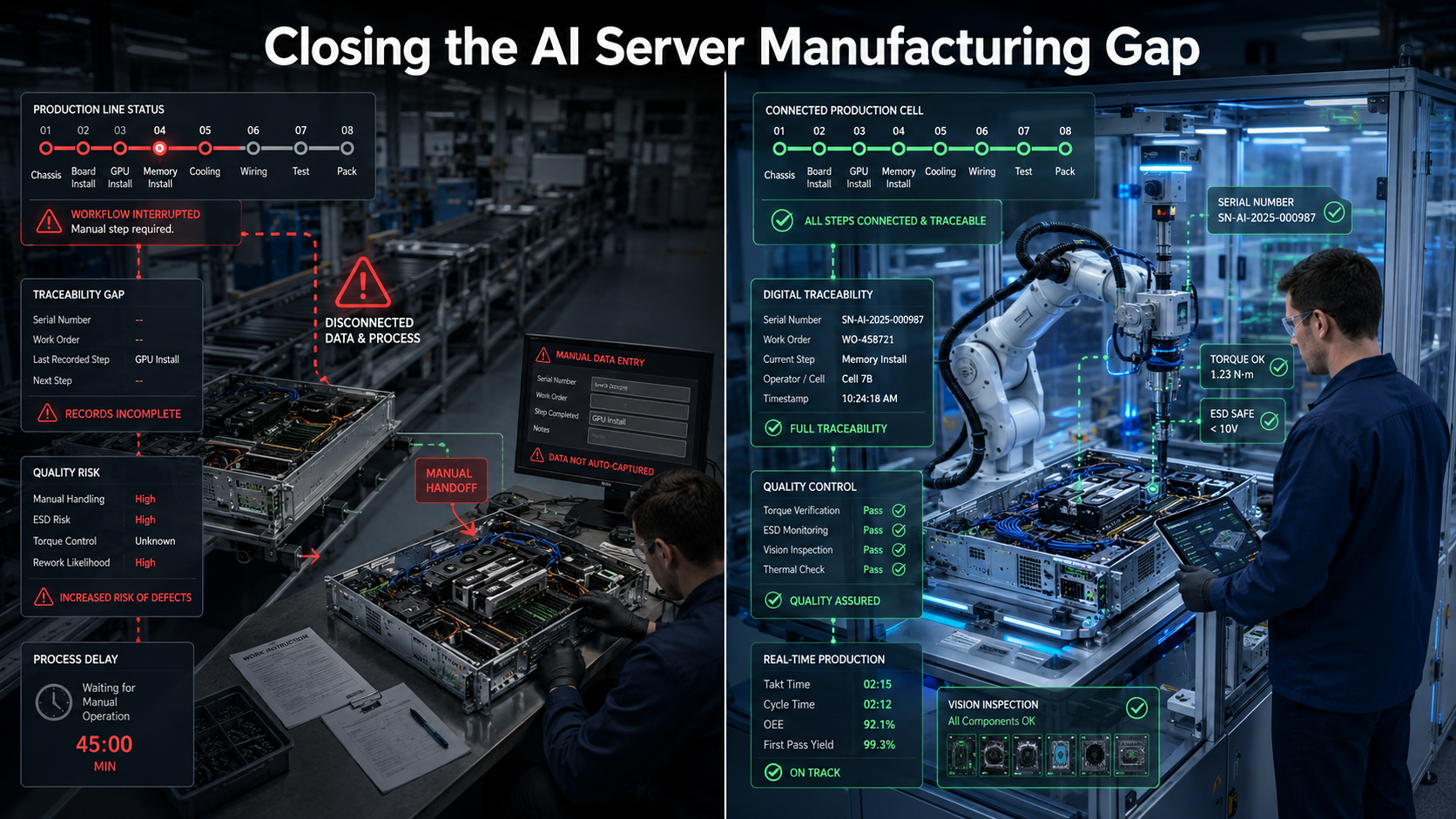
The central problem is not that manufacturers have no robots or no skilled workers. The problem is what happens when an automated process encounters a task that requires manual assistance.
Manufacturers have traditionally faced two imperfect options: stop the line until the exception is resolved, or move the product to a separate manual station that may not be connected to the same sensors and production database.
The second option creates difficult questions later. Was the correct component installed? Were all required steps completed? If a failure occurs in a customer’s data center, can it be traced to a specific assembly action?
The Hybrid BRC attempts to close this gap. It keeps manual work inside the monitored production environment, allowing manufacturers to preserve continuity without losing visibility.
Bright Machines says the production record remains available inside the Bright Factory platform for later quality analysis or field-failure investigation.
How the Hybrid Manufacturing Workflow Works
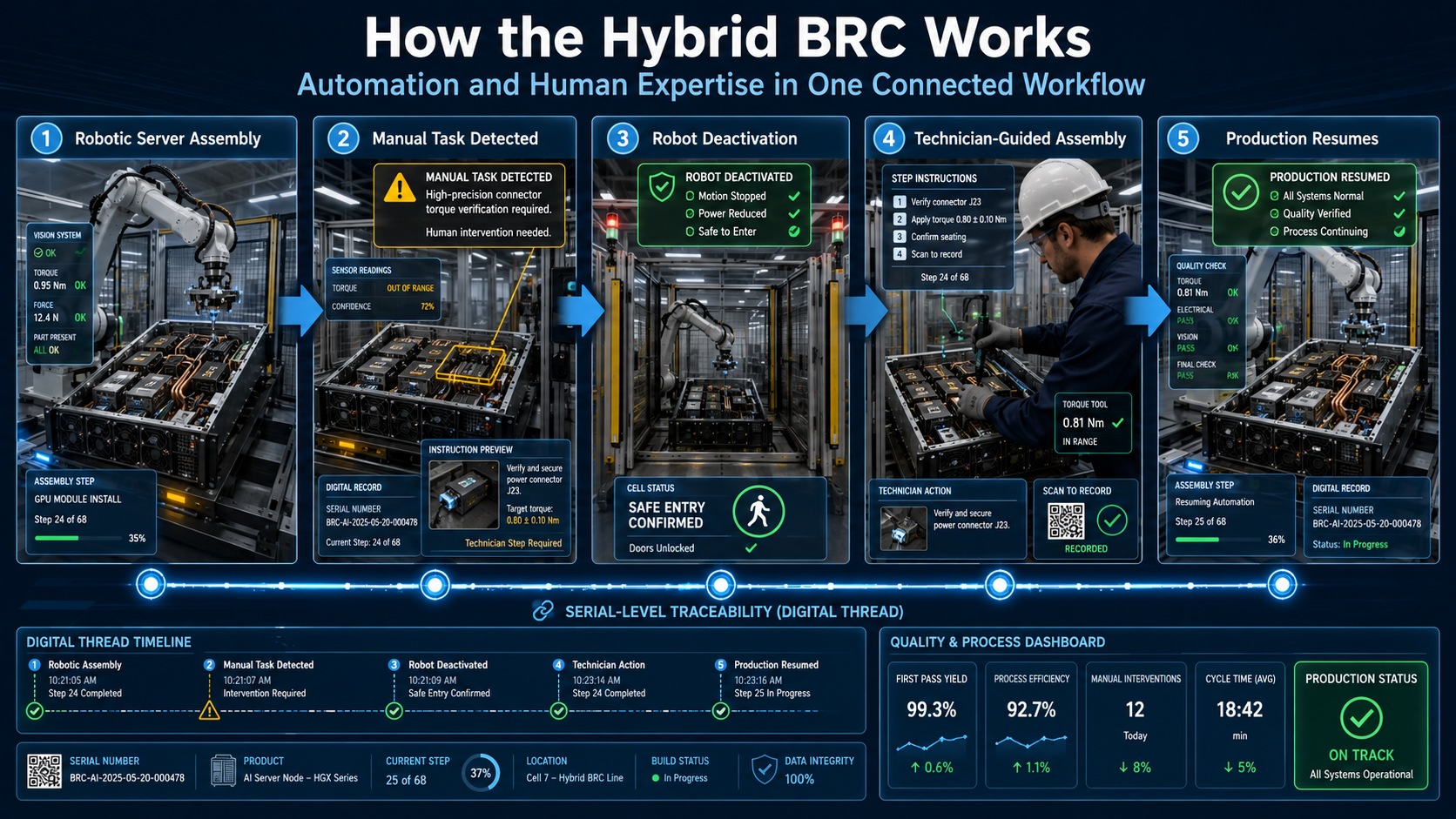
A Hybrid BRC workflow can be understood in five stages.
1. Automated Operations Begin the Process
The robotic cell performs the tasks already suited to automation. Depending on the production setup, these may include component handling, DIMM insertion, CPU and heat-sink placement, fastening, or inspection.
Bright Machines lists automated DIMM insertion, CPU installation, screwdriving, machine-vision guidance, and server-level data logging among its broader AI server manufacturing capabilities.
2. The System Identifies a Manual Step
A particular configuration, exception, or difficult operation may require a technician. Rather than sending the unit to an unconnected workstation, the Hybrid BRC pauses the robotic activity and prepares the cell for safe entry.
3. The Operator Enters the Guarded Cell
Opening the access doors deactivates the robotic arm. The operator can then work inside the cell without competing with active robotic movement.
This physical separation is important because human-robot collaboration does not necessarily mean a robot and a person must move simultaneously in the same space.
4. Digital Instructions Guide the Work
On-screen instructions tell the operator which prescribed steps to perform. The monitored environment continues checking for errors such as a missed operation, an incorrect part, or an improper installation.
This brings a level of process discipline to manual work that is difficult to maintain at a disconnected station.
5. Production Resumes With the Record Intact
After the operator completes the task and exits, automated production can continue. The data from the manual and robotic stages remains connected to the same unit, helping preserve end-to-end traceability.
Why a Hybrid Approach Can Be Better Than Full Automation
Full automation works best when products are stable and tasks can be defined precisely. AI server manufacturing does not always fit that pattern because customers may request different GPUs, networking options, memory capacities, cooling systems, and rack configurations.
Humans are better at handling variation and delicate operations. Robots are better at repeating precise actions and collecting consistent data. A hybrid cell applies each where it is most useful.
Bright Machines has reported that its broader Microfactory assembly lines can deliver a 98% first-pass yield, new-product introduction in under four hours, and full traceability.
Those figures describe the company’s wider automation deployments, not a guarantee for every Hybrid BRC installation, but they show the operational targets behind the platform.
Key Benefits for AI Server Manufacturers
1. Production Continuity
A unit can remain inside the connected workflow when manual assistance is required, reducing disruption during exceptions.
2. Stronger Quality Control
Digital instructions and monitored checks help confirm that the correct steps and components are used before final testing or deployment.
3. Serial-Level Traceability
A complete production record can support failure investigation, procedure verification, and pattern analysis across multiple units.
4. Greater Product Flexibility
Manufacturers can automate stable tasks while retaining human support for changing configurations.
5. Easier Scaling
The modular design of Bright Robotic Cells allows capacity to be expanded through additional cells rather than a complete redesign of a traditional fixed line.
Bright Machines says it has experience deploying more than 130 microfactories across more than 10 countries and over 60 customers.
6. Better Use of Skilled Labor
The system is not presented simply as a worker-replacement tool. It shifts repetitive or precision-heavy tasks toward automation while keeping technicians involved in exception handling, specialized assembly, validation, and process improvement.
Why This Matters Beyond One Factory
AI infrastructure pressure affects the wider electronics supply chain. Demand for GPUs is connected to demand for advanced memory, networking equipment, cooling systems, power hardware, server racks, and manufacturing capacity.
AiToza’s report on the AI-driven memory crunch shows how data center demand can influence component allocation far beyond the server market. As suppliers prioritize high-bandwidth memory and enterprise hardware, consumer electronics manufacturers can face higher costs and tighter availability.
Available accelerators do not become usable computing capacity until they are integrated into tested systems. The Hybrid BRC targets this conversion point between silicon supply and operational AI capacity, with the aim of reducing data gaps and production disruption.
Bright Machines’ Wider Manufacturing Strategy
The Hybrid BRC fits into Bright Machines’ broader vision of software-defined manufacturing.
Instead of treating factory automation as a collection of isolated machines, the Bright Factory platform connects equipment, software, production data, instructions, inspections, and quality records.
This connected approach allows manufacturers to see how individual systems move through production. It also creates data that can be analyzed to identify recurring defects, improve assembly instructions, optimize cycle times, and compare performance across different production facilities.
The strategy is particularly relevant to AI hardware because product configurations can change quickly. A manufacturing system that depends on fixed tooling and static procedures may become expensive to update whenever a new processor, memory module, cooling design, or rack architecture is introduced.
Software-driven cells are intended to make those changes easier to manage. A manufacturer can update instructions, inspection rules, automation sequences, and product data without rebuilding an entire factory line.
Bright Machines describes its wider platform as an intelligent manufacturing system that connects design, automation, and production data. The Hybrid BRC extends that model by bringing prescribed human activity into the same digital environment.
What Bright Machines Still Needs to Prove
The announcement is significant, but the Hybrid BRC’s long-term impact will depend on real customer deployments.
Manufacturers will want evidence on throughput, defect reduction, integration time, training, safety, maintenance, and total cost of ownership. They will also assess how easily the system connects with existing manufacturing software, testing equipment, and compliance processes.
Its value will rise if the design can support servers, racks, networking systems, power shelves, cooling equipment, and edge hardware without excessive re-engineering.
The concept’s strength is its recognition that modern infrastructure production needs both adaptability and data integrity.
Manufacturers will also need to compare the Hybrid BRC with collaborative robots, conventional guarded robotic cells, manual workstations, and fully automated production lines. The best choice will depend on product volume, configuration variety, labor availability, facility layout, and quality requirements.
The Hybrid BRC is therefore not automatically the correct solution for every factory. Its strongest use case appears to be complex, high-value production in which some manual work remains necessary but losing traceability is unacceptable.
Frequently Asked Questions
What does BRC stand for?
BRC stands for Bright Robotic Cell. The Hybrid BRC is an enhanced version that permits controlled manual work inside the monitored robotic environment.
Does the Hybrid BRC replace human workers?
Bright Machines presents it as a human-in-the-loop system. Robots handle repeatable automated tasks, while operators complete prescribed steps that require flexibility, dexterity, or manual judgment.
Why is traceability important in AI server manufacturing?
AI servers contain expensive, tightly integrated components. A serial-level production record helps verify how each system was assembled and supports root-cause analysis when quality or field issues occur.
What types of errors can the Hybrid BRC detect?
Bright Machines says the monitored environment can check for incorrect installations, wrong components, and missed assembly steps while a human operator works inside the cell.
Is the Hybrid BRC available now?
Bright Machines said the Hybrid BRC was available as part of the Bright Factory platform when it announced the product on July 29, 2026.
Conclusion
Bright Machines’ Hybrid BRC addresses an overlooked but increasingly important AI infrastructure bottleneck: how to preserve speed, flexibility, and production data when automated server assembly still requires human intervention.
By allowing operators to perform guided work inside a sensor-monitored robotic cell, the system aims to keep the production record intact from the first automated operation to the finished unit. That can improve traceability, reduce disruption, and make it easier to investigate quality problems across complex AI server configurations.
The Hybrid BRC will not solve chip shortages, power limitations, cooling constraints, or data center construction delays on its own. Its potential value lies in making the manufacturing layer more adaptable and accountable.
As AI hardware becomes denser, more expensive, and more specialized, the factories assembling it will need to evolve just as quickly as the models running on it.