

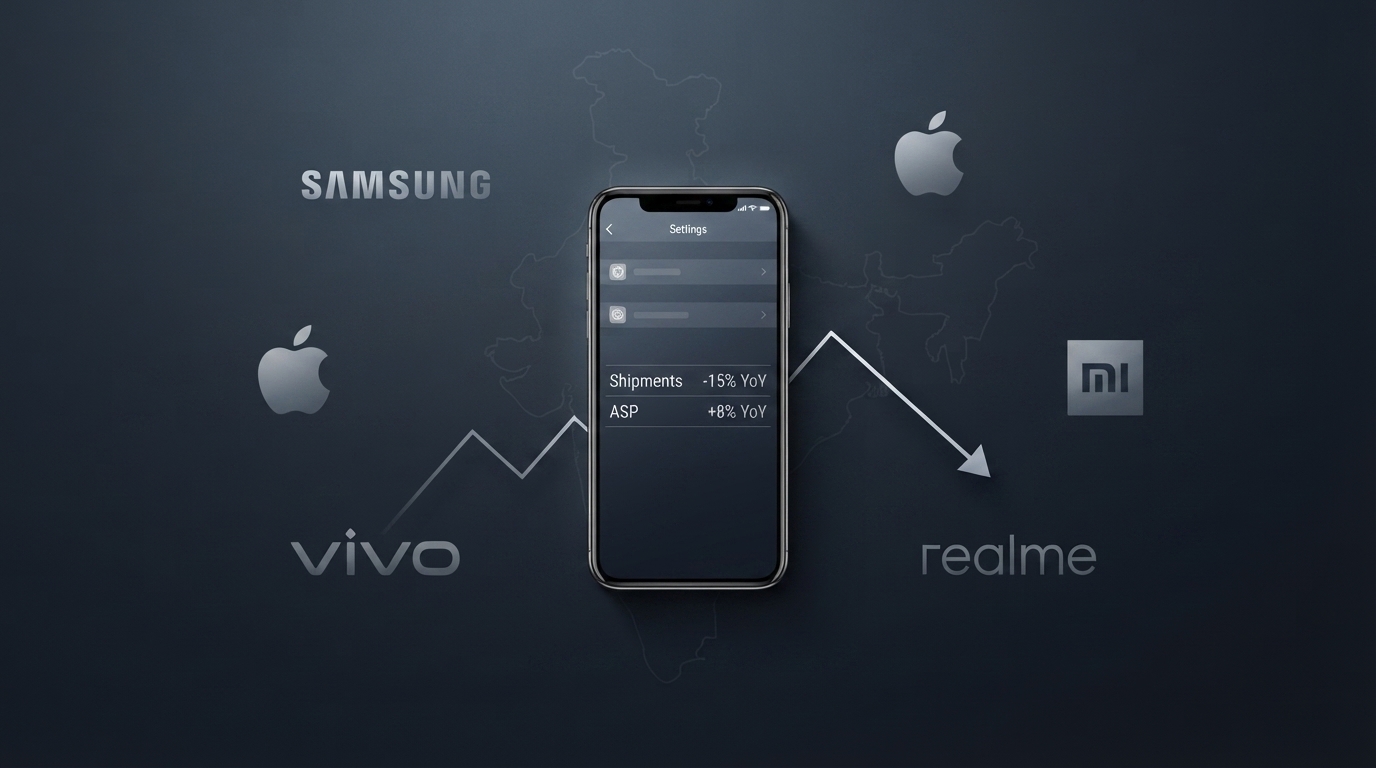
India’s smartphone market suffered a sharp setback during the second quarter of 2026 as rising memory-chip costs forced manufacturers to increase prices and consumers postponed buying new devices.
Smartphone shipments in India fell 10% year over year between April and June 2026, according to Counterpoint Research’s Monthly India Smartphone Tracker. It was the country’s largest shipment decline for a June quarter in six years. The damage was most visible in the affordable segment, where smartphones priced below ₹15,000 recorded a dramatic 45% decline in shipments.
The decline is not simply another period of weak smartphone demand. It is closely connected to the rapid expansion of artificial intelligence infrastructure.
AI data centers require enormous quantities of advanced memory to operate powerful GPUs and AI accelerators. Memory manufacturers are therefore directing more production capacity toward high-bandwidth memory and other profitable server products. That shift is tightening the supply of conventional memory used in smartphones and pushing component prices higher.
India is particularly vulnerable to this disruption because millions of buyers depend on affordable and mid-range phones. A moderate component-price increase can be absorbed more easily in a premium phone, but it can completely change the economics of a device designed to sell below ₹15,000 or ₹20,000.
The result is a smartphone market increasingly divided between struggling budget devices and a comparatively resilient premium segment.
India’s Smartphone Shipments Fell as Prices Rose
Counterpoint published its India market findings on July 16, 2026, covering smartphone shipments during the April-to-June quarter.
The research company found that repeated price increases across almost every major segment had weakened demand. By the end of the second quarter, the average smartphone price in India had increased by approximately 15%, according to Counterpoint Senior Analyst Prachir Singh.
Higher component costs were not the only factor. Inflation, uncertain economic conditions and weak discretionary spending also made consumers less willing to replace functioning phones. Promotional campaigns and financing options were not enough to prevent the market from contracting.
The difference between shipments and final retail sales is important. Shipment data measures the number of devices manufacturers send into sales channels rather than the exact number purchased by consumers. However, declining shipments still provide a strong indication that brands and retailers expect weaker demand and are becoming more cautious about inventory.
Manufacturers are reluctant to send large quantities of increasingly expensive phones into stores when buyers are keeping their existing devices longer. This creates pressure across the supply chain, from component suppliers and assemblers to distributors and physical retailers.
Counterpoint Research Director Tarun Pathak said smartphone memory prices had increased nearly four times since September 2025. The firm expects prices to rise further and potentially reach five times their September level in the coming months. The fourfold increase reflects Counterpoint’s assessment of what has already happened, while the fivefold figure remains a forecast rather than a confirmed outcome.
Counterpoint now expects India’s smartphone shipments to fall 13% for the full year of 2026. That forecast could still change depending on memory availability, exchange rates, consumer spending, festive-season promotions and the prices manufacturers negotiate with suppliers.
How the AI Boom Created a Smartphone Memory Shortage


The connection between AI data centers and smartphone prices begins with the different types of memory used across the technology industry.
Smartphones generally use DRAM to run applications and perform active tasks. NAND flash is used to store photographs, videos, applications and operating-system files. These are the components commonly described to consumers as a phone’s RAM and storage.
AI servers require much more advanced memory configurations. High-bandwidth memory, usually called HBM, is installed close to GPUs and AI accelerators so that large quantities of data can move quickly between computing and memory components.
AI training already requires substantial memory, but large-scale AI inference is also increasing demand. Inference refers to the process through which a trained AI model responds to users, analyzes information or generates content. As companies move AI products from experiments into daily operations, their need for data-center memory continues to grow.
IDC says AI infrastructure demand is expanding faster than memory supply can adjust. Major manufacturers are prioritizing HBM, advanced DRAM and enterprise-grade NAND instead of rushing to expand the supply of lower-margin consumer components.
Producing additional memory is not as easy as increasing the speed of an existing assembly line. Semiconductor factories are extremely complex, expensive and slow to build. New fabrication capacity can take years to plan, construct, equip and qualify.
HBM production can also consume more manufacturing resources than conventional memory. As suppliers commit more advanced production capacity to AI products, manufacturers of smartphones and personal computers must compete for what remains.
IDC describes the current disruption as potentially more structural than a typical semiconductor cycle. In an ordinary cycle, strong demand causes prices to rise, suppliers increase production and prices eventually fall. AI infrastructure is changing that pattern because data-center demand continues to accumulate rather than disappearing after a single buying season.
Memory companies also have little incentive to flood the market with cheaper components. They can sign longer contracts and receive stronger margins from AI infrastructure customers. This means the current pressure is not necessarily caused by a complete absence of manufacturing capacity. It also reflects deliberate decisions about which customers and products receive priority.
That is why the issue is better described as an AI-driven memory allocation problem than a simple shortage affecting every chip equally.
Why Budget Smartphones Are Taking the Biggest Hit
The effect of rising memory prices is not evenly distributed.
A premium smartphone selling above ₹45,000 has more room to absorb an increase in component costs. The manufacturer can accept a slightly lower profit margin, increase the retail price or use financing offers to spread the cost over several months.
Affordable smartphones operate under much tighter limits. Manufacturers compete aggressively on small differences in RAM, storage, camera hardware, displays and battery capacity. Their margins are already narrow, and many customers choose devices based on differences of only a few hundred or a few thousand rupees.
When memory prices rise sharply, a brand has several unattractive choices. It can increase the retail price, reduce its profit, lower the phone’s RAM or storage, remove another feature, continue selling an older model or leave that price segment entirely.
This pressure explains why shipments below ₹15,000 fell 45% year over year, even though the overall Indian market declined by 10%.
Memory is also becoming a much larger part of the manufacturing cost of an affordable handset. Counterpoint data reported by Financial Express indicated that memory’s share of the bill of materials for devices in this segment had increased from less than 20% to more than 45%. The bill of materials represents the combined cost of the parts required to produce a device.
That change makes it much harder for brands to preserve the specifications buyers expect at familiar prices.
IDC has warned that some manufacturers may respond by reducing memory configurations. A device that might previously have included 12GB of RAM and 256GB of storage could instead offer 8GB and 128GB at a similar price. This is an expected industry response rather than confirmation that every Indian smartphone manufacturer will make those exact changes.
Brands are also expanding their 4G portfolios in the mass-market segment. Although 5G remains the industry’s long-term direction, removing some of the cost associated with 5G hardware can help manufacturers continue serving highly price-sensitive customers. Counterpoint expects 4G phones to remain relevant until component prices stabilize.
This does not mean India is abandoning 5G. It shows that affordability can temporarily become more important than offering the newest connectivity standard in every device.
Samsung Gains Ground as Chinese Brands Face Greater Pressure
The market decline has affected smartphone companies differently because each brand has a different product mix, supply position and level of exposure to affordable devices.
Vivo remained India’s leading smartphone brand by shipment volume during the second quarter, but its market share fell from 19.2% in Q2 2025 to 17.8% in Q2 2026.
Samsung moved close behind it. The South Korean company’s share increased from 15.5% to 17.6%, while its shipments grew 2% year over year. Samsung was the only company among India’s five leading brands to report shipment growth during the quarter.
Samsung’s broader portfolio gave it some protection. It participates in affordable, mid-range and premium categories, while its Galaxy A and Galaxy S devices allow it to reach buyers with very different budgets. Counterpoint’s global research also found that Samsung benefited from better product availability, fewer price increases in some markets and aggressive promotions.
Chinese smartphone companies remained central to the Indian market, but their combined position weakened. Counterpoint said their overall market share fell to its lowest level for a second calendar quarter since 2020.

The main reason was not simply the nationality of the companies. Chinese brands such as Vivo, Xiaomi, Realme and others have traditionally depended heavily on entry-level and mid-range phones. Those were precisely the categories most damaged by memory inflation and weak consumer spending.
Oppo’s market share increased slightly from 13.2% to 13.6%. Xiaomi’s share rose from 8% to 9.4%, while Realme’s share moved from 9.6% to 10%. However, changes in market share do not always indicate shipment growth. A company can gain share while its actual shipments fall if the total market contracts more quickly. Counterpoint said repeated price increases weakened demand for Xiaomi and Realme devices, particularly below ₹20,000.
Apple also recorded a 3% shipment decline in India during the quarter and held approximately 7% of the market. However, its situation differed from that of affordable Android brands. Counterpoint attributed part of Apple’s decline to supply constraints and inventory shortages across online and physical retail channels. Demand for the iPhone 17 series remained strong.
The premium market generally proved more resilient than the budget category. Devices priced above ₹45,000 continued to receive support from trade-in offers, installment plans and financing arrangements that reduced the amount buyers had to pay immediately.
Nothing was the standout smaller brand. Its shipments increased 105% year over year, making it India’s fastest-growing smartphone company during the quarter. Counterpoint linked that performance to demand for the Phone (4a) and Phone (4a) Pro, along with stronger brand visibility from its Royal Challengers Bengaluru sponsorship during the Indian Premier League.
The percentage is notable, but it needs context. Nothing started from a much smaller base than Samsung, Vivo or Apple. Doubling shipments does not mean it sold more phones than the market leaders. It does show that distinctive branding and well-positioned products can still produce growth during a broad industry contraction.
What the Decline Means for Smartphone Buyers
For Indian consumers, the immediate consequence is that the familiar relationship between price and specifications is becoming less reliable.
A new phone may cost more than its predecessor without offering a similarly large improvement. Another model may launch at the same price but include less RAM, less storage or fewer premium components.
Discounts may also become less generous if manufacturers and retailers have limited inventory. Conversely, brands holding older stock could offer temporary promotions to clear devices before introducing more expensive replacements.
Consumers are already responding by extending replacement cycles. A phone that might previously have been replaced after two or three years may now be kept until its battery, screen or software support becomes a serious problem.
This behavior reduces new-device shipments further. It can also increase demand for repairs, battery replacement and used or professionally refurbished phones.
Financing is becoming another major part of the market. Premium smartphones above ₹45,000 remained comparatively stable partly because installment plans allow buyers to spread payments over time. Financing does not make the device cheaper, but it lowers the upfront barrier and can make an expensive phone feel more accessible.
Consumers should not assume that every smartphone price will immediately increase or that buying any available phone is automatically the right decision. Pricing depends on a manufacturer’s existing inventory, supplier contracts, launch schedule and willingness to absorb costs.
A person who urgently needs a replacement may benefit from comparing current discounts, exchange offers and last-generation models. Someone with a functioning phone may find that waiting provides more information about festive promotions and future memory prices. The market outlook remains uncertain enough that a universal “buy now” or “wait” recommendation would be misleading.
The Problem Extends Beyond India
India’s decline is part of a broader smartphone-industry downturn.
Counterpoint estimated that global smartphone shipments fell 11% year over year in Q2 2026, reaching their lowest second-quarter level since 2013. The global study also identified the DRAM and NAND shortage as the leading source of pressure on the industry.
India stands out because the consequences are particularly severe in its large affordable-phone market. When component costs increase globally, markets dominated by higher-priced devices have more room to absorb the change. Indian manufacturers and buyers have much less flexibility at the entry level.
The downturn also demonstrates how the AI boom can create costs outside the companies building chatbots, AI models and data centers.
Investment in AI infrastructure is generating enormous demand for GPUs, networking equipment, electricity, cooling systems and memory. Suppliers naturally prioritize customers prepared to sign large contracts and pay premium prices. Consumer-device manufacturers then face higher costs or reduced access to the same production ecosystem.
In that sense, the smartphone decline is one example of a wider redistribution of technology resources. AI is not only changing software. It is reshaping which hardware gets manufactured, who receives it first and how much ordinary electronic devices cost.
What Happens Next?
Counterpoint expects India’s smartphone market to remain under pressure throughout the rest of 2026 and currently forecasts a 13% full-year shipment decline. That figure is not guaranteed.
The festive shopping period will be an important test. Aggressive financing, exchange programs and discounts could revive demand, but manufacturers may have limited freedom to cut prices if component costs continue rising.
Brands are likely to optimize their portfolios by reducing the number of similar models, extending the lives of existing devices and concentrating marketing on phones that offer stronger margins. Some may emphasize premium products, while others expand affordable 4G devices to protect their volume businesses.
The memory market itself may remain tight through 2027. IDC says AI infrastructure demand continues to grow faster than supply can rebalance, while manufacturers are prioritizing advanced memory and controlling capacity carefully. New factories will eventually increase supply, but long construction and qualification periods mean relief is unlikely to arrive immediately.
India’s smartphone decline should therefore be viewed as more than one disappointing quarter.
It shows how quickly AI infrastructure spending can influence consumer-electronics prices. It also reveals the vulnerability of a smartphone market built around intense competition and affordable hardware.
The confirmed figures are already significant: shipments fell 10%, average prices increased around 15%, and the sub-₹15,000 category contracted by 45%. The forecast that the full-year market will decline 13% remains uncertain, but the pressure behind it is real.
Unless memory costs stabilize or manufacturers find effective ways to redesign their devices, India’s smartphone buyers may face a difficult choice for the rest of 2026: pay more for a new phone, accept fewer specifications or keep their current device for longer.