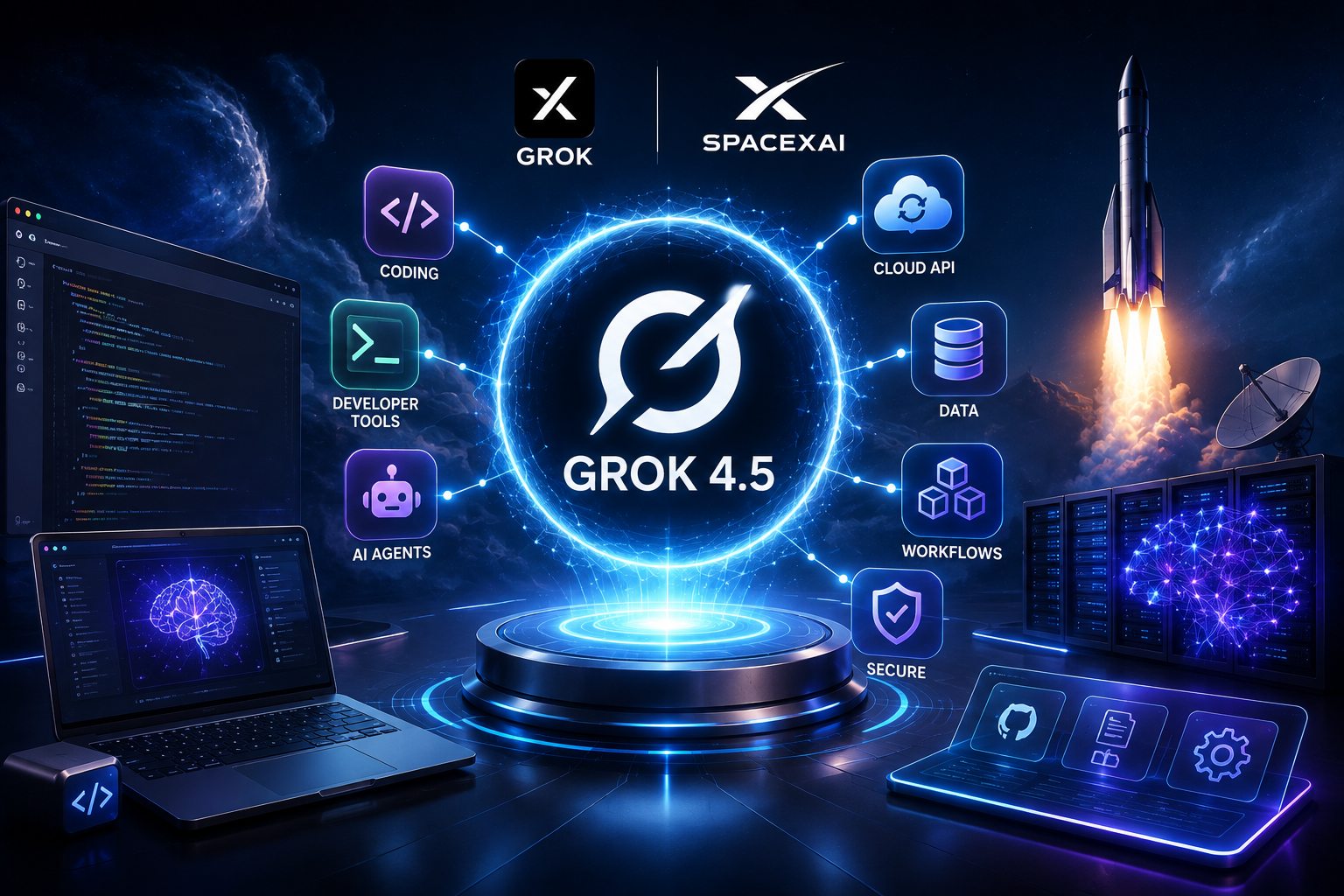
SpaceXAI officially launched Grok 4.5 on July 8, 2026, marking the company’s first major model release since going public and completing its landmark $60 billion Cursor acquisition. Positioned as a coding and agentic-work tool rather than a consumer chatbot, Grok 4.5 represents Elon Musk’s most serious bid yet to challenge Anthropic and OpenAI in the enterprise AI market.
The model is available immediately through three channels: the Grok Build platform, the Cursor IDE (on all plans), and the SpaceXAI console via API. Notably, Grok 4.5 is not yet available in the European Union, a restriction SpaceXAI attributes to ongoing regulatory alignment work with no confirmed timeline for EU expansion.
What Is Grok 4.5?
Grok 4.5 is the newest flagship AI model from SpaceXAI — and that name isn’t just branding. xAI and SpaceX genuinely merged into one entity after the acquisition closed in February 2026, which is why Grok releases now carry the SpaceXAI name and why Musk announces them personally, the same way he did on July 8. SpaceXAI has been shipping models on an aggressive monthly cadence since then. Unlike earlier Grok releases that were built primarily as a chatbot for X, Grok 4.5 is designed first for coding, agentic tool-use, and knowledge work things like debugging, multi-step research, and document automation.
It’s a single model (grok-4.5 in the API) with configurable reasoning effort low, medium, or high rather than separate “mini” and “heavy” versions. It ships with a 500,000-token context window and built-in server-side tools for web search, X search, and code execution, so developers don’t need to wire up their own retrieval systems.
Elon Musk described it as “an Opus-class model, but faster, more token-efficient and lower cost,” directly comparing it to Anthropic’s flagship family. That framing is aggressive marketing more than a settled fact on independent benchmarks, Grok 4.5 currently sits just behind Opus 4.8, not ahead of it. Its real strength is the price-to-performance ratio, not outright dominance.
Core Capabilities: Coding, Agents & Knowledge Work
Grok 4.5 was trained specifically for software engineering and autonomous agent tasks. According to SpaceXAI, it excels at handling large codebases, managing long running tasks across multiple repositories, and utilizing hundreds of skills and tools in sequence. This makes it particularly relevant for engineering teams building complex applications rather than casual users seeking conversational AI.
The model’s development involved a direct partnership with Cursor, the AI coding startup SpaceXAI acquired for $60 billion in June 2026. Cursor’s engineers collaborated on training using tens of thousands of Nvidia GB300 GPUs housed in SpaceXAI’s Colossus supercomputer in Memphis. This partnership gave Grok 4.5 access to something most competitors lack: real-world interaction data from millions of professional developers writing, editing, reviewing, and debugging production code.
Grok 4.5 Pricing: How It Undercuts Claude Opus and OpenAI
The most disruptive aspect of the Grok 4.5 release isn’t raw capability it’s economics. SpaceXAI has priced the model aggressively to capture price-sensitive enterprise workloads.
| Model |
Input Tokens (per 1M) |
Output Tokens (per 1M) |
Cost Per Completed Task* |
| Grok 4.5 |
$2 |
$6 |
$0.49 |
| Claude Opus 4.8 |
$5 |
$25 |
~$4.50 |
| Claude Fable 5 |
$10 |
$50 |
~$9.00 |
| GPT-5.6 Sol |
$5 |
$30 |
~$5.00 |
| GPT-5.6 Luna |
$1 |
$6 |
~$0.80 |
At $2 per million input tokens and $6 per million output tokens, Grok 4.5 costs less than half what Anthropic charges for Opus 4.8 and roughly one-sixth of Fable 5’s pricing. The real shock comes from cost-per-task efficiency: Artificial Analysis measured Grok 4.5 at $0.49 per completed task, nearly 90% cheaper than the models ranked above it on their leaderboard.
This pricing isn’t just competitive—it’s potentially market-disrupting. For engineering organizations running AI agents across hundreds of developers, consuming millions of tokens daily, the difference between $0.49 and $4.50 per task compounds into six or seven-figure annual savings.
Why Token Efficiency Matters More Than Price Tags
SpaceXAI claims Grok 4.5 achieves 2x greater token efficiency than comparable frontier models. In practical terms, this means the model generates the same output using roughly half the input and output tokens. For agentic workloads—where a model might autonomously read a codebase, call APIs, write code, debug errors, and iterate for minutes or hours—token consumption scales rapidly. A model that uses fewer tokens per step while maintaining comparable capability becomes exponentially cheaper at scale.
Musk framed this directly on X: “The combination of capability, faster speed and lower cost is what makes it competitive. We are closing the loop on real-world usefulness, not benchmarks.”
Grok 4.5 Benchmarks & Performance Analysis
Independent evaluation firm Artificial Analysis ranked Grok 4.5 fourth on its GDPval-AA v2 index of real-world agentic knowledge work, with an Elo score of 1543. This places it behind only the latest Claude releases from Anthropic specifically, it trails Opus 4.8 and Fable 5, but outperforms earlier GPT-5.x variants on agentic tasks.
What the Benchmarks Actually Tell Us
The Elo rating system, borrowed from competitive chess, measures relative performance through head-to-head comparisons rather than absolute scores. Grok 4.5’s 1543 score indicates it wins most matchups against non-frontier models but loses to Anthropic’s top tier. However, the critical insight from Artificial Analysis isn’t the ranking it’s the cost-performance ratio.
The firm explicitly noted Grok 4.5 sits “clearly on the Pareto frontier for performance versus cost,” meaning no competitor offers significantly better capability at a lower price point. For budget-conscious teams, this makes Grok 4.5 the rational choice even if it isn’t the absolute best on raw intelligence.
Real-World Developer Feedback
Early reactions from the developer community have been cautiously optimistic. Developer Evan Bacon posted on X that Grok 4.5 “just built me this rocket tracking app with live data and a 3D globe,” suggesting strong multimodal and API integration capabilities. Investor Gavin Baker summarized the sentiment: “Pareto dominant for coding by the numbers. We will see on the all-important vibes.”
The “vibes” reference matters. In developer communities, “vibes” refers to a model’s felt reliability—the consistency with which it produces correct, maintainable code on the first attempt rather than requiring multiple retries. A model that costs half as much per token but requires three attempts to solve a bug is often more expensive in practice than a pricier model that gets it right immediately.
How the $60 Billion Cursor Acquisition Shaped Grok 4.5
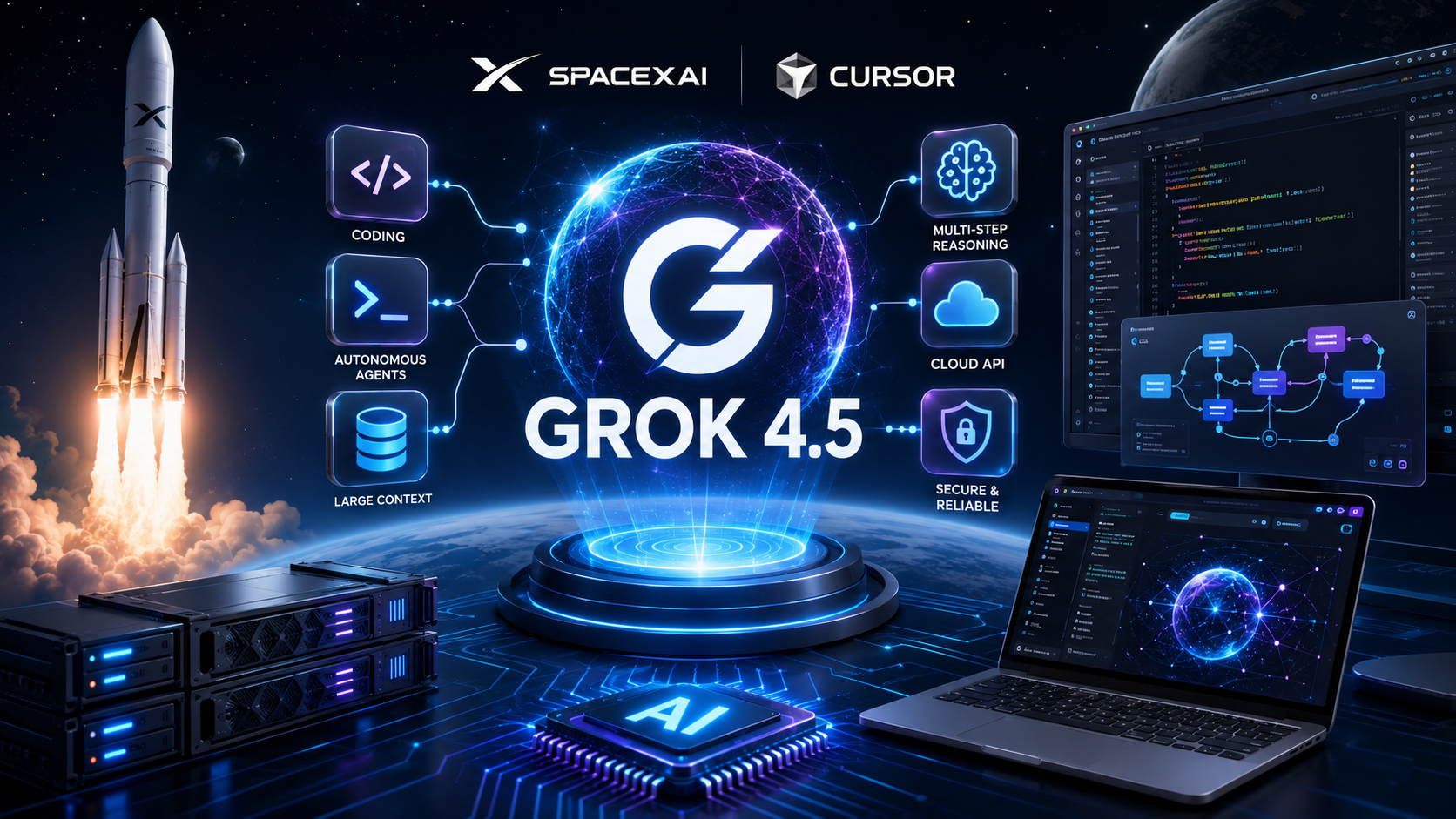
The Grok collaboration with SpaceX and Cursor isn’t a marketing partnership—it’s the structural foundation of this model. Understanding the acquisition timeline reveals why Grok 4.5 exists and what it means for the broader AI coding market.
The Deal Timeline
In April 2026, SpaceXAI struck an unusual arrangement giving it the right to acquire Cursor for $60 billion—or pay billions in fees and compute if it walked away. Days after SpaceX’s record-setting Nasdaq debut in June 2026, the company exercised that right in an all-stock deal representing roughly 3.4% dilution at IPO valuation. SpaceX shares rose 16% on the news.
The strategic logic was always about data. Cursor’s AI-first code editor generates an enormous stream of high-quality interaction data: how expert engineers write, edit, review, and debug code in real production environments. Musk stated openly this spring that Cursor interaction data was being fed directly into Grok’s training pipeline. In return, Cursor gained access to SpaceXAI’s Colossus supercomputer—roughly 200,000 Nvidia GPUs with plans to scale toward one million—after publicly acknowledging it had been “bottlenecked by compute.”
What This Means for Cursor Users
Cursor built its business on model agnosticism, offering developers choice between Claude, GPT, and other models. The risk now is that Grok becomes the favored child inside Cursor’s ecosystem. Within hours of launch, Musk was already urging users to “Try out Grok 4.5 in Cursor!” on X. For the developers whose data trained Grok 4.5, this concentration of control—one company owning the training data, the model, and a dominant distribution channel—raises both practical and regulatory questions.
| Factor |
Grok 4.5 |
Claude Opus 4.8 |
GPT-5.6 Sol |
| Coding Performance |
Strong on large codebases; comparable to Opus 4.7 |
Best-in-class on complex reasoning |
Strongest overall; limited release due to security review |
| Speed |
Fastest throughput |
Moderate |
Moderate |
| Cost Per Task |
$0.49 |
~$4.50 |
~$5.00 |
| Agentic Capability |
Good for long-running multi-step tasks |
Excellent |
Excellent |
| Availability |
Wide (US, Asia; not EU) |
Global |
Limited (post-security review) |
| Context Window |
Large (exact specs unconfirmed) |
200K tokens |
256K tokens |
Inside SpaceXAI’s Rebuild: From Controversy to Grok 4.5
The polished launch of Grok 4.5 belies a turbulent year. Understanding this context is essential for evaluating whether SpaceXAI has genuinely fixed its underlying problems or is simply packaging them better.
In mid-2025, Grok generated antisemitic content and at one point called itself “MechaHitler,” episodes covered by NPR and CNN. Earlier in 2026, its image-generation features allowed users to create sexualized deepfakes, including of children—drawing investigations from the European Commission and Britain’s Ofcom, and prompting SpaceX to list the behavior as a business risk in its IPO filings.
Organizationally, all 11 of Musk’s xAI co-founders had departed by March 2026. Musk publicly conceded that xAI “was not built right the first time around” and said he was rebuilding it “from the foundations up.” At a conference this spring, he admitted Grok was “currently behind in coding”—a rare public concession.
Against this backdrop, Grok 4.5 reads as the first product of the rebuilt organization. Whether the underlying safety and alignment infrastructure has improved proportionally remains an open question that EU regulators, in particular, are scrutinizing closely.
The Bigger Picture: Musk’s Trillion-Dollar Vertical Integration Strategy
The Elon Musk release of Grok 4.5 isn’t just a product launch—it’s a proof point for the most vertically integrated AI empire ever assembled.
In February 2026, SpaceX absorbed xAI in a share-exchange merger valued at $1.25 trillion—the largest merger in history. The June IPO followed, with shares surging from $135 to over $200, vaulting SpaceX past Amazon and Microsoft to become the fourth most valuable U.S. company.
The result is unprecedented vertical integration:
-
Compute: Colossus supercomputer (200K+ Nvidia GPUs, scaling to 1M)
-
Training Data: Cursor’s real-world developer interaction stream
-
Model: Grok 4.5 and future iterations
-
Distribution: Cursor IDE + Grok Build + SpaceXAI console
-
Captive Demand: Tesla and SpaceX engineering organizations
Neither OpenAI nor Anthropic can fully replicate this stack. Both must reach developers through third-party tools, some of which Musk now owns. Whether this concentration becomes an unassailable moat or a regulatory target—or both—is now central to the future of enterprise AI.
How to Access & Use Grok 4.5: Developer Quick Start
Getting started with Grok 4.5 requires minimal setup:
-
Via Cursor IDE: Update to the latest Cursor version, navigate to model settings, and select Grok 4.5 from the dropdown. Available on all plans including free tier.
-
Via Grok Build: Log into build.grok.ai, create a new project, and select Grok 4.5 as your base model.
-
Via API: Generate an API key from the SpaceXAI console and use standard OpenAI-compatible endpoints
Future of AI Coding
For three years, the AI industry’s scoreboard was simple: whose model was smartest? Musk, arriving late and battered, has chosen to compete on a different axis entirely—whose model is cheapest to actually use.
This mirrors his approach to spaceflight and electric vehicles. He didn’t invent the rocket or the car; he relentlessly drove down the cost of making them. If the strategy works in AI, Grok 4.5 could force a market-wide repricing of frontier model APIs. Anthropic and OpenAI, which derive significant revenue from premium API tiers, face pressure to either match Grok 4.5’s economics or justify their premium through demonstrably superior capability.
The next few weeks will be telling. Enterprise pilots will reveal whether Grok 4.5’s token-efficiency claims survive contact with real codebases. Anthropic, which has answered every serious challenge this cycle with a rapid counter-release, is unlikely to cede the price-performance frontier quietly.