
NVIDIA is pushing deeper into autonomous mobility with the commercial release of NVIDIA Alpamayo 2 Super, an open Vision-Language-Action foundation model designed for self-driving vehicles.
The model is intended to help developers, carmakers and robotaxi companies build systems that do more than detect objects and follow fixed rules. It is designed to interpret a driving scene, understand the wider context, consider possible outcomes and select an appropriate action.
That reasoning-first approach is the main news. Most autonomous-driving systems already combine cameras, sensors, mapping, prediction and vehicle control. Alpamayo 2 Super adds a foundation-model layer that can connect what the vehicle sees with language-based reasoning and planned actions.
In practical terms, the system may be able to explain why a vehicle should slow down near a crowded crossing, wait before turning or prepare for a lane change.
NVIDIA is also making the model available for commercial use rather than keeping it limited to research. That could give automotive companies and mobility startups a faster starting point for developing advanced driving systems.
However, commercial access does not mean the model is ready to control vehicles on public roads without further work. It still requires integration, validation, safety testing and approval under the rules of each market.
[Featured image placement: Add the featured image directly below this introduction.]
A Foundation Model Built for Driving Decisions
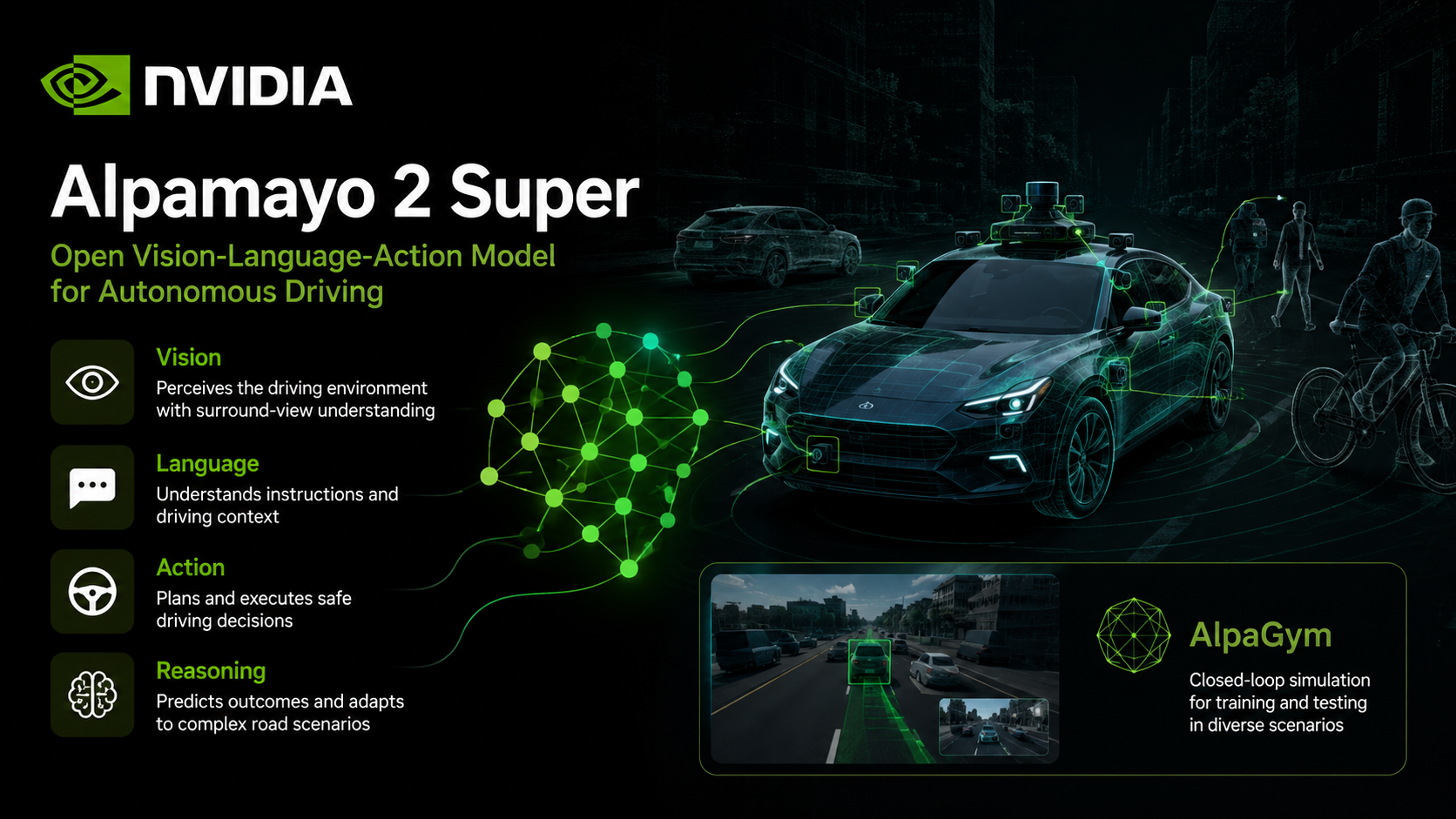
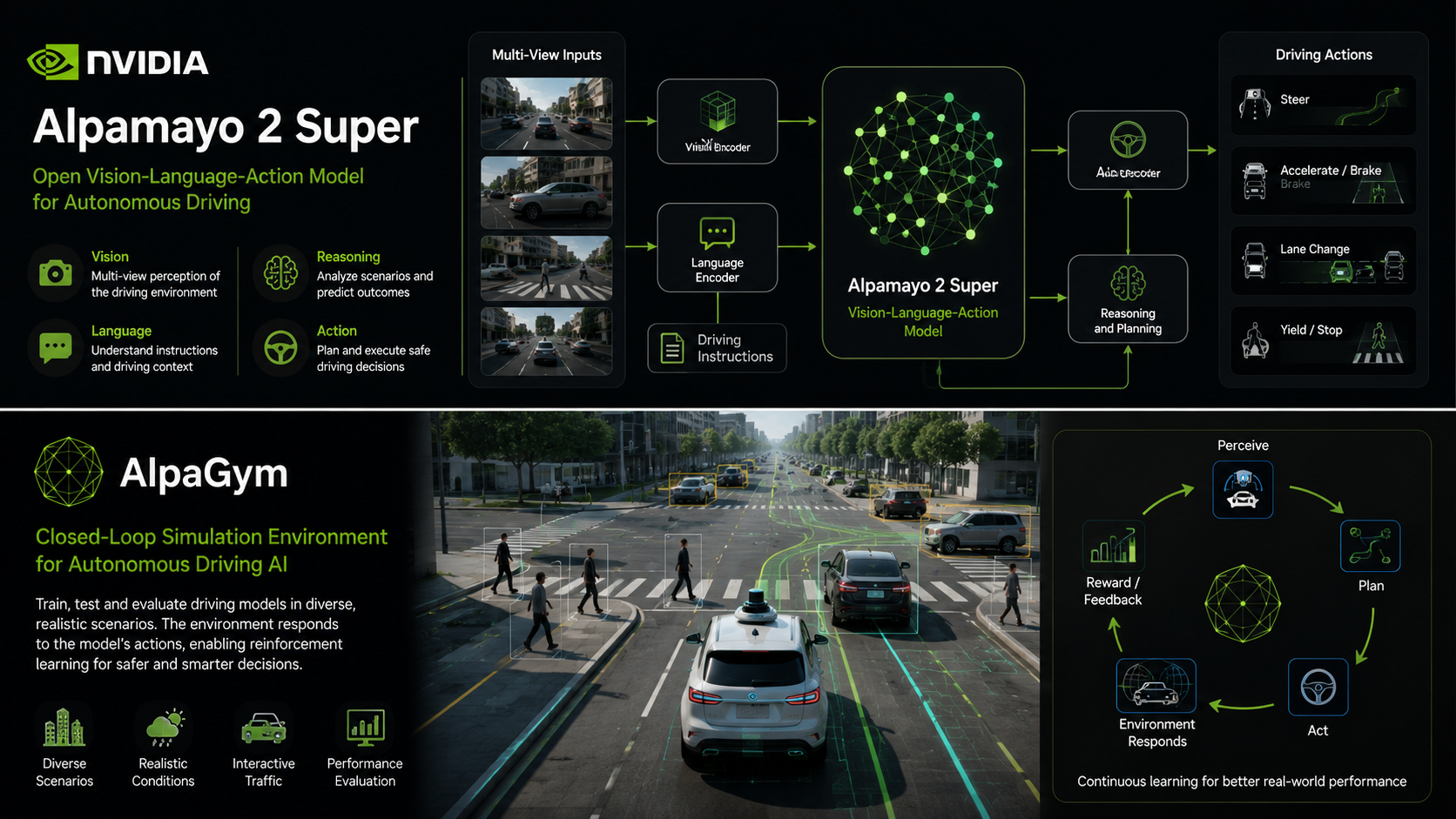
Alpamayo 2 Super belongs to a category known as Vision-Language-Action, or VLA, models. These models connect three important abilities within one system.
The vision component processes information from cameras and other supported inputs. It identifies road users, lane markings, signs, signals and changes in the surrounding environment.
The language component helps the model interpret instructions and understand the relationships between those visual details.
The action component turns that understanding into a driving intention or control decision.
This structure differs from a basic perception model. A perception model may report that a cyclist is present, a traffic light is green and another vehicle is approaching from the right.
A VLA model is designed to consider those facts together. It may conclude that the safest response is to reduce speed, hold position or delay a turn because the cyclist could enter the vehicle’s path.
According to the supplied announcement, Alpamayo 2 Super is built on NVIDIA’s Cosmos 3 Super Reasoner foundation. The aim is to support better planning, stronger contextual understanding and longer decision chains across complicated road situations.
The model should not be viewed as a complete autonomous-driving platform on its own. A production vehicle still needs dependable cameras and sensors, mapping, localization, control software, computing hardware and backup safety systems.
Alpamayo 2 Super is more accurately understood as a reasoning layer that could operate within a much larger vehicle system.
Commercial Availability Changes the Opportunity
The commercial release is important because advanced autonomous-driving models are often introduced as research projects, demonstrations or restricted tools.
In those cases, companies may be able to study the technology but cannot necessarily build paid products or services around it.
Commercial availability gives developers more freedom to evaluate the model for robotaxis, autonomous delivery fleets, passenger vehicles and other mobility services.
It may also reduce the time needed to create an early prototype. Development teams can begin with a pre-trained foundation model rather than building every reasoning component from the beginning.
For large carmakers, the attraction is speed and scale. A common foundation could support work across several vehicle programs, regions and road environments.
For startups, it could lower the technical barrier to exploring advanced autonomy. However, integrating and testing the model would still require significant investment, specialist engineers and access to reliable driving data.
Commercial availability may also encourage more companies to build supporting AI tools around the model. These could include evaluation platforms, safety-testing systems, data-management services and regional driving adaptations.
Open development can support wider review as well. Engineers and researchers may be able to examine the model’s behavior, identify weaknesses and explore how it responds to difficult road situations.
Greater access can speed up experimentation, but it does not automatically guarantee safety or regulatory approval. Those results must be demonstrated through controlled testing and real-world evidence.
Reasoning Beyond Basic Object Detection
Autonomous vehicles operate in environments where the same object can carry different meanings.
A pedestrian standing well back from the curb may present little immediate risk. A pedestrian looking towards traffic while stepping closer to a crossing may require the vehicle to slow down.
A parked van can appear harmless in one moment and become a serious concern in the next if it blocks the vehicle’s view of a child, cyclist or approaching car.
Rule-based systems can handle many familiar situations, but the number of possible combinations on a public road is enormous.
Construction work may change lane positions. Poor weather can reduce visibility. Emergency vehicles can alter normal traffic behavior. Drivers may ignore road markings, stop suddenly or merge without leaving enough space.
Alpamayo 2 Super is designed to evaluate these relationships rather than react to each detected object in isolation.
The model can consider what is happening now, what may happen next and which action leaves the safest available margin.
This does not mean the model thinks exactly like a person. Its decisions are still based on patterns learned from training data, simulation and feedback.
Its value comes from giving developers a more flexible way to address situations that may not fit neatly into a fixed set of programmed rules.
[In-content image 1 placement: Add the surround-view reasoning image here.]
The Driving Decision Pipeline
The model’s workflow can be understood as a series of connected stages. In an operating vehicle, several of these stages may take place at the same time.
Perception of the Surrounding Scene
The first stage is environmental perception.
The vehicle gathers information from surround-view cameras and any other sensors connected to the driving platform. The system looks for vehicles, pedestrians, cyclists, lane boundaries, road signs, traffic lights, weather conditions and physical obstacles.
Surround-view understanding matters because road risks rarely appear in only one direction.
A vehicle preparing to change lanes may need to track traffic ahead, cars in the next lane and a motorcycle approaching from behind. Several camera views can provide a more complete picture than a single forward-facing image.
Understanding Context and Risk
Detection is followed by context.
The system considers where each object is located, how it is moving and whether it may affect the vehicle’s planned path.
A pedestrian near a crossing, for example, may require more attention than someone walking away from the road.
A vehicle using its indicator may be preparing to merge. A bus stopped beside a school could hide people who are about to enter the street.
These details help the system determine which parts of the scene require the most caution.
Planning Possible Outcomes
The planning stage looks ahead. The model can consider several possible developments before selecting an action.
It may evaluate whether another vehicle is likely to merge, whether a traffic signal could change, whether there is enough space to overtake or whether the vehicle should wait before turning.
This supports proactive driving. The system is not only responding to something that has already happened. It is preparing for events that appear reasonably likely.
Producing a Driving Intention
Alpamayo 2 Super can generate higher-level intentions, sometimes described as meta-actions.
Instead of immediately sending a low-level steering or braking command, it may first form a plan such as yielding to a cyclist, preparing to merge or creating more distance from the vehicle ahead.
A separate control layer can then translate that intention into exact braking, acceleration and steering movements.
Separating the intention from the final control action may make the system easier to review. Engineers can study both why the decision was made and how the vehicle attempted to carry it out.
Reviewing the Decision
Explainability is another central part of the model’s appeal.
Developers need to understand why an autonomous system selected one action instead of another. A clear reasoning trace can help teams investigate mistakes, compare possible decisions and improve training data.
Inspectable reasoning may also support safety reviews and regulatory discussions.
It does not remove the need for formal testing, but it can make unexpected behavior easier to examine.
Closed-Loop Training Through NVIDIA AlpaGym
The supplied material also introduces NVIDIA AlpaGym, a closed-loop simulation environment for training autonomous-driving AI.
Closed-loop training allows a model to take an action inside a simulated scene and then experience the result of that action.
This differs from reviewing a fixed video or driving recording. In a closed-loop simulation, the environment responds to the model’s decisions.
When the model brakes late, traffic around it continues to move. When it changes lanes, nearby vehicles may respond. The system can then receive a reward for safe and efficient behavior or a penalty for an unsafe choice.
Simulation is valuable because real-world road testing is expensive and cannot safely reproduce every dangerous event.
Developers cannot repeatedly place pedestrians in risky positions or create multi-vehicle near-collisions simply to test a model. A virtual environment can recreate these difficult situations without placing real people in danger.
AlpaGym may expose the model to heavy traffic, highways, roundabouts, construction areas, low visibility, night driving, emergency vehicles and unexpected pedestrian movements.
Developers can change the conditions, repeat the same event and compare how different versions of the model respond.
Reinforcement learning can then refine the system’s behavior. The model receives feedback based on the outcome of its decisions, helping it learn which actions produce better results inside the simulation.
This process can improve planning before the model is tested in a real vehicle.
However, simulation has limits. A virtual environment can only represent the conditions included by its designers.
Lighting, sensor noise, unusual human behavior and local driving customs may be different on real roads. Simulation therefore supports controlled track testing and carefully monitored public-road trials rather than replacing them.
[In-content image 2 placement: Add the AlpaGym simulation image here.]
Potential Value for Robotaxi Companies
Robotaxi services face some of the hardest challenges in autonomous driving.
They operate in busy public areas, often without a human driver ready to take control. Their systems must deal with passengers, pedestrians, cyclists, delivery vehicles, road construction and unpredictable human drivers.
A reasoning model could help robotaxis handle unusual situations that are difficult to cover through fixed rules.
For example, a vehicle approaching a blocked lane may need to understand temporary signs, observe nearby drivers and decide when it is safe to merge.
At a crowded pickup point, the vehicle may need to choose a stopping location that is safe, legal and convenient for the passenger.
Commercial access to Alpamayo 2 Super may allow robotaxi developers to test these capabilities without creating a new foundation model internally.
It could also make it easier to adapt systems when companies expand into cities with different road layouts, traffic rules or driving habits.
The technology may have value outside passenger robotaxis as well.
Autonomous delivery vans, yard vehicles, shuttles and industrial transport systems also need to interpret their surroundings and plan safe movements.
Some of these environments are more controlled than public streets, which could make them useful early testing locations for reasoning-based autonomous systems.
Impact on Carmakers and Software Developers
For automotive manufacturers, Alpamayo 2 Super could become part of a broader software-defined vehicle strategy.
Carmakers are increasingly building vehicles around software platforms that can be updated instead of relying only on fixed electronic systems.
A foundation model supporting perception, reasoning and planning could fit within that direction.
Developers may be able to adapt the model to particular vehicle types, driving regions or operating limits.
A highway assistance system, for example, has different requirements from an urban robotaxi.
A delivery vehicle may prioritize low-speed maneuvering and curbside awareness, while a passenger car may focus more on comfort and predictable behavior.
However, the cost of deployment will extend far beyond obtaining access to the model.
Companies will still need computing hardware, sensor integration, high-quality data, cybersecurity controls, monitoring systems and teams capable of validating the complete vehicle platform.
Safety and Regulatory Questions Remain
Reasoning models can make autonomous systems more capable, but they also introduce new questions.
A model may produce a convincing explanation even when its final conclusion is wrong. It may perform well in familiar scenes but struggle with road layouts, signs or behaviors that were uncommon in its training data.
Developers must test not only whether the model reaches the correct decision, but also how consistently it reaches that decision.
Safety teams need to understand its failure modes, confidence levels and response to incomplete or conflicting information.
Regulators are likely to focus on measurable performance rather than terms such as reasoning or explainability.
They may require evidence showing how the system behaves in clearly defined situations, how it responds to hardware or software faults and what happens when its sensor information becomes unreliable.
Privacy and data governance will also remain important.
Camera-based driving systems can capture faces, license plates and detailed views of public spaces. Companies using the model must manage that information under local privacy, security and data-retention rules.
Commercial availability therefore marks the beginning of a longer development process, not the end.
Before an Alpamayo-powered system carries passengers without a driver, its developers will need extensive evidence that the complete vehicle can operate safely within a clearly defined area and set of conditions.
A Wider Move Towards Physical AI
Alpamayo 2 Super also reflects NVIDIA’s wider interest in physical AI.
Physical AI describes artificial intelligence that can understand its environment and act in the real world through vehicles, robots and machines.
The challenge is greater than generating text or analyzing one image. Physical systems must make decisions under time pressure, handle uncertainty and avoid actions that could harm people or property.
They also need hardware powerful enough to process large amounts of information quickly and reliably.
Autonomous vehicles are a major test case because they combine complex perception, real-time planning and strict safety requirements.
Progress in this area could influence warehouse robots, industrial machines, delivery systems and other forms of intelligent automation.
NVIDIA already plays an important role in AI computing and automotive hardware.
A commercial VLA model gives the company another layer in the autonomous-driving stack by connecting computing chips, simulation environments, foundation models and developer tools.
What the Release Means for Autonomous Driving
The immediate importance of Alpamayo 2 Super is not that fully autonomous vehicles will suddenly appear everywhere.
The more realistic impact is that companies now have another model to evaluate as they build and test future driving systems.
Its strongest promise is the ability to connect visual understanding with contextual reasoning and planned action.
That could help vehicles respond more effectively to complicated scenes that cannot be handled through object detection alone.
Its commercial license may broaden access and speed up experimentation. AlpaGym may help development teams test difficult situations earlier and more safely.
Inspectable reasoning could also make debugging and safety reviews more practical.
The remaining challenge is proving that these advantages continue outside controlled demonstrations.
Real roads contain uncertain behavior, unusual conditions and local differences that no training set or simulation can capture perfectly.
Alpamayo 2 Super therefore represents an important step in the development of reasoning-based autonomous mobility.
It gives robotaxi companies, carmakers and robotics developers a new tool for building systems that can interpret, plan and act.
Whether it eventually leads to safer commercial vehicles will depend on the quality of integration, testing, regulation and real-world evidence that follows.