
Snowflake is introducing dynamic model routing in Cortex AI Gateway, allowing enterprises to automatically match AI tasks with models based on factors such as quality, cost and performance. The company says the approach delivered up to 3x greater token efficiency in one internal test.
As businesses deploy more AI agents and applications, choosing the right model for every task is becoming both an operational and financial challenge.
A simple request does not necessarily need the same model as a complex reasoning task. Yet sending every request to a powerful frontier model can increase inference and token costs.
Snowflake’s answer is dynamic model routing.
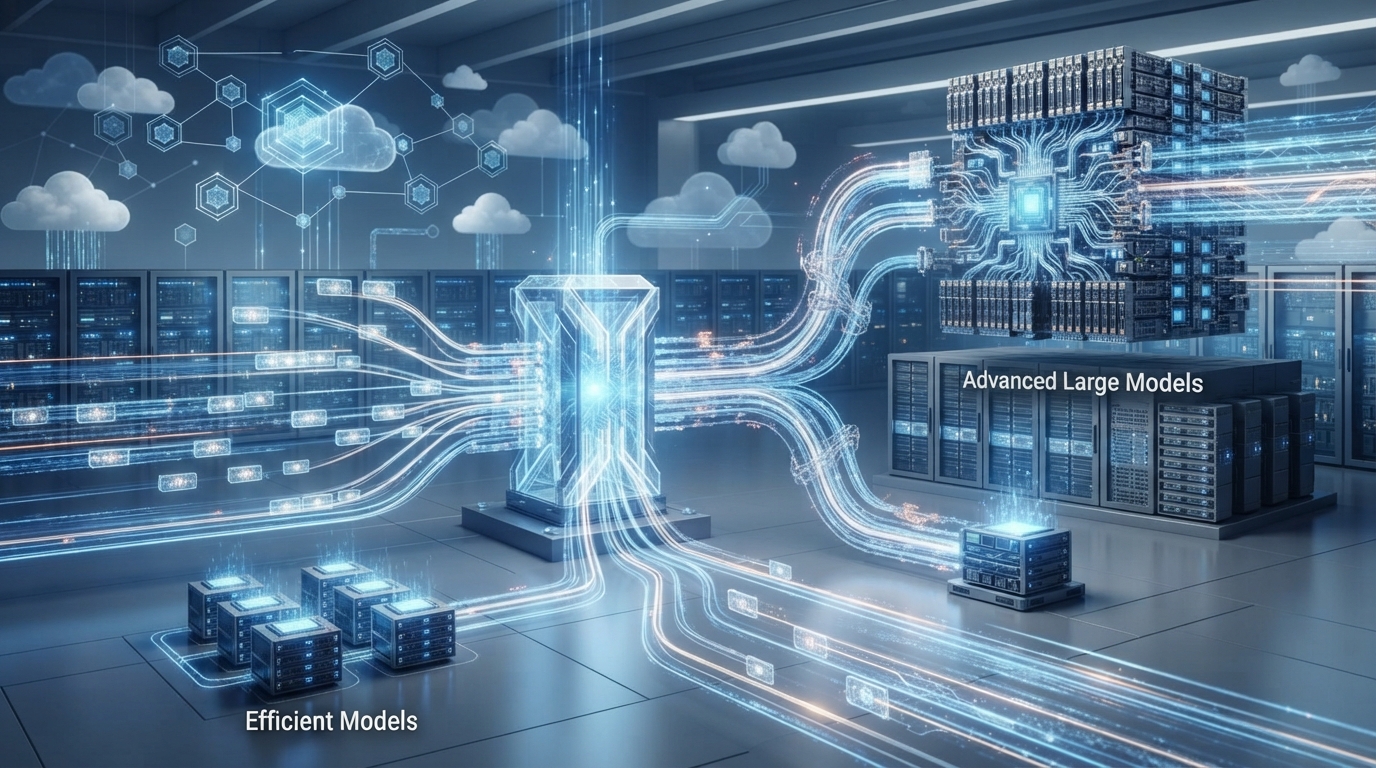
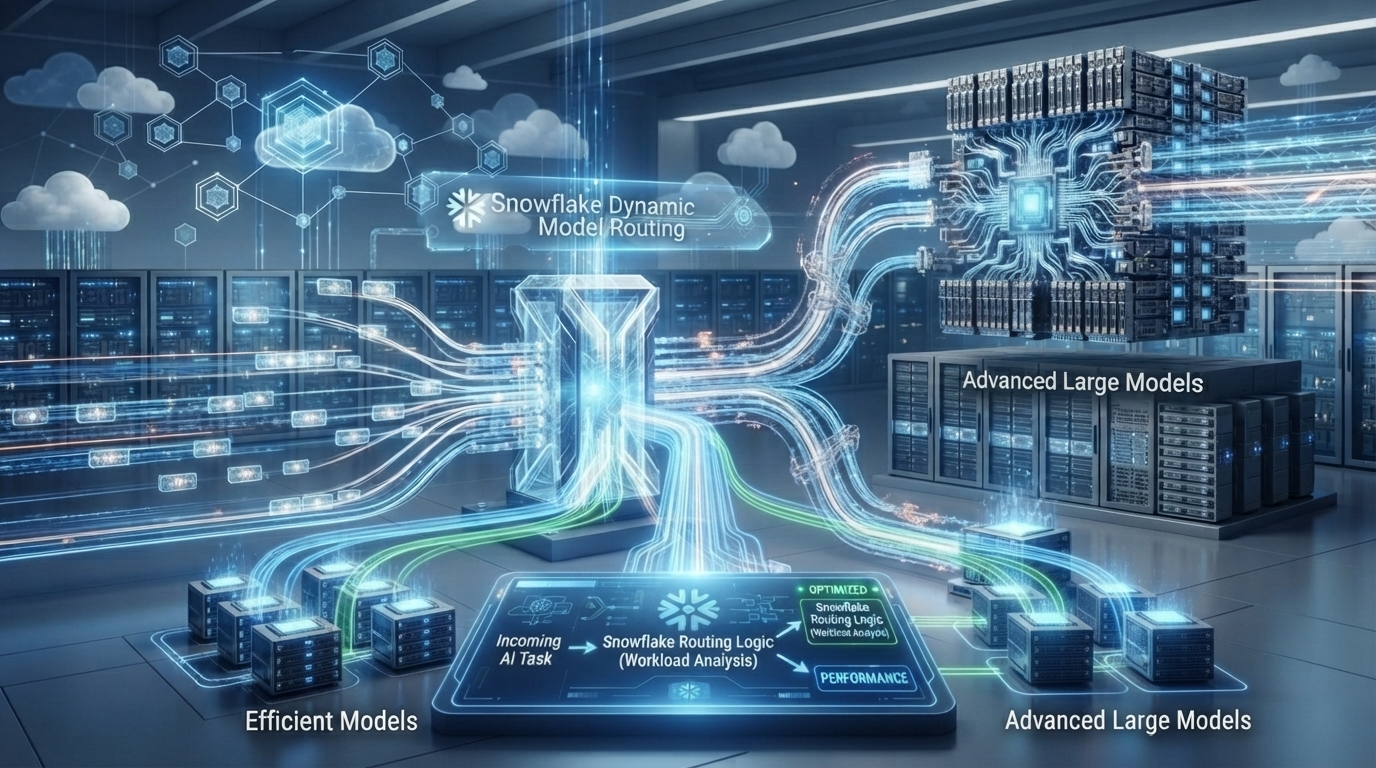
The new capability in Cortex AI Gateway can automatically select a suitable model for each task, directing simpler workloads to more efficient models while sending tasks that require deeper reasoning to more capable models.
What Did Snowflake Announce?
Snowflake announced dynamic model routing on August 18, 2026, as part of an expansion of Cortex AI.
The feature is designed to automatically choose a model based on the requirements of a particular task. Snowflake says the routing system considers factors including quality, speed, customer preferences and cost.
The capability is being integrated into Snowflake’s AI products, including Snowflake CoCo and Snowflake CoWork, and is also available to third-party AI agents using Cortex AI Gateway.
The underlying goal is straightforward: don’t use an expensive model when a more efficient model can complete the task just as effectively.
This approach fits into a wider shift toward enterprise AI agents and business automation, where organizations are using AI to handle increasingly complex workflows rather than isolated prompts.
How Does Snowflake’s Dynamic Model Routing Work?
Dynamic model routing adds a decision layer between an AI application and the models available to it.
Instead of an application relying on one fixed model, each request can be evaluated and directed to a model that fits the workload.
For example:
Simple or repetitive task → More efficient model
Complex reasoning task → More capable model
This allows enterprises to balance model quality with the cost of running each request.
Snowflake says the router can select the most affordable model that can confidently complete a task while taking enterprise controls into account.
Why Model Selection Matters
AI models differ significantly in their capabilities, latency and cost.
A model that is ideal for complex reasoning may be unnecessary for a basic classification or summarization task.
Without automated routing, developers may have to create and maintain their own model-selection logic. As new models appear and prices change, that approach can become increasingly difficult to manage.
Snowflake is attempting to move that complexity into the gateway itself.
The idea becomes even more relevant as enterprises gain access to a wider range of models, including cost-focused options such as DeepSeek alongside models from major AI providers.
Snowflake Reports Up to 3x Greater Token Efficiency
The biggest number attached to the announcement is Snowflake’s claim of up to 3x greater token efficiency.
In an internal evaluation, Snowflake said agents using dynamic model routing completed a dbt pipeline workload with up to three times greater token efficiency than a frontier-model-only approach while maintaining comparable quality.
Snowflake also reported a separate coding workload in which engineering teams maintained the same pull-request throughput while using approximately 25% fewer tokens.
However, there is an important distinction for readers.
These are Snowflake’s internal test results, not independent industry benchmarks. Actual savings can vary depending on the workload, models involved, routing decisions and quality requirements.
That makes the 3x figure useful as an indication of Snowflake’s testing, but it should not be interpreted as a guaranteed cost reduction for every enterprise.
Why Dynamic Model Routing Could Lower AI Costs
Enterprise AI costs can rise quickly when applications and agents make large numbers of model calls.
Consider an AI agent handling hundreds or thousands of tasks.
If every request is automatically sent to a premium model, the organization could end up paying for more model capability than the workload actually requires.
Dynamic routing changes that equation.
Instead of asking:
“What is our best AI model?”
companies can ask:
“What is the right model for this task?”
That distinction becomes increasingly important as AI agents move into production.
A routine task might need speed and low cost. A complex coding or reasoning task may justify a more capable model.
The router attempts to make that tradeoff automatically.
This is also why enterprise AI platforms are increasingly focused on automation, orchestration and measurable efficiency, rather than simply adding another chatbot to an existing workflow.
Snowflake Is Expanding Its Model Options
Model routing becomes more useful when organizations have multiple models available.
Alongside dynamic routing, Snowflake is expanding its Cortex AI model portfolio with DeepSeek-V4-Flash 0731 and GLM-5.3.
These models join a broader selection that includes models from providers such as OpenAI, Anthropic, Google, Meta and Mistral, giving enterprises more options when balancing capability and cost.
Snowflake’s logic is essentially:
More model choices + intelligent routing = more opportunities to optimize each workload.
The company says DeepSeek-V4-Flash 0731 is in private preview, while GLM-5.3 is planned for private preview, subject to availability.
For enterprises evaluating the broader DeepSeek ecosystem, understanding its existing models and capabilities can also provide useful context around why lower-cost model options are becoming increasingly important.
AI Governance Is a Major Part of the Update
Cost savings are only one part of enterprise AI management.
Companies also need to control which models can access their data and which agents can perform particular actions.
Snowflake says dynamic model routing operates within existing governance controls.
The routing system considers only administrator-approved models and respects data-residency settings. Snowflake also says routing decisions are logged, providing visibility into which model handled a request.
This is particularly relevant for regulated organizations.
An enterprise may want the flexibility of multiple AI models without giving applications unrestricted access to every available provider.
Cortex AI Gateway is designed to provide that control while managing model selection underneath the application layer.
That governance requirement is becoming increasingly important as companies move toward agentic AI systems, where autonomous tools can access enterprise information and carry out actions across multiple systems.
What Does This Mean for AI Agents?
The update is especially relevant as companies move from individual AI prompts toward agentic workflows.
AI agents can perform multiple steps to complete a task. Depending on the workflow, those steps may involve repeated model calls, data retrieval, tool use and reasoning.
That can make inefficient model selection expensive.
Snowflake’s approach attempts to match model capability to each step instead of treating every interaction as equally demanding.
This also means that context matters.
An agent with the right information already available may be able to complete a task using a less expensive model. A poorly contextualized request could require additional reasoning, retries or model calls.
The result is that AI efficiency is not simply about finding the cheapest model.
It is about finding the right combination of model, context, data and workload requirements.
This is similar to the broader enterprise AI shift toward platforms that combine AI agents with existing workflows, data and automation rather than treating AI as a standalone tool.
How Snowflake’s Approach Differs From Other AI Routing Platforms
Snowflake is entering a broader market for model gateways and routing systems.
Platforms such as OpenRouter focus heavily on access to multiple models and providers, while companies including Databricks and NVIDIA are also developing capabilities around AI model selection and infrastructure.
Snowflake’s differentiating pitch is its connection between model routing, enterprise data, AI agents and governance.
| Platform | Primary focus |
|---|---|
| Snowflake | Model routing, enterprise data and governance |
| Databricks | Data and AI infrastructure |
| NVIDIA | AI infrastructure and model capabilities |
| OpenRouter | Multi-model and provider access |
| AI model gateways | Model management, routing and provider flexibility |
For enterprises, the best option may ultimately depend on their existing data infrastructure, security requirements and AI stack.
That is why enterprise buyers are increasingly evaluating AI solutions based not only on model quality, but also on integration, governance, automation and operational cost.
What Snowflake’s Announcement Means for Enterprise AI
The broader significance of Snowflake’s announcement is that enterprise AI is moving beyond simply asking which model is best.
Companies increasingly need to determine whether the additional capability of a more expensive model actually produces better business outcomes.
Dynamic model routing attempts to automate that decision.
A company could reserve expensive frontier models for workloads that genuinely require them while directing simpler requests to more efficient alternatives.
That could help organizations control inference spending without abandoning access to powerful models.
Snowflake calls this broader goal “intelligence efficiency” using compute, models, data and context in a way that produces measurable business value.
This direction also mirrors the wider enterprise movement toward AI-powered automation, where the goal is not simply to generate content but to improve workflows, reduce repetitive work and increase operational efficiency.
What We Still Don’t Know
Snowflake’s announcement is significant, but several questions remain.
Are the 3x Savings Achievable in Real-World Workloads?
The reported 3x improvement comes from Snowflake’s internal evaluation. Different organizations could see different results depending on their workloads and model usage.
How Accurate Is the Routing?
A routing system must correctly identify when a cheaper model is sufficient.
Sending a difficult task to an unsuitable model could lead to retries, additional model calls or lower-quality results, potentially reducing the expected savings.
How Much Will Enterprises Actually Save?
The answer will depend on workload volume, model pricing, task complexity and how frequently requests can be handled by lower-cost models.
How Quickly Can Routing Adapt?
AI models and pricing change rapidly.
One advantage of dynamic routing is that enterprises can potentially introduce new models into their available model pool without rebuilding every application around a different model.
That flexibility could become increasingly valuable as the AI model market continues to expand.
Frequently Asked Questions
What Is Snowflake Dynamic Model Routing?
Snowflake dynamic model routing automatically selects an appropriate AI model for a task through Cortex AI Gateway, balancing factors such as quality, performance and cost.
How Does Snowflake Dynamic Model Routing Reduce AI Costs?
It can send simpler workloads to more efficient models instead of using expensive frontier models for every request.
What Is Cortex AI Gateway?
Cortex AI Gateway is Snowflake’s centralized layer for governing AI agents, managing access to models and tools, routing requests and monitoring AI consumption.
How Much Token Efficiency Does Snowflake Claim?
Snowflake reports up to 3x greater token efficiency in an internal dbt pipeline evaluation and approximately 25% fewer tokens in a separate engineering test.
Is Snowflake’s 3x Claim Independently Verified?
No independent benchmark is cited in Snowflake’s announcement. The 3x result is described as an internal evaluation.
Which Models Is Snowflake Adding?
Snowflake announced expanded access to DeepSeek-V4-Flash 0731 and GLM-5.3, alongside its broader model portfolio.
Can Third-Party AI Agents Use Dynamic Model Routing?
Yes. Snowflake says the capability is available to third-party AI agents using Cortex AI Gateway.
Why Does Model Routing Matter for Enterprises?
It can help enterprises avoid using expensive models for tasks that can be completed by more efficient alternatives while maintaining centralized governance over model access.
The Bottom Line
Snowflake’s dynamic model routing addresses a growing problem in enterprise AI: not every task needs the most expensive model available.
By automatically matching workloads with appropriate models, Snowflake wants enterprises to reduce unnecessary inference spending while maintaining quality and governance.
The reported 3x token-efficiency improvement is promising, but it remains a Snowflake internal result rather than an independently verified benchmark.
The bigger development is the direction of enterprise AI itself. As companies deploy more agents, model selection is becoming something that needs to happen dynamically, continuously and at scale.
Snowflake is betting that the next stage of AI optimization will not be about choosing one winning model. It will be about choosing the right model for every task.