

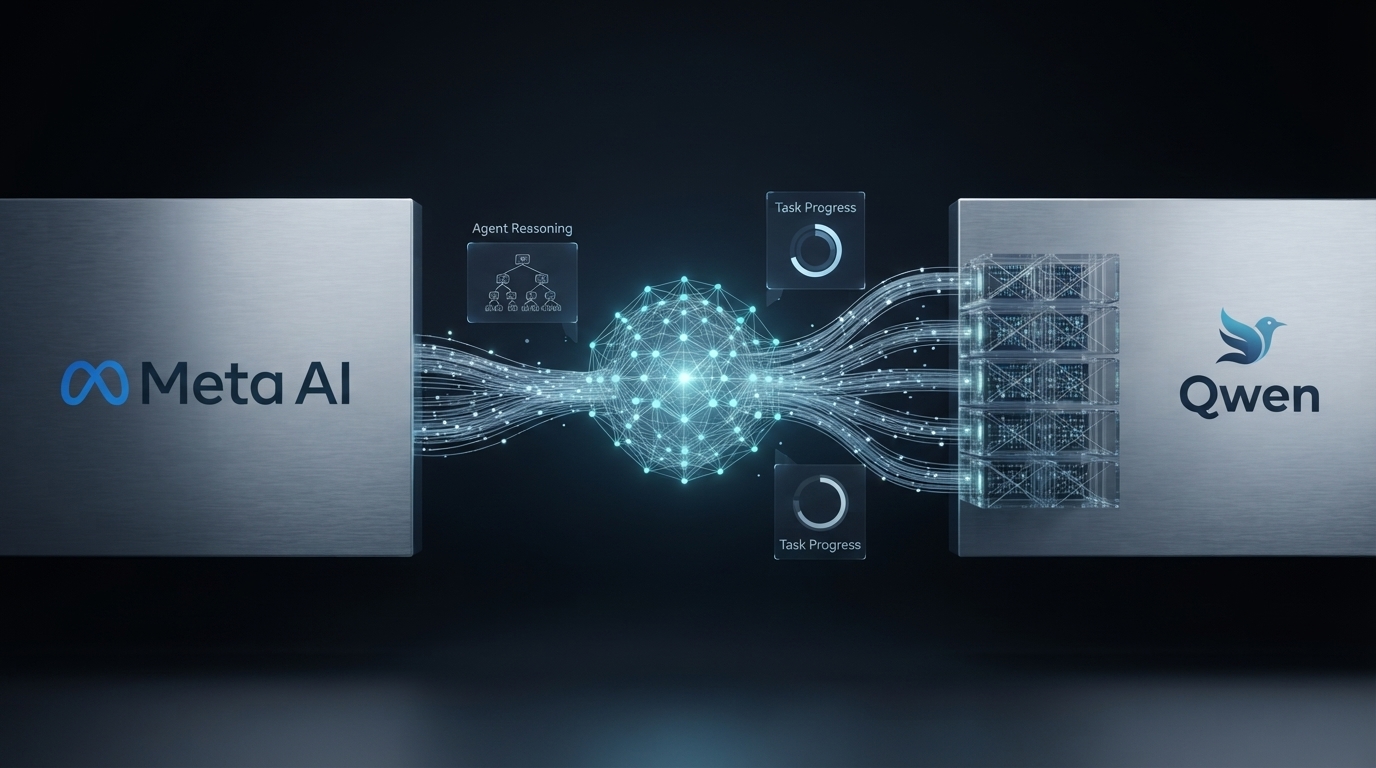
Researchers from Meta AI and the University of Illinois Urbana-Champaign have demonstrated how an 8-billion-parameter AI model can achieve frontier-level performance on a long-horizon agent benchmark — without increasing the model’s size.
The technique, called EvoHarness-RL, trained Alibaba’s open-weight Qwen3-8B to manage its own external memory, task progress, and accumulated experience.
On the ALFWorld benchmark’s seen-task split, the trained model achieved a 96.9% success rate, compared with 96.4% for Claude Opus 4.5 in the researchers’ comparison. The same harness also improved Claude Opus 4.5 to 98.5%.
That makes the result interesting for a reason that goes beyond the headline.
The research suggests that improving how an AI agent manages information during a task can sometimes deliver gains comparable to using a much larger model.
However, the result should not be interpreted as proof that an 8B model has generally surpassed Claude Opus 4.5. The comparison comes from one simulated environment, and the 96.9% result is from the benchmark’s seen split.
The more important question is therefore: What did the researchers change, and why did it work?
What Is EvoHarness-RL?
EvoHarness-RL is a training framework designed to teach AI agents how to manage their own runtime state.
An AI agent does more than generate text. It may need to remember what happened earlier, track which steps of a task are complete, decide what information is important, recover from mistakes, and reuse knowledge from previous attempts.
That creates a problem.
A model may have strong reasoning capabilities but still struggle when a task becomes long and complicated because too much information has to be tracked at once.
This is where an agent harness comes in.
A harness is the runtime infrastructure surrounding a model. It can provide tools for storing information, tracking progress, checking results, and retrieving previous experience.
Traditional agent systems often rely on engineers to decide when those mechanisms should be used.
EvoHarness-RL takes a different approach.
Instead of completely hard-coding the memory policy, the researchers trained the model to decide when it should interact with its external state and what information should be stored or retrieved.
Why AI Agents Need a Runtime Harness
Short tasks are relatively easy for modern language models.
If a user asks an AI assistant to summarize an email, rewrite a paragraph, or answer a simple question, the model can often keep the necessary information inside its context window.
Long-horizon tasks are different.
Imagine an agent that needs to complete dozens of actions to accomplish one objective. During the process, it may need to remember:
- What the original goal was
- Which steps have already been completed
- What information it discovered
- Which actions failed
- What it learned from those failures
- What it needs to do next
Without deliberate state management, the agent can lose track of important details.
A runtime harness provides an external workspace where those details can be organized.
The problem is that a poorly designed harness can create its own inefficiencies.
If an agent constantly checks its external memory, it wastes tokens and computation. If it rarely checks, it may miss information that could help it complete the task.
EvoHarness-RL attempts to solve this by making harness usage itself a learned behavior.
EvoHarness-RL’s Belief, Progress and Experience System
The framework organizes external state into three major components known as BPE:
| Component | What it stores | Example |
|---|---|---|
| Belief | The agent’s current understanding of the environment | Where an object is located |
| Progress | The current status of the task and its subgoals | Which actions have already been completed |
| Experience | Useful information learned from previous attempts | Which strategy worked or failed |
This structure gives the model a more organized workspace rather than forcing it to treat its entire interaction history as one large stream of information.
The researchers then give the agent four ways to interact with that workspace.
1. Track
The Track action updates the agent’s understanding of the current environment.
For example, if an object has moved, the agent can update its belief about where that object is located.
2. Commit
The Commit action records completed progress.
Instead of repeatedly reconsidering whether a subgoal has been completed, the agent can explicitly mark it as finished.
3. Recall
The Recall action retrieves useful information from stored experience.
This can help the agent reuse information from an earlier attempt instead of solving the same problem again.
4. Note
The Note action allows the agent to save information that may become useful later.
The key difference is that these actions are not simply triggered according to a fixed schedule.
The model learns when using them is worth the additional cost.
How Meta Trained the Qwen3-8B Model
The researchers used a two-stage training process.
The base model was Qwen3-8B, an open-weight model from the Qwen family. The model is available through Hugging Face under the Apache 2.0 license.
Stage One: Supervised Harness Fine-Tuning
The first stage taught the model how to use the harness.
The researchers collected teacher-generated trajectories and refined them into successful examples showing how the model should interact with the BPE state and harness actions.
This stage essentially taught the model the mechanics.
It learned what a valid Track, Commit, Recall, or Note operation looks like and how those operations should be used during a task.
Stage Two: Cost-Aware Reinforcement Learning
The second stage used Group Relative Policy Optimization, or GRPO, as the reinforcement learning method.
This stage was particularly important because the objective was not simply to maximize task completion.
The reward system also considered efficiency.
The model was encouraged to:
- Complete the task successfully
- Use the harness correctly
- Avoid unnecessary memory operations
- Avoid repetitive calls
- Produce valid harness actions
- Balance information retrieval against its associated cost
This effectively teaches the agent to ask itself a practical question:
“Is using my external memory worth it right now?”
That is different from giving an agent unlimited access to memory and expecting it to use that memory intelligently.
The Results: How Did the 8B Model Perform?
The researchers evaluated EvoHarness-RL using ALFWorld, a benchmark designed for interactive tasks involving sequential reasoning and state tracking. ALFWorld connects text-based environments with corresponding embodied environments and is widely used for studying interactive agents.
The reported seen-split results were:
| Model or method | ALFWorld seen success |
|---|---|
| Qwen3-8B with ReAct | 47.9% |
| SkillOS | 80.2% |
| SkillRL | 89.9% |
| Claude Opus 4.5 | 96.4% |
| EvoHarness-RL + Qwen3-8B | 96.9% |
| Claude Opus 4.5 + EvoHarness | 98.5% |
The improvement over the Qwen3-8B ReAct baseline is the most striking part of the result.
The model moved from 47.9% to 96.9%, representing a 49 percentage-point improvement.
The paper reports that the framework also improved larger frontier models when the BPE harness was made available to them.
That suggests the improvement is not simply a trick that makes small models look better.
The harness itself appears to provide useful structure for agents at different capability levels.
Does the 8B Model Really Beat Claude Opus 4.5?
Not in the broad sense.
The 96.9% versus 96.4% comparison is technically valid for the reported ALFWorld seen split, but the difference is only 0.5 percentage points.
That is not enough to conclude that Qwen3-8B is a better general-purpose model than Claude Opus 4.5.
Anthropic describes Claude Opus 4.5 as a frontier model designed for coding, agents, computer use, and other demanding workflows.
The EvoHarness research is testing something much narrower:
Can a relatively small model perform extremely well on a specific long-horizon agent benchmark when given a learned state-management system?
On that question, the answer appears to be yes.
The distinction matters because benchmark performance and general intelligence are not the same thing.
The Biggest Caveat: Seen vs. Unseen Tasks
The most important qualification concerns generalization.
ALFWorld includes seen and unseen task splits.
The trained EvoHarness-RL model achieved 96.9% on the seen split, but its performance fell to 86.6% on the unseen split.
That drop does not make the result weak.
An 86.6% success rate is still substantially higher than the model’s baseline performance.
But it does show that the 96.9% headline should not be interpreted as universal frontier-level performance.
There is another important limitation.
The published frontier-model comparison is primarily centered on the seen split. That means there is not an equivalent Claude Opus 4.5 versus EvoHarness-RL Qwen3-8B comparison on the harder unseen tasks.
So we cannot say from this research that the 8B model remains competitive with Claude on unfamiliar tasks.
What Is Harness Annealing?
One of the more interesting findings was a behavior the researchers call harness annealing.
Early during training, the model tends to interact with the harness frequently.
It checks information, updates state, and uses external memory more often.
As training progresses, some of those recurring behaviors appear to become internalized by the model.
The result is more selective harness use.
Instead of checking external memory every time, the model increasingly learns when it actually needs that information.
This is important because external memory is not automatically beneficial.
Every additional retrieval or update can introduce computational and token costs.
A good agent therefore needs to balance two competing goals:
Use memory when it helps. Avoid memory when it does not.
Harness annealing suggests the model can learn that balance through reinforcement learning.
What Is Harness Evolution?
The second emergent behavior is harness evolution.
As the agent works through a task, it does not simply accumulate an ever-growing log of events.
The BPE state can be updated and consolidated as the task develops.
Progress information becomes more structured.
Experience becomes more useful.
The external state therefore evolves alongside the task.
A useful way to think about this is to compare the harness with a working notebook.
A raw activity log might contain everything that happened.
A useful notebook contains only the information you are likely to need later.
EvoHarness-RL attempts to make the agent’s external workspace behave more like the second example.
Why the Research Matters for AI Agents
The broader significance of EvoHarness-RL is that it shifts attention away from model size alone.
For years, much of the AI industry has focused on scaling models.
More parameters can bring better reasoning, broader knowledge, and stronger performance.
But agentic systems introduce another bottleneck:
coordination.
An agent needs to know not only how to reason, but also:
- What information should it remember?
- What should it ignore?
- When should it check its state?
- What has already been completed?
- What should be retrieved?
- When should previous experience influence the current decision?
That means the architecture surrounding a model can become almost as important as the model itself for certain workflows.
Could Smaller AI Models Become More Competitive?
Potentially.
The EvoHarness result does not mean that an 8B model can replace every frontier model.
It does suggest that developers should think beyond the simplistic equation of:
bigger model = better agent.
A smaller model with better orchestration may outperform a stronger model that is poorly organized for a particular workflow.
This is especially relevant for companies that want to deploy AI agents at scale.
An organization might not need its most expensive model for every step of an automated workflow.
Instead, it could use:
- Smaller models for routine actions
- Larger models for difficult reasoning
- External memory for persistent state
- Specialized tools for specific tasks
- A learned harness to coordinate the entire process
That kind of architecture could become more important as AI moves from chat interfaces toward autonomous workflows.
Does EvoHarness-RL Make AI Cheaper?
This is another area where the headline needs careful wording.
An 8B open-weight model can be attractive because it may be easier and cheaper to deploy than a large closed model.
Qwen3-8B is available as an open-weight model, giving developers more flexibility over deployment and infrastructure.
However, the EvoHarness research does not establish a complete dollar-for-dollar cost comparison with Claude Opus 4.5.
Training the model requires compute.
Building and maintaining the harness requires engineering.
Running an agent also involves inference, tool calls, memory operations, and potentially other infrastructure costs.
Therefore, the safest conclusion is:
EvoHarness-RL demonstrates a potentially more efficient capability path, not a proven total-cost advantage over Claude.
That distinction is particularly important for enterprise buyers evaluating AI infrastructure.
Why the Claude Result Is Even More Interesting
There is an important detail that gets lost in the “8B beats Claude” headline.
The same harness improved Claude Opus 4.5.
When EvoHarness was applied to Claude, its reported ALFWorld seen-split performance increased from 96.4% to 98.5%.
That changes the interpretation of the research.
The main discovery may not be that a small model can replace a frontier model.
It may be that better state management makes different models more effective.
That is a much more useful finding for AI developers.
Instead of asking only which model is best, developers may increasingly ask:
Which model plus which runtime architecture produces the best result for this workflow?
Where Could This Approach Be Useful?
If the technique generalizes beyond ALFWorld, learned harnesses could be particularly useful for long-running AI agents.
Coding agents
A coding agent may need to remember which files it changed, which tests failed, what errors have already been investigated, and what remains unfinished.
A structured external state could help prevent repetitive work.
Research agents
Research workflows often involve collecting information from multiple sources, tracking unanswered questions, and revisiting earlier findings.
A learned memory policy could help determine which discoveries deserve to be retained.
Business automation
Enterprise workflows can involve multiple systems and dozens of sequential steps.
An agent could use external state to track progress while deciding when it needs additional context.
Long-running assistants
Persistent assistants may need to maintain useful context across extended workflows rather than treating every interaction as isolated.
These use cases align with the wider industry move toward AI agents that perform tasks rather than simply generate responses.
What Are the Biggest Limitations?
Despite the impressive benchmark result, EvoHarness-RL has several important limitations.
First, it was evaluated on one primary environment. ALFWorld is useful for studying sequential reasoning and interactive behavior, but it is still a simulated environment.
Second, the headline 96.9% score comes from the seen split. Performance falls to 86.6% on unseen tasks.
Third, the frontier comparison is not a general model comparison. Claude Opus 4.5’s 96.4% result and Qwen3-8B’s 96.9% result come from the same reported benchmark setting, not from a comprehensive evaluation across coding, reasoning, multimodal understanding, research, and real-world tool use.
Fourth, the domain adapter matters. The researchers demonstrated the approach in ALFWorld. Applying the same system to coding repositories, web browsing, enterprise applications, or physical robots requires additional work.
Finally, benchmark capability is not the same as deployment economics. The research does not establish that an EvoHarness-trained 8B system will necessarily cost less to operate end to end than Claude Opus 4.5.
What EvoHarness-RL Really Tells Us

The most useful takeaway from the research is not that “8B beats Claude.”
It is that agent performance can depend heavily on how effectively a model manages its external state.
EvoHarness-RL gives the model a structured workspace for:
- Understanding its environment
- Tracking progress
- Remembering useful experience
- Deciding when to retrieve information
- Deciding when to save information
- Consolidating what it has learned
The Qwen3-8B result shows how powerful that combination can be on ALFWorld.
At the same time, the improvement to Claude Opus 4.5 suggests that the idea is not limited to smaller models.
That may be the most important strategic implication.
The future of AI agents may not be a simple competition between small and large models.
Instead, performance could increasingly depend on the entire stack:
Model + memory + tools + planning + runtime harness + feedback.
For developers, that means the next major performance gains may come not only from training larger models, but from building smarter systems around the models that already exist.
Frequently Asked Questions
What is EvoHarness-RL?
EvoHarness-RL is a training framework developed by researchers from Meta AI and the University of Illinois Urbana-Champaign. It teaches AI agents to construct and manage external runtime state for long-horizon tasks. The framework uses Belief, Progress, and Experience as its core state representation.
How did Qwen3-8B reach 96.9% on ALFWorld?
The researchers trained Qwen3-8B in two stages. Supervised fine-tuning taught the model how to use the harness, while cost-aware GRPO trained it to decide when those harness operations were useful.
Did Qwen3-8B actually outperform Claude Opus 4.5?
Only in the narrow benchmark comparison reported in the study. EvoHarness-RL achieved 96.9% on the ALFWorld seen split, compared with 96.4% for Claude Opus 4.5. That does not establish that the 8B model is generally more capable than Claude.
What is Qwen3-8B?
Qwen3-8B is an open-weight 8-billion-parameter language model from the Qwen family. Its official model repository is available through Hugging Face.
What is ALFWorld?
ALFWorld is an interactive benchmark that connects text-based environments with corresponding embodied environments. It is designed to study planning, reasoning, and interactive learning in multi-step tasks.
What is harness annealing?
Harness annealing describes the observed shift during training from frequent external-state calls toward more selective harness usage. Recurring patterns appear to become internalized by the model.
What is harness evolution?
Harness evolution refers to how the agent’s external state becomes more useful and compact as it updates progress and consolidates experience during task execution.
Can EvoHarness-RL replace frontier AI models?
The research does not establish that. It shows that a relatively small model can reach a frontier-model performance range on a specific benchmark when combined with a learned harness. More testing is needed across coding, web use, research, enterprise automation, and real-world environments.
The Bottom Line
EvoHarness-RL is less about making an 8B model magically equal to every frontier model and more about changing how AI agents use their own runtime infrastructure.
The 96.9% ALFWorld score is impressive, particularly compared with Qwen3-8B’s 47.9% ReAct baseline. But the result becomes more meaningful when viewed alongside the unseen-task score and the improvement observed when the same harness was applied to frontier models.
The research points toward a future in which agent architecture matters almost as much as model scale.
For AI developers, that could mean the next competitive advantage will not always come from buying the biggest model.
It may come from building the smartest system around the model.