

AI coding agents are becoming capable of handling increasingly complex development work, but one problem remains surprisingly basic: a new agent session can start without the context built up during previous work.
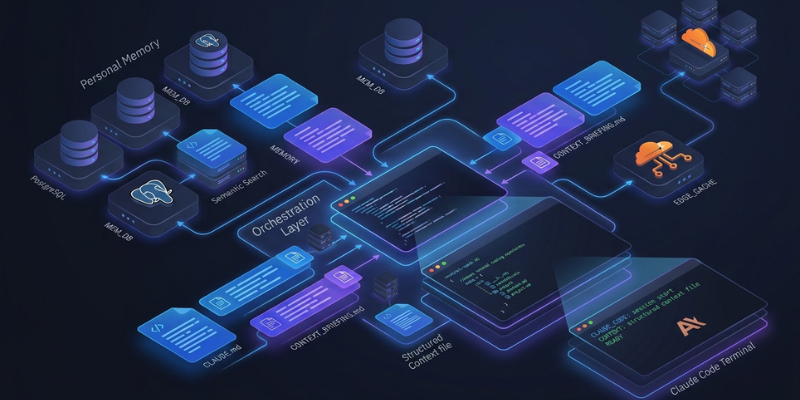
A new system called PrimeAgentOrchestrator (PAO) is taking a different approach to that problem. Instead of changing the underlying AI model, it retrieves relevant information from existing personal memory systems and gives a fresh Claude Code agent that context before it starts working.
Created by Myron Koch of Peak Summit Labs, PAO is designed to spawn new instances of Anthropic’s terminal-based Claude Code with a prepared memory briefing. The system is documented in an experience report covering four months of regular deployment from December 2025 through March 2026.
The project is significant because it treats memory as an external infrastructure layer rather than something that must be permanently built into the AI model.
One distinction is important from the start: PrimeAgentOrchestrator is not an Anthropic product or a newly announced Claude Code feature. It is an external orchestration system built around Claude Code.
Why AI Coding Agents Have a Cold-Start Problem
A coding agent can accumulate a large amount of useful information during a development session.
It may learn:
- How a project is structured
- Which architecture decisions were made
- What bugs have already been investigated
- Which tools and databases are being used
- What coding conventions a developer prefers
- Which approaches have already failed
- What remains unfinished
But when another session starts, that information may not automatically be available.
The developer can explain everything again. The agent can search through files and reconstruct the project’s state. Or an external system can retrieve relevant information before the agent begins.
That third approach is what PrimeAgentOrchestrator attempts to provide.
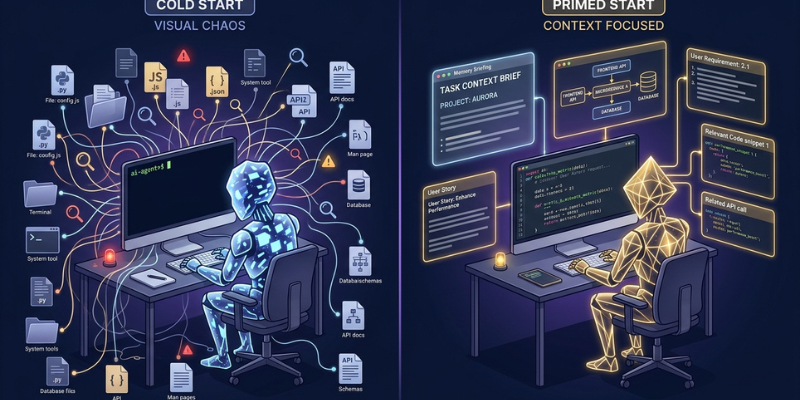
Koch describes the issue as the cold-start problem for LLM coding agents. His existing memory infrastructure already contained information accumulated through previous work, but a new Claude Code session could not access that knowledge at initialization.
The problem becomes more important as AI moves beyond simple question-and-answer interactions. A chatbot can often start fresh without much consequence. An AI coding agent working on a long-running project cannot.
That is also why AI automation workflows are increasingly moving toward systems that connect models with persistent data, tools, and orchestration layers.
What Is PrimeAgentOrchestrator?
PrimeAgentOrchestrator is an external system that prepares a new Claude Code agent with relevant memories before the session begins.
Its basic workflow looks like this:
Existing memory → Retrieval → Context briefing → Claude Code → Development task
The system queries existing memory sources, combines the relevant results into a structured briefing, places that briefing in the agent’s working environment, and then starts Claude Code.
The objective is not to make Claude Code permanently remember every previous conversation.
Instead, PAO attempts to answer a narrower question:
What information from previous work should this new agent know before it starts?
The underlying research paper describes PAO as a system that spawns Claude Code instances pre-loaded with relevant memories from the user’s existing personal databases.
How PrimeAgentOrchestrator Works
PAO combines memory retrieval with agent orchestration.
It Queries Existing Memory Systems
The system does not begin by building a single giant database containing everything the user has ever done.
Instead, it connects to existing memory infrastructure.
The implementation described by Koch queries two independently operated backends in parallel:
- A PostgreSQL entity-observation database
- A Cloudflare Worker semantic-search index
The results are retrieved using backend-specific strategies and then combined into a briefing for the new agent.
This approach allows PAO to reuse information that has already been collected rather than forcing the user to migrate everything into a new memory system.
It Compiles the Retrieved Information
The retrieved memories are not simply dumped into Claude Code.
PAO compiles the results into a structured context briefing.
That distinction matters because retrieving too much information can create another problem. An AI agent has limited context, and irrelevant memories can distract it just as missing information can slow it down.
The objective is therefore not maximum retrieval.
It is relevant retrieval.
It Uses Filesystem Injection
PAO eventually settled on a filesystem-based method for delivering the briefing.
The system creates a file called CONTEXT_BRIEFING.md inside the agent’s working directory. It also creates a CLAUDE.md file that points the agent toward the briefing.
This allows the new Claude Code session to discover the prepared context through its existing configuration and filesystem behavior.
The reported pipeline for querying the memory systems, compiling the information, and creating the files takes about 586 milliseconds on average.
That is the key architectural idea behind PAO: prepare the context before the agent starts rather than trying to inject it after the session is already running.
Why PAO Uses Multiple Memory Backends
One of the more interesting aspects of the project is its decision not to create a unified memory database.
Instead, PAO follows a bridge rather than own approach.
Existing databases continue to store information, while the orchestrator connects them to the AI agent when needed.
That can make the infrastructure more flexible.
A developer can maintain different databases for different types of information, while the orchestrator becomes the layer responsible for retrieving and preparing context.
But this approach also creates engineering challenges.
Different databases can use different schemas, retrieval methods, ranking systems, and data structures. The orchestrator therefore has to reconcile information coming from systems that were not necessarily designed to work together.
That tradeoff is central to the research. The project explores whether it is more practical to bridge heterogeneous memory systems than to build one unified memory layer.
The same broader principle can be seen in enterprise AI systems, where orchestration layers connect multiple tools and data sources rather than forcing every workflow into one application. AiToza’s coverage of AI-powered workflow orchestration explores this wider shift toward AI systems that coordinate data, tools, and autonomous agents.
Three Versions Were Needed to Make Context Delivery Reliable
PrimeAgentOrchestrator was not built successfully on its first attempt.
Koch describes three generations of context-delivery mechanisms, with each version created to solve problems discovered in the previous one.
Version One: Clipboard Injection
The first approach relied on a temporary file and clipboard-based terminal automation.
The problem was timing.
Claude Code could take several seconds to initialize its environment and load MCP servers. If the automated input arrived too early, the text could disappear before the agent was ready to process it.
The system therefore had a classic automation race condition.
The memory was ready.
The agent was not.
Version Two: Readiness Polling
The next version attempted to determine when the terminal was ready before sending the context.
This reduced some failures but introduced another problem.
A terminal could appear ready even though the underlying agent was still initializing.
In other words, the system had found a signal for readiness, but the signal was not reliable enough.
Version Three: Filesystem Injection
The third approach changed the architecture.
Instead of trying to send the context at exactly the right moment, PAO placed the briefing in the working directory before Claude Code launched.
The CONTEXT_BRIEFING.md file could then be referenced through CLAUDE.md.
This removed the dependency on terminal timing and made the process considerably more robust.
The progression is important because it shows that AI agent orchestration is not only a model problem.
It is also a systems-engineering problem involving startup states, filesystems, terminal automation, trust dialogs, error detection, and timing.
Did Memory Actually Make Claude Code Better?
The research provides a more nuanced answer than simply saying that memory improves AI agents.
Koch compared five cold agents with five primed agents across a set of tasks. Responses were evaluated for specificity, accuracy, and actionability, with a maximum score of 15.
The reported results were:
| Task | Cold Agent | Primed Agent |
|---|---|---|
| Backchannel architecture | 4 | 9 |
| MCP server inventory | 11 | 8 |
| App Store notarization | 3 | 10 |
| Cloudflare infrastructure | 12 | 10 |
| Agent orchestration | 6 | 11 |
The primed agents achieved an average score of 9.6, compared with 7.2 for cold agents.
They won three of the five task comparisons.
But cold agents won two.
That detail is important.
The research does not show that adding memory automatically makes an AI coding agent better at every task.
Instead, it suggests that memory can be particularly useful when the task depends on knowledge from previous work.
Why a Cold Agent Can Sometimes Win
A fresh agent has one unexpected advantage: it starts exploring immediately.
Without a memory briefing, it may quickly:
- Search the filesystem
- Inspect project files
- Call available tools
- Examine configuration
- Investigate the current environment
A memory-primed agent has another job first.
It must process the supplied context.
That can be beneficial when the briefing contains information the agent would otherwise have to reconstruct. But it can also create overhead when the required information is easy to discover through tools.
This creates an important distinction between recall and exploration.
If the question is:
What did we decide about this architecture last month?
Memory can be extremely valuable.
If the question is:
What files are currently in this directory?
The agent may be better off simply checking.
The results therefore point to a broader principle for AI agent memory: more context is not necessarily better context.
The right context has to be relevant to the task.
The research also has to be interpreted within its limits. It is an experience report based on a small evaluation rather than a large benchmark designed to establish universal performance improvements.
The Memory Retrieval Problem Is Just as Important
PAO’s development also exposed a problem with one of its earlier memory sources.
The system originally queried three databases. One of them, Reminisce, used keyword substring matching.
That created false positives.
For example, a search for “quantum error correction codes” returned unrelated memories because words such as “error” and “correction” appeared in previous software debugging work.
This is a useful example of why AI memory cannot be judged only by storage capacity.
A system can remember thousands of facts and still be ineffective if it retrieves the wrong ones.
After evaluating retrieval quality across 15 tasks, Koch reported that removing the problematic backend reduced false positives on control tasks from 12 to 4, while in-domain precision remained almost unchanged, moving from 56.9% to 57.4%.
The lesson is straightforward:
AI agents need useful memory, not simply more memory.
PAO Also Solves Agent Startup Problems
Memory retrieval is only part of the system.
PAO also manages parts of the Claude Code lifecycle, including trust pre-seeding, readiness polling, error detection, and adaptive terminal text injection.
One problem involved workspace trust.
When Claude Code opened an unfamiliar directory, a trust dialog could interrupt terminal input. If automated input arrived while the dialog was active, the context could disappear without an obvious failure signal.
This illustrates why agent orchestration can become complicated very quickly.
A successful system needs to coordinate:
Memory retrieval → Context preparation → Environment setup → Agent launch → Input delivery → Error handling
PAO therefore goes beyond being a memory layer. It is an orchestration system designed to manage the entire process of creating a prepared coding agent.
What PrimeAgentOrchestrator Means for AI Coding Agents
The bigger idea behind PAO extends beyond Claude Code.
It suggests that persistent AI agents do not necessarily require every piece of long-term knowledge to live inside the model itself.
Instead, external infrastructure can provide continuity.
A simplified architecture could look like:
User data → Memory layer → Orchestrator → AI agent → Tools
The memory layer stores information.
The orchestrator retrieves relevant information.
The agent reasons over that context.
The tools allow the agent to act.
This separation could eventually make AI agents more flexible because the same memory infrastructure could potentially serve different agents and workflows.
It also fits the wider movement toward agentic AI and intelligent automation, where AI systems increasingly need to coordinate multiple tools, data sources, and actions instead of simply generating a response.
PrimeAgentOrchestrator Is Not a New Claude Code Feature
There is an important distinction for developers following the story.
Anthropic did not announce PrimeAgentOrchestrator.
The project was created externally and uses Claude Code as the coding agent it spawns.
The original research paper describes PAO as a system that launches new Claude Code instances and supplies them with relevant memories from existing personal databases.
So claims that “Claude Code now has permanent memory” would be inaccurate.
A more precise description is:
PrimeAgentOrchestrator gives newly spawned Claude Code agents access to selected memories before they begin working.
That makes the project an example of external AI infrastructure rather than a new built-in Claude capability.
What the Research Does Not Prove
The results are promising, but they should not be overstated.
The paper is an experience report covering four months of regular deployment. It documents how the system was built, how it evolved, and what the developer observed during real-world use.
It is not a large-scale controlled study.
The evaluation also involved a small number of tasks and agents.
That means the findings do not establish that memory priming will improve every Claude Code workflow or every AI coding agent.
There is also a technical dependency on Claude Code’s current configuration and filesystem behavior. If that behavior changes, an external orchestration system built around it may need to change as well.
These limitations do not make the project unimportant.
They simply put its findings into the right context.
PAO is evidence of a practical approach to agent memory, not proof that the problem has been completely solved.
What Could Come Next?
The project is already pointing beyond a single primed coding agent.
Koch describes a direction involving multiple primed agents running simultaneously, coordinated through a real-time dashboard that can display agent status, tasks, and communication.
That would represent a significant step beyond simply giving one agent a memory briefing.
An orchestration system could potentially:
- Select an agent for a specific task
- Retrieve relevant memories
- Launch several agents
- Monitor their progress
- Coordinate communication
- Combine their results
- Preserve useful information for future sessions
The result would look less like a conventional chatbot and more like a persistent AI workspace.
The Bigger Picture
PrimeAgentOrchestrator tackles a simple but increasingly important problem: a capable AI coding agent can still waste time if it does not know what happened before it started.
Its solution is to keep memory outside the model, retrieve relevant information when a new agent is created, and provide that context through the agent’s working environment.
The early results are promising but mixed.
Memory-primed agents achieved a higher average score in the reported evaluation, but cold agents still performed better on some tasks. The project also demonstrated that poor retrieval can introduce irrelevant context and that reliable agent orchestration requires much more than simply storing information.
The most important takeaway is therefore not that Claude Code suddenly gained permanent memory.
Instead, PrimeAgentOrchestrator demonstrates a broader shift in AI development:
The infrastructure surrounding an AI model may become just as important as the model itself.
As coding agents take on longer and more complex projects, persistent context, high-quality retrieval, and reliable orchestration could become essential components of the developer stack.
For now, PAO offers one practical answer to the cold-start problem: retrieve the knowledge that already exists, turn it into useful context, and give the next AI coding agent a head start.
Frequently Asked Questions
What is PrimeAgentOrchestrator?
PrimeAgentOrchestrator is an external orchestration system that retrieves relevant information from personal memory databases and provides it to newly spawned Claude Code agents.
Is PrimeAgentOrchestrator an Anthropic product?
No. It was developed by Myron Koch and works externally with Claude Code.
Does PrimeAgentOrchestrator give Claude Code permanent memory?
No. It provides selected external memories to a new Claude Code session at startup.
What memory systems does PAO use?
The documented implementation queries a PostgreSQL entity-observation database and a Cloudflare Worker semantic-search index.
What is the cold-start problem in AI coding agents?
It is the problem of a new agent session beginning without the useful context accumulated during previous work.
Did memory always improve the AI agents in the evaluation?
No. Primed agents performed better overall, but cold agents outperformed primed agents on two of the five reported task comparisons.
How long was PrimeAgentOrchestrator tested?
The experience report covers four months of regular deployment, from December 2025 through March 2026.