
Enterprise AI is entering a new phase. The challenge is no longer simply finding a model that can reason well, generate high-quality content, or answer difficult questions. Businesses also need to control what happens after an AI agent receives a task: how many model calls it makes, how much context it processes, how often it repeats information, and how much the complete workflow costs.
Writer is targeting that problem with Palmyra X6, its latest enterprise-focused AI model. The model is designed for agentic workloads in which an AI system can plan, use tools, retrieve information, evaluate results, and continue through multiple steps before completing a task.
The release is particularly notable because Writer is focusing on both the model and the system surrounding it. A July 2026 research paper from Writer argues that the orchestration layer, or “harness,” can significantly influence token consumption, latency, and cost. In a controlled evaluation involving 22 enterprise tasks and six models, Writer reported that its Agent Harness reduced blended cost per task by 41%, tokens per task by 38%, and median execution time by 44%.
These are vendor-reported research findings from an arXiv preprint, so they should be viewed as evidence of Writer’s approach rather than a universal guarantee. Nevertheless, the results highlight an increasingly important question for businesses: How much does it cost to complete an AI task, rather than simply generate an AI response?
What Is Palmyra X6?
Palmyra X6 is Writer’s flagship enterprise AI model focused on multi-step and agentic workflows. Instead of treating AI as a system that simply receives a prompt and returns an answer, Writer is designing around workflows where an agent has to complete a larger objective.
For example, an enterprise research agent could receive a request to analyze a market. It might interpret the objective, search approved sources, retrieve internal documents, compare findings, create a report, identify missing information, and revise the final result.
The user sees one completed task. Behind the scenes, however, the agent may perform numerous model calls and tool interactions.
That difference is central to Palmyra X6.
Writer’s broader Palmyra model family is positioned around enterprise capabilities such as reasoning, tool calling, retrieval-augmented generation, coding, multilingual tasks, and industry-specific applications. Writer describes its models as being built for mission-critical workflows rather than only general consumer conversations.
Why Enterprise AI Agents Need Token Efficiency
Tokens are the basic units that AI models process when reading and generating information. For a short chatbot interaction, token consumption may be relatively easy to manage.
Agentic workflows are different.
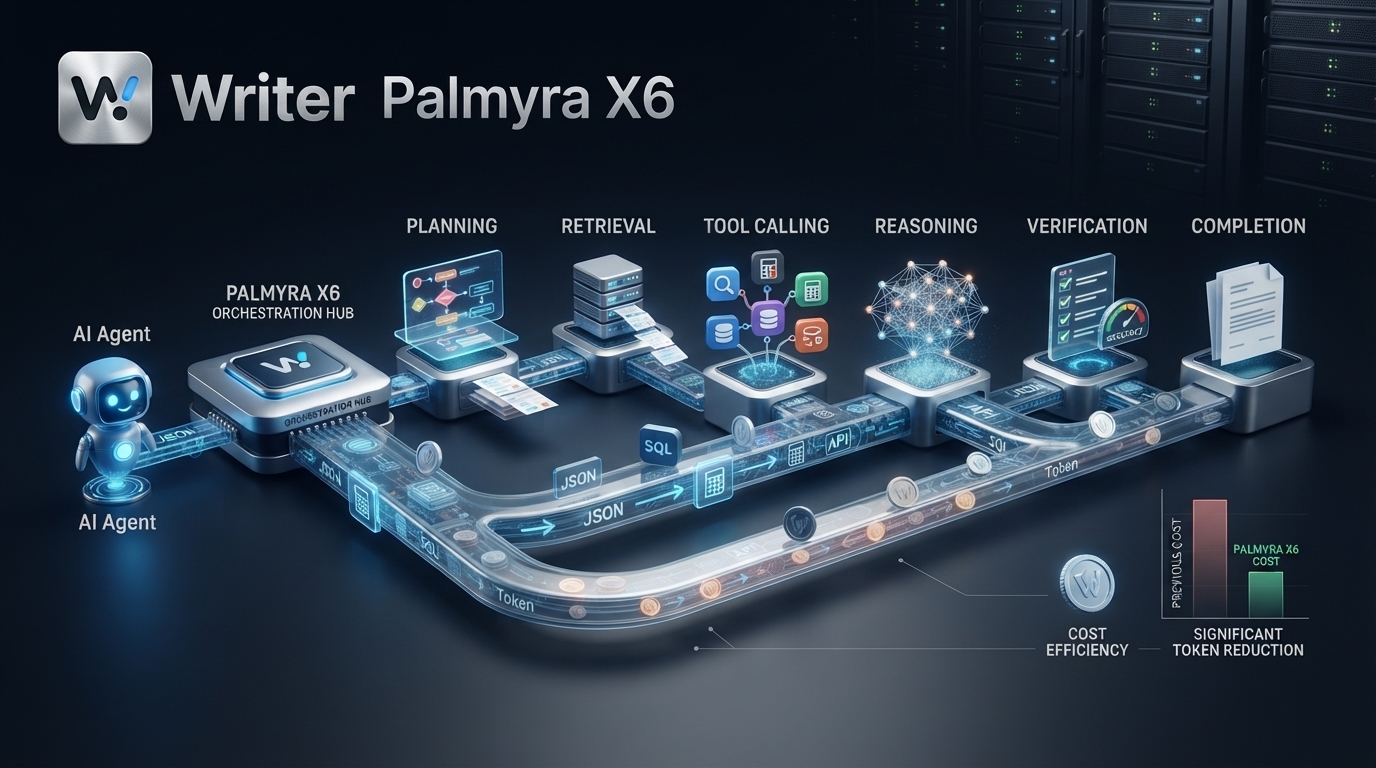
A single request can trigger a chain of operations:
- Understand the user’s objective.
- Create a plan.
- Retrieve relevant information.
- Call an external tool or API.
- Analyze the tool’s response.
- Perform another action.
- Verify the result.
- Generate the final output.
Every additional model interaction can increase token usage and latency.
Large contexts can make the problem even more expensive. If an agent repeatedly sends the same instructions, documents, tool results, or conversation history back to a model, the amount of processed information can grow quickly.
This means enterprises need to look beyond the advertised cost per million tokens.
A more useful measurement can be cost per successful task.
A model with a low token price may still become expensive if it requires many calls to finish a workflow. Similarly, a more capable model could deliver better economics if it completes a task with fewer unnecessary interactions.
The Foundation Behind Palmyra X6
Palmyra X6 represents an interesting shift in Writer’s model strategy because it was not trained entirely from scratch.
Reporting on the release describes Palmyra X6 as a post-trained version of Z.ai’s GLM-5.2 open-weight mixture-of-experts model.
Starting with an existing foundation gives Writer an opportunity to concentrate resources on specialization, post-training, enterprise behavior, and orchestration instead of building every component of a foundation model from the ground up.
The approach also reflects the wider growth of open-weight AI. Companies can use capable open-weight foundations as starting points and then adapt them to particular workloads.
For Writer, however, the foundation model is only one part of Palmyra X6’s value proposition.
The company is pairing the model with an agentic execution layer designed to make multi-step work more efficient.
How the Writer Agent Harness Reduces AI Costs
The most important idea behind Writer’s latest research is that an AI agent can waste tokens because of how it is orchestrated, not only because of the model it uses.
Writer’s July 2026 preprint, The Harness Effect: How Orchestration Design Sets the Token Economics of Enterprise Agentic AI, compared a conventional production agent loop with the Writer Agent Harness while keeping the underlying models constant. The evaluation covered 22 locked enterprise tasks and six models, including Palmyra X6, Claude Sonnet 4.6, Gemini 3.1, Gemini Flash 3.5, Qwen 3.6, and GLM 5.1.
Across the combined evaluation, Writer reported:
- 41% lower cost per task
- 38% fewer tokens per task
- 44% lower median wall-clock time
- Cost reductions across all six tested models
For Palmyra X6 specifically, Writer reported a 52% reduction in cost per task, from $0.25 to $0.12, and a 48% reduction in median execution time.
These results are important because they suggest that optimization does not have to come exclusively from developing a more powerful model.
It can also come from improving the system that controls the model.
What an AI Agent Harness Actually Does
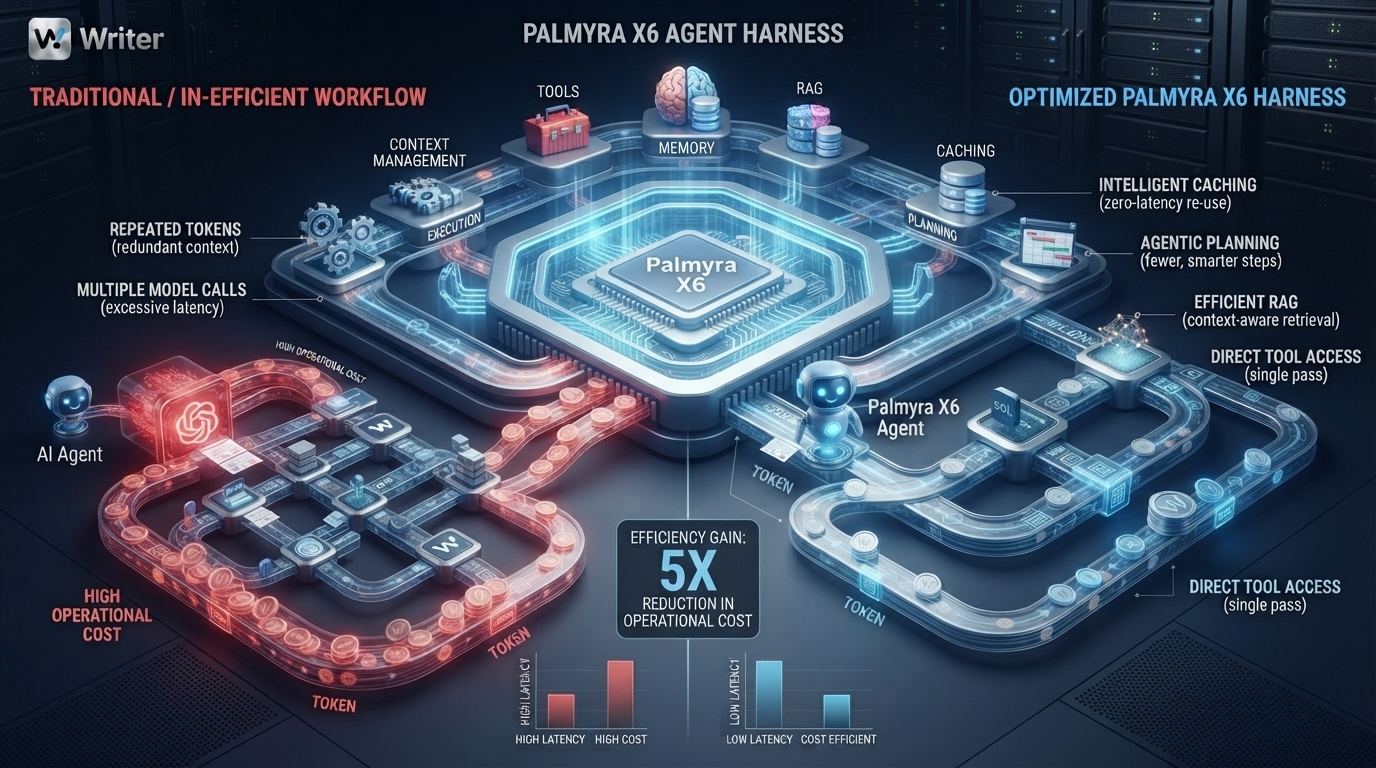
An agent harness is essentially the orchestration layer connecting the model with tools, data, memory, instructions, and execution logic.
One of its most important responsibilities is context management.
An agent needs previous information to make good decisions, but sending everything from every earlier step into every new model call can be inefficient. A good harness can preserve relevant context while reducing unnecessary repetition.
Tool management is another important factor.
An enterprise agent may have access to dozens of tools, APIs, databases, or connectors. Giving the model unnecessary information about every available tool can increase context size and make decision-making more complicated.
A well-designed harness can expose the appropriate tools at the appropriate stage.
Caching can also improve efficiency. If parts of a prompt or context are repeatedly reused, caching can reduce the effective cost of processing repeated information. Writer’s research specifically analyzes prompt-cache economics as part of its explanation of agent efficiency.
Failure handling matters too. An agent that repeatedly retries failed operations can consume tokens without creating additional business value.
The harness can therefore become a control layer for context, tools, retries, delegation, and execution.
Why Palmyra X6 Targets Multi-Step Tasks
Palmyra X6 is designed around a category of AI work that is becoming increasingly important for enterprises: multi-step workflows.
Consider an AI agent responsible for preparing a business report.
It might need to search company databases, retrieve documents, analyze financial information, compare sources, summarize findings, and prepare a final presentation.
A traditional chatbot is mainly optimized for generating an answer.
An agentic system is optimized for completing the process.
Writer has been building its broader platform around this concept. Its Agent Builder supports workflows involving business logic, tool calling, and RAG-based knowledge retrieval.
This makes Palmyra X6 particularly relevant to businesses looking beyond simple AI assistants.
Palmyra X6 and the Bigger-Model Strategy
For years, AI development has been heavily focused on scaling models.
Larger and more capable models can improve reasoning, coding, knowledge, and complex problem-solving. But enterprise AI introduces another requirement: economic efficiency.
The important question becomes:
How much does it cost to successfully complete a business task?
That is different from asking how much a model costs per million tokens.
Palmyra X6 represents this broader shift. Writer is still focused on model capability, but it is also emphasizing orchestration, latency, token consumption, and workflow efficiency.
This does not mean bigger models are becoming irrelevant. Strong models remain valuable for difficult reasoning and complex workflows. In fact, Writer’s research suggests that stronger models may gain more quality benefits from effective orchestration.
The practical lesson is to evaluate the entire AI system rather than choosing a model based on size or benchmark scores alone.
What the 50% Cost Reduction Really Means
The headline around Palmyra X6 is closely connected to its reported cost reductions.
Writer’s research reported a 52% reduction in cost per task for Palmyra X6 within its evaluation. The broader test across six models produced a 41% reduction in blended cost per task.
However, these figures should not be interpreted as a guaranteed 50% saving for every enterprise.
Real-world costs can vary based on:
- workflow complexity;
- number of agent steps;
- model pricing;
- context size;
- tool calls;
- caching;
- infrastructure;
- concurrency;
- failed agent runs; and
- the complexity of the business task.
A simple workflow may produce very different results from a long-running research or automation agent.
The more defensible conclusion is that agent orchestration can have a measurable effect on AI economics.
Writer’s Model-Agnostic Direction
Another important part of Writer’s strategy is model flexibility.
Enterprise organizations often need more than one model. A company may choose one model for reasoning, another for coding, another for speed-sensitive tasks, and specialized models for specific business functions.
Writer has previously supported external model integrations alongside its Palmyra models. Its documentation, for example, describes using Amazon Bedrock models through Writer while maintaining centralized model management and governance.
This makes the orchestration layer strategically important.
If an efficient harness can reduce unnecessary work regardless of the underlying model, enterprises can potentially carry those efficiency improvements across different models.
That is a different proposition from simply selling one model.
Palmyra X6 in the Enterprise AI Landscape
The broader enterprise AI market is also moving toward systems that combine models with automation, data, and workflows.
For example, businesses exploring AI business automation tools are increasingly looking for platforms that can connect intelligence with real operational processes. AiToza’s coverage of enterprise automation tools shows how products are moving beyond basic chat interfaces toward workflow execution and business process automation.
Platforms such as UiPath AI and ServiceNow AI illustrate this broader direction. Both connect AI capabilities with enterprise workflows, automation, business systems, and operational processes.
This makes Palmyra X6 part of a larger movement in enterprise software: AI is becoming an execution layer rather than simply an answer-generation layer.
Why Cost Per Completed Task Could Become the Key Metric
As organizations deploy more AI agents, token spending can become difficult to control.
A company might initially celebrate a lower price per million tokens. But if employees begin running more agents, workflows become longer, and models perform more reasoning steps, overall spending can continue to rise.
This creates a need for better operational metrics.
Instead of measuring only tokens consumed, businesses may increasingly track:
Cost per completed task
Tokens per completed task
Time to completion
Successful task rate
Tool calls per workflow
Failure and retry rates
These measurements provide a clearer picture of whether an AI deployment is actually becoming more efficient.
Writer’s research reinforces this idea by measuring the economics of the full workflow rather than focusing only on the model’s individual token price.
What Palmyra X6 Means for Enterprise AI
Palmyra X6 represents a broader change in AI development: from optimizing models in isolation to optimizing the complete AI system.
The model still matters. Intelligence, reasoning ability, tool use, context handling, and reliability remain critical.
But the surrounding architecture matters too.
Efficient context management can reduce repetition. Better tool selection can limit unnecessary information. Caching can reduce repeated processing. Failure controls can prevent wasted calls. Planning can help an agent reach its goal with fewer unnecessary steps.
Together, these improvements can influence the economics of AI agents at scale.
Writer’s Palmyra X6 approach combines a post-trained GLM-5.2 foundation with an agentic harness designed for enterprise workflows. The company’s reported results suggest that the combination can reduce token consumption and execution costs substantially in tested scenarios.
Enterprises should nevertheless validate those claims against their own workloads. A production evaluation should measure quality, latency, token usage, failure rates, tool calls, and total cost per successful task.
That last measurement could become increasingly important as AI agents move from experimental projects into everyday business operations.
The future of enterprise AI may therefore not belong simply to the largest model. It may belong to the systems that turn strong models into reliable, efficient, and economically sustainable workflows.
Palmyra X6 is Writer’s latest attempt to build exactly that kind of system.