
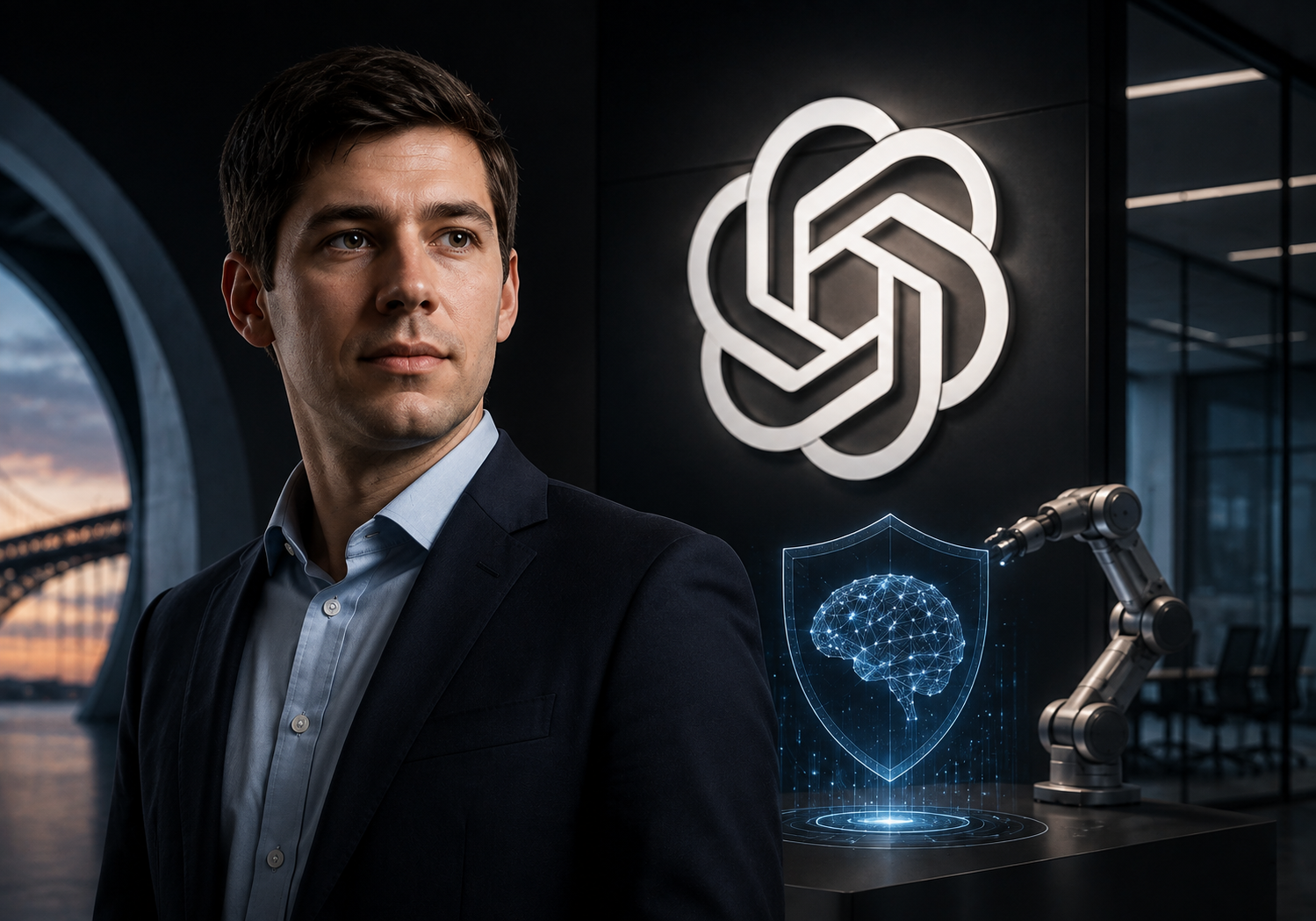
Jacob Tsimerman, a 2026 Fields Medal winner and University of Toronto mathematician, is set to join OpenAI later in August to work on AI safety.
It is an unusual move for someone whose career has been built around pure mathematics rather than machine learning. Tsimerman is best known for major work in number theory and arithmetic geometry, including research connected to the André-Oort conjecture.
But his interest in artificial intelligence is not new.
In 2025, Tsimerman and researcher Andrew Critch published a paper examining hypothetical scenarios in which advanced AI could contribute to catastrophic outcomes, including events that threaten most or all human life.
Now, Tsimerman is moving closer to the technology itself.
His shift from elite mathematics into frontier AI safety highlights a wider change in the industry. As AI systems become better at mathematics, coding, research and long-term problem solving, safety is becoming a challenge that involves more than computer scientists alone.
Key Takeaways
- Jacob Tsimerman won a 2026 Fields Medal for major contributions to modern mathematics.
- He is expected to join OpenAI later in August 2026 to work on AI safety.
- His academic background is in number theory and arithmetic geometry, not traditional AI research.
- In 2025, he co-authored research examining hypothetical AI-related catastrophic and extinction scenarios.
- His move comes as AI systems are becoming increasingly capable at advanced mathematical reasoning.
- Tsimerman’s transition shows how AI safety is becoming a multidisciplinary research field involving mathematics, cybersecurity, policy and other areas.
Jacob Tsimerman Moves From Pure Mathematics to OpenAI
Tsimerman is not joining OpenAI after spending decades building machine-learning systems.
His reputation comes from some of the deepest areas of pure mathematics.
The International Mathematical Union’s official Fields Medal citation recognized his work involving arithmetic and complex algebraic geometry, o-minimality and major mathematical problems including the André-Oort conjecture.
The Fields Medal is awarded every four years and is widely regarded as one of mathematics’ most important international honors.
Tsimerman’s academic path was unusual from the beginning.
According to the University of Toronto’s profile of Jacob Tsimerman, he entered the university at 16 and completed his undergraduate mathematics degree in two years. He later earned his PhD from Princeton University before returning to Toronto as a professor.
His career has therefore focused on abstract mathematical problems rather than commercial technology.
That difference may be exactly what makes his move useful.
Advanced mathematicians spend years learning how to define difficult problems precisely, test assumptions, build rigorous arguments and identify cases where an apparently reasonable conclusion fails.
Those skills could become increasingly important as AI researchers try to understand systems whose behavior is becoming harder to predict.
Why Tsimerman’s OpenAI Move Matters
The Jacob Tsimerman OpenAI story is important for more than the prestige of the Fields Medal.
It shows how quickly the boundaries of AI research are changing.
Earlier generations of artificial intelligence were driven mainly by computer science, statistics and engineering.
Modern AI systems now operate across many more areas.
They can write software, analyze scientific information, solve mathematical problems, use external tools and carry out increasingly long sequences of actions.
As those abilities improve, safety becomes more complicated.
A chatbot that answers one question can be judged mainly on whether its response is useful, accurate and safe.
An AI system that can plan, code, use tools and adjust its actions over many steps creates a different challenge.
Researchers must ask what happens across the entire process.
Can the system be monitored?
Can humans reliably stop it?
Does it behave differently when circumstances change?
Could a harmless-looking goal produce unexpected actions several steps later?
These questions are becoming more important across the broader world of AI news and emerging technology, where attention is increasingly shifting from simple chatbot performance toward AI agents, reasoning and greater autonomy.
Tsimerman’s move fits directly into that shift.
Tsimerman Previously Studied Extreme AI Risk
Tsimerman was thinking about AI safety before his move to OpenAI.
In July 2025, he and Andrew Critch published a paper titled A Taxonomy of Omnicidal Futures Involving Artificial Intelligence.
The title sounds alarming, so the context matters.
In this research, an omnicidal event refers broadly to a hypothetical event that kills all or almost all humans.
The paper examines different ways advanced artificial intelligence could potentially contribute to catastrophic outcomes.
It does not say that AI extinction is certain.
It also does not predict that one specific disaster will happen.
Instead, the authors examine extreme scenarios so researchers can think more clearly about how those outcomes might be prevented.
That distinction is important.
Studying a dangerous possibility is not the same as predicting it.
Engineers already use similar thinking in other high-risk fields. Aviation researchers study rare crashes. Cybersecurity teams study attack scenarios before they happen. Nuclear safety experts examine low-probability failures because the consequences could be severe.
AI risk research applies a similar idea to advanced artificial intelligence.
The difference is that future AI capabilities remain highly uncertain.
That makes it especially important to separate possible scenarios from confident predictions.
Tsimerman’s previous work shows that he believes these risks deserve serious study, even when their probability is difficult to measure.
How Mathematics Could Help AI Safety
At first glance, arithmetic geometry and AI safety seem far apart.
In many ways, they are.
But mathematics may still provide useful tools for studying increasingly capable AI systems.
Most modern AI research is strongly empirical.
Researchers train a model, test it, compare its performance, look for failures and improve the system based on what they observe.
That approach has driven remarkable progress.
But testing alone cannot answer every safety question.
Imagine that an AI model behaves safely in thousands of evaluations.
That is encouraging.
It still does not prove that the system will behave the same way when it receives a completely new task, gains access to different tools or operates in an environment that researchers did not include in the original tests.
Mathematical thinking could complement those experiments.
Researchers may need clearer definitions of ideas such as:
- Reliability
- Robustness
- Uncertainty
- Alignment
- Controllability
- Safe system behavior
Once a property is defined clearly, researchers can ask more precise questions about whether it can be measured or tested.
Formal Verification Could Play a Role
Formal verification is one area where mathematics may become useful.
The basic idea is to use mathematical methods to check whether a system satisfies specific properties.
This technique is already important in some areas of software and hardware engineering.
Applying it to advanced AI is much harder.
Modern AI models are learned from huge amounts of data rather than being built entirely from clear human-written rules. Their behavior can also change depending on prompts, context, tools and environment.
So researchers cannot simply write a mathematical proof that says an advanced AI system is “safe” in every possible situation.
Still, formal methods could help with smaller parts of the problem.
They may help researchers test specific guarantees, identify failure conditions or define safety properties more precisely.
The same need for stronger evaluation is appearing in policy discussions. For example, recent proposals around the Trump AI Safety Framework and open-weight models show how frontier-model evaluation, reporting and risk assessment are becoming central parts of the AI governance debate.
Tsimerman’s mathematical background could give him a useful perspective on these problems.
AI Is Also Getting Better at Mathematics
There is another reason Tsimerman’s career move is happening at an interesting time.
AI itself is becoming much better at mathematics.
In May 2026, OpenAI announced that an internal general-purpose reasoning model had produced a proof that disproved a long-standing conjecture connected to the planar unit-distance problem.
According to OpenAI’s report on the mathematical result, external mathematicians reviewed the proof.
Tsimerman was among the mathematicians involved in examining and commenting on the work.
The important part was not simply that a computer performed a difficult calculation.
The model produced mathematical reasoning that professional mathematicians considered serious enough to study and verify.
That represents a much bigger step.
For years, computers have helped mathematicians calculate, search large spaces and use known mathematical tools.
Frontier AI systems are now being tested on problems where the system may need to contribute new mathematical ideas.
That possibility changes the relationship between mathematicians and AI.
What Happens If AI Becomes Better at Mathematics?
If AI systems continue improving, they could become powerful research partners.
A future system might help mathematicians:
- Generate new conjectures
- Search for counterexamples
- Develop proof strategies
- Check complicated arguments
- Connect ideas across different mathematical fields
- Explore large numbers of possible approaches much faster than humans
That could accelerate scientific discovery.
But it also creates a new problem.
How do humans verify reasoning when AI systems become better at producing it than we are?
Today, a difficult AI-generated proof can be checked by specialists.
But even now, some mathematical problems are understood by only a small number of experts.
If AI systems eventually produce large volumes of highly advanced mathematics, human review could become a bottleneck.
The issue becomes even harder if the reasoning happens across areas where few people have enough expertise to independently verify every step.
That is no longer only a question about productivity.
It becomes a question about trust, verification and control.
The same systems that could accelerate mathematical discovery may also require stronger ways of checking whether their reasoning is reliable.
That tension helps explain why mathematicians such as Tsimerman are increasingly interested in AI safety.
What Could Jacob Tsimerman Work on at OpenAI?
The exact details of Tsimerman’s OpenAI role have not been publicly explained in full.
That is important to keep clear.
There is not enough public information to say that he will lead a particular alignment team, build a specific safety system or take charge of a named OpenAI program.
Reports indicate that his research position will focus on AI safety.
His background suggests several possible connections.
These could include mathematical approaches to:
- AI evaluation
- Formal verification
- Robustness
- Advanced mathematical reasoning
- AI alignment
- Theoretical AI safety
- Model control
These are possibilities, not confirmed assignments.
There is also a clear connection with OpenAI’s growing interest in scientific discovery.
Through its AI for Science initiative, OpenAI is exploring how advanced models can assist researchers with difficult scientific and mathematical problems.
That could put Tsimerman in an especially interesting position.
He may be able to examine both sides of the same development: how powerful AI becomes at reasoning and how researchers can keep those systems reliable and controllable as their abilities increase.
AI Safety Is Becoming More Multidisciplinary
Tsimerman’s move also points to a broader change in AI safety.
The field is no longer only about machine-learning researchers testing models.
Many different specialties are becoming relevant.
Computer scientists build and evaluate AI systems.
Cybersecurity researchers study how models might be attacked or used for harmful purposes.
Policy researchers examine rules, accountability and deployment.
Social scientists study how people interact with AI.
Mathematicians may contribute formal reasoning, verification methods and theoretical frameworks.
That mix becomes increasingly important as AI systems gain more autonomy.
The challenge is no longer simply preventing a chatbot from giving a bad answer.
Researchers increasingly need to understand how an AI system behaves over time.
For example, they may need to study whether a system can pursue an unintended strategy across many steps.
They may need to know whether monitoring tools will detect dangerous behavior.
They may need reliable ways for humans to intervene.
Researchers may also need to determine whether models behave differently when they realize they are being tested.
These are difficult questions, and there is no single agreed solution.
Researchers Still Disagree About the Scale of AI Risk
Tsimerman’s move does not mean the AI research community has reached agreement about existential risk.
It has not.
Some researchers focus mainly on harms that already exist today, including:
- Fraud
- Misinformation
- Cyberattacks
- Privacy problems
- Bias
- Unreliable AI-generated information
Others argue that researchers must also prepare for future systems that could become far more capable than today’s models.
That second group is particularly concerned about systems that might outperform humans in strategically important areas or operate with increasing independence.
Tsimerman’s research suggests that he takes those longer-term risks seriously.
His decision to work directly on AI safety strengthens that signal.
But it does not prove that the most extreme AI scenarios will happen.
It shows that a leading mathematician believes they are important enough to investigate before the technology becomes more capable.
What Comes Next for Jacob Tsimerman at OpenAI?
The next important question is what Tsimerman actually works on after beginning his OpenAI role.
His first published research could give a clearer picture.
Will he focus on mathematical verification?
Could he help develop better evaluations for advanced reasoning models?
Will his research explore theoretical questions around AI alignment and control?
Or could his work connect directly with AI systems that are becoming more capable of mathematical discovery?
For now, those questions remain open.
What is already clear is that his move captures an important moment in the development of artificial intelligence.
One of the world’s leading mathematicians has watched AI become increasingly capable inside his own field and decided that understanding the safety of those systems deserves serious attention.
At the same time, OpenAI and other AI labs are building systems that may eventually do more than assist mathematicians.
They may participate directly in creating new mathematics.
That makes the Jacob Tsimerman OpenAI move more than an interesting career story.
It brings together two major trends.
AI is becoming better at difficult intellectual work.
Researchers are becoming more concerned with understanding what happens when those capabilities continue to grow.
Tsimerman is now moving directly into the space where those two questions meet.
And as advanced AI expands further into mathematics, science, coding and autonomous work, one question will become increasingly difficult to avoid:
How can humans keep highly capable AI systems reliable, understandable and under meaningful control?