
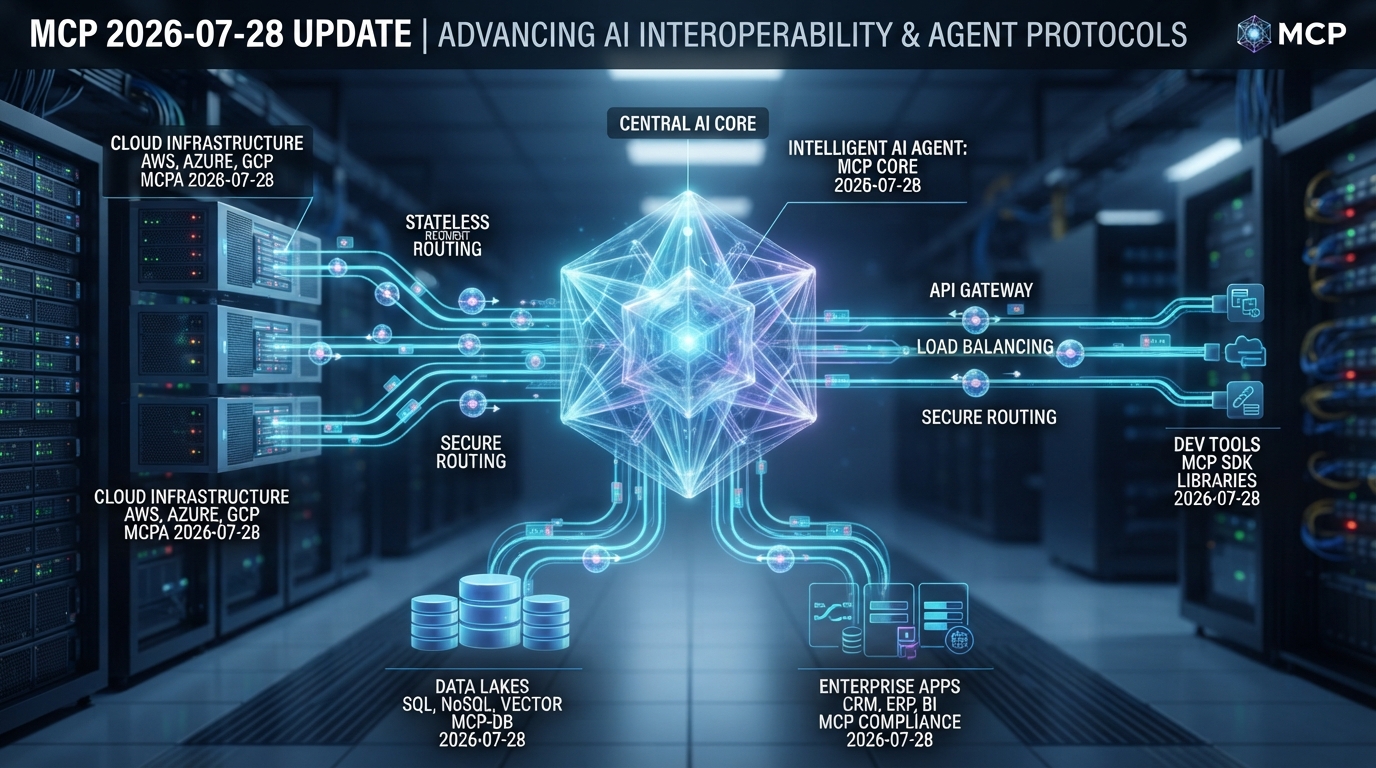
The MCP 2026-07-28 update changes how artificial intelligence agents connect with tools, applications and business data. It may not look as exciting as a new AI model, but its effects could be more practical for companies trying to move AI agents from experiments into real production systems.
The Model Context Protocol, commonly called MCP, provides a standard method for AI applications to discover and use external tools. Instead of building a separate integration for every model and service, developers can use MCP as a common connection layer.
The new specification removes much of the session-based architecture that previously made large MCP deployments difficult to manage. It also introduces stronger authorization rules, better routing, cacheable responses and official extensions for interactive interfaces and long-running tasks.
For readers following the growth of AI tools and applications, this release matters because it improves the infrastructure underneath many emerging agentic workflows. This guide explains what changed, why it happened, which risks remain and what developers should do next.
Quick answer: The MCP 2026-07-28 update makes the protocol stateless at its core. Requests can reach any available server instance without relying on a hidden session, making MCP easier to scale across cloud, serverless and enterprise infrastructure.
What Is the MCP 2026-07-28 Update?
The MCP 2026-07-28 specification is the fifth major release of the Model Context Protocol. It was published on July 28, 2026, following a release-candidate period that began on May 21.
The update was developed by MCP maintainers and contributors working across the wider ecosystem. MCP now sits under the Agentic AI Foundation, which the Linux Foundation formed to support open technologies for AI agents. The foundation also includes projects such as AGENTS.md and Block’s goose.
The release introduces several major changes:
- A stateless protocol core
- Self-contained requests
- Optional server discovery
- Multi Round-Trip Requests
- Header-based routing
- Cacheable tool, prompt and resource lists
- Stronger authorization
- A formal extensions framework
- Updated TypeScript, Python, Go and C# SDKs
- A minimum 12-month deprecation period
The maintainers describe it as one of the most significant revisions since MCP launched. Unlike a smaller feature release, it changes basic assumptions about how MCP clients communicate with servers.
Why MCP Needed a Major Redesign
Earlier versions of MCP commonly required a client to begin with an initialization handshake. The server would respond with a session identifier, and later requests had to remain connected to that session.
That process worked reasonably well for local development and smaller deployments. Problems appeared when companies tried to run several MCP server instances behind load balancers.
A request linked to one session could not always be sent safely to another server. Infrastructure teams often needed sticky routing, shared session storage or additional gateway logic to keep the connection working.
These requirements created several operational problems:
- Failed sessions after server restarts
- Complicated regional deployments
- Additional shared-storage costs
- More difficult autoscaling
- Greater load-balancer complexity
- Long-lived connections that consumed resources
- Gateways that needed to inspect request bodies
The release candidate described the production effect plainly:
“The practical effect on a production deployment is immediate.”
The redesign makes MCP behave more like standard request-and-response web infrastructure. This is especially relevant to companies building agentic workflows with platforms such as ServiceNow AI, where AI systems must interact reliably with many enterprise applications.
Stateful vs Stateless MCP
The central change in the MCP 2026-07-28 update is the move away from protocol-managed sessions.
A stateless protocol does not mean an AI application must forget everything. It means the protocol no longer depends on hidden state stored by one particular server instance.
Applications can still maintain conversation history, task progress, user preferences and workflow state. However, they must manage that information explicitly.
| Area | Earlier MCP Architecture | MCP 2026-07-28 |
|---|---|---|
| Initial connection | Required initialization handshake | Requests can begin directly |
| Session management | Server-issued session ID | Protocol session ID removed |
| Routing | Often required sticky routing | Any suitable server can respond |
| Server state | Frequently tied to one instance | State handled explicitly |
| Scaling | Shared session storage often needed | Standard horizontal scaling |
| Long-running work | Persistent connection patterns | Tasks or round-trip requests |
| Gateway routing | Body inspection may be required | Method and tool headers available |
| Failure recovery | Sessions could be interrupted | Requests are more independent |
Under the new design, each request carries information such as the protocol version, client identity and supported capabilities. A request can therefore be processed by any compatible server instance.
This helps MCP servers operate behind normal round-robin load balancers and across serverless or edge environments.
Every Major Change in the MCP 2026-07-28 Update
No Mandatory Initialization Handshake
Clients no longer need to establish a protocol session before making a request.
A client can call a tool directly, provided the request contains the necessary protocol and capability information.
This reduces the number of network steps required before useful work begins. It may also lower the chance that an initialization failure prevents an agent from performing a task.
Removal of the MCP Session ID
The former MCP-Session-Id mechanism has been removed from the protocol core.
This is the change most likely to affect existing implementations. Developers who used session IDs for routing, state recovery, authorization or logging will need to replace those assumptions with explicit application logic.
Optional Server Discovery
A new discovery method allows clients to inspect a server’s capabilities before making other requests.
However, discovery is optional. A client that already knows what the server supports can send a request without performing a separate negotiation step.
Multi Round-Trip Requests
Some agent tasks require a server to ask the client for more information.
For example, a purchasing tool may need the user to confirm a delivery address. A financial tool may require approval before completing a transaction.
Multi Round-Trip Requests allow the server to ask for missing information without keeping a bidirectional connection open. The client can return with the additional information and continue the original operation.
Header-Based Routing
The new specification can expose method and tool names through HTTP headers.
An API gateway may therefore route a tools/call request differently from a resource lookup without parsing the entire JSON body.
This can support:
- Faster routing decisions
- Tool-specific rate limits
- Usage metering
- Security policies
- Better monitoring
- Cleaner gateway configurations
Cacheable List Responses
MCP clients often request lists of available tools, prompts or resources. Repeatedly retrieving unchanged lists wastes bandwidth and processing time.
The MCP 2026-07-28 update allows servers to provide cache information for these responses. A client can reuse the result until the specified period expires.
Caching may also keep tool definitions more stable inside an AI model’s working context, although its real performance benefit will depend on the implementation.
MCP Apps and Tasks Explained
The update also formalizes an extensions framework. Extensions provide optional features without forcing every MCP client and server to support them.
Two important extensions are MCP Apps and Tasks.
MCP Apps
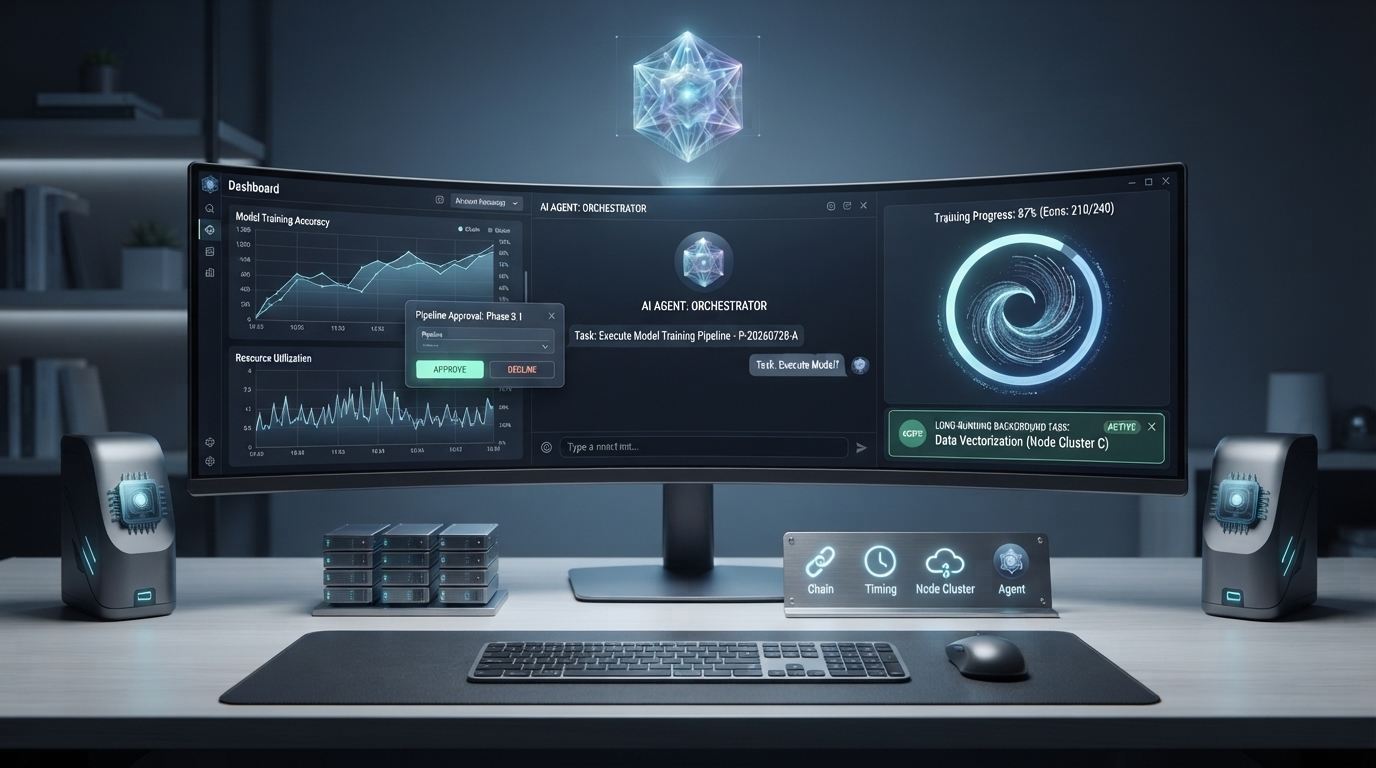
MCP Apps allow a server to render an interactive interface inside a compatible AI conversation.
Instead of returning only text, an MCP server could display:
- A chart
- A form
- A product selector
- A video player
- A dashboard
- An approval panel
- An editable data table
This gives users greater visibility into what an agent is doing. It can also make sensitive actions easier to review before approval.
MCP Tasks
Tasks support operations that take longer than a normal request.
A client can start a task, receive a durable handle and check its progress later. The operation does not need to keep one network connection open until completion.
Tasks could support:
- Large document analysis
- Codebase reviews
- Data exports
- Report generation
- Batch image processing
- Complex research workflows
- Multi-system business automation
The model is relevant to enterprise orchestration platforms such as Workato, where workflows may continue across several systems and require more than a single response.
| Requirement | Recommended MCP Feature |
|---|---|
| Display an interactive form | MCP Apps |
| Run a long analysis | Tasks |
| Ask a user for missing details | Multi Round-Trip Requests |
| Reduce repeated tool discovery | Cacheable list responses |
| Route calls by tool | Header-based routing |
Security Improvements and Remaining Risks
The MCP 2026-07-28 update strengthens authorization by aligning the protocol more closely with established OAuth and OpenID Connect practices.
One important change involves authorization-server issuer validation. This helps a client confirm which authorization server produced a response and reduces exposure to OAuth mix-up attacks.
RFC 9207 defines an issuer identifier that allows clients to verify the identity of the authorization server involved in a flow.
The update also improves credential binding and provides support for enterprise-managed authorization. This can allow administrators to provision approved MCP connections through an organization’s identity provider.
However, stronger authorization does not make every MCP server safe.
The specification still advises implementers to consider user consent, data privacy, permissions and the risks created by external code or data access.
The update does not automatically prevent:
- Prompt injection
- Malicious tool descriptions
- Tool poisoning
- Excessive permissions
- Compromised MCP servers
- Data leakage
- Unsafe autonomous actions
- Weak audit logging
- Poorly configured identity systems
Research into MCP threat models has identified tool poisoning and limited client-side validation as important risks. A protocol can secure the connection while the connected tool itself remains dangerous.
Businesses should therefore combine the new specification with least-privilege access, trusted-server policies, human approval for sensitive actions and detailed monitoring.
Which MCP Features Are Deprecated?
The update introduces a formal lifecycle for protocol features.
A feature can move through three stages:
- Active
- Deprecated
- Removed
At least 12 months must pass between deprecation and the earliest possible removal. This gives enterprise teams more time to plan upgrades and avoid sudden disruption.
Features identified for deprecation include:
- Roots
- Sampling
- Logging
- Dynamic Client Registration
- Legacy HTTP and Server-Sent Events transport
Deprecation does not mean these features stop working immediately. It means developers should avoid using them in new implementations and start planning replacements.
Sampling may require particular attention. Some applications used it to let servers request model-generated content from clients. Moving this responsibility can affect authentication, network architecture, billing and model-selection logic.
Which SDKs Support MCP 2026-07-28?
All four Tier 1 SDKs supported the final specification when it launched:
- TypeScript
- Python
- Go
- C#
The Rust SDK also offered beta support.
Using an official SDK can reduce migration work because the libraries implement much of the protocol handling. However, upgrading a package does not automatically fix custom infrastructure built around session identifiers.
Teams should test:
- Existing tools
- Authentication flows
- Gateway rules
- Error handling
- Retry behaviour
- Caching
- Long-running operations
- Third-party client compatibility
Developers exploring different AI platforms can also review Aitoza’s top AI tools in 2026 to understand the wider ecosystem in which MCP integrations are developing.
MCP 2026-07-28 Migration Checklist
Migration should begin with an audit rather than a production update.
1. Inventory Your MCP Components
Document every MCP client, server, SDK, connector and gateway used in your environment.
Include third-party servers that your organization did not build.
2. Find Session Dependencies
Search for code or infrastructure that depends on:
MCP-Session-Id- Sticky routing
- In-memory session data
- Shared session stores
- Initialization callbacks
- Long-held connections
3. Separate Protocol State from Application State
Decide where conversation history, task progress and business data should live.
The new protocol removes hidden session state, but applications may still require databases, caches or durable task stores.
4. Update a Test Environment
Install a compatible SDK and validate the new protocol version outside production.
Do not assume every third-party client or server has upgraded.
5. Review Deprecated Capabilities
Check whether your implementation uses Sampling, Roots, Logging, Dynamic Client Registration or the older transport.
Create a migration owner and target date for each dependency.
6. Test Authorization
Verify authorization-server issuer information, redirect handling, credential binding and access-token scope.
Security teams should review the complete flow rather than only confirming that login succeeds.
7. Update Gateway Rules
Use the new headers for routing, metering and policy enforcement where appropriate.
Avoid trusting a header without also validating the request and authorization context.
8. Test Failure Scenarios
Restart servers during requests. Route repeated calls to different instances. Simulate expired credentials and unavailable task workers.
A successful demonstration is not the same as a resilient production deployment.
9. Add Monitoring
Track latency, tool errors, authorization failures, task completion and client-version mismatches.
10. Maintain a Rollback Plan
Keep the previous environment available until critical clients and tools pass compatibility testing.
What the Update Means for Claude
Anthropic says support for MCP 2026-07-28 is rolling out across Claude products.
The company reports that MCP has surpassed 400 million monthly SDK downloads, representing fourfold growth during 2026. Claude’s connector directory also lists more than 950 MCP servers used by millions of people each day.
The official MCP project reports close to half a billion monthly downloads across Tier 1 SDKs. It also says the TypeScript and Python SDKs have each crossed one billion cumulative downloads.
These figures point to significant adoption, although the totals may use different dates or measurement scopes. They should not be presented as identical statistics.
Claude’s implementation also highlights:
- MCP Apps inside conversations
- Enterprise-managed authentication
- Connector analytics
- Error and latency monitoring
- Private-network MCP tunnels
- Easier deployment across serverless infrastructure
Readers comparing Claude with other systems can explore Aitoza’s DeepSeek and Claude comparison for a broader look at how different AI models are positioned.
Business and Industry Impact
The MCP 2026-07-28 update could lower the infrastructure burden of running AI-agent integrations.
Companies may no longer need to maintain the same level of sticky routing, shared session infrastructure or persistent network connections. This could simplify deployment, although no independent benchmark has yet established a universal cost reduction.
The update may benefit:
- Cloud infrastructure providers
- MCP hosting platforms
- Identity vendors
- API-gateway companies
- Agent observability tools
- Enterprise automation platforms
- SaaS companies offering MCP connectors
- AI development frameworks
It may also change the competitive landscape.
Vendors that mainly solved session-management problems may need to provide more value through governance, analytics, security or managed deployment. Meanwhile, businesses using AI tools for business automation may find it easier to connect agents with existing applications.
MCP is also becoming relevant outside traditional software companies. Reuters recently introduced an MCP server that allows subscribed customers to connect trusted news content with AI-powered editorial and research workflows.
The important point is that this update does not make AI models smarter. It improves the infrastructure agents use to access tools and complete actions.
Model reasoning, hallucinations, prompt injection and unsafe decisions remain separate challenges.
Conclusion
The MCP 2026-07-28 update is a major infrastructure change for AI agents. Its stateless core allows requests to move more easily across ordinary cloud servers, while the new routing, caching, authorization and extension features make the protocol more suitable for production use.
The release does not remove every challenge. Developers still need to manage application state, test compatibility and protect users from unsafe tools and excessive permissions.
For businesses, the immediate task is not to rush into production. It is to identify session dependencies, review deprecated features and test the updated SDKs in a controlled environment.
Follow Aitoza’s AI News & Updates for coverage of MCP, Claude, enterprise automation and the tools shaping the next generation of AI applications.