
Anthropic is making a bigger bet on enterprise AI: the next breakthrough may not come from simply building smarter models, but from making AI useful to entire teams instead of individual users.
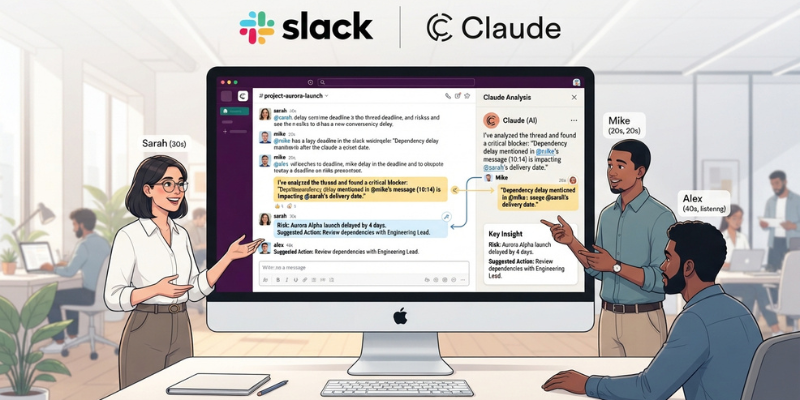
That strategy is becoming visible through the latest Claude Tag update, which brings a more contextual and proactive version of Anthropic’s AI agent into Slack.
The update allows Claude to consider the broader context of conversations rather than evaluating Slack messages one at a time. Anthropic says this makes Claude roughly 30% better at deciding when it should jump into a conversation—and when it should stay silent.
That sounds like a small technical improvement. In practice, it could change how workplace AI operates.
Instead of employees constantly opening a chatbot, explaining what is happening and asking for help, Claude can increasingly understand what a team is discussing, retain relevant context, work on delegated tasks and, when its proactive behavior is enabled, step in when it believes it can contribute.
Anthropic calls the broader idea “multiplayer AI.”
The goal is to move Claude from being an assistant for one person toward becoming an AI teammate that can work across an organization.
What Is Claude Tag?
Claude Tag is Anthropic’s collaborative AI agent designed to work inside Slack.
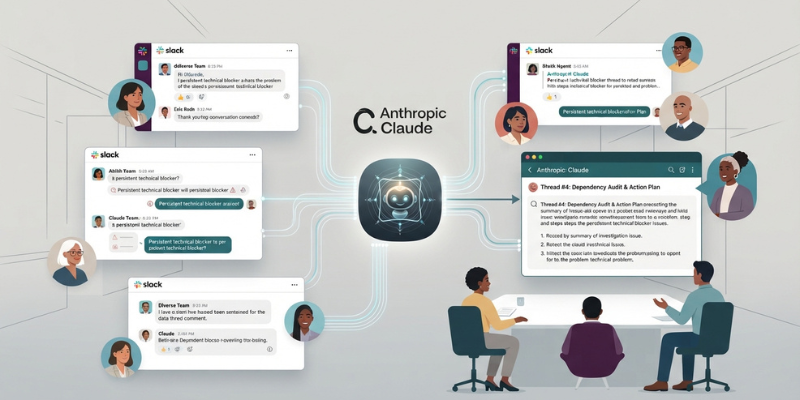
Anthropic introduced Claude Tag in June 2026 as a way for teams to work with Claude directly inside Slack channels. Organizations can give Claude access to selected channels, tools, data sources and even codebases. Team members can then mention @Claude, delegate work and continue with their own tasks while the agent works in the background.
The concept is different from simply adding another chatbot to Slack.
A traditional AI workflow looks like this:
User asks → AI answers → user continues working.
Claude Tag is designed around a more continuous workflow:
Team discusses → Claude understands context → Claude identifies where it can help → Claude works → Claude reports back.
That distinction is becoming increasingly important as companies move from basic generative AI toward agentic AI, where systems can plan and execute multi-step tasks rather than simply generate responses.
This is also why Claude Tag fits into the same broader enterprise trend seen in platforms such as ServiceNow AI, where AI agents are increasingly being positioned as systems that can understand workflows, coordinate actions and connect multiple enterprise processes.
The New Claude Tag Update Is About Context
The central change in the latest Claude Tag update is simple to explain: Claude can now consider a broader conversation before deciding whether to respond.
Previously, Anthropic used a lightweight classifier that evaluated individual Slack messages and made a binary decision about whether Claude should participate.
That approach had an obvious weakness.
A single message rarely tells the entire story.
Imagine two engineers investigating the same software bug.
The first engineer posts a theory about what caused the problem.
Several messages later, another engineer shares logs that appear to support that theory.
If an AI looks at those messages independently, neither message may appear important enough to trigger a response.
But when the conversation is considered as a whole, the connection becomes obvious.
One engineer has the hypothesis.
The other has the evidence.
Claude can recognize that the two pieces of information belong together and potentially start an investigation.
That is the type of scenario Anthropic is targeting with the update. VentureBeat reports that Claude now considers the channel’s broader context, along with its memory and standing instructions, when deciding what to do.
Claude Can Choose Whether to Speak
There is an important detail here that is easy to miss.
Anthropic is not simply trying to make Claude respond more often.
It wants Claude to become better at deciding when a response is actually useful.
That distinction could determine whether proactive AI becomes helpful or irritating.
An agent that responds to every message would quickly become workplace noise.
Claude Tag can instead choose among different actions depending on the situation. It may respond directly, start deeper work in a thread, route information into an existing workstream or decide that there is nothing useful to add.
That final option matters.
For an AI agent that is present in workplace conversations throughout the day, knowing when to remain silent is part of intelligence.
Anthropic has designed Claude to become dormant in channels where it repeatedly determines that it has nothing meaningful to contribute.
The philosophy is straightforward: a noisy AI agent can be worse than an unhelpful one.
Claude Tag Moves AI Toward “Multiplayer AI”
The latest update makes more sense when viewed through Anthropic’s broader multiplayer AI strategy.
Most generative AI products were initially designed around one person.
An employee opens Claude, enters a prompt and receives an answer.
That model is useful, but it does not fully reflect how businesses operate.
Companies work through teams.
A product manager might have customer feedback.
An engineer has technical information.
A salesperson knows what a major customer wants.
A data scientist has access to analytics.
A support team sees recurring customer problems.
The information exists, but it is fragmented.
Anthropic’s argument is that AI agents can become more valuable when they operate across those existing workflows and help connect the information.
That is why Claude Tag is not simply about Slack.
Slack is the environment where the team’s conversations already happen.
Claude can potentially use those conversations as part of a much larger organizational context.
The same fundamental problem is being addressed by tools such as Atlassian Rovo, which focuses on connecting organizational knowledge across systems and helping teams find and act on information without constantly switching between applications.
From Completing Tasks to Pursuing Goals
Anthropic sees enterprise AI progressing through several stages.
The first generation of AI handled parts of tasks.
Examples included answering questions, completing a line of code or summarizing a document.
The next generation became capable of completing entire tasks.
An AI could write a full function, prepare a research report or analyze multiple sources.
Anthropic now sees the industry moving toward projects and goals.
Instead of asking an AI to:
“Write this report.”
A company could eventually tell it:
“Improve our customer support process.”
That is a much more complicated objective.
The AI would need to determine which information matters, which systems contain it, what tasks need to happen and where human judgment is required.
And goals are rarely individual.
They involve multiple people, departments and systems.
That is why Anthropic believes increasingly capable AI naturally pushes toward multiplayer workflows.
Why Knowledge Work Is Harder Than Coding
Software development already has mature collaboration infrastructure.
Developers have Git repositories, pull requests, issue trackers, automated testing and deployment systems.
Knowledge work is much less structured.
A legal decision might depend on contracts, emails, Slack messages and professional judgment.
A product decision could require customer feedback, analytics, engineering constraints and business priorities.
There is often no automated test that can definitively say whether the final decision is correct.
That makes workplace AI considerably more complicated.
The agent needs to understand not only information but also people, context, permissions, objectives and uncertainty.
This is one reason Claude Tag’s ability to understand an entire conversation is more significant than it might initially appear.
MCP Gives Claude Access to More Than Slack
Claude cannot become an organizational agent if it only understands Slack.
Companies store information across dozens of systems.
This is where Anthropic’s Model Context Protocol, or MCP, becomes strategically important.
Model Context Protocol documentation
MCP provides a standardized approach for connecting AI applications with external tools and data.
The basic idea is similar to creating a common connection layer between AI and enterprise software.
Instead of building a completely different integration for every application, organizations can use a common protocol for connecting models to external systems.
That makes the Claude Tag strategy broader than Slack.
A customer issue, for example, could require information from a CRM, internal Slack conversations, product analytics and engineering systems.
The real value comes from connecting those pieces.
This is also why enterprise AI platforms such as UiPath AI are moving toward agentic automation: the objective is increasingly to connect AI reasoning with real business systems and workflows rather than keeping AI inside an isolated chat window.
Claude Can Work Asynchronously
Another major Claude Tag capability is asynchronous work.
Users do not necessarily have to sit and wait for Claude to finish a task.
Anthropic says users can delegate work to Claude while they focus on other priorities. Claude can break tasks into stages, use the tools it has been given and return its results in a Slack thread. It can also schedule tasks for itself and continue pursuing projects over longer periods.
That changes the economics of AI assistance.
Instead of using AI for a five-minute question, an employee could delegate a larger research or analysis task.
For example:
“Investigate why customer complaints increased this month and summarize the likely causes.”
An agent could potentially gather relevant information, analyze it and return with findings.
The human then spends time evaluating the result rather than manually collecting every piece of information.
What Claude Tag Could Mean for Different Teams
The biggest opportunity is not necessarily individual productivity.
It is reducing the handoffs that slow teams down.
Engineering
Claude can help investigate bugs, analyze technical information and work with authorized codebases and tools.
Anthropic says its own teams use Claude Tag for difficult engineering problems and that Claude can help connect information across technical workflows.
Product
Product teams can use Claude to investigate metrics, follow product conversations and help connect customer feedback with internal discussions.
Customer support
Claude can assist with support tickets, identify recurring issues and follow up on unresolved problems.
Data teams
Instead of answering repetitive requests for analysis, data specialists can build infrastructure and workflows that allow Claude to perform certain analyses directly.
Cross-functional teams
This may ultimately be the strongest use case.
When product, engineering, sales and support teams are discussing the same problem, Claude can potentially act as the connective layer between their information.
Anthropic Is Already Using Claude Tag Internally
Anthropic’s own adoption provides an interesting indication of how the company expects Claude Tag to be used.
When Claude Tag launched, Anthropic said 65% of its product team’s code was being created by its internal version of Claude Tag. The company also said teams were using Claude to investigate product metrics and data, work through support tickets and identify the causes of difficult bugs.
That is important because Anthropic is not presenting Claude Tag purely as a theoretical enterprise product.
It is using its own organization as a testing ground for the model.
The company’s argument is essentially that AI should remove some of the repetitive coordination work while leaving people with more time for judgment, strategy and decision-making.
The Biggest Security Question Is Prompt Injection
The more powerful Claude Tag becomes, the more important security becomes.
An AI agent with access to Slack, documents, databases and external tools has a much larger attack surface than a chatbot that only generates text.
One major threat is prompt injection.
Prompt injection occurs when malicious instructions are embedded inside content that an AI agent reads.
If an agent treats those instructions as trustworthy, an attacker could potentially manipulate its behavior.
The risk becomes more serious when the AI has permission to take actions across enterprise systems.
Anthropic has therefore emphasized layered defenses for agentic systems, including model-level safeguards and classifiers designed to identify malicious behavior.
For enterprise customers, however, security cannot rely on the model alone.
Permissions, monitoring and governance remain essential.
Claude’s Access Is Designed to Be Permission Controlled
The other major issue is data access.
If Claude can see more information than an individual employee, the AI could accidentally become a way to expose information that person was never supposed to see.
Anthropic says Claude Tag is designed around administrator-controlled permissions.
Administrators can determine which channels, tools and information Claude can access. Claude’s memories remain scoped to the channels defined by those administrators.
That means an AI configured for one business function should not automatically transfer its memories or access into another.
For example, a Claude instance configured for sales should not simply expose sales information inside an engineering workflow.
This kind of access control will become increasingly important as enterprise AI agents become more autonomous.
The Pricing Question Has Not Been Fully Settled
There is another issue businesses will need to watch closely:
How much will always-on AI agents cost?
Anthropic currently says the expanded channel context does not count toward usage or spend limits.
That is attractive for organizations experimenting with Claude Tag.
But enterprise AI economics are still evolving.
A chatbot that answers a handful of questions each day has predictable usage.
An agent that continuously reads context, checks systems, performs tasks and follows up with employees is a different proposition.
Anthropic has emphasized controls such as organizational spending limits, channel-level limits and different model entitlements to help enterprises balance cost and performance.
For now, businesses should treat Claude Tag as an evolving product rather than assume today’s pricing and usage model will remain unchanged permanently.
Claude Tag Is Competing With More Than Chatbots
Anthropic is entering a market where Microsoft, Google and Salesforce are also building enterprise AI agents.
Salesforce has the advantage of owning Slack.
Microsoft has Teams and its wider Microsoft 365 ecosystem.
Google has Workspace.
All three have enormous enterprise distribution.
Anthropic’s answer is essentially interoperability.
Most companies do not operate inside one vendor’s ecosystem.
They use dozens of applications.
A valuable AI agent therefore needs to work across those systems rather than being locked into one software environment.
That is where Anthropic’s combination of Claude, MCP and Slack becomes strategically interesting.
The company is effectively positioning Claude as an orchestration layer that can connect information and workflows across an organization’s existing technology stack.
Whether that approach can overcome the distribution advantage of Microsoft, Google and Salesforce remains one of the biggest unanswered questions in enterprise AI.
Is Claude Tag Available?
Claude Tag was initially launched in beta for Claude Team and Enterprise customers. Anthropic said administrators could pair Claude Tag with Slack, provide access to approved tools, set organizational spending limits and test the agent in a private channel before wider deployment.
Slack’s current documentation says Claude Tag replaced the existing Claude app in Slack starting August 3, 2026. Slack also explains that users can mention Claude in channels and threads and use it for tasks such as summarizing conversations, analyzing files and drafting content.
This means businesses should distinguish between simply having Claude available in Slack and having the newer Claude Tag experience configured with the appropriate enterprise controls.
What Comes Next for Claude?
Anthropic’s longer-term vision is considerably more ambitious than answering Slack questions.
The company sees a future in which organizations give Claude increasingly broad objectives rather than individual tasks.
Today:
“Analyze this data.”
Tomorrow:
“Find out why customer retention is falling.”
Eventually:
“Improve customer retention.”
The final example requires the AI to determine what work needs to happen.
It may need to investigate data, identify problems, recommend projects, connect employees and monitor progress.
That is where AI stops being simply a productivity tool and starts becoming an organizational system.
It also raises difficult questions.
Who decides what Claude should prioritize?
Who approves its actions?
How much autonomy should it have?
What happens when Claude’s recommendation conflicts with a manager’s judgment?
And who remains accountable when an autonomous agent makes a mistake?
Those questions will become increasingly important as enterprise AI moves from generating content to pursuing goals.
What the Claude Tag Update Really Means
The easiest way to describe the latest Claude Tag news is that Claude can now understand more of a Slack conversation before deciding whether to participate.
But that description misses the larger story.
Anthropic is experimenting with a new model of enterprise AI.
The company wants Claude to move from:
Assistant → Agent → Team member → Organizational orchestrator.
Claude Tag is an early step toward that vision.
The technology behind the strategy includes broader conversation context, persistent memory, Slack integration, MCP connectivity, tool access, asynchronous execution, proactive behavior and enterprise permissions.
The objective is not simply to make employees faster at individual tasks.
It is to reduce the friction between people, information and systems.
That is also why the shift matters for the wider AI market. As the Top 100 AI Tools in 2026 landscape shows, AI products are increasingly moving beyond standalone chatbots toward specialized agents, automation and workflow integration.
The Bottom Line
Anthropic’s Claude Tag update is more significant than a routine Slack feature release.
The company is betting that the next stage of enterprise AI will be collaborative rather than individual.
Claude can now use broader conversation context to make better decisions about when to contribute, while the wider Claude Tag system gives it memory, tools, asynchronous workflows and the ability to act proactively when enabled.
The reported 30% improvement in deciding when to jump into conversations is only one piece of the story.
The bigger shift is philosophical.
Anthropic wants people to stop thinking about AI as something they open when they need an answer.
Instead, it wants Claude to become part of the workplace itself—understanding what teams are discussing, connecting information across systems, handling delegated work and stepping in when human attention is actually needed.
That could make AI dramatically more useful.
It could also make security, permissions, pricing and governance dramatically more important.
For now, Claude Tag is still an early experiment in that future.
But Anthropic’s direction is clear: the company is no longer building Claude only to be someone’s personal assistant. It is building toward an AI teammate that can work across the organization.