
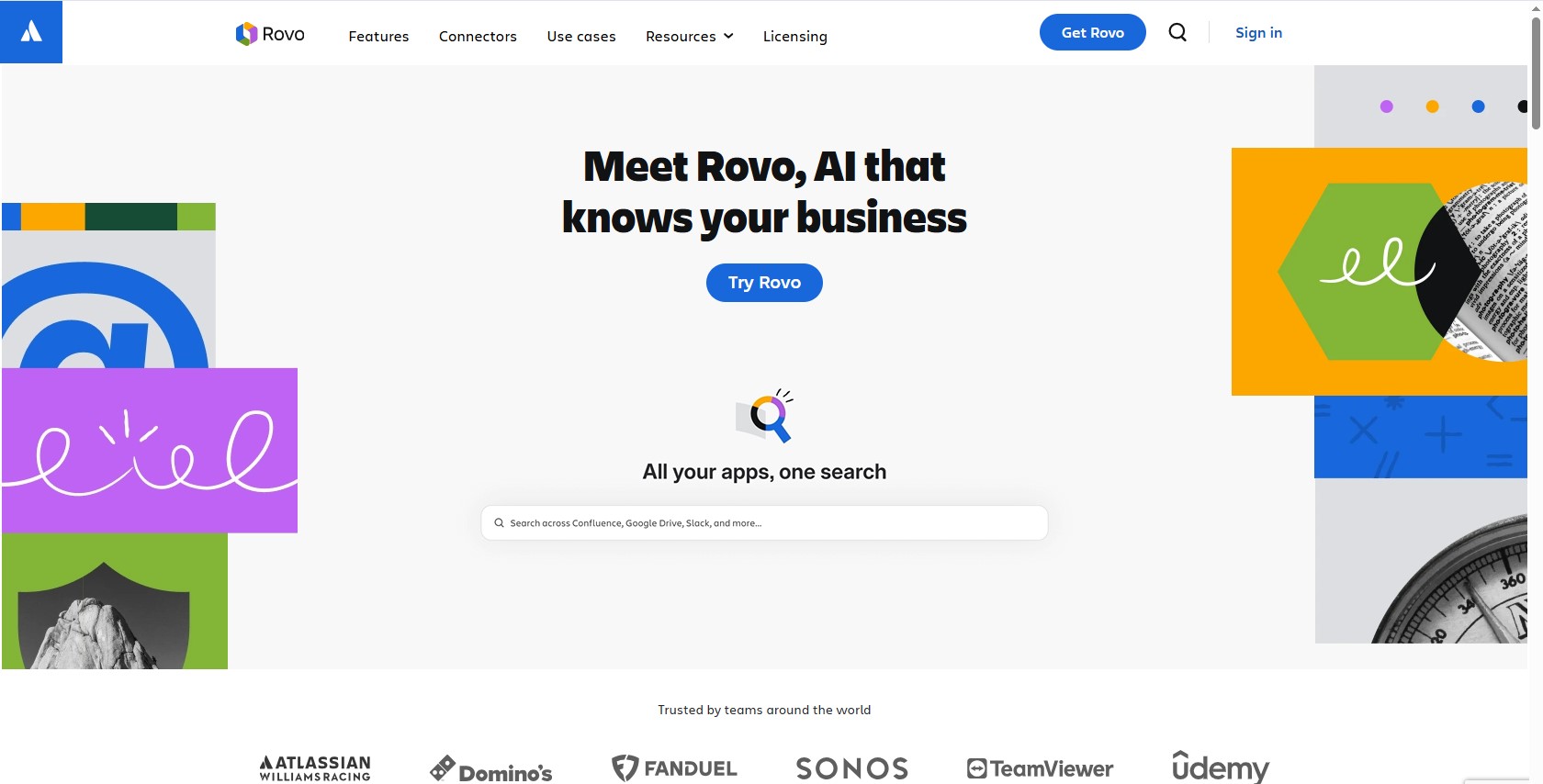

In 2026, Atlassian Rovo has emerged as a cornerstone AI-driven collaboration and knowledge platform for teams working inside the Atlassian ecosystem and across connected SaaS tools. Rovo is designed specifically to solve a pervasive problem in modern work: fragment- ed information across multiple tools, clouds, and documents that slows down productivity and decision-making. Instead of forcing users to manually hunt for answers across Jira tickets, Confluence pages, Slack messages, Google Drive files, and other applications, Rovo provides unified search, context-aware chat, and AI agents that help teams find, understand, and act on information where they already work. These capabilities are tightly integrated into Atlassian Cloud products and extend via connectors to key third-party systems.
Atlassian Rovo is a product of Atlassian Corporation Plc, the Australian-founded and Nasdaq-listed software company best known for flagship products like Jira, Confluence, Bitbucket, and Trello. Atlassian has been focusing on “Teamwork AI” initiatives since 2024, and Rovo reflects the company’s strategic shift toward embedding advanced generative AI and semantic understanding deeply into team workflows. Atlassian operates globally with a large enterprise and mid-market customer base, and Rovo is part of its broader strategy to increase the intelligence and automation available in its core collaboration and work management platforms.
Under the hood, Rovo combines Atlassian’s proprietary Teamwork Graph — a data intelligence layer that understands relationships between people, work, and content — with generative AI and semantic indexing. When a team member enters a natural language query, Rovo doesn’t just return keyword matches; it pulls contextually relevant information from registered sources, respects existing permissions, and synthesizes answers that reflect both internal and connected third-party knowledge sources. Rovo’s feature set includes Rovo Search for unified organizational search, Rovo Chat for conversational retrieval and exploration, Knowledge Cards for contextual insights, and AI Agents that can assist with automating tasks and generating work outputs. The system is designed to sit alongside users in Jira, Confluence, and via a browser extension, reducing the need to switch apps and centralizing actionable knowledge.
In real-world teams, Rovo is used to accelerate information discovery and reduce cognitive load. Product managers use it to surface trends and decisions buried in historical Jira tickets and Confluence docs. Support teams leverage its AI agents to triage and summarize customer issues automatically. Engineering leaders use Rovo Search to find technical decisions and rationale across source repositories, knowledge bases, and task histories. Custom Rovo Agents can automate routine work — such as organizing issues into sprints, summarizing onboarding materials, or generating content from project context — reducing repetitive steps that previously consumed valuable team time. Teams also benefit from the Rovo Studio environment, where custom agents, hubs, and automation workflows can be designed with minimal code.
By 2026 Atlassian has shifted Rovo’s pricing model significantly compared with its initial launch. Rovo is no longer a standalone paid add-on; it is bundled into the paid Cloud subscriptions of Jira, Confluence, Jira Service Management, or the Teamwork Collection at the Standard, Premium, and Enterprise tiers. There is no separate line item for Rovo on most customer bills, and eligible customers receive Rovo capabilities automatically as part of their existing subscriptions. Usage is governed by quotas tied to subscription tier and user counts, and there may be additional consumption-based charges in the future as Atlassian finalizes its pricing model. A free tier does not exist outside of customer trials, and any standalone Rovo product offering has been deprecated in favor of this integrated approach.
Atlassian’s integrated pricing contrasts with competitors that sell AI-augmented search and assistants as standalone paid products. For example, enterprise knowledge platforms like Coveo, IBM Watson Discovery, and Microsoft Viva Insights typically require separate licenses or premium add-ons, while general AI assistants (Copilot services from Microsoft, Slack AI, or Google’s Duet AI) offer integrated experiences with varying pricing and security postures. Rovo’s bundling gives Atlassian Cloud customers AI capabilities without a separate software purchase — a competitive advantage for customers already invested in Atlassian’s suite. However, for organizations not using Jira or Confluence, standalone AI knowledge platforms may still be more cost-effective.
The ideal users of Rovo in 2026 are medium to large enterprises and teams that rely on Atlassian Cloud products as central hubs of knowledge and work. Teams that struggle with information silos — such as cross-functional delivery teams, support and ops units, and product and engineering groups — benefit most from Rovo’s unified search, agentic automation, and contextual AI. Smaller teams or organizations that do not use Atlassian’s ecosystem may find Rovo’s value limited and would be better served by more generalist AI search tools or lower-cost assistants tailored to their specific stacks.
Rovo’s strengths include deep integration into Atlassian tools, secure and permission-aware access to organizational knowledge, and flexible AI agents that can automate and enhance workflows. Its unified search reduces context-switching and accelerates decision cycles. However, there are limitations: the system’s full power depends on how well content sources are connected and indexed, and some users report gaps in indexing attachments or databases. There is also complexity in understanding usage quotas and how future consumption-based pricing will apply. Additionally, teams heavily invested in non-Atlassian tools may find connectors limited relative to vendor-agnostic platforms.
In corporate settings, Rovo is increasingly used as a foundational layer for AI-enhanced work orchestration. Customer engineering teams create automated agents that proactively organize work, developers use Rovo Dev — an extension of Rovo targeted specifically at software engineers — to plan, generate, and review code in context, and operational teams embed Rovo insights into daily standups and service workflows. The platform’s Model Context Protocol (MCP) server now enables secure read/write access to Atlassian data by third-party clients like ChatGPT, expanding how Rovo intelligence can be applied across systems.
Within the broader AI landscape in 2026, Rovo matters because it represents a practical evolution of AI from standalone assistants to integrated, context-aware collaborators embedded in everyday tools. It demonstrates how large enterprise platforms can harness generative AI responsibly, with governance controls, data residency, and compliance built into the product. Rather than replacing human expertise, Rovo is designed to augment it, reducing manual work and helping teams focus on high-impact tasks.
In summary, Atlassian Rovo in 2026 is a strategic AI capability embedded across the Atlassian Cloud that unifies search, chat, and automation to help teams access and act on organizational knowledge more effectively. Its integration without separate pricing makes it compelling for Atlassian customers, while its complexity and ecosystem focus mean it’s best suited for teams already invested in Atlassian’s platform rather than broad standalone usage.