
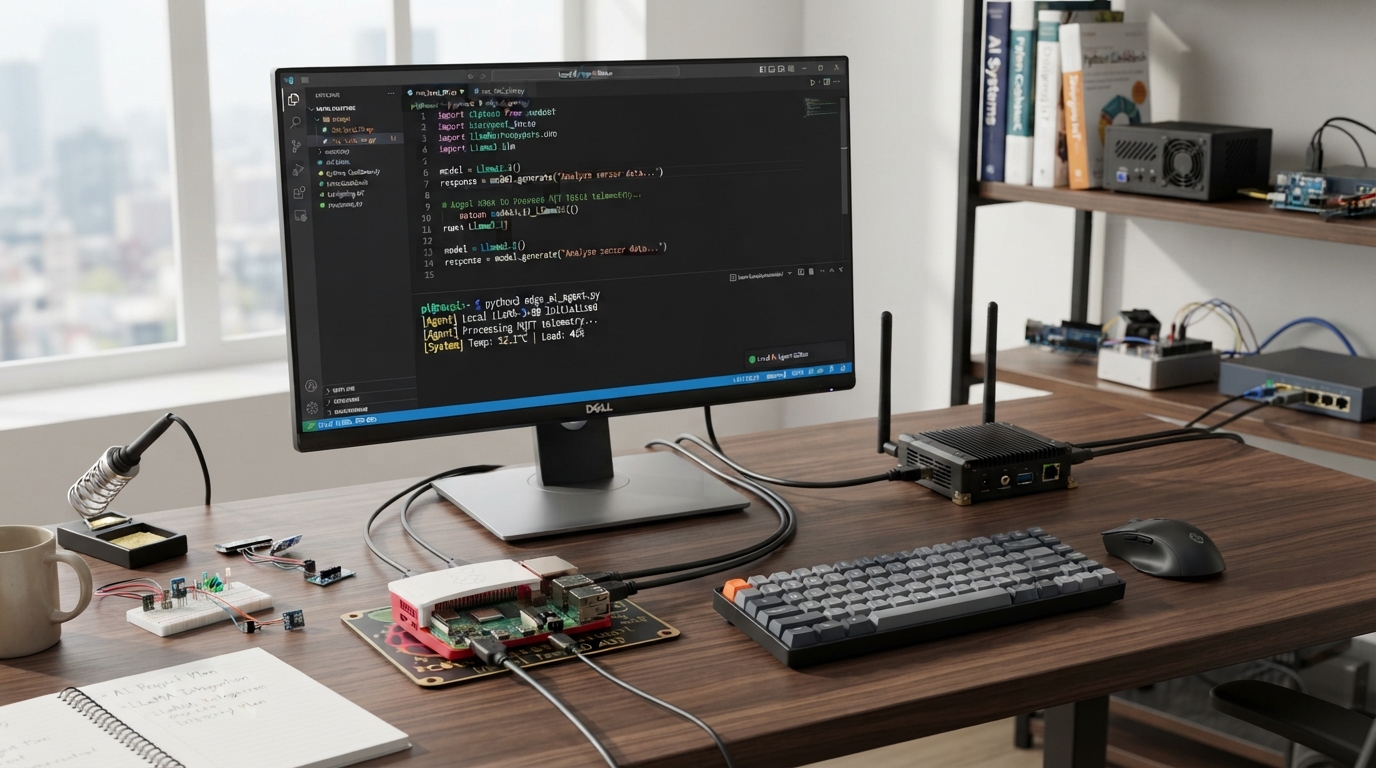
Artificial intelligence is steadily moving beyond massive cloud servers and into the devices people use every day. Liquid AI’s LFM2.5-2.6B is a notable step in that direction, bringing compact AI agents closer to laptops, edge systems and even Raspberry Pi-class hardware.
The model reflects a wider shift visible across the latest AI news and emerging technology developments, where efficiency, specialised hardware and agent-based systems are becoming increasingly important.
With roughly 2.6 billion parameters, LFM2.5-2.6B takes a different approach from the race to build ever-larger AI systems. Instead of depending on huge GPU clusters for every task, it is designed around the idea that useful AI can run much closer to where data is created.
That could make local AI more practical for private assistants, robotics, smart-home systems, industrial devices and offline applications.
The bigger story is not simply the arrival of another AI model. It is that on-device AI agents are becoming practical on increasingly affordable hardware.
What Is Liquid AI LFM2.5-2.6B?
LFM2.5-2.6B is a compact AI model developed by Liquid AI with approximately 2.6 billion parameters.
Its relatively small size makes it particularly interesting for local inference and edge computing, where memory, processing power and energy use are limited.
Large frontier models often rely on powerful GPUs and cloud infrastructure. A compact model works within a different set of priorities.
Rather than maximising scale at all costs, it aims to provide useful AI capabilities while keeping hardware requirements manageable.
That can matter in applications where:
- data needs to stay local;
- internet access is unreliable;
- response latency matters;
- cloud inference costs are undesirable;
- hardware resources are limited.
LFM2.5-2.6B is therefore better understood as part of the growing small-model and edge-AI movement rather than a direct replacement for the biggest cloud systems.
Why a 2.6B Model Matters
AI discussions often focus heavily on parameter count, but bigger is not automatically better for every use case.
A very large model may provide stronger reasoning and broader knowledge. It may also require expensive infrastructure, substantial memory and continuous access to cloud services.
A smaller model solves a different problem.
It can bring useful intelligence directly to the laptop, robot, sensor, smart device or embedded computer that actually needs it.
This shift towards efficiency is closely connected with developments in custom AI silicon and specialised AI hardware. AI companies are increasingly thinking about models and hardware together rather than treating computing infrastructure as an afterthought.
For developers, that changes the question.
Instead of simply asking which model has the most parameters, the more useful question becomes:
Which model provides enough capability for the task while staying within the available memory, power, latency and privacy limits?
That is where compact models become especially valuable.
From Local Chatbots to On-Device AI Agents
The word agent is central to understanding why LFM2.5-2.6B matters.
A conventional chatbot receives a prompt and generates a response.
An AI agent can potentially do more. It can use a language model as its reasoning layer while interacting with authorised tools, files, applications, APIs or hardware.
Imagine asking:
“Prepare my schedule for tomorrow.”
A chatbot could suggest how to organise the day.
An agent could potentially inspect an authorised calendar, identify meetings, prepare a summary and pass relevant information to another approved application.
That turns AI from a conversational interface into part of an actual workflow.
This transition also fits the broader move towards structured AI pipelines instead of unrestricted free-form workflows, particularly when reliability, validation and repeatable execution matter.
For local AI, this is especially interesting.
An agent running on-device could potentially interact with private files, productivity software, smart-home systems or robotics hardware without sending every request to a remote data centre.
Can LFM2.5-2.6B Really Run on a Raspberry Pi?
The Raspberry Pi angle is one of the most interesting parts of the LFM2.5-2.6B story.
However, there is an important difference between being able to run a model and running it at high speed.
A Raspberry Pi has far less processing power and memory bandwidth than a workstation equipped with a modern GPU.
Real-world performance therefore depends on several factors:
- available RAM;
- CPU performance;
- model format;
- inference runtime;
- context length;
- quantisation level;
- system cooling.
A compact model may fit into memory while still generating responses more slowly than it would on stronger hardware.
That does not make it useless.
Many edge applications do not require the instant response speed expected from a mainstream cloud chatbot.
A home automation agent, background assistant, industrial controller or offline tool may value privacy and local operation more than maximum token generation speed.
The Raspberry Pi matters because it represents accessible computing.
If useful AI can run on relatively inexpensive development boards, more students, independent developers and hardware builders can experiment with local AI without investing in high-end GPU systems.
Why Memory Efficiency Matters
Getting a language model onto smaller hardware involves more than reducing parameter count.
The system also needs memory for the operating system, active applications, model weights, inference runtime and temporary data used during generation.
That makes memory one of the most important constraints in edge AI.
This is where quantisation becomes especially useful.
Quantisation stores model values using lower numerical precision. In simpler terms, it allows the model to use less memory.
That can provide several benefits:
- smaller model files;
- lower RAM requirements;
- reduced VRAM use;
- wider hardware compatibility;
- potentially faster inference.
For compact systems, these savings may determine whether a model fits comfortably into available memory.
There is a trade-off, however.
More aggressive quantisation can reduce memory requirements further, but it may also affect model quality or behaviour.
Developers therefore need to balance three things:
memory usage, inference speed and output quality.
Why KV Cache Matters Just as Much
Model weights are only one part of memory consumption.
Another important component is the KV cache.
KV stands for key-value.
During text generation, transformer models need information from tokens they have already processed. Recalculating everything from scratch each time a new token is generated would be inefficient.
Instead, the model stores key and value information from previous tokens in memory.
That stored information is known as the KV cache.
It helps generation run efficiently, but the cache becomes larger as more context is retained.
For a short conversation, that may not be a major issue. Longer sessions can be very different.
An AI agent may need to retain:
- earlier instructions;
- tool outputs;
- document content;
- workflow history;
- previous conversation context.
As that information grows, memory use can increase.
On a powerful server, that extra memory pressure may be relatively easy to handle. On edge hardware, every gigabyte matters.
What KV-Cache Quantisation Changes
KV-cache quantisation applies lower numerical precision to the information stored in the cache.
The goal is straightforward: reduce memory consumption while retaining enough information for useful generation.
This can potentially make longer conversations and sustained agent workflows more practical on devices with limited RAM.
It also explains why comparing models only by download size can be misleading.
Real-world memory use depends on more than model weights.
A more complete picture includes:
model weights + runtime overhead + context length + KV cache + operating system usage.
For developers interested in compact AI, understanding that full memory picture is far more useful than looking at parameter count alone.
Running LFM2.5-2.6B Locally With Ollama
The local AI ecosystem has become considerably easier to experiment with because of runtimes such as Ollama.
Instead of manually configuring every part of an inference environment, developers can use a local runtime to download, test and manage supported model builds more easily.
A typical workflow may involve:
- installing a compatible local inference runtime;
- choosing an appropriate model build;
- selecting a suitable quantisation level;
- downloading and launching the model;
- monitoring RAM and CPU usage;
- testing output quality and response speed;
- connecting the model to an application or agent framework.
Hardware still makes a major difference.
A modern desktop CPU, GPU-equipped workstation and Raspberry Pi will produce very different performance characteristics even when running the same model.
The smallest quantisation is not automatically the best option either.
The practical goal is to find a configuration that offers acceptable quality while fitting comfortably within the available hardware.
What Can Developers Build With LFM2.5-2.6B?
The most interesting opportunity is not simply putting another chatbot on a computer.
Compact AI models make it possible to add language intelligence to software and devices that previously depended on rigid rules or constant cloud access.
They also fit into a much broader ecosystem of AI tools available in 2026, where assistants, workflow platforms, developer tools and automation products are increasingly using models behind the scenes.
Private Personal Assistants
A local assistant could search files, summarise documents, organise notes and answer questions while keeping more information on the user’s own hardware.
That can be particularly useful for private or confidential material.
Smart-Home Agents
A compact home server or Raspberry Pi could potentially interpret natural-language instructions and connect them with authorised automation systems.
Instead of relying entirely on rigid commands, users could interact with home systems more naturally.
Robotics
Compact AI models could help robots understand instructions, break down tasks and communicate with people without requiring constant internet access.
This may be useful in environments where connectivity is unreliable or latency needs to stay low.
Offline Knowledge Assistants
A local model could be paired with stored documents to create an AI assistant that remains usable without a permanent connection to a cloud service.
Edge Data Processing
Information could be interpreted, classified or summarised on the device before selected results are sent elsewhere.
This can reduce unnecessary data movement and make distributed systems more efficient.
Local Productivity Tools
Compact models could also support drafting, document analysis, coding assistance and repetitive workflow automation directly on personal computers.
On-Device AI vs Cloud AI
Local AI and cloud AI solve different problems. One does not automatically replace the other.
| Factor | On-Device AI | Cloud AI |
|---|---|---|
| Data processing | Can remain on the device | Usually processed remotely |
| Internet access | Can work offline | Usually required |
| Hardware | Limited by local device | Highly scalable |
| Model size | Typically smaller | Can support very large models |
| Latency | No cloud round trip | Depends on connectivity |
| Privacy control | Greater local control | Depends on service |
| Cost model | Hardware and electricity | API or infrastructure costs |
| Updates | Locally managed | Centrally managed |
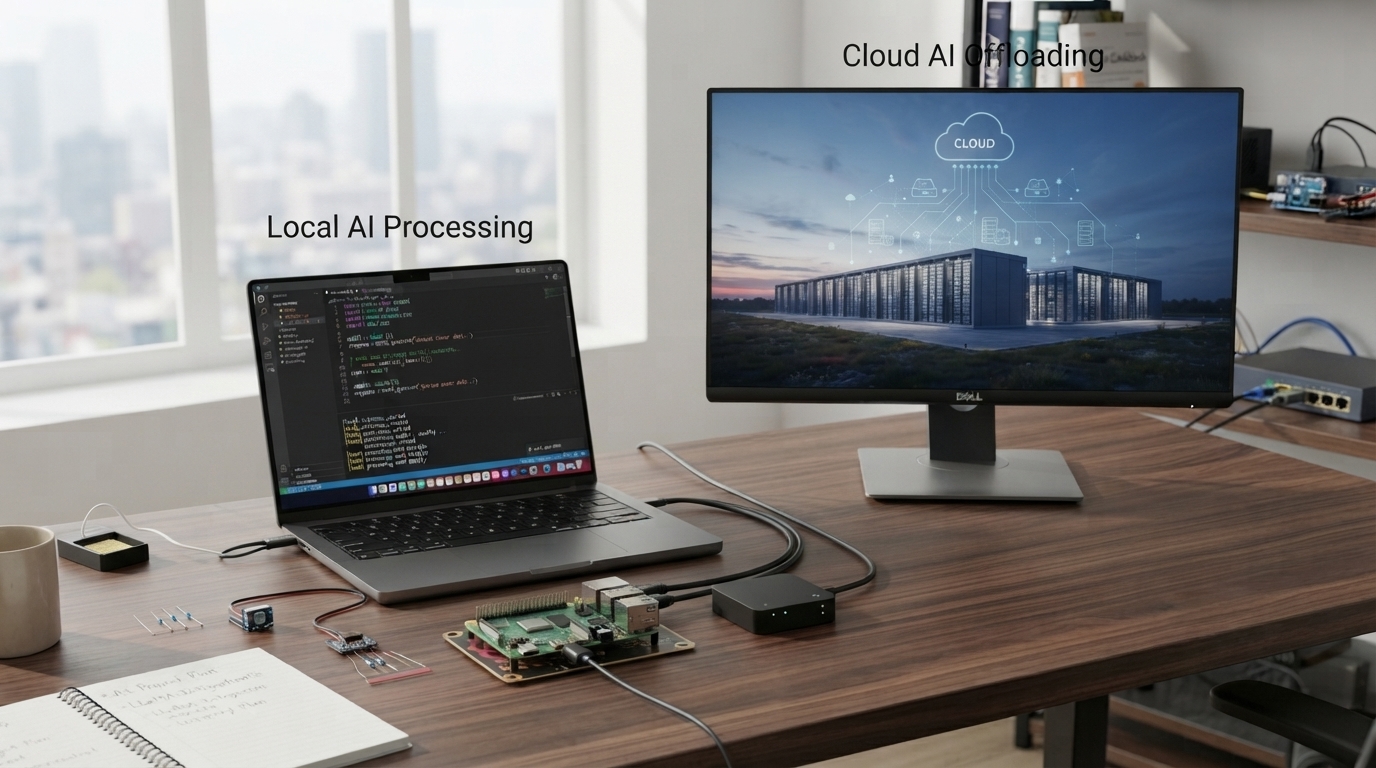
For many applications, the most practical future may be hybrid AI.
Routine, private or latency-sensitive tasks could remain on the device. More demanding reasoning could be passed to larger cloud systems when needed.
That approach gives developers a better balance between capability, speed, privacy and cost.
Privacy and Offline Access Strengthen the Case for Edge AI
One of the clearest benefits of local inference is greater control over where information is processed.
A private document assistant may be able to analyse files without sending every document and prompt to a remote server.
Industrial systems can process operational data closer to the machines that generate it.
Robots and field systems can continue operating when connectivity becomes unreliable.
Local processing is not automatically secure.
Applications still need strong permission management, secure storage and careful network configuration.
But reducing unnecessary data movement can provide meaningful privacy and operational advantages.
AI Agents Also Introduce New Security Risks
Giving an AI model permission to use tools is very different from asking it to generate text.
An agent could potentially access files, call APIs, modify software settings or interact with connected hardware.
That makes permission design critical.
Developers should restrict agents to the tools they genuinely need, protect credentials and request confirmation before sensitive actions.
Human oversight remains important as well.
Running a model locally does not eliminate hallucinations or reasoning errors.
An incorrect chatbot answer may be inconvenient. An incorrect agent action could have much greater consequences.
Local agents therefore need boundaries, logging and carefully controlled access.
Where LFM2.5-2.6B Has Limits
Efficiency comes with trade-offs.
A 2.6-billion-parameter model should not automatically be expected to match much larger frontier systems on demanding reasoning, broad knowledge or highly complex coding tasks.
Hardware can also change the experience dramatically.
A model that feels responsive on a modern desktop may run much more slowly on a low-power ARM system.
Long context can increase memory pressure, while aggressive quantisation can introduce quality trade-offs.
Those limitations do not make compact models less useful.
They simply define the situations where they make the most sense.
LFM2.5-2.6B becomes particularly interesting when local execution itself provides a meaningful advantage.
Small AI Models Are Becoming a Serious Competitive Category
The AI industry is increasingly investing in models that prioritise efficiency rather than maximum scale.
Model families including Gemma, Phi, Qwen, Llama variants and SmolLM have helped make local AI an important part of the wider development landscape.
That landscape continues to evolve quickly, with new models, infrastructure strategies and applications appearing across the broader artificial intelligence ecosystem.
This is also changing how developers judge models.
Benchmark scores still matter, but so do:
- memory footprint;
- CPU performance;
- quantisation support;
- context efficiency;
- tool use;
- licensing;
- deployment complexity;
- power requirements.
A model that scores slightly lower on a benchmark but runs reliably on inexpensive hardware can be the better engineering choice for a real product.
Efficiency is becoming a capability in its own right.
What LFM2.5-2.6B Means for the Future of Edge AI
LFM2.5-2.6B reflects a larger change in artificial intelligence.
AI is gradually moving beyond centralised data centres and into laptops, phones, robots, vehicles, smart-home hubs and industrial systems.
Similar developments across AI models, infrastructure and emerging technology suggest that local and edge inference will play an increasingly important role in how future AI systems are built.
Cloud AI will remain essential for demanding workloads.
But sending every request to the largest available remote model is unlikely to remain the only practical architecture.
Smaller models can handle private, repetitive and device-specific tasks locally. Larger systems can remain available when additional reasoning power is required.
That makes the Raspberry Pi angle more meaningful than a simple hardware demonstration.
The point is not that a tiny computer is about to replace a data centre.
It is that useful AI is becoming small and efficient enough to live much closer to the user.
For developers, the next question may no longer be whether AI can run locally.
It will be deciding which workloads should stay on the device and which still deserve the cloud.