

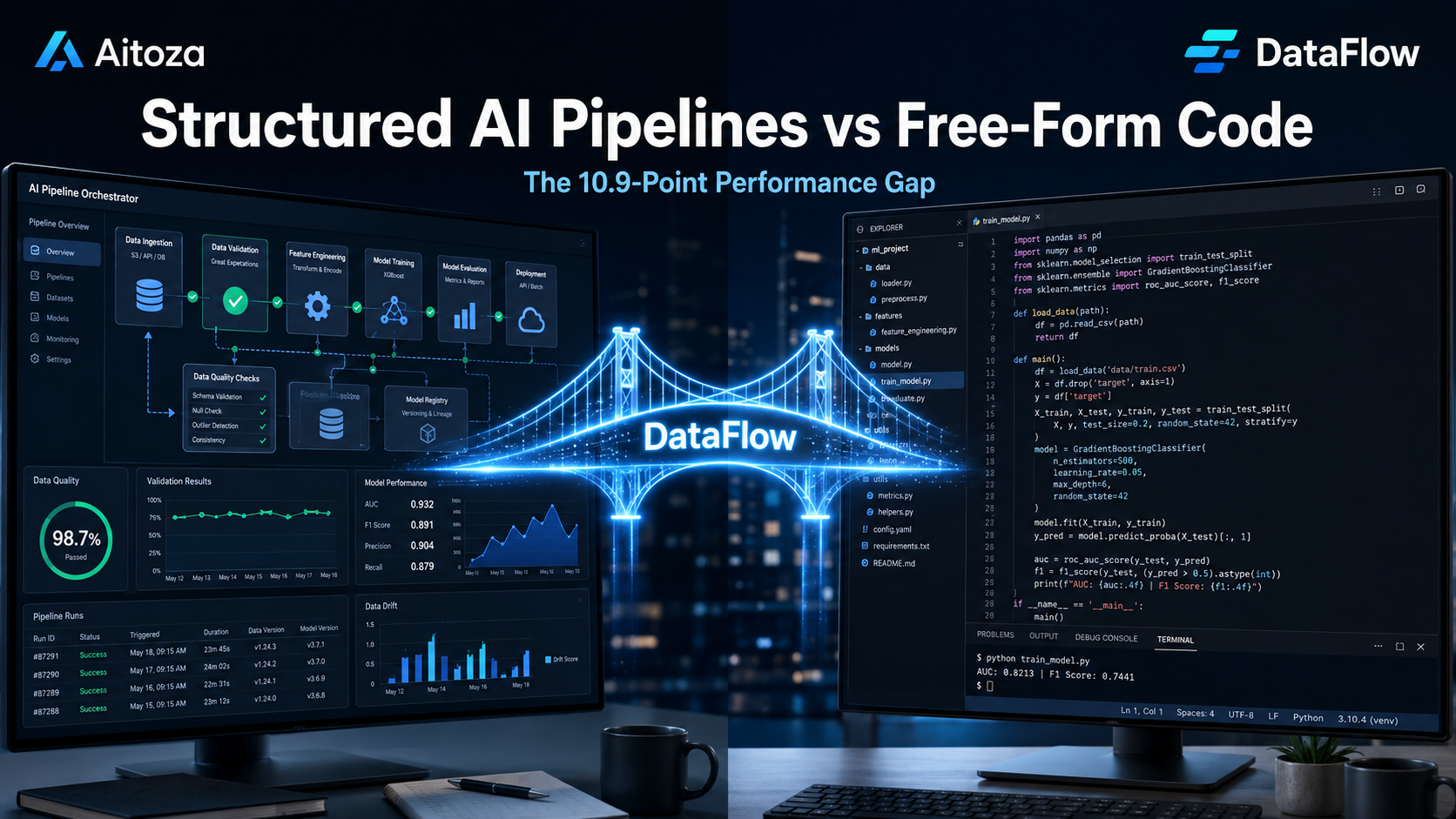
Artificial intelligence is changing how data teams build and manage complex workflows. However, one key question remains. Should AI systems follow structured pipelines, or should they be free to generate custom code?
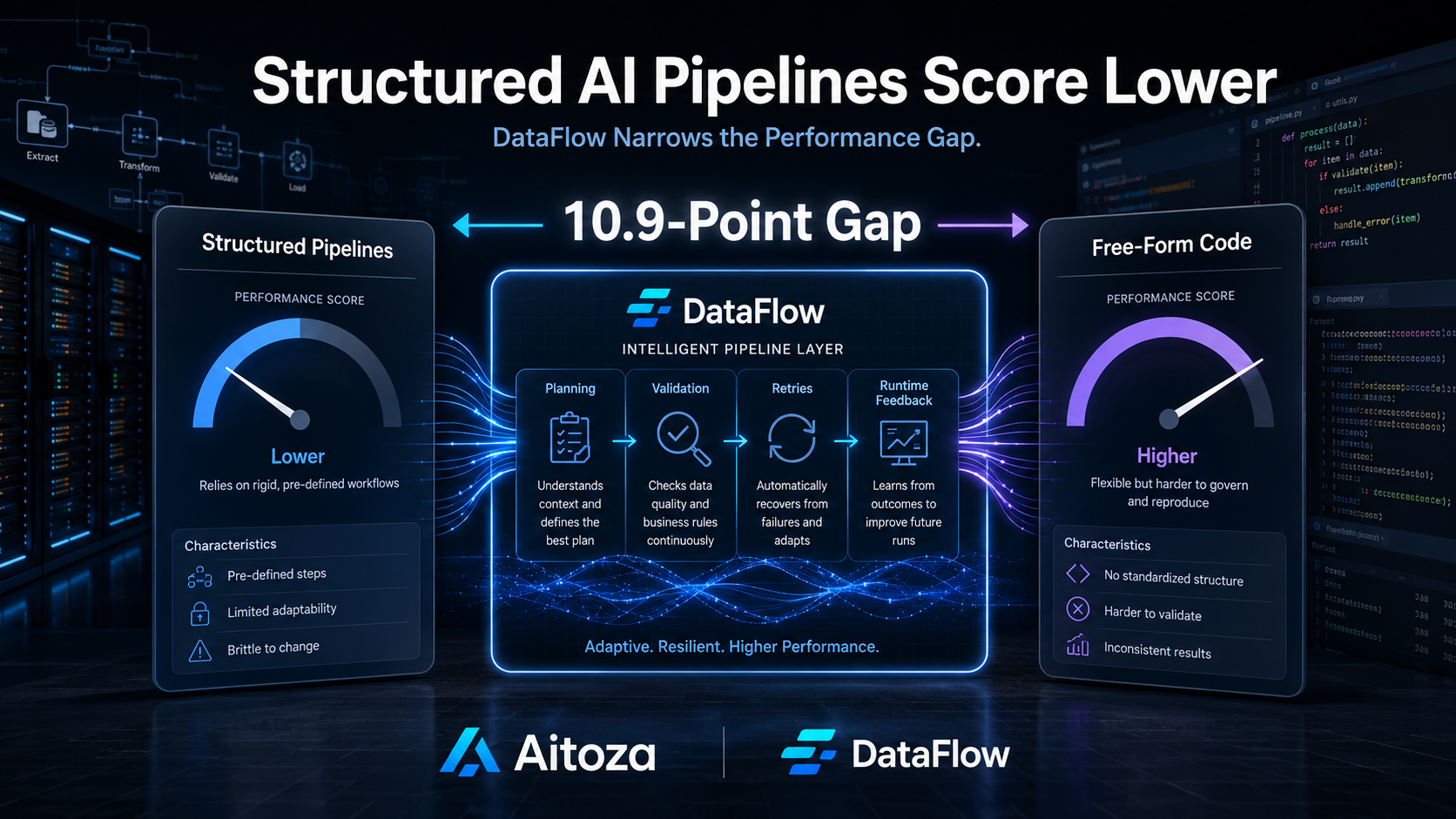
A recent benchmark brought this debate into focus. Structured AI data pipelines reportedly scored 10.9 points below free-form code on the evaluated tasks.
This result suggests that strict rules can sometimes limit an AI model. In particular, the model may struggle when a task needs custom logic or an unusual approach.
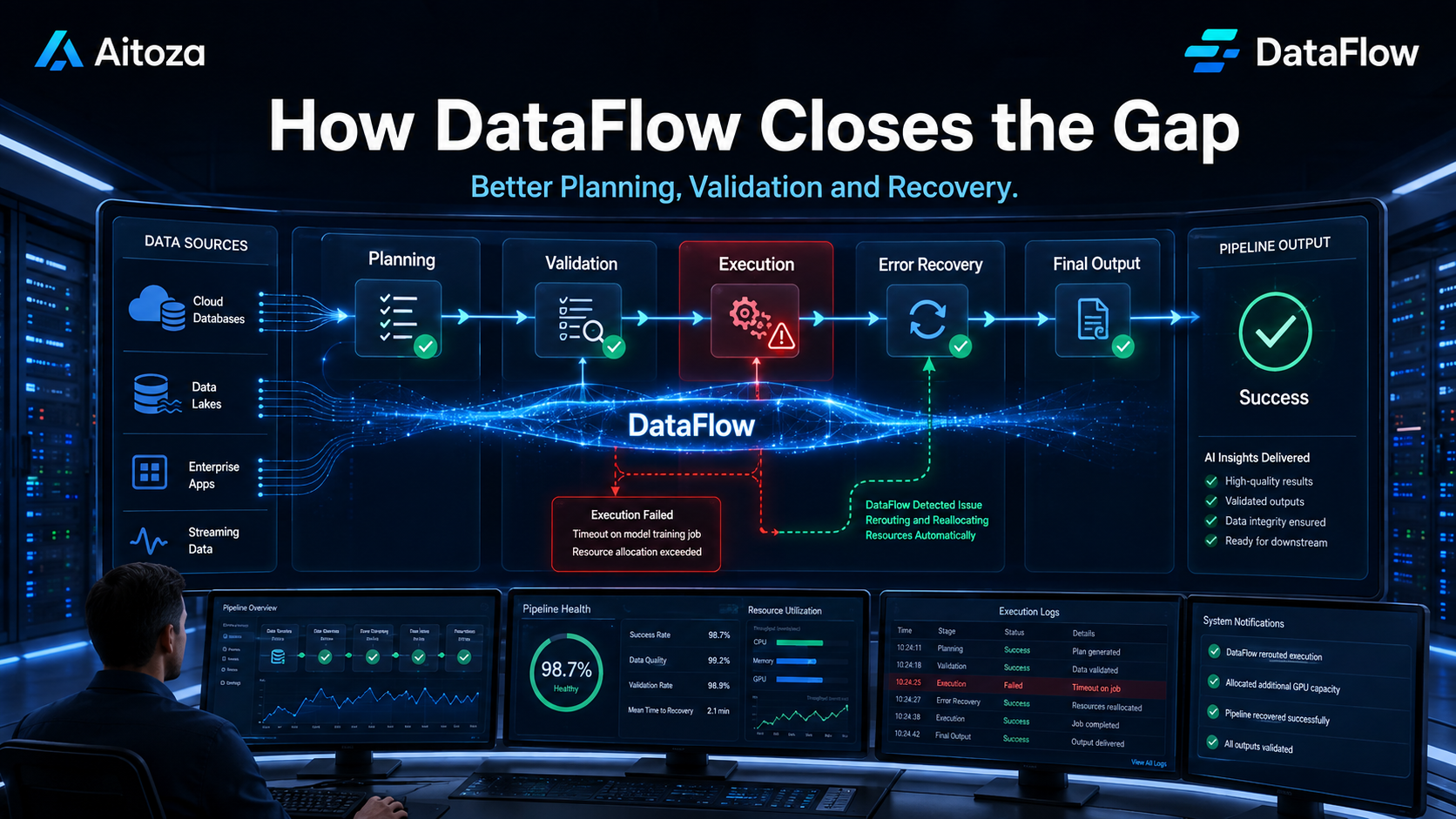
However, the DataFlow harness reportedly reduced this performance gap. It uses better planning, validation, execution feedback, and error recovery to improve structured workflows.
For developers and business leaders, this is not only about which method earned the higher score. It also highlights the trade-off between flexibility and control.
Free-form code gives AI models more freedom. Structured pipelines provide clearer rules, stronger oversight, and more predictable execution.
Therefore, the best choice depends on the task, the risk level, and the production environment.
What Are Structured AI Data Pipelines?
Structured AI data pipelines use predefined stages, tools, and rules to process information.
A typical pipeline may include:
- Data collection
- Data cleaning
- Transformation
- Validation
- Analysis
- Storage
- Final output generation
Instead of allowing an AI model to write any program it wants, a structured system guides the model through approved steps.
For example, an AI system may need to clean a customer database. It might remove duplicate records, correct date formats, fill missing values, calculate totals, and save the final dataset.
In a structured pipeline, each task appears as a separate step. The AI can select or configure these steps. However, it must still work within the limits of the framework.
As a result, structured workflows are often easier to monitor and control.
They may provide:
- More predictable results
- Better workflow visibility
- Stronger security controls
- Easier debugging
- Clearer audit records
- More consistent execution
- Better compliance support
- Greater control over data access
These benefits are especially useful for organizations that handle financial, medical, customer, or other sensitive information.
However, structured systems also have limits. A model may struggle when a task requires custom logic or an operation that the framework does not support.
What Is Free-Form Code Generation?
Free-form code generation gives an AI model more control over how it solves a task.
The model can write custom functions, use different libraries, build new workflows, and change its method based on the data.
This flexibility is helpful when a task does not fit into a predefined pipeline.
For example, imagine a dataset with several date formats, missing values, inconsistent product names, and unusual symbols.
A free-form coding system can write a custom script for these exact problems. In contrast, a structured pipeline may only use the cleaning tools already available in its framework.
This freedom can help free-form code perform better in technical benchmarks. However, it also creates more risk.
AI-generated code may:
- Use unsafe commands
- Import unapproved packages
- Produce inconsistent results
- Fail during execution
- Create hidden dependencies
- Be difficult to review
- Increase debugging time
- Behave differently across repeated runs
Free-form code can be useful for research, testing, and rapid development. However, production use requires strong security controls, testing, monitoring, and human review.
What Does the 10.9-Point Gap Mean?
The reported 10.9-point gap shows that structured AI data pipelines performed below free-form code during the evaluation.
Flexibility may be one reason for this difference.
Free-form code allows the model to create custom logic and select the most suitable method for each task. Structured pipelines must work within fixed tools, formats, and workflow rules.
Therefore, performance may drop when the available pipeline components do not match the task.
Still, the 10.9-point gap does not prove that free-form code is always the better choice.
A benchmark usually measures performance under specific conditions. In contrast, real production systems must also meet business, security, and operational requirements.
Teams must consider:
- Reliability
- Security
- Cost
- Execution speed
- Runtime errors
- Maintenance
- Consistency
- Human review
- Governance
- Reproducibility
A system may earn a higher benchmark score but create more operational risk.
On the other hand, a slightly lower-scoring system may be easier to review, reproduce, monitor, and control.
For enterprise teams, these differences matter.
The best business system is not always the one with the highest raw score. Instead, it may be the one that offers strong performance while remaining secure and manageable.
Why Structured AI Pipelines May Perform Worse
Several factors may limit the performance of structured AI workflows.
Limited Problem-Solving Options
A structured framework gives the AI model a fixed set of operations.
If the ideal solution needs a custom function or an unusual combination of steps, the model may have to use a weaker option.
Free-form code does not face the same restriction. It can create task-specific logic when needed.
Limited Pipeline Components
A structured system is only as capable as the tools inside it.
For example, a framework with only basic transformations may struggle with:
- Complex joins
- Unusual file formats
- Multi-stage calculations
- Domain-specific processing
- Custom validation rules
Adding more components may improve performance. However, it can also make the system harder to manage.
Errors Can Spread Through the Pipeline
Structured pipelines often contain several connected stages.
A mistake in the first stage may affect every step that follows.
For example, the system may identify a text column as numeric. Later calculations may then fail, even when the remaining steps are correct.
As a result, one early mistake can reduce the quality of the final output.
Meaning Can Be Lost During Translation
An AI model may understand a request in natural language. However, it may lose part of that meaning when it converts the request into structured steps.
This problem can happen when the task must fit into a strict schema, workflow graph, or limited toolset.
The original plan may be correct, but the structured version may not capture every detail.
Weak Error Recovery
Some structured systems stop when one stage fails.
Others provide limited feedback about the error. Without clear feedback, the AI may not know how to fix the workflow.
Even a small error can then cause the whole task to fail.
Extra Orchestration Steps
Structured workflows often require planning, tool selection, validation, and multiple execution stages.
These steps can improve control. However, each one can also create a new failure point.
The goal is to add enough structure to improve reliability without making the workflow too rigid.
What Is the DataFlow Harness?
The DataFlow harness is designed to improve how structured AI data pipelines are created and executed.
A harness is the system that surrounds the AI model. It controls how the model plans the task, selects tools, runs each step, handles errors, and produces the final output.
The AI model may still decide how to solve the problem. However, the harness manages how that solution is carried out.
A DataFlow-style system can help the AI:
- Understand the task
- Break the task into smaller stages
- Select suitable pipeline components
- Check dependencies
- Validate steps before execution
- Review runtime results
- Detect failures
- Retry incorrect operations
- Adjust the workflow
- Produce the final output
This matters because the model is only one part of an AI system.
Even a strong model can fail inside a weak execution environment. In contrast, a strong orchestration layer can help the same model complete tasks more reliably.
How DataFlow Can Reduce the Gap
DataFlow aims to connect flexible AI reasoning with controlled execution.
Several features may help it improve structured workflows.
Better Planning
Instead of forcing the model to create a rigid pipeline immediately, the system can first help it understand the full task.
After that, the plan can be divided into structured stages.
This approach gives the model more freedom during planning. At the same time, it keeps the execution process controlled.
Validation Before Execution
The harness can check whether:
- Required inputs are available
- Steps appear in the correct order
- Pipeline components are compatible
- Dependencies are complete
- Output formats match the next stage
These checks can catch problems before the workflow starts.
As a result, the system may avoid unnecessary runtime failures.
Runtime Feedback
When a step fails, the harness can return the error message or execution result to the model.
The model can then revise the pipeline instead of ending the task.
This creates a useful correction loop.
Retry and Recovery
A failed first attempt does not always mean the full plan is wrong.
Sometimes the problem is only a missing parameter, an incorrect tool, or a formatting issue.
A retry system can fix these mistakes without rebuilding the whole workflow.
Better Tool Selection
A structured framework may contain several tools that perform similar tasks.
The harness can help the model select the tool that best matches the data and the goal.
This may prevent the AI from choosing a tool that works technically but produces a weaker result.
Together, these features can improve structured pipeline performance without removing control and visibility.
Structured Pipelines vs Free-Form Code
| Factor | Structured AI Pipelines | Free-Form Code |
|---|---|---|
| Flexibility | More limited | High |
| Predictability | Usually stronger | Can vary |
| Governance | Easier to manage | More difficult |
| Security | Easier to restrict | Needs stronger controls |
| Debugging | Step-by-step visibility | Code-level investigation |
| Custom logic | May be limited | Strong |
| Reproducibility | Often better | May vary |
| Enterprise deployment | Easier to standardize | Needs more oversight |
| Unusual tasks | May struggle | More adaptable |
| Maintenance | More controlled | Can become complex |
Neither option is automatically better.
Free-form code offers greater flexibility. Structured pipelines usually provide stronger control.
Therefore, teams should choose the approach that matches their goals, risk level, and technical resources.
Why Enterprises May Prefer Structured Pipelines
Businesses need more than high benchmark scores.
They must understand how data is accessed, which tools are used, what changes are made, and whether the same process can be repeated.
Structured pipelines can provide:
- Approved data sources
- Role-based access
- Audit logs
- Human approval stages
- Repeatable execution
- Compliance checks
- Restricted tool use
- Cost controls
- Easier incident reviews
- Standardized deployment
These features are important in sectors such as healthcare, finance, insurance, manufacturing, retail, and government.
A free-form system may solve a task successfully. However, a business still needs to review the code, check dependencies, monitor data access, and confirm that the result can be reproduced.
For many organizations, a hybrid model may offer the best balance.
The AI can keep enough freedom to solve difficult tasks. Meanwhile, the harness can control how the solution is executed.
Where Free-Form Code May Be Stronger
Free-form code may work better for:
- Rapid prototyping
- Research projects
- One-time analysis
- Complex custom logic
- Unusual transformations
- New types of problems
- Tasks not supported by existing pipeline tools
It may also suit experienced engineering teams that already use secure execution environments, automated testing, dependency controls, code review, and monitoring.
The choice should depend on the task rather than the benchmark headline.
For example, a low-risk research task may benefit from maximum flexibility. In contrast, a regulated production workflow may need stronger control.
What This Means for AI and Data Teams
For AI engineers, the reported gap shows that orchestration can be as important as the model itself.
For data engineers, it highlights the need for strong validation, monitoring, debugging, and recovery systems.
For business leaders, it shows why AI systems should be measured across several areas, not only task accuracy.
For AI platform vendors, the result creates a clear opportunity. Companies need tools that combine the creativity of AI-generated code with the safety of structured execution.
The most successful platforms may avoid forcing users to choose between total freedom and strict control.
Instead, they may allow the AI to create custom logic inside secure and visible boundaries.
Final Takeaway
The reported 10.9-point gap shows that structured AI data pipelines may lose some performance when compared with free-form code.
However, this does not mean structured workflows are the wrong choice.
They can offer important benefits in governance, security, visibility, repeatability, and deployment. For many organizations, these benefits may matter more than a benchmark score.
DataFlow points toward a possible middle ground.
Better planning, validation, feedback, tool selection, and error recovery may help structured systems perform better without removing the controls that businesses need.
The future may not belong entirely to free-form code or rigid pipelines. Instead, it may belong to systems that combine flexible AI reasoning with secure, structured, and observable execution.