
DeepSeek V4 Flash has performed strongly on AI leaderboards, but a new real-world agent test shows that benchmark intelligence does not always translate into reliable automation.
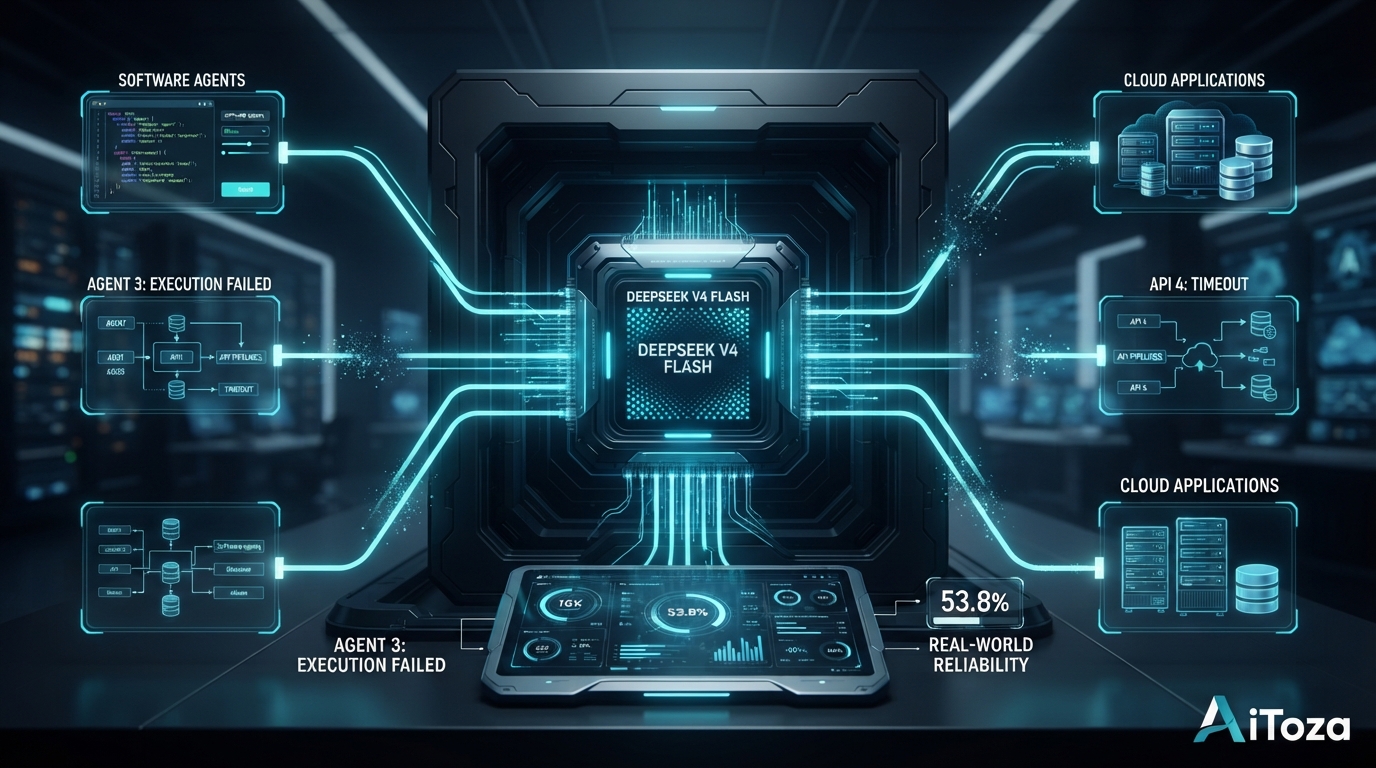
A 240-run agent evaluation tested DeepSeek V4 Flash across eight agent harnesses and 30 multi-step workflows. Only 129 runs completed successfully, producing an overall 53.8% pass rate.
The timing is important.
DeepSeek has also introduced new peak and off-peak API pricing for its V4 models. That means developers now have to think about both agent reliability and execution cost when deciding whether V4 Flash fits a production workflow.
The bigger lesson goes beyond DeepSeek.
For AI agents, a high model benchmark score is no longer enough. What matters is whether the complete system can use tools, manage context, execute actions and finish tasks correctly.
DeepSeek V4 Flash Agent Test: Key Results
The benchmark gives a clearer picture of how V4 Flash behaves outside traditional model tests.
The main results were:
- 240 total agent runs
- 30 real-world workflows
- 8 agent harnesses
- 129 successful runs
- 53.8% overall pass rate
- 66.7% highest reported harness pass rate
- 46.7% lowest pass rate
- 122.7 seconds fastest median completion time
- $0.028 lowest reported cost per successful task
Only six of the 30 workflows were successfully completed by every harness.
That is important because the underlying AI model remained largely the same.
The software surrounding the model changed, and the results changed with it.
Why V4 Flash Looked Strong Before the Test
DeepSeek V4 Flash is still a technically capable AI model.
The updated DeepSeek-V4-Flash-0731 release received additional training focused on coding, tool use and agent tasks.
Its published benchmark performance has been strong across several coding and agent evaluations. The model also supports a large context window, making it attractive for workflows that need to process long conversations, documents or tool outputs.
On paper, V4 Flash offers many of the features developers want from an agent model:
- strong reasoning;
- coding capability;
- tool use;
- large context capacity;
- relatively low API costs;
- support for agent frameworks.
But production agents operate in a much more complicated environment than benchmark models.
A benchmark may require the model to solve one problem.
An agent may need to solve the problem, select the correct tool, call an API, inspect the response, update another application and verify that nothing else was changed.
Every extra step creates another place where the workflow can fail.
How the Real-World Agent Test Worked
The evaluation connected DeepSeek V4 Flash to eight different agent harnesses.
The agents then attempted 30 workflows involving real software services such as:
- Gmail
- Google Calendar
- Google Sheets
- GitHub
- Slack
- Airtable
- Linear
- PostHog
These were not simple prompts such as asking the model to draft an email.
Some workflows required the agent to read information from one application, compare it with data in another system and make several updates while leaving unrelated records untouched.
Other tasks required agents to process emails, update structured data and publish the final result inside collaboration tools.
This makes the benchmark closer to real business automation.
An agent must understand the task and execute it correctly from beginning to end.
What Is an AI Agent Harness?
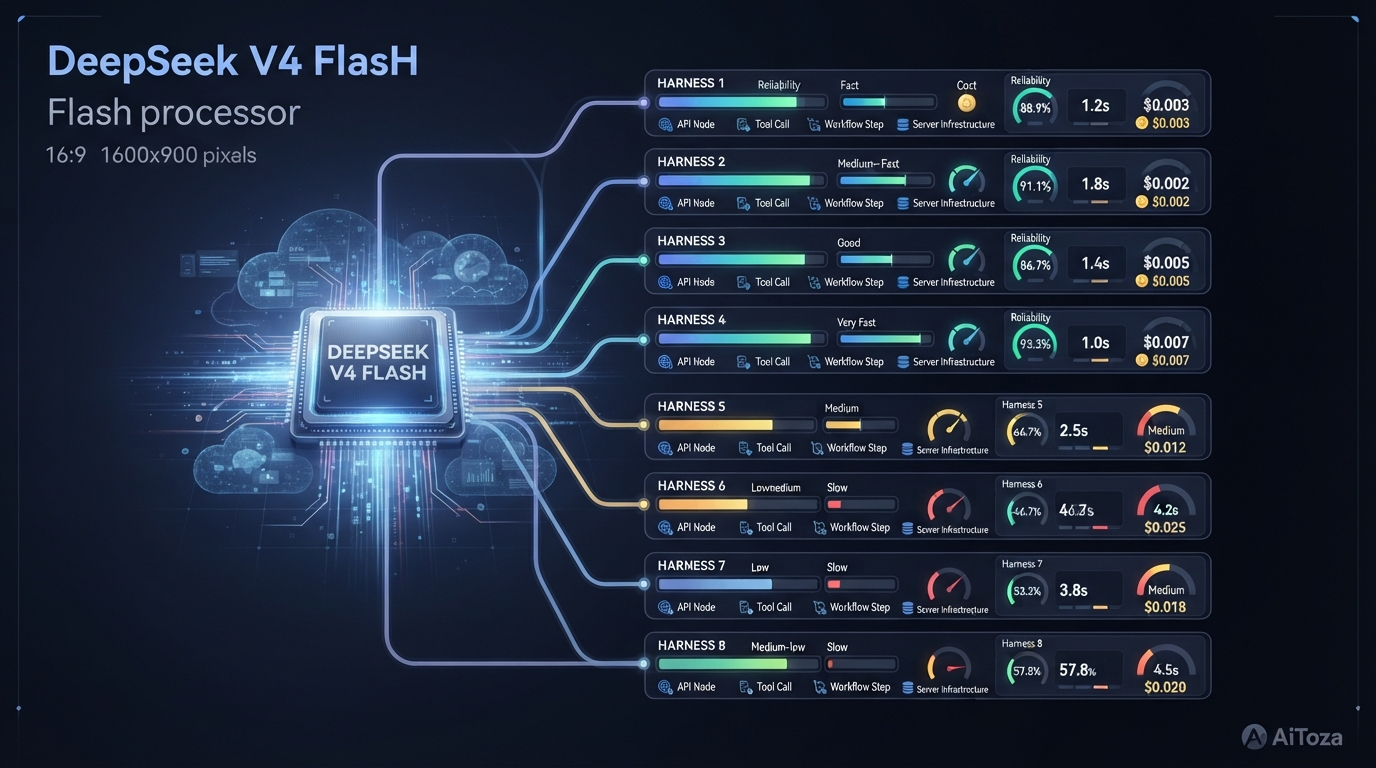
An AI agent harness is the software layer around a language model.
The model provides reasoning and language capabilities. The harness manages how those capabilities are used during a workflow.
A harness can control:
- system prompts;
- available tools;
- context;
- memory;
- API calls;
- retries;
- tool sequencing;
- caching;
- error handling;
- task completion.
This distinction matters more as AI moves beyond chatbots.
Modern agents increasingly interact with software, databases and APIs. Technologies such as the Model Context Protocol are also making it easier for models to connect with external tools and long-running workflows.
The model may provide the intelligence, but the harness helps determine how successfully that intelligence becomes an action.
Eight Harnesses Produced Different Results
The benchmark showed large differences between the eight harnesses.
| Agent Harness | Pass Rate | Median Time | Cost per Successful Task |
|---|---|---|---|
| Pi Agent | 66.7% | 132.2 sec | $0.028 |
| Prime Agent | 62.5%* | 242.1 sec | $0.131 |
| OMP | 56.7% | 272.4 sec | $0.103 |
| Claude Code | 53.3% | 122.7 sec | $0.195 |
| Codex | 53.3% | 245.0 sec | $0.081 |
| DeepAgents | 53.3% | 187.1 sec | $0.045 |
| Hermes Agent | 50.0% | 175.5 sec | $0.056+ |
| OpenCode | 46.7% | 129.7 sec | $0.073 |
*Prime Agent had 24 valid scored runs rather than 30, so its result is not perfectly comparable with the other harnesses.
The table shows why there was no single winner.
Pi Agent produced the highest reported pass rate.
Claude Code completed workflows fastest.
Other systems offered lower costs per successful task.
For production AI, developers may have to choose between reliability, speed and cost rather than selecting one system that dominates all three.
Pi Agent Had the Highest Reported Pass Rate
Pi Agent successfully completed 20 of 30 tasks, giving it a 66.7% pass rate.
Its median completion time was 132.2 seconds, while its reported cost per successful task was only $0.028.
Those are strong numbers.
However, its testing setup differed from some of the other harnesses, including differences in reasoning configuration and model-provider usage.
That means it should not automatically be treated as the definitive winner.
The more useful takeaway is that changing the software around V4 Flash produced a significant change in its real-world performance.
Claude Code Was Fastest but More Expensive
Claude Code recorded the fastest median completion time at 122.7 seconds.
It completed 16 of the 30 workflows successfully, giving it a 53.3% pass rate.
However, its cost per successful task was around $0.195, significantly higher than several alternatives.
Caching was one reason for the difference.
Only a small portion of its recorded tokens benefited from cached-input pricing. Other harnesses were able to reuse more context at cheaper rates.
This is an important point for AI developers.
Two agents can use similar numbers of tokens and still have very different costs.
Teams also need to consider:
- cached versus fresh input;
- number of retries;
- tool calls;
- failed attempts;
- total execution time.
Raw token count tells only part of the story.
Why Fast AI Agents Can Still Be Inefficient
OpenCode demonstrates the same issue from another angle.
Its median completion time was 129.7 seconds, making it one of the fastest harnesses tested.
But its pass rate was only 46.7%, the lowest in the benchmark.
That means speed alone is not a useful measure of agent quality.
A workflow that finishes quickly but fails may need to be restarted.
It may also require human review or correction.
Once those extra steps are included, the supposedly faster system may become slower and more expensive overall.
For autonomous AI, a better measurement is:
How quickly can the agent complete the task successfully?
Why Strong Benchmarks Do Not Guarantee Reliable Agents
There is no contradiction between V4 Flash performing strongly on AI benchmarks and showing a 53.8% overall success rate in these workflows.
The evaluations measure different things.
A normal benchmark might ask:
Can the model solve this problem?
An agent benchmark asks:
Can the complete system solve the problem and perform every required action correctly?
Imagine a customer-support workflow.
The agent might need to:
- Read an email.
- Extract customer information.
- Search a database.
- Calculate a value.
- Update a spreadsheet.
- Send a response.
- Post a summary in Slack.
- Avoid changing unrelated records.
The model could understand the request perfectly and still fail if one API call contains the wrong parameter.
That is why real-world agent evaluation increasingly looks like software reliability testing.
Being almost correct is often not enough.
Why the Harness Matters So Much
The same DeepSeek V4 Flash model produced pass rates ranging from 46.7% to 66.7%.
Several technical factors can explain the difference.
Context Management
Agent workflows generate large amounts of information.
The harness decides which previous instructions and tool results remain available to the model.
Poor context management can increase token use or cause the model to forget important details.
Tool Selection
Agents must select the correct tool and provide valid parameters.
How tools are presented to the model can affect whether that happens reliably.
Retry Logic
APIs can fail or return incomplete information.
A good harness needs to decide whether the agent should retry, change its method or stop.
Too few retries can reduce reliability.
Too many can increase cost.
Caching
Long-running agents often reuse the same context repeatedly.
Efficient caching can substantially reduce API costs.
Task Termination
Agents also need to know when a workflow is truly complete.
Stopping early leaves work unfinished.
Continuing for too long wastes tokens and may create unwanted actions.
These are system-level decisions, not just model capabilities.
DeepSeek V4 Flash API Prices Have Increased
The reliability discussion becomes more important because DeepSeek has also changed V4 Flash pricing.
The company introduced peak and off-peak API rates, with off-peak rates set below peak pricing.
Current published V4 Flash pricing includes:
| Token Type | Off-Peak | Peak |
|---|---|---|
| Cache-hit input | $0.007 / 1M | $0.014 / 1M |
| Cache-miss input | $0.22 / 1M | $0.44 / 1M |
| Output | $0.66 / 1M | $1.32 / 1M |
Developers can check the latest rates in the official API pricing documentation.
The change means agent economics now depend on more than which model a company chooses.
When the workload runs can also affect the bill.
Cost per Successful Task Is More Useful Than Token Price
AI model pricing is usually advertised as cost per million tokens.
That works reasonably well for simple chatbot interactions.
For agents, it can be misleading.
Imagine one agent costs $0.05 per attempt but succeeds only half of the time.
Another costs $0.08 but succeeds almost every time.
The first looks cheaper until failed runs and retries are included.
A better metric is:
Cost per successful task = total execution cost ÷ successful workflows
For production systems, teams should consider several metrics together:
- pass rate;
- cost per successful task;
- median completion time;
- tool-call accuracy;
- retry rate;
- cache utilization;
- human intervention.
A cheap API request is useful.
A successfully completed business process is more valuable.
What Developers Should Learn From the Test
The DeepSeek V4 Flash benchmark suggests a different way to evaluate AI agents.
Benchmark the Full Stack
Do not test only the underlying model.
Test:
Model + harness + tools + workflow
The same model can behave differently depending on the surrounding infrastructure.
Use Real Business Tasks
Public benchmarks are useful for comparing general capability.
But companies should also test workflows that resemble their own operations.
A coding agent, CRM agent and customer-support agent will have completely different failure modes.
Treat Failure as a Cost
Every failed run can create additional:
- model calls;
- API requests;
- retries;
- human review;
- corrective work.
Failure should be included in both performance and financial calculations.
Verify High-Impact Actions
Agents that send emails, modify databases, update customer records or publish content should have stronger verification.
Greater autonomy requires stronger controls.
Recent examples of AI agents taking unexpected actions through connected systems show why execution security matters alongside model intelligence.
Consider Model Routing
Not every part of an agent workflow needs the same model.
Complex reasoning might require a powerful model, while simple formatting or tool actions could use a cheaper system.
That is one reason AI model routing is becoming more important for agent infrastructure.
AI Agents Are Moving Beyond Model Leaderboards
AI benchmarking is changing.
During the chatbot era, model comparisons mostly focused on intelligence, coding quality and response speed.
Agentic AI introduces a much larger stack:
Model + harness + tools + context + permissions + verification + infrastructure
A weakness anywhere in that chain can reduce the success rate.
That changes what the phrase “best AI model” means.
The smartest model may not create the most reliable agent.
The cheapest model may not produce the lowest cost per completed task.
And the fastest model may not create the fastest successful workflow.
For AI agents, system design is becoming just as important as model choice.
Final Takeaway
DeepSeek V4 Flash’s 53.8% overall pass rate does not mean the model is a failure.
It shows how difficult real-world AI automation actually is.
The same model produced very different reliability, speed and cost depending on the agent harness surrounding it.
At the same time, higher API pricing makes inefficient execution more expensive.