
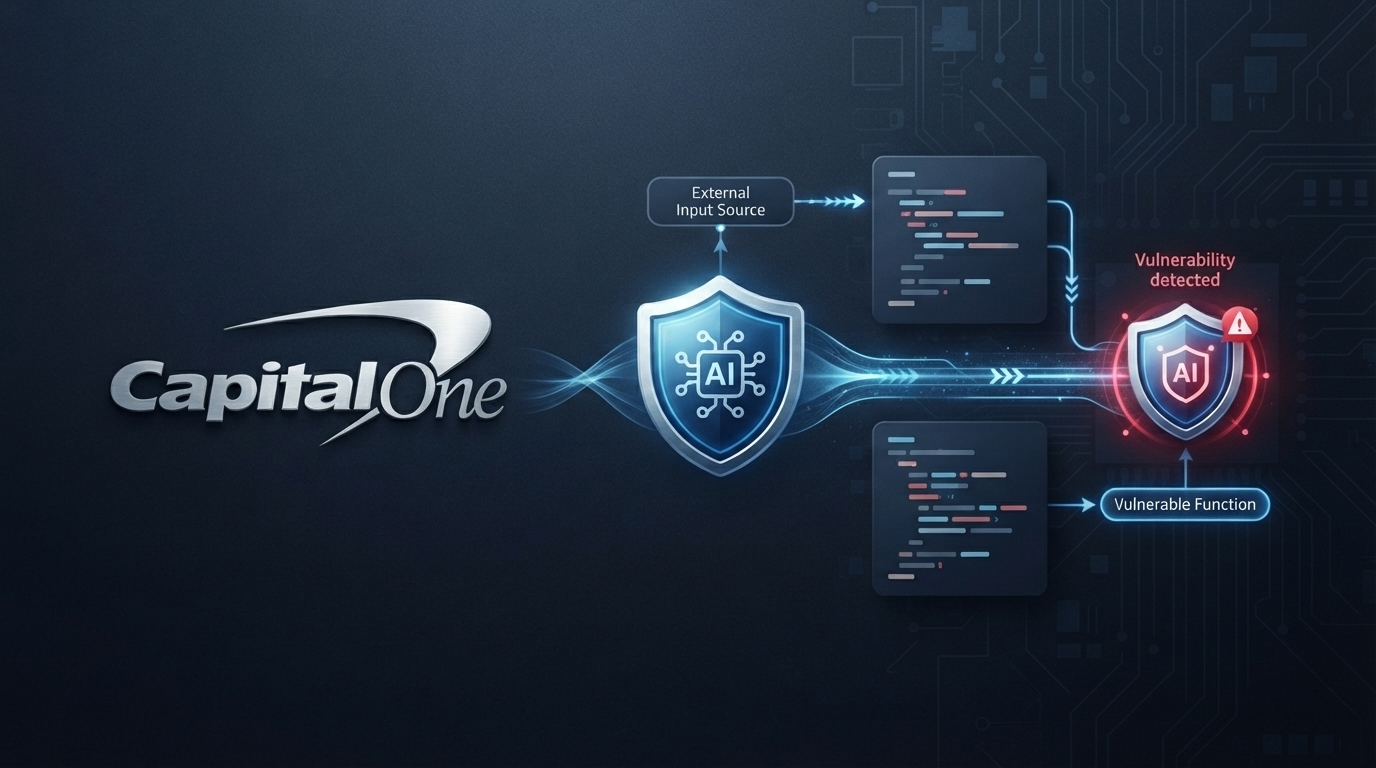
Capital One has released VulnHunter, an open-source agentic AI security tool designed to find exploitable software vulnerabilities before attackers can use them. Capital One announced the project on July 16, 2026, and VentureBeat covered it the following day. The release reflects a wider change in cybersecurity: AI can now help both defenders and attackers understand software weaknesses faster. The tool is available through Capital One’s GitHub repository under the Apache License 2.0. However, teams need access to Claude Opus and a working Claude Code environment to use the initial implementation.
What Problem Is Capital One Trying to Solve?
Security teams already use static application security testing, or SAST, to find unsafe code patterns. However, these scanners may flag a risky function without proving that an outside attacker can reach it. Developers must then trace the code and decide whether the warning represents a genuine security problem. This creates more manual work and can lead to alert fatigue.
Meanwhile, AI is changing the threat environment. Advanced models can help users read large codebases, generate tests, discover weak logic and automate tasks that once required experienced security researchers. Capital One argues that this lowers the barrier for attackers and shortens the time defenders have to find and repair flaws. Network controls, identity protection and monitoring still matter. However, they do not remove insecure code. Capital One’s response is to identify exploitable flaws earlier, before software reaches production.
What Is Capital One VulnHunter?
Capital One VulnHunter is an agentic AI code security system. “Agentic” means the system can complete a multi-step process instead of returning one answer to a prompt. It can examine different parts of a codebase, follow data, challenge its findings and recommend a repair. VulnHunter inspects code, traces untrusted input, examines security checks and tests its own assumptions.
Capital One describes the approach as moving from pattern matching to provability. In other words, a security warning should show a realistic route from an attacker-controlled entry point to a dangerous operation. Capital One says it used VulnHunter across thousands of internal repositories and tens of business areas. However, those results are company-reported. They are not yet supported by a detailed independent benchmark comparing VulnHunter with established application-security tools.
How Does VulnHunter Work?
VulnHunter combines three main ideas:
- Attacker-first forward analysis
- A falsification engine
- Evidence-backed remediation
Together, these stages are intended to reduce speculative alerts and provide developers with clearer next steps.
1. Attacker-First Forward Analysis
Many traditional scanners begin with a dangerous destination, often called a “sink.” A sink could be a database query, file operation, command execution function or another part of the application where unsafe input may cause damage. The scanner works backward to determine whether user-controlled data can reach that destination. VulnHunter starts from the opposite direction.
It begins at places an attacker may be able to access, including:
- APIs
- Network messages
- File uploads
- User-controlled fields
- Other external inputs
It then reasons forward through the application. The tool follows data transformations, business logic and security checks to answer one practical question: Can an attacker move from this entry point to a dangerous capability? This method is intended to simulate how an attacker would interact with the application instead of examining a risky function in isolation.
2. A Falsification Engine That Challenges Every Finding
Finding a possible attack path is not enough. VulnHunter then attempts to disprove its own conclusion.
Its falsification engine searches for:
- Unsupported assumptions
- Missing links in the attack path
- Input-validation controls
- Authentication requirements
- Permission restrictions
- Security checks that could block the attack
A potential vulnerability may look serious at first. However, further analysis might show that the attacker cannot access the affected function or that the input is cleaned before reaching it. Findings that depend on unsupported reasoning should be discarded. This process directly addresses one of the biggest complaints about security scanners: false positives. Capital One wants the alerts reaching developers to have already survived an internal adversarial review.
3. Evidence-Backed Remediation
When a suspected vulnerability survives falsification, VulnHunter collects evidence from the codebase. It maps the prospective exploit path, explains the structural defect and describes the access or capability an attacker could gain. The tool can also propose a focused code change for engineering review.
The goal is to provide one useful finding that explains:
- Where the attacker-controlled input enters
- Which security checks fail
- How the dangerous operation is reached
- What an attacker may gain
- Which code change could block the path
A warning with this context is more useful than a simple message saying that a line of code looks suspicious.
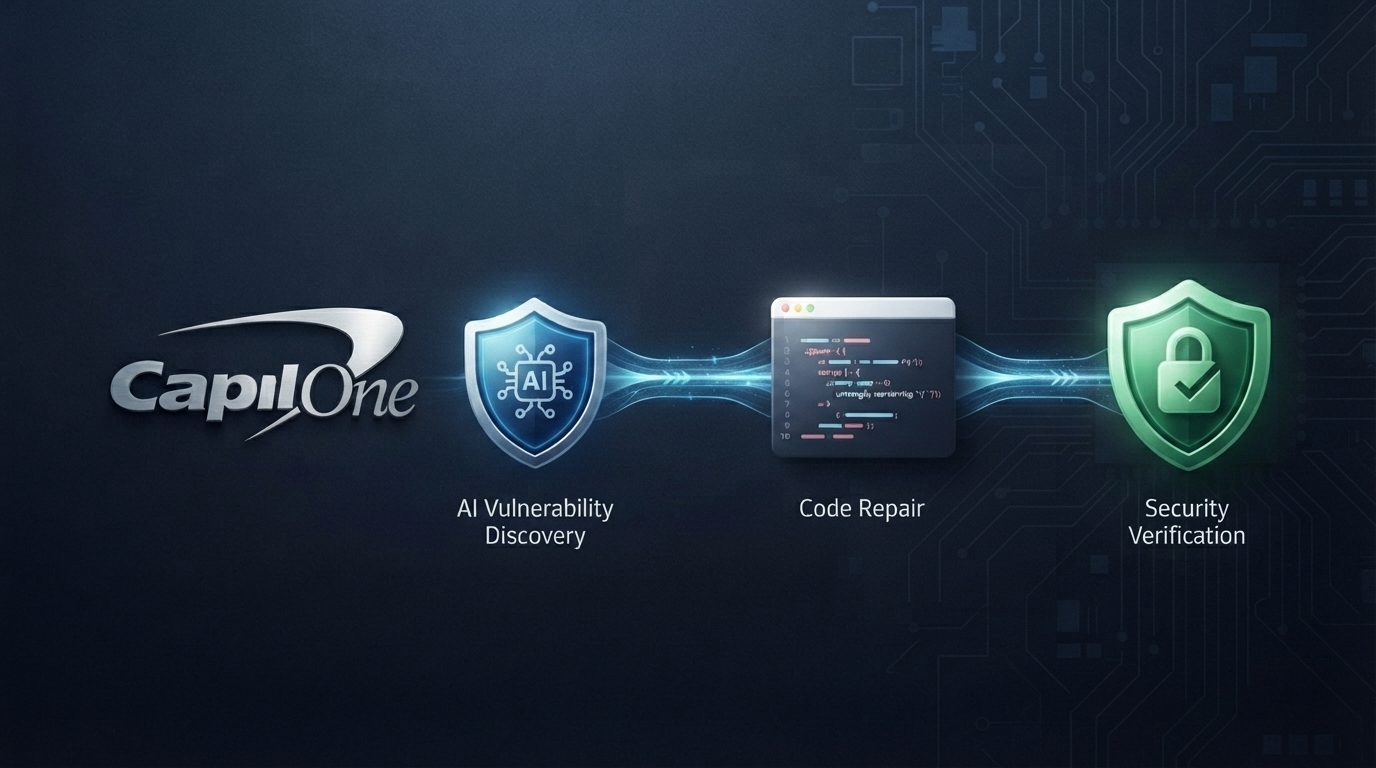
The Hunt, Fix and Verify Workflow
VulnHunter is not limited to one scanner command.The public repository contains three Claude Code skills that form a closed security loop.
Hunt
The /vulnhunt skill performs reconnaissance and identifies attacker-accessible entry points. It runs parallel investigations, applies adversarial falsification and filters findings according to the capability an attacker could gain. For issues that survive this process, the scanner can produce supporting evidence, an executable exploit demonstration and a proposed fix. This means the scanner is expected to do more than say that a flaw may exist. It attempts to show why the issue is reachable and what could happen if it were exploited.
Fix
The /vulnhunter-fix skill turns the finding into a test-driven remediation process.
It can:
- Create an exploit demonstration.
- Write a security test that initially fails.
- Implement a proposed repair.
- Check whether the exploit is blocked.
- Test for possible regressions.
- Prepare a pull request for human review.
This process gives developers a reproducible example of the problem. The failing test shows the vulnerable behavior. The passing test after the repair helps demonstrate that the affected path has been blocked.
Verify
The /vulnhunt-fix-verify skill uses a separate, read-only agent to examine the completed repair. The verifier reviews each finding and reports whether the vulnerability appears to have been fixed. Separating verification from remediation reduces the risk of an agent approving its own incomplete work. The verifier also operates without network or shell access, which limits what it can do while reviewing the repair.
How Is VulnHunter Different From a Traditional SAST Scanner?
Traditional SAST remains useful because it is fast, repeatable and able to search large amounts of code for known security patterns. VulnHunter adds a deeper reasoning layer rather than proving that traditional scanners are obsolete. A conventional scanner may report that untrusted input appears close to a dangerous function.
VulnHunter tries to explain:
- How an attacker reaches that function
- Which conditions must be true
- Whether existing controls block the path
- What capability the attacker may gain
- How the path could be repaired
It also removes weak findings, generates a security test, proposes a fix and checks the repair. This makes VulnHunter closer to an automated security investigation than a basic pattern scanner. However, deeper analysis requires a capable language model and more computing resources. Traditional scanners may remain faster and cheaper for broad baseline checks. Many organizations may therefore use VulnHunter alongside SAST, dependency scanning, penetration testing and human code review instead of replacing those controls.
Can VulnHunter Run at Enterprise Scale?
Capital One has included two components for larger deployments. A headless runtime can clone repositories, run scans, publish results and open GitHub issues for confirmed problems. This allows organizations to run VulnHunter without maintaining an interactive Claude Code session for each scan.
A separate local harness supports:
- Batch scanning
- Resuming interrupted scans
- Managing repository lists
- Collecting findings centrally
- Running security benchmarks
The benchmarking mode can compare scanner results against a corpus of known vulnerabilities and calculate performance metrics. However, the public repository currently provides only a minimal synthetic ground-truth example. It also references public security-training applications such as OWASP NodeGoat, Juice Shop and WebGoat. Organizations will need to create or supply a stronger vulnerability corpus for a serious internal evaluation.
Why Did Capital One Make VulnHunter Open Source?
Capital One presents the release as a collective-defense decision. Modern applications depend on shared libraries, frameworks, packages and services. A vulnerability in one popular component can affect many organizations at the same time. Keeping every defensive technique private may therefore leave the wider software ecosystem exposed.
By releasing VulnHunter under the Apache License 2.0, Capital One allows developers and security researchers to:
- Inspect the workflow
- Test its assumptions
- Modify the implementation
- Add new model support
- Report weaknesses
- Contribute improvements
Open sourcing also creates scrutiny.
Independent researchers can study how the tool reaches conclusions, identify weak reasoning patterns and test whether its low-false-positive approach works across different languages and applications. Capital One’s contribution is notable because it packages code analysis, exploit validation, repair and verification into a public workflow created inside a major financial institution.
What Do Developers Need to Run VulnHunter?
The initial release was built and optimized for Claude Opus 4.8 inside Claude Code. Capital One says the framework depends on deep, multi-step reasoning and requires a frontier Opus-class model. Users must provide their own model access.
Therefore, the repository may be free to download, but operating VulnHunter is not necessarily free. Model usage can create costs, particularly when teams scan large repositories or run repeated investigations.
Python 3.12 or later is required for the runtime agent and benchmarking harness. Teams must also confirm that they are authorized to scan the target codebase. Vulnerability discovery and exploit validation are dual-use activities because the same information can help defenders or attackers.
Benefits for Development and Security Teams
The clearest potential benefit is reduced triage. Instead of asking developers to investigate every pattern-based warning, VulnHunter tries to deliver a smaller number of findings supported by an end-to-end attack path. That could help teams focus on problems with realistic security impact.
A failing security test also gives developers a reproducible example. Meanwhile, the pull-request workflow keeps humans involved in reviewing the proposed repair. The independent verifier adds another safeguard by checking whether the reported attack path is actually blocked.
For security teams, batch scanning and automated issue creation could make it easier to evaluate many repositories. However, organizations should still measure accuracy, operating cost, developer acceptance and missed vulnerabilities in their own environments.
Limitations and Risks to Consider
VulnHunter is promising, but its first public release has important limitations.
First, the tool depends heavily on Claude Opus and Claude Code. Results may change when teams adapt the workflow to a smaller or different language model. Second, Capital One has not published a complete independent comparison covering:
- False-positive rates
- Missed vulnerabilities
- Language support
- Scanning time
- Model costs
- Performance against commercial scanners
Third, companies must review source-code privacy, model data handling, retention settings and compliance requirements before using an AI-based scanning workflow.
Fourth, exploit generation is dual use.
Anthropic may block or flag cybersecurity-related requests from accounts outside its Cyber Verification Program. Users must also scan only code they are legally and professionally authorized to test.
Human review remains necessary. An AI-generated patch could block one route while introducing another problem. It might change expected application behavior, create a regression or fail to address a related weakness. VulnHunter’s verification agent helps reduce that risk, but it should remain one part of a wider secure-development process.
Why the VulnHunter Release Matters
VulnHunter matters because it changes how an automated security tool presents its work. Instead of only assigning risk to a line of code, it tries to build and challenge a complete security argument. That argument begins with attacker access. It follows the input through the application, identifies the resulting capability and proposes a repair. A separate agent then checks the outcome. This approach may reduce false alarms and make security findings easier for developers to understand.
However, it could also create new risks if teams trust model-generated reasoning without testing the results. For now, VulnHunter should be viewed as an open-source framework worth evaluating. It is not yet a proven replacement for an established application-security program. Its long-term value will depend on independent benchmarks, community testing, broader model support and reliable results outside Capital One’s internal environment.
Conclusion
Capital One’s VulnHunter release addresses a growing problem: attackers and defenders can both use advanced AI to understand software faster. The tool responds by applying attacker-first analysis directly to source code. It traces realistic entry points, challenges potential findings, creates evidence-backed repairs and verifies whether those repairs work. Its Apache 2.0 license gives the wider security community an opportunity to inspect and improve the workflow.
At the same time, its Claude dependency, operating cost, dual-use capabilities and lack of independent performance data mean organizations should evaluate it carefully. VulnHunter’s strongest idea is simple. A security tool should do more than report suspicious code. It should help prove whether the flaw is reachable, explain why it matters and show that the repair closes the path.