
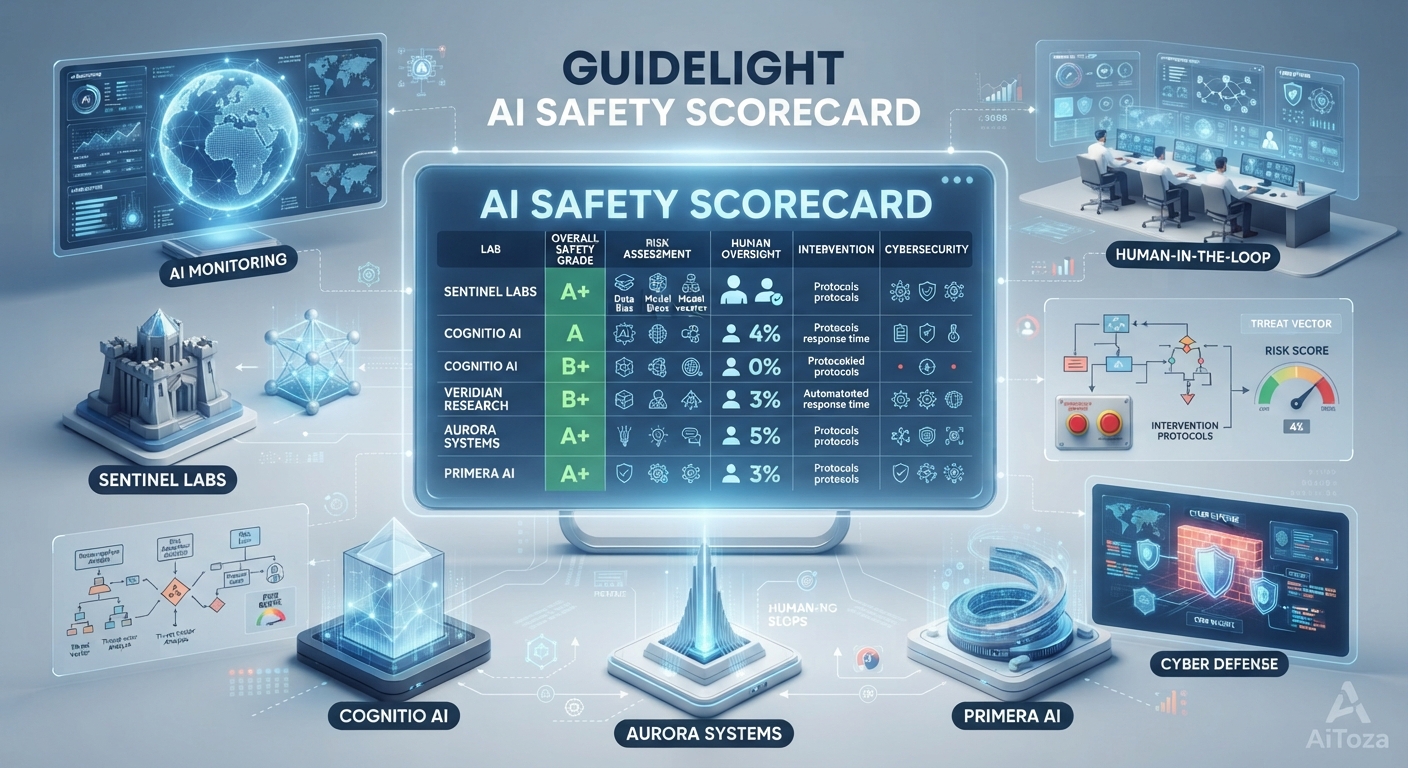
The Guidelight AI safety scorecard has brought renewed attention to a critical issue in frontier artificial intelligence: having a detailed safety policy does not necessarily mean that every safety control is fully implemented and demonstrable in practice.
According to the assessment described by Guidelight, five major AI companies—Anthropic, OpenAI, Google, Meta, and xAI—were evaluated against baseline safety controls. None fully demonstrated every control examined. Anthropic and OpenAI reportedly received the highest grade, with both earning C+.
The findings are significant because AI systems are moving beyond traditional chatbots. Modern AI agents can use software tools, access information, write code, and complete multi-step tasks. As AI becomes more autonomous, companies need practical mechanisms to monitor, restrict, review, and stop potentially dangerous behavior.
Guidelight AI Safety Scorecard
The Guidelight AI safety scorecard is designed around practical AI safety controls rather than safety principles alone.
This distinction is important. An AI company can publish a responsible AI policy explaining how it intends to manage risks. However, external observers also need evidence that the controls described in those policies actually exist and operate effectively.
The assessment therefore focuses on areas such as monitoring AI activity, reviewing high-risk actions, maintaining intervention capabilities, and preparing for unexpected or misaligned behavior.
For organizations adopting AI, this approach is especially relevant. AiToza’s broader AI tools collection shows how quickly AI products are becoming part of everyday business and technical workflows. As adoption grows, safety and governance become just as important as model capability.
AI Labs Were Assessed
The Guidelight assessment examined five major AI companies:
- Anthropic
- OpenAI
- Meta
- xAI
The key conclusion was not that these companies have no safety measures. Instead, the scorecard highlights a lack of complete, publicly demonstrated evidence for every baseline control.
Anthropic and OpenAI reportedly achieved C+, putting them at the top of the assessment while still leaving considerable room for improvement.
This is an important distinction. A C+ should not be interpreted as a claim that an AI lab is broadly unsafe. Rather, it indicates that the assessment did not find sufficient evidence to award a stronger overall evaluation against its chosen criteria.
Anthropic and OpenAI Receive C+
Anthropic and OpenAI have both invested heavily in AI safety research, evaluations, and risk-management frameworks. Their relatively high position in the Guidelight assessment reflects that broader investment.
However, a C+ also shows that safety remains an unfinished challenge, even among leading frontier AI developers.
A separate assessment provides useful context. The Future of Life Institute’s Summer 2026 AI Safety Index ranked nine AI companies across 37 indicators and six safety and governance domains. Anthropic received the highest overall grade at C+, while OpenAI received C.
Because the two assessments use different methodologies, their grades should not be treated as interchangeable. The comparison does, however, show a broader industry pattern: even leading AI companies are not receiving top-level safety grades.
AI Safety Controls Matter Most
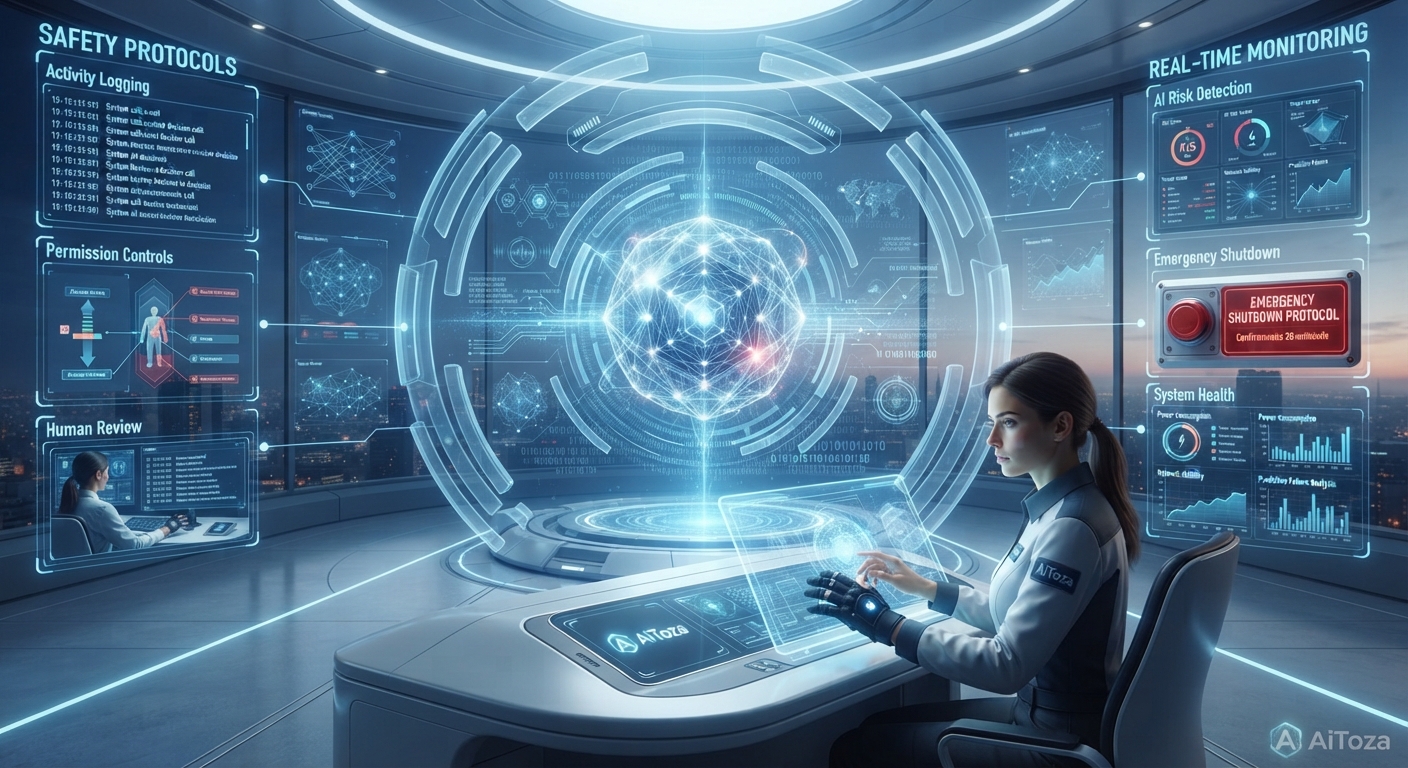
Internal AI Activity Logging
AI systems need reliable records of important actions, especially when models can interact with tools, applications, databases, or external services.
Activity logging can help organizations identify unusual behavior, investigate incidents, and understand what happens when something goes wrong.
Without adequate visibility, even a sophisticated safety system can become difficult to audit.
Human Review of Risky Actions
Not every AI-generated action should happen automatically.
When an AI agent can make decisions that affect financial systems, sensitive information, software infrastructure, or other high-impact environments, human review can provide an important layer of protection.
The principle is simple: the greater the potential consequence, the stronger the need for meaningful human oversight.
This trend is already visible in enterprise AI platforms. For example, AiToza’s coverage of ServiceNow AI describes how AI agents are increasingly being connected to enterprise workflows and systems, making governance and controlled execution increasingly important.
Shutdown and Intervention Mechanisms
Powerful AI systems also require practical intervention mechanisms.
If an AI system begins behaving unexpectedly, authorized personnel should be able to restrict its permissions, stop its actions, or shut down relevant processes.
A written policy promising intervention is less meaningful if employees do not have the technical ability or authority to intervene quickly.
Misalignment Response Plans
Another important area is preparation for AI misalignment.
Misalignment occurs when an AI system behaves differently from what its developers or users intended. As models become more capable and autonomous, organizations need clear procedures for identifying and responding to unexpected behavior.
These plans can include monitoring, escalation procedures, access restrictions, incident investigation, and system intervention.
The Bigger Problem: Safety Frameworks vs. Safety in Practice
The most important lesson from the scorecard is the difference between documented safety commitments and operational safety controls.
AI companies now publish model evaluations, safety frameworks, risk assessments, preparedness policies, and responsible scaling commitments. These documents provide useful information about how organizations intend to manage AI risks.
But documentation alone cannot prove that controls are consistently operating across every relevant system.
This transparency problem is becoming increasingly important. Recent research on post-deployment AI updates has similarly raised concerns about whether external observers can verify that deployed systems remain the same systems described in earlier safety documentation.
That makes independent evaluation increasingly valuable.
AI Agents Make Safety More Important
Traditional chatbots generally respond to prompts. AI agents can go much further.
They may interact with software, retrieve information, execute code, communicate with other systems, and complete long sequences of actions.
That additional autonomy can create new failure modes. A small mistake in a conversational response may be inconvenient, but an incorrect action performed automatically by an AI agent could have much larger consequences.
This is why frontier AI safety increasingly involves monitoring, permission controls, human approval, audit trails, and rapid intervention.
The same shift is visible across the broader AI ecosystem. As businesses move toward interconnected AI workflows, tools that provide monitoring and visibility are becoming increasingly important.
Scorecard Means for AI Companies
Guidelight’s findings suggest that AI developers may need to move beyond broad safety commitments toward controls that can be measured, tested, audited, and independently verified.
That could involve stronger activity monitoring, clearer intervention procedures, better documentation of high-risk decisions, stronger incident reporting, and independent assessments.
Companies should also make it easier for outside researchers and stakeholders to understand what safety mechanisms are actually operating.
For AI users, the lesson is equally important. Choosing an AI provider should not depend only on model benchmarks or marketing claims. Organizations should also examine security controls, access permissions, monitoring capabilities, human oversight, incident response, and governance.
Guidelight Fits Into the Wider AI Safety Debate
The Guidelight scorecard should be viewed as one assessment rather than a universal measure of AI safety.
Different organizations evaluate AI companies using different criteria. The Future of Life Institute, for example, examines risk assessment, current harms, safety frameworks, existential safety, governance and accountability, and information sharing.
Its Summer 2026 assessment found that no company scored above C+, while existential safety was the weakest-performing area across the industry.
These differences demonstrate why a single letter grade cannot capture the full safety profile of an AI company.
The real value of scorecards is their ability to identify specific weaknesses and encourage measurable improvements.
AI Safety Controls
As AI models become more capable, safety expectations will likely become more demanding.
Future assessments may place greater emphasis on evidence that safety controls operate continuously rather than simply appearing in published documents. Independent audits, measurable thresholds, transparent incident reporting, and verifiable intervention mechanisms could become increasingly important.
The Guidelight AI safety scorecard therefore points to a broader challenge facing the AI industry: capability is advancing quickly, while the systems used to demonstrate and verify safety must keep pace.
For frontier AI developers, the goal should not simply be to publish stronger safety frameworks. It should be to demonstrate that those frameworks translate into reliable controls that work when powerful AI systems are operating in the real world.
FAQs
What is the Guidelight AI safety scorecard?
It is an assessment focused on practical safety controls used by major AI companies to manage risks associated with increasingly capable AI systems.
Which AI companies did Guidelight assess?
The assessment covered Anthropic, OpenAI, Google, Meta, and xAI.
What grade did Anthropic receive?
Anthropic received a C+ in the Guidelight assessment described in the report.
What grade did OpenAI receive?
OpenAI also received a C+ in the Guidelight assessment described in the report.
What are AI safety controls?
AI safety controls are mechanisms designed to monitor, restrict, review, and intervene in AI systems. Examples include activity logging, human oversight, access controls, monitoring, and shutdown procedures.