

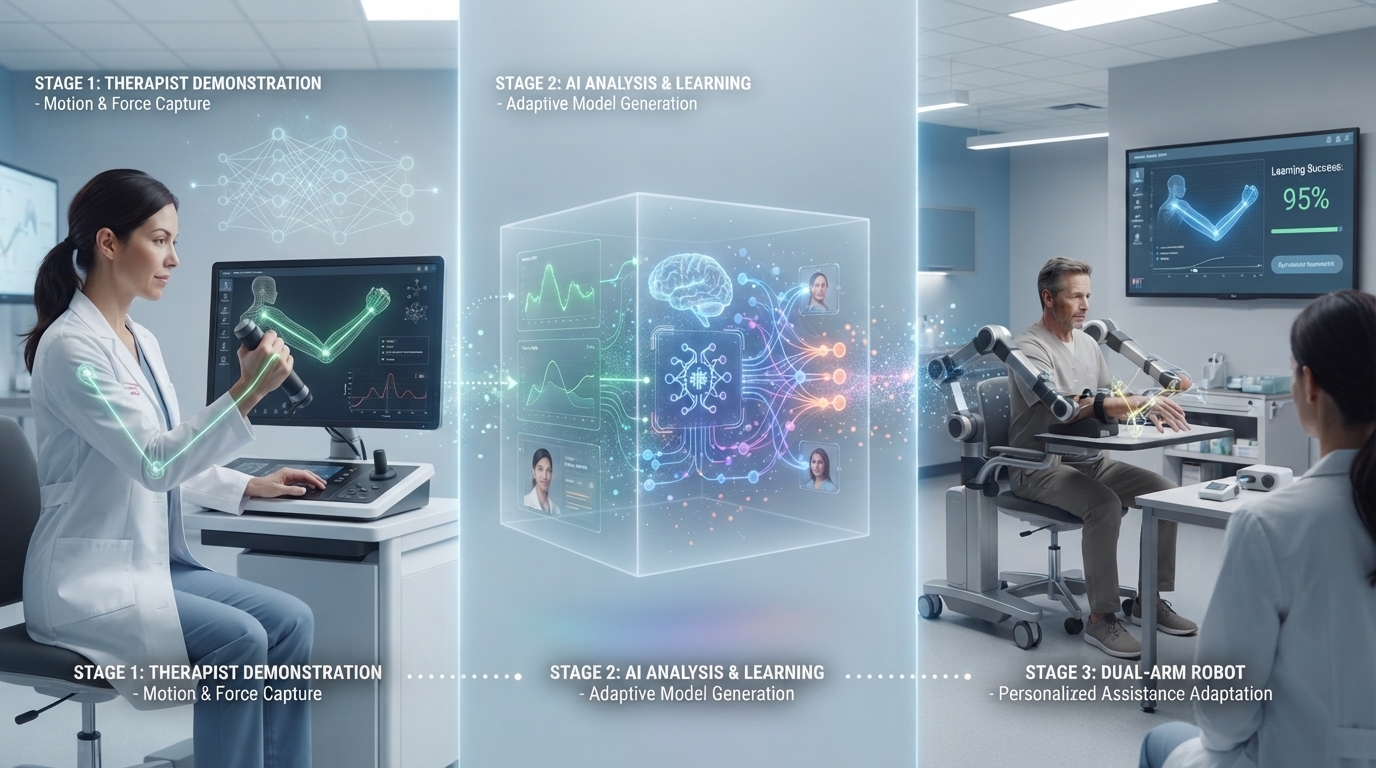
Stroke recovery often depends on repeated physical therapy, careful monitoring, and consistent patient effort. Yet providing that level of personalized rehabilitation is difficult when therapists face limited time, growing demand, and patients with very different recovery needs.
A new AI-powered stroke rehabilitation robot developed by MIT engineers is exploring a different approach. Instead of programming a robot to simply repeat a fixed exercise, researchers are teaching it how to physically interact with patients by learning from physical therapists.
The system combines generative AI, transformer-based diffusion models, robotics, and real-time force feedback. Its purpose is to determine how much assistance a patient needs during a movement and adjust that assistance according to the patient’s effort and capabilities.
MIT researchers emphasize that the technology is designed to extend the reach of physical therapists rather than replace them. If future clinical studies demonstrate its safety and effectiveness, the approach could become an important development in personalized and scalable stroke rehabilitation.
.
What Is MIT’s AI-Powered Stroke Rehabilitation Robot
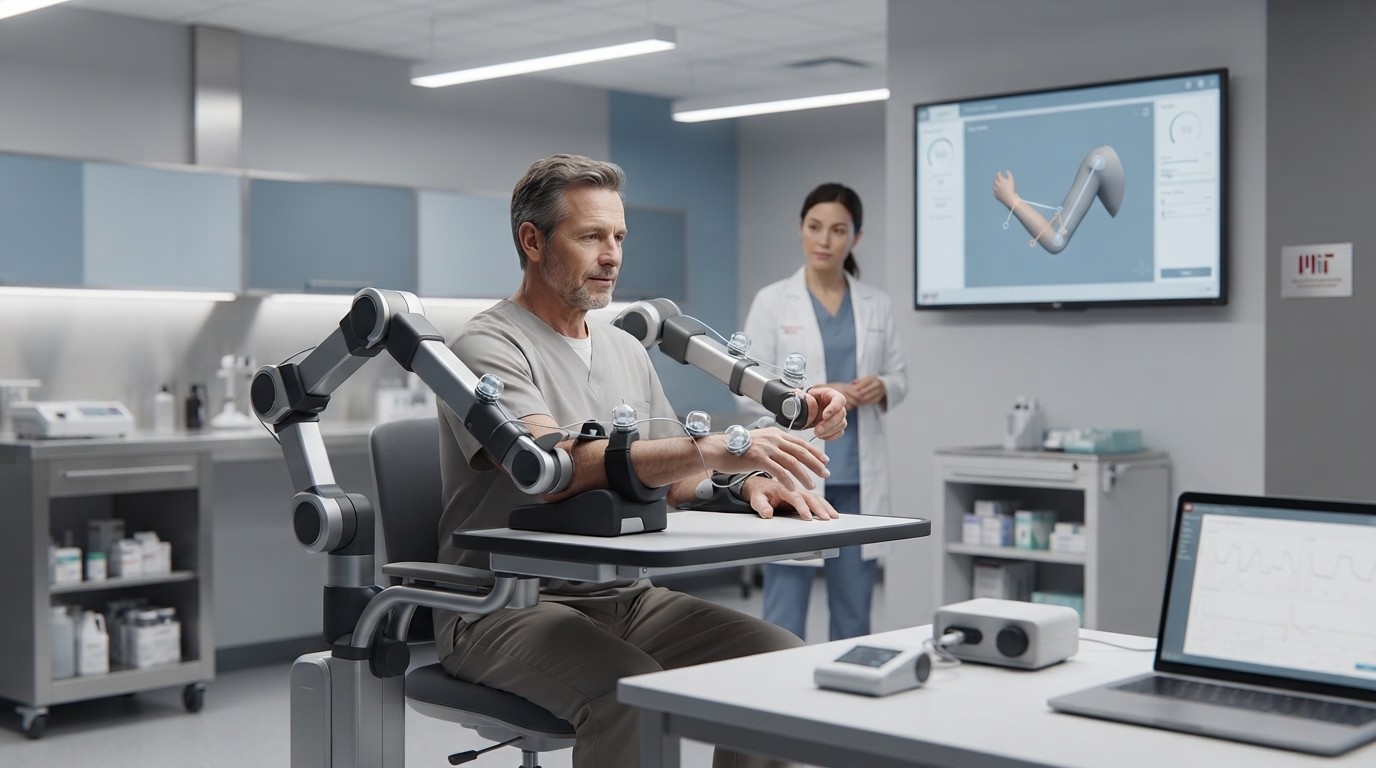
MIT’s system is a dual-arm robotic platform designed for adaptive physical and occupational therapy. Rather than following only predetermined movement trajectories, the robot learns physical interaction behaviors from demonstrations and uses force feedback to determine how it should assist a person.
This distinction matters because rehabilitation is not simply about moving an arm from one position to another.
A therapist may gently support a patient’s arm, reduce assistance when the patient begins contributing more effort, or change the direction and amount of force when the patient struggles. These small physical adjustments are part of the therapist’s expertise.
The MIT system attempts to capture some of that interaction through AI.
Researchers combine real-world physical interaction data with generative AI models. The system can learn behaviors involving touch, force, resistance, and patient effort, allowing the robot to produce adaptive assistance instead of merely replaying a demonstration.
This makes the technology particularly interesting within the wider movement toward physical AI, where machines must understand not only digital information but also how their actions affect people and objects in the physical world.
Why Stroke Rehabilitation Needs More Personalized Therapy
Stroke remains a major cause of disability worldwide. MIT reports that approximately 15 million people experience stroke each year, with around 5 million left with long-term impairments. At the same time, shortages of physical therapists can make consistent, high-quality rehabilitation difficult to access.
Recovery also varies significantly between individuals.
One patient may have enough strength to complete most of an arm movement independently, while another may need substantial physical support. Providing the same level of robotic assistance to both patients would not necessarily produce the best rehabilitation experience.
Too much assistance could reduce the patient’s active contribution. Too little assistance could make a movement difficult or unsafe.
This creates a central challenge for AI in stroke rehabilitation: how can technology provide enough assistance to help a patient while still encouraging independent movement?
MIT’s approach attempts to address that challenge by allowing the robot to respond dynamically to the patient’s physical interaction.
How the MIT Robot Learns Physical Therapy
The most important innovation is that the robot is designed to learn how to interact, not simply what movement to perform.
Researchers first used real-world telemanipulation experiments to collect physical interaction data. Participants performed rehabilitation-related movements while intentionally changing their level of effort.
The experiments included movements such as:
- Arm lifting
- Out-of-plane reaching
- Contact-rich manipulation
- Movements involving different levels of physical effort
This data helped the generative AI model learn how assistance should change as a person participates more or less actively.
Human operators also guided the robot through contact-rich manipulation tasks. Together, these datasets provided examples of how physical interaction can change during a movement.
The result is a different training philosophy for rehabilitation robotics.
Instead of telling the robot, “Move the patient’s arm along this exact path,” researchers are working toward teaching it principles such as:
If the patient contributes more effort, adapt the assistance. If resistance changes, respond appropriately. If physical contact changes, modify the robot’s behavior.
That makes the robot’s behavior more flexible than a simple programmed trajectory.
Generative AI Gives the Robot a New Learning Approach
Generative AI is usually associated with systems that generate text, images, audio, or video. MIT researchers are applying a similar concept to robotic behavior.
The system uses transformer-based diffusion models to learn how a robot should behave during physical interaction. According to MIT, the model is designed to learn dynamic physical interaction beyond conventional motion planning.
This is significant because physical rehabilitation contains many variables.
A patient’s arm may move differently from one session to another. The amount of resistance can change. The patient’s effort can increase as recovery progresses. A therapist may also apply different techniques depending on the individual.
A generative model can potentially learn a distribution of successful interaction behaviors rather than memorizing one fixed movement.
That opens the door to more adaptive robot-assisted stroke rehabilitation.
Traditional Robotic Therapy vs. MIT’s Adaptive Approach
Traditional rehabilitation robots can be highly useful because they provide controlled, repetitive movement. However, many systems depend on predefined exercises, trajectories, or assistance strategies.
MIT’s research takes a more interactive approach.
| Traditional Robotic Therapy | MIT’s AI-Based Approach |
| Uses programmed movements | Learns physical interaction |
| Follows predefined trajectories | Generates adaptive behavior |
| Assistance can follow fixed rules | Assistance can respond to effort |
| Focuses primarily on motion | Focuses on motion and physical interaction |
| Robot behavior is programmed | Therapist demonstrations help train the model |
The difference is especially important in rehabilitation because physical therapy involves continuous interaction between therapist and patient.
A robot that understands only where a patient’s arm should move may be less flexible than one that also learns how a therapist supports, resists, guides, and responds to that movement.
MIT researchers describe this as a shift from learning motion alone toward learning dynamic physical interaction.
How AI Could Personalize Stroke Rehabilitation
Personalization is one of the strongest potential benefits of this technology.
Imagine two patients performing the same arm-lifting exercise.
The first patient can raise the arm independently but has difficulty maintaining a smooth movement. The robot could provide limited assistance.
The second patient has considerably weaker movement. The robot could provide more physical support while still allowing the patient to participate.
As the first patient’s strength improves, assistance could potentially be reduced. This creates a rehabilitation strategy based more closely on the patient’s active performance.
MIT’s system uses real-time force feedback to help determine how the robot should interact with the patient. The robot’s dual-arm design also allows it to perform a broader range of physical therapy interactions.
The long-term goal is even more personalized.
MIT researchers are conducting an ongoing clinical study with the Technical University of Munich and Pfennigparade, an outpatient rehabilitation center in Munich. Physical and occupational therapists are being recorded while treating patients using force-sensing gloves and cameras.
The collected information is being used to develop AI models that capture the physical interaction style of individual therapists.
That could eventually allow a rehabilitation robot to reproduce not only an exercise but also aspects of a particular therapist’s physical approach.
What Movements Can the Robot Support
Initial experiments involved movements including arm lifting and out-of-plane reaching. MIT says the system builds on previous work that was more limited to planar reaching and expands toward a broader and more functional range of actions.
This is particularly relevant for stroke survivors with upper-limb impairments, where rehabilitation can involve repeated practice of reaching, lifting, positioning, and other functional movements.
The researchers also identify potential applications beyond stroke rehabilitation.
The same underlying technology could potentially assist:
- Post-surgical patients recovering range of motion
- Older adults maintaining arm and shoulder strength
- People requiring physical or occupational therapy
- Other rehabilitation scenarios involving physical interaction
These possibilities remain research directions rather than established clinical applications.
The Role of the Therapist Remains Essential
AI-powered rehabilitation does not eliminate the need for physical therapists.
A therapist does far more than physically move a patient’s arm. Clinical care involves evaluating impairment, understanding medical history, setting goals, selecting appropriate exercises, monitoring safety, identifying problems, and adapting treatment.
A robotic system cannot independently replace that broader clinical judgment.
Instead, MIT researchers frame the technology as a way to extend therapist reach. A robot could potentially handle some repetitive physical assistance while the therapist focuses on assessment, decision-making, communication, and more complex interventions.
This human-AI collaboration is consistent with a broader trend in healthcare AI, where technology is increasingly positioned as an augmentation tool rather than a complete replacement for professionals.
AI in Stroke Rehabilitation Goes Beyond Robotics
Robotic therapy is only one part of the expanding AI rehabilitation ecosystem.
Artificial intelligence is also being explored for movement analysis, recovery prediction, wearable monitoring, brain-computer interfaces, virtual reality, and tele-rehabilitation.
Machine learning models can analyze movement data and identify patterns that may be difficult to measure consistently by observation alone. Wearable sensors can capture motion continuously, while AI systems can potentially turn that data into useful feedback.
Virtual and augmented reality can also provide interactive rehabilitation environments, while tele-rehabilitation technologies can help therapists monitor patients outside traditional clinical settings.
Together, these technologies point toward a rehabilitation model in which patient data, AI analysis, robotic assistance, and human expertise work together.
For a broader look at how AI systems are evolving into physical and autonomous environments, AI models provide another example of the rapidly developing embodied-AI landscape.
Potential Benefits of AI-Powered Rehabilitation
If validated through clinical research, adaptive rehabilitation robots could offer several potential advantages.
Personalized Assistance
The robot can potentially adjust physical support according to patient effort and capability instead of providing identical assistance throughout an exercise.
Repetitive Training
Robots can perform repetitive physical tasks consistently, potentially helping therapists deliver more practice without requiring the therapist to physically perform every repetition.
Real-Time Feedback
Force sensing provides information about physical interaction that can help the robot respond to changes during therapy.
Therapist-Specific Training
The ongoing clinical study explores whether AI models can capture individual therapists’ physical interaction styles, potentially making robotic assistance more personalized.
Greater Scalability
If the technology proves safe, effective, and affordable, robotic systems could potentially help therapists serve more patients while maintaining human oversight.
These potential benefits should not be interpreted as proof that the MIT system is already clinically superior to conventional rehabilitation. The technology remains under research and evaluation.
Safety and Clinical Challenges
Physical interaction between a robot and a human patient creates unusually demanding safety requirements.
A rehabilitation robot must respond appropriately to unexpected resistance, sudden movements, changes in patient condition, and other physical variables. Any error can have consequences that are very different from an incorrect response generated by a purely digital AI system.
Clinical validation is therefore essential.
MIT’s current work is moving toward longer-term clinical evaluation. The research team aims to develop therapist-specific models and evaluate them with patients who previously received manual therapy.
Other challenges include:
- Patient safety
- Data privacy
- Cost of robotic systems
- Clinical validation
- Regulatory approval
- Integration with existing healthcare workflows
- Therapist training
- Accessibility for smaller rehabilitation centers
These issues will determine whether AI-powered rehabilitation can move successfully from research laboratories into everyday clinical practice.
From MIT-Manus to Generative AI Rehabilitation
MIT’s work on robotic stroke therapy is not entirely new. The institution has a long history of researching robots for rehabilitation.
Earlier MIT-Manus research explored robotic assistance for stroke patients and demonstrated how robots could provide adjustable guidance while recording movement and force data.
The newer research builds on that foundation but introduces a different AI paradigm.
Earlier systems could learn or reproduce therapeutic exercises and adjust assistance according to patient movement. The newer MIT approach aims to learn physical interaction itself, using generative AI to model how assistance should be delivered.
That progression—from programmed rehabilitation, to interactive robotic therapy, to AI-learned physical interaction—shows how rehabilitation robotics is evolving.
What the Future Could Look Like
The future of AI-powered stroke rehabilitation could involve a combination of therapist expertise, robotics, wearable sensors, computer vision, and generative AI.
A patient might perform therapy while sensors monitor movement and force. AI could analyze performance in real time, while a robot provides carefully controlled physical assistance. The therapist could oversee the session, adjust goals, and intervene when necessary.
Therapist-specific models could potentially make this even more personalized.
Instead of using one generic robotic behavior, future systems might learn different interaction strategies from different therapists and apply those strategies according to individual patient needs.
Home-based rehabilitation is another possible long-term direction, although significant safety, regulatory, and clinical challenges would need to be solved before sophisticated physical robots could safely operate outside professional settings.
The broader AI industry is already moving toward systems capable of acting in physical environments. Developments such as gong intelligence suggest that the technology underlying physical AI is advancing quickly.
Why MIT’s Research Matters
MIT’s AI-powered stroke rehabilitation robot represents an important shift in how researchers think about rehabilitation robotics.
The key idea is not simply to make a robot move an arm.
It is to make the robot understand how to help a person move.
That distinction could become increasingly important as AI enters healthcare. Physical rehabilitation requires sensitivity to human effort, resistance, movement quality, safety, and changing capabilities. These are fundamentally physical problems, not just computational ones.
By combining generative AI with force feedback and therapist demonstrations, MIT researchers are exploring a way to bring more of the therapist’s physical expertise into robotic systems.
The approach is still being evaluated, and it should not be viewed as a replacement for professional rehabilitation. But if future clinical studies demonstrate reliable safety and effectiveness, this technology could help make personalized therapy more scalable.
The research also highlights a broader transformation in AI: machines are increasingly being designed not only to understand information but to interact intelligently with the physical world.
Frequently Asked Questions
What is an AI-powered stroke rehabilitation robot?
An AI-powered stroke rehabilitation robot is a robotic system that uses artificial intelligence to assist patients during rehabilitation exercises. MIT’s system combines generative AI with real-time force feedback to learn adaptive physical interaction.
How does MIT’s rehabilitation robot work?
The system learns from physical interaction demonstrations and uses force feedback to determine how it should assist a patient. Its AI model is designed to learn responses to touch, force, resistance, and patient effort.
What makes MIT’s robot different from traditional rehabilitation robots?
Traditional systems may rely heavily on programmed movement trajectories. MIT’s newer approach focuses on learning dynamic physical interaction, allowing the robot to potentially adapt its assistance according to the patient’s participation.
Can the MIT robot replace physical therapists?
No. The researchers describe the technology as a way to extend therapists’ reach. Physical therapists remain responsible for clinical assessment, treatment decisions, safety, and patient care.
Is the MIT AI rehabilitation robot available to patients?
The system is still under research and clinical evaluation. MIT researchers are working with collaborators in Germany on an ongoing clinical study designed to develop therapist-specific models and evaluate the technology over a longer period.
What types of patients could benefit from the technology?
Potential applications include stroke survivors with upper-limb impairments, post-surgical patients recovering range of motion, and older adults working to maintain strength and mobility. These applications remain areas of research rather than established treatment recommendations.