
Artificial intelligence is changing how software is planned, written, tested, and maintained.
Early AI coding assistants mainly completed lines of code or generated small functions. Newer tools can analyse repositories, investigate bugs, write tests, and support developers across longer projects. For a broader overview of the rapidly expanding AI software market, see Aitoza’s guide to the Top 100 AI Tools in 2026.
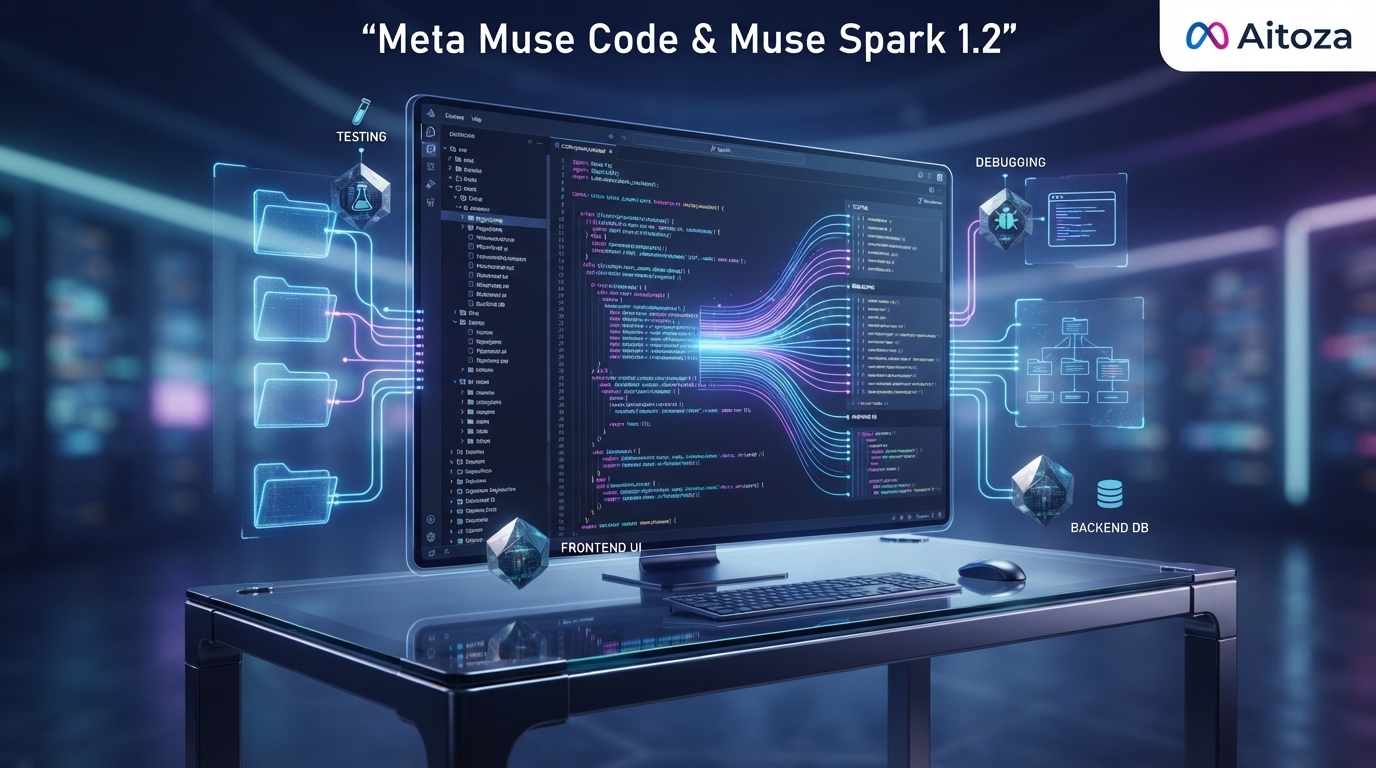
Meta Muse Code takes this idea further. Powered by Muse Spark 1.2, it is presented as an autonomous software engineering platform built for complex and long-running coding tasks.
Instead of waiting for a new prompt after every step, Muse Code can plan work, coordinate background agents, modify related files, test its changes, and keep working while the developer handles other tasks.
What Is Meta Muse Code?
Meta Muse Code is an AI-powered software engineering agent created for professional development workflows.
Unlike a standard coding chatbot, it is designed to complete a series of connected tasks rather than respond only with a code snippet.
A developer can assign a high-level objective, such as:
- Adding a new application feature
- Fixing a repository-wide problem
- Updating old dependencies
- Migrating to a different framework
- Creating automated tests
- Improving technical documentation
- Modernising a legacy application
Muse Code can then examine the repository, prepare a plan, make changes, run checks, and present the results.
This makes it closer to an autonomous development assistant than a traditional autocomplete tool.
What Is Muse Spark 1.2?
Muse Spark 1.2 is the reasoning model that powers Meta Muse Code.
It is designed around software engineering tasks such as planning, repository analysis, tool coordination, error recovery, and long-context reasoning.
Instead of treating a project as a collection of unrelated files, Muse Spark 1.2 attempts to understand how the parts of a codebase work together.
This can include:
- Application architecture
- Frontend and backend modules
- Database connections
- APIs and integrations
- Dependencies and libraries
- Configuration files
- Existing coding standards
- Test environments
- Deployment workflows
This broader understanding is important when a change affects several parts of an application.
For example, adding an authentication feature may require changes to the user interface, backend services, database schema, security settings, and test suite. A repository-aware model can identify these relationships before editing the code.
Key Features of Meta Muse Code
Persistent Background Agents
Persistent execution is one of the platform’s main features.
Many coding assistants stop once they deliver an answer or the session closes. Muse Code is designed to continue working on an assigned task in the background.
This approach may help with longer jobs such as:
- Refactoring large numbers of files
- Updating project-wide dependencies
- Migrating frameworks
- Generating documentation
- Investigating complex bugs
- Running extensive test suites
Developers can assign work and return later to review its progress and results.
Multi-Agent Orchestration
Muse Code can divide a large engineering goal between multiple specialised agents.
Each agent may handle a separate part of the task. For example:
- One agent analyses the project architecture.
- Another updates backend services.
- A third edits frontend components.
- Another creates automated tests.
- A validation agent reviews the completed changes.
This allows several parts of a project to be handled in parallel instead of completing every step one by one.
The final results still need human review, especially when different agents make connected changes.
Repository-Wide Understanding
Smaller AI coding tools may work well on individual files but struggle with large projects.
Muse Code is designed to examine a wider repository before making changes. It can consider folder structures, dependencies, APIs, documentation, configuration files, and coding conventions. Developers unfamiliar with repository structures can also refer to GitHub’s repository documentation for a broader explanation of how software repositories are organised and managed.
This repository-level context may reduce problems such as:
- Editing the wrong module
- Breaking an existing dependency
- Ignoring project conventions
- Creating incompatible components
- Duplicating existing functions
- Missing related tests
Repository understanding is especially useful for mature applications containing many connected services and modules.
Planning Before Coding
Muse Code does not immediately begin generating code after receiving a task.
It first prepares an implementation plan.
The plan may identify:
- Files that need to be changed
- Dependencies that could be affected
- Possible technical conflicts
- Testing requirements
- Validation steps
- Documentation updates
- Tasks that can run in parallel
A planning-first process can make large changes easier to manage and review.
It also gives developers an opportunity to examine the proposed approach before accepting major modifications.
Autonomous Debugging
Complex bugs are not always caused by a single line of code.
An error may come from a dependency conflict, incorrect API response, database problem, configuration issue, or interaction between several modules.
Muse Code is designed to investigate related files and dependencies before proposing a fix.
The system may:
- Review the reported error.
- Identify affected modules.
- Trace connected functions and dependencies.
- Suggest a possible root cause.
- Modify the relevant code.
- Run tests to check the fix.
- Report unresolved issues.
This can reduce the time developers spend manually tracing problems across a large repository.
Code Testing and Validation
Writing code is only part of software development.
Generated changes must also compile, integrate correctly, pass tests, and follow project requirements.
Depending on the repository, Muse Code may be able to:
- Generate unit tests
- Prepare integration tests
- Check compilation
- Run validation workflows
- Identify dependency conflicts
- Detect integration problems
- Review code quality
- Report failed checks
Automated validation can make AI-generated work easier to review, but it does not remove the need for human testing.
Activity Logs and Crash Recovery
Long-running tasks need a clear record of what has happened.
Muse Code maintains activity logs during execution. These logs can help developers understand which files were analysed, what changes were made, and where problems occurred.
The platform is also designed to recover from interruptions.
If a network failure, restart, or other issue stops the process, Muse Code may continue from a saved checkpoint instead of beginning the task again.
This feature can be valuable for jobs that run for several hours.
How Meta Muse Code Works
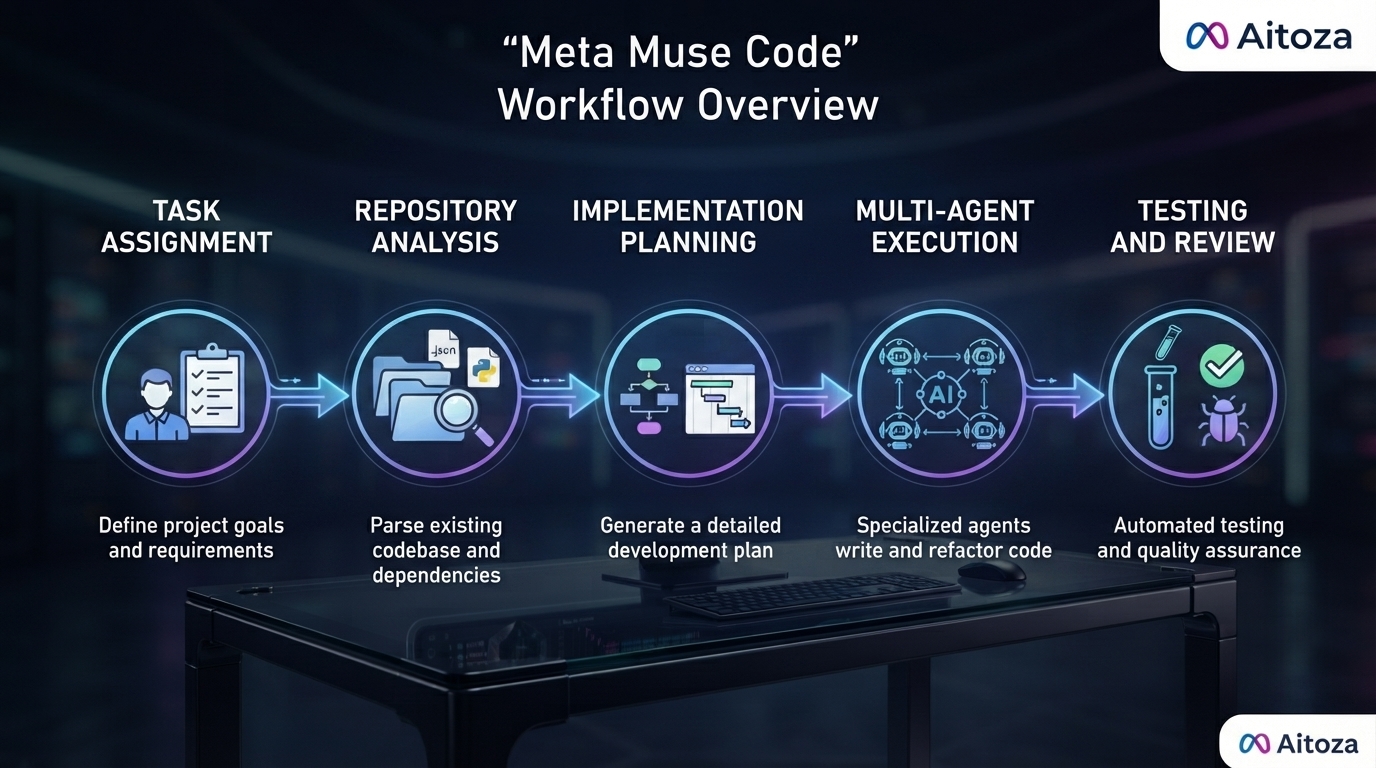
The workflow can be divided into five main stages.
1. The Developer Assigns a Task
The developer provides a high-level objective.
Examples include implementing a feature, investigating an error, updating a framework, improving application speed, or generating tests.
The request does not need to explain every individual code change.
2. Muse Code Analyses the Repository
The platform examines the project before making changes.
It may review:
- Existing modules
- Project architecture
- Dependencies
- APIs
- Coding conventions
- Related components
- Configuration files
- Available tests
This creates the context needed for planning.
3. It Creates an Implementation Plan
Muse Code identifies the files, dependencies, tests, and validation steps involved in completing the task.
It can then divide the work between different background agents.
4. Multiple Agents Complete the Work
Specialised agents handle different parts of the project.
A backend agent may update services while another agent edits the interface, prepares tests, or reviews configuration changes.
This parallel workflow may shorten the time needed for large assignments.
5. Muse Code Validates the Changes
After implementation, the platform runs checks and reviews the generated code.
It then presents the completed work, activity records, test results, and any remaining problems to the developer.
Meta Muse Code Pricing and Availability
The available information describes Muse Code as a beta platform aimed primarily at professional developers and enterprise engineering teams.
Its pricing structure may combine different payment options rather than relying on a single monthly subscription.
Possible options mentioned in the source material include:
- Usage-based pricing linked to tokens or computing resources
- Discounted contributor plans
- Enterprise packages with team and security controls
- Future API pricing for external integrations
Exact prices, plan limits, regional availability, and data contribution terms may change during the beta period.
Developers should check Meta’s official product documentation before registering or sharing a private repository.
Organisations should also review:
- Code retention policies
- Model-training permissions
- Security controls
- Data-processing locations
- Compliance requirements
- Access management
- Repository permissions
These details may be more important than the basic subscription price when sensitive or commercial code is involved.
Meta Muse Code vs Other AI Coding Tools
Different AI coding products are built around different workflows.
Developers comparing autonomous coding platforms may also find Aitoza’s list of the Top 100 AI Tools in 2026 useful for discovering other coding and productivity tools.
The following overview is based on the feature descriptions in the supplied draft and should be checked against each platform’s current documentation.
| Feature | Meta Muse Code | Claude Code | OpenAI Codex | Cursor | Gemini CLI |
|---|---|---|---|---|---|
| Main focus | Autonomous software engineering | Conversational coding | AI-assisted programming | AI code editor | Terminal-based development |
| Background execution | Yes | Limited | Limited | Limited | Limited |
| Persistent agents | Yes | Limited | Limited | No | Limited |
| Multi-agent coordination | Yes | Limited | Limited | Limited | Limited |
| Repository understanding | Extensive | Strong | Strong | Strong | Strong |
| Automated planning | Yes | Partial | Partial | Partial | Partial |
| Debugging support | Yes | Yes | Yes | Yes | Yes |
| Long-running tasks | Yes | Limited | Limited | Limited | Limited |
| Enterprise workflow focus | High | High | High | Medium | Medium |
Muse Code’s main difference is its focus on persistent execution and coordinated background agents.
Claude Code is more closely associated with conversational and command-line coding workflows. Cursor places AI assistance directly inside a code editor, while Gemini CLI focuses on terminal-based interaction. Codex supports AI-assisted software development across supported OpenAI workflows.
Actual capabilities can change quickly. Developers should compare current documentation, pricing, privacy terms, integrations, and supported languages before selecting a tool.
Why Persistent Coding Agents Matter
Most coding assistants work through an active conversation.
The developer asks a question, receives an answer, reviews the output, and submits another prompt. This process is useful for short tasks but can become slow during large software projects.
Persistent agents can continue working after the initial assignment.
For example, a framework migration may involve hundreds of files. A persistent coding agent could continue identifying outdated APIs, editing affected modules, updating dependencies, preparing tests, and reporting failed checks without waiting for a new prompt at every stage.
Potential benefits include:
- Fewer interruptions during development
- Better support for extended tasks
- Faster handling of repetitive maintenance
- Parallel work across different project areas
- Continued progress when the developer is unavailable
- More detailed records of completed changes
However, longer autonomous execution also creates additional risk.
An incorrect assumption can affect many files before a developer notices it. Clear permissions, checkpoints, change previews, and code review are therefore essential.
Enterprise Use Cases
Large Repository Refactoring
Older applications may contain millions of lines of code written over many years.
Muse Code could help identify connected modules, update repeated patterns, remove outdated methods, and check whether the changes affect existing features.
Framework and Library Migration
Development teams regularly move between frameworks, runtime versions, and libraries.
An AI engineering agent can help identify deprecated APIs, update implementations, review dependencies, and produce migration documentation.
Complex Bug Investigation
Production bugs may involve several services, configuration files, or database interactions.
Repository-level analysis can help developers trace relationships and investigate the underlying cause rather than only treating the visible error.
Automated Testing
Muse Code can support quality assurance by generating test cases, preparing validation scripts, and checking whether new changes cause regressions.
Developers should still review generated tests to ensure they reflect real business requirements.
Documentation Creation
Technical documentation often becomes outdated as software changes.
The platform may help create or update:
- API documentation
- Repository instructions
- Architecture notes
- Deployment guides
- Change summaries
- Configuration explanations
Continuous Integration Support
Muse Code may also support CI/CD workflows by running checks, identifying conflicts, reviewing changes, and preparing code for deployment.
Developers can learn more about common automated software workflows through GitHub Actions documentation, which covers automated builds, testing, deployment, and repository workflows.
Production releases should still require human approval.
Main Strengths
Less Manual Supervision
Persistent agents can continue working without requiring a prompt after each step.
Support for Large Codebases
Repository-wide analysis may help the platform understand connections between modules, dependencies, tests, and APIs.
Faster Parallel Work
Multiple agents can handle different responsibilities at the same time.
Structured Planning
The system prepares a plan before making changes, which can improve transparency and reduce unnecessary edits.
Integrated Testing
Testing and validation are part of the workflow rather than separate afterthoughts.
Enterprise-Oriented Features
Activity logs, recovery, repository analysis, and long-running execution make the platform relevant to professional engineering teams.
Current Limitations and Risks
Beta-Stage Changes
Features, prices, availability, and supported integrations may change before a wider release.
Privacy and Data Governance
Businesses must understand how their repositories, prompts, logs, and generated code are stored and processed.
Security Risks
AI-generated code may include insecure logic, incorrect permissions, exposed secrets, or vulnerable dependencies.
Security review remains essential. Development teams can also use resources such as the OWASP Top 10 to understand common web application security risks that should be considered when reviewing generated code.
High Computing Requirements
Long-running background agents and parallel execution may require more computing resources than standard chat-based coding tools.
Learning Curve
Developers used to direct prompt-and-response tools may need time to adapt to a more autonomous workflow.
Incorrect Repository Assumptions
A platform can analyse a codebase but still misunderstand undocumented business rules or architectural decisions.
Human Review Is Still Required
Developers remain responsible for:
- Security
- Architecture
- Legal compliance
- Business logic
- Data handling
- Test coverage
- Production readiness
Muse Code should support engineering teams, not replace their final judgement.
What Muse Code Could Mean for Developers
Individual developers could use autonomous coding agents to reduce time spent on repetitive maintenance, documentation, and basic debugging.
Startups may be able to build and update products with smaller engineering teams, although experienced technical oversight will still be necessary.
Large organisations could use repository-aware agents to modernise legacy applications, prepare migrations, improve test coverage, and maintain internal documentation.
Open-source projects may also benefit from issue investigation, pull request preparation, repository documentation, and automated test creation.
As these tools improve, the developer’s role may gradually shift from writing every line manually to defining requirements, reviewing plans, supervising execution, and approving completed work.
Future Outlook
Meta Muse Code represents a wider movement toward AI systems that can complete connected software engineering tasks.
Future development may focus on:
- More programming languages
- Better reasoning accuracy
- Deeper IDE integrations
- API access
- Improved security controls
- Stronger compliance features
- Better DevOps integration
- More reliable agent coordination
- Clearer approval checkpoints
- Improved cost controls
The success of autonomous coding systems will depend on more than code-generation quality.
Reliability, privacy, transparency, security, pricing, and developer trust will determine whether businesses allow these tools to work across important repositories.
Final Verdict
Meta Muse Code and Muse Spark 1.2 present a more autonomous approach to AI-assisted software engineering.
Instead of generating isolated snippets, the platform is designed to analyse complete repositories, prepare implementation plans, coordinate background agents, make related changes, and validate the results.
Its strongest potential benefits are persistent execution, repository-wide reasoning, multi-agent collaboration, and support for complex development workflows.
Its main concerns include privacy, security, computing costs, beta-stage uncertainty, and the risk of an autonomous system making incorrect changes across a large project.
Muse Code may become a useful option for teams handling migrations, maintenance, testing, documentation, and repository-wide updates. Its real value will depend on reliable performance, transparent pricing, strong data controls, and effective human review.
For more coverage of AI platforms, software tools, and emerging technology developments, visit Aitoza News.