
Artificial intelligence is becoming a practical part of modern dentistry.
The best AI tools for dentists can now support far more than simple administrative tasks. Depending on the platform, dental AI can analyze X-rays, identify potential abnormalities, measure bone levels, review CBCT scans, monitor orthodontic treatment, generate clinical notes, perform periodontal charting, design restorations, and answer patient calls.
However, not every dental practice needs the same type of AI.
A general dentist reviewing bitewing X-rays may benefit from a dental imaging platform. An orthodontist may need AI for cephalometric analysis or remote treatment monitoring. Meanwhile, a dental laboratory may get more value from AI-assisted CAD design, while a busy practice may benefit from an AI receptionist or documentation assistant.
AI adoption is also moving into real dental workflows. American Dental Association survey data published in 2026 found dentists using AI for areas including imaging and diagnostics, insurance verification, patient communication, business analytics, and front-desk operations.
The key is choosing the right AI tool for the right dental workflow.
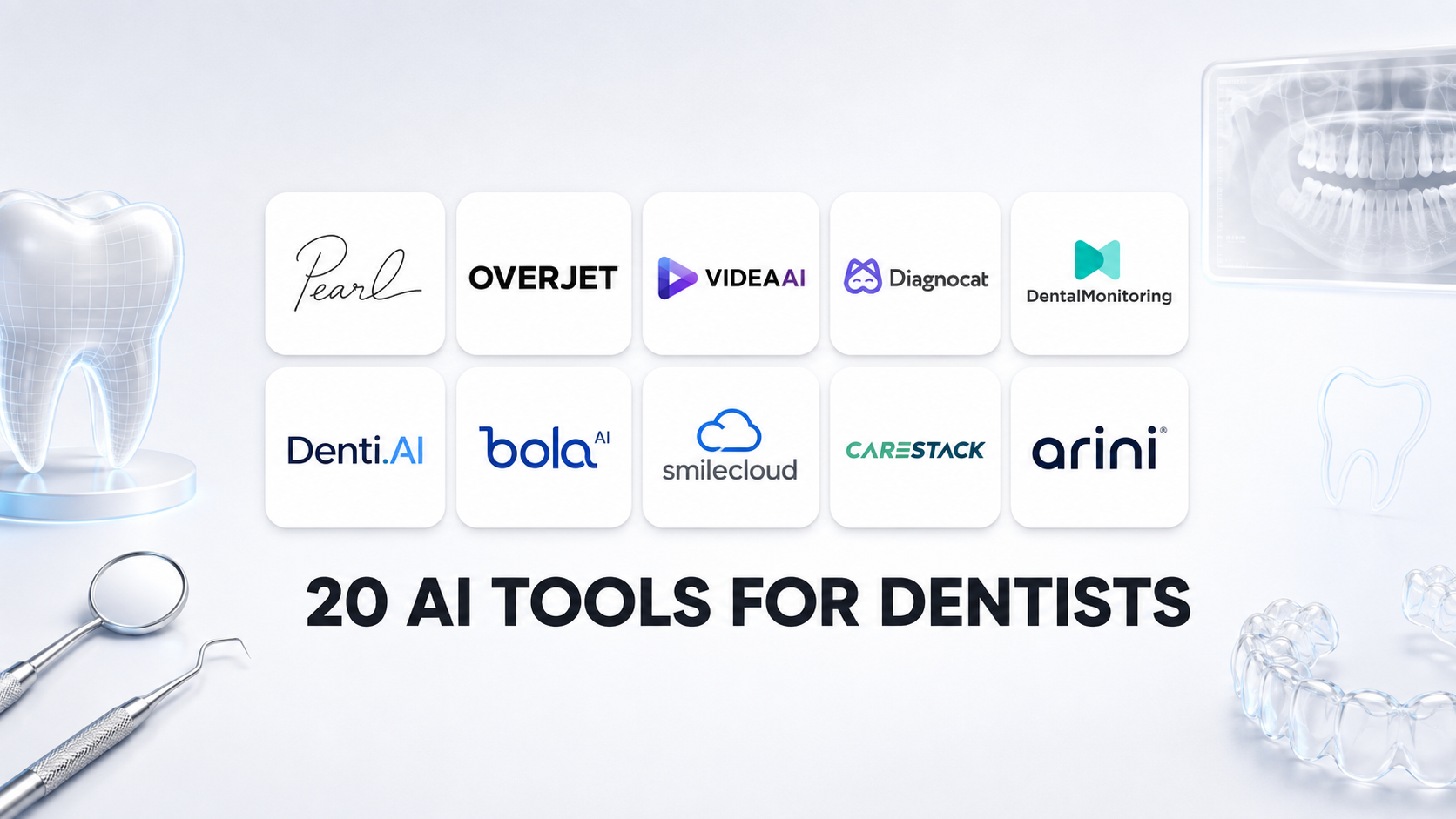
Below are 20 AI tools dentists, orthodontists, dental groups, and related dental professionals can explore in 2026.
Best AI Tools for Dentists at a Glance
| AI Tool | Best For | Official Website |
|---|---|---|
| Pearl Second Opinion | Dental X-ray analysis | https://hellopearl.com/ |
| Overjet | Radiographs and clinical intelligence | https://www.overjet.com/ |
| VideaAI | AI-assisted dental diagnosis | https://www.videa.ai/ |
| Diagnocat | CBCT and dental imaging analysis | https://diagnocat.com/ |
| DentalMonitoring | Remote orthodontic monitoring | https://dentalmonitoring.com/ |
| Denti.AI | Dental notes and voice AI | https://www.denti.ai/ |
| Bola AI | Voice periodontal charting | https://bola.ai/ |
| Kiroku | Dental clinical notes | https://www.trykiroku.com/ |
| Smilecloud | AI smile design | https://smilecloud.com/ |
| Relu Automate | Dental design automation | https://www.relu.ai/ |
| 3Shape Automate | AI dental CAD designs | https://www.3shape.com/en/services/automate |
| Planmeca Romexis AI | Imaging and CBCT workflows | https://www.planmeca.com/artificial-intelligence/ |
| WebCeph | AI orthodontic analysis | https://webceph.com/ |
| CephX | Cephalometric analysis and CBCT segmentation | https://cephx.com/ |
| Dentrix Detect AI | AI inside Dentrix workflows | https://www.dentrix.com/ |
| Invisalign Virtual Care AI | Remote Invisalign monitoring | https://www.invisalign.com/provider/align-digital-platform/virtual-care-ai |
| CareStack AI Suite | Dental practice automation | https://carestack.com/dental-software/ai-suite |
| Arini | AI dental receptionist | https://www.arini.ai/ |
| Viva AI | Calls, scheduling and patient communication | https://www.getviva.ai/ |
| Heidi | AI dental clinical documentation | https://www.heidihealth.com/solutions/dentists |
Best AI Tools for Dental Imaging and Diagnosis
Dental imaging is one of the most established applications of artificial intelligence in dentistry.
These tools can analyze radiographs, highlight potential findings, measure bone levels, and support clinicians during image review.
They are particularly useful for dentists who want an additional visual layer during diagnosis and patient consultations.
1. Pearl Second Opinion

Website: https://hellopearl.com/
Pearl is one of the most recognizable names in dental artificial intelligence. Its Second Opinion platform focuses on helping dental professionals review radiographs.
The software applies computer vision to dental X-rays and visually marks potential findings for clinician review. Pearl lists capabilities covering findings such as caries, calculus, bone loss, periapical radiolucencies, restoration margins, and existing dental work.
One of its main advantages is visualization. Instead of receiving only a written AI result, dentists can see color-coded information directly over the dental image.
This can also make X-rays easier to explain during patient consultations.
Second Opinion is intended as an assistive system rather than a replacement for the dentist’s clinical judgment. Its 2D radiographic technology has received FDA clearance for specified applications.
Best for: Dental radiograph analysis, clinical decision support, and patient education.
Dentist example: Open a patient’s bitewing images during an examination and use Pearl’s visual overlays as an additional review layer before discussing potential treatment.
2. Overjet

Website: https://www.overjet.com/
Overjet combines dental imaging AI with clinical and operational intelligence for individual practices, dental groups, DSOs, and insurance organizations.
Its technology can analyze dental radiographs and provide visual information that helps clinicians evaluate conditions and communicate findings more clearly.
Overjet has developed AI capabilities for areas including caries detection, bone-level measurement, charting, clinical documentation, and CBCT workflows.
That makes it broader than a basic X-ray detection platform.
For multi-location dental organizations, another potential advantage is consistency. AI can provide a standardized analytical layer across clinicians and offices while dentists remain responsible for the final clinical interpretation.
Overjet has also expanded its AI documentation capabilities with Overjet Voice.
Best for: Dental imaging, treatment presentation, clinical intelligence, and larger dental organizations.
Dentist example: Use AI-enhanced radiographs to visualize suspected caries or periodontal bone levels while explaining why a particular treatment may be recommended.
3. VideaAI

Website: https://www.videa.ai/
VideaAI is an artificial intelligence platform designed specifically for dental practices and DSOs.
Its technology analyzes dental images and supports clinicians in reviewing potential findings while integrating AI into the broader dental workflow.
The platform is useful when a practice wants AI to support more than one isolated task. Videa positions its technology around clinical care, productivity, case presentation, and practice performance.
Another benefit of AI-assisted radiograph analysis is patient communication. Potential findings can be visually presented instead of requiring patients to interpret a traditional grayscale X-ray.
Videa technology also powers Dentrix Detect AI, demonstrating its integration into established dental software ecosystems.
Best for: AI-assisted dental diagnosis, radiograph review, patient communication, and DSOs.
Dentist example: Review AI-highlighted areas on a patient’s dental X-ray before discussing whether additional clinical examination or treatment is appropriate.
4. Dentrix Detect AI

Website: https://www.dentrix.com/
Product page: https://www.dentrix.com/dental-solutions/charting-imaging-and-clinical-ai/enhanced-diagnostic-accuracy/
Dentrix Detect AI is particularly useful for practices that already rely heavily on the Dentrix ecosystem.
Instead of requiring a completely separate AI platform, the technology brings AI-assisted X-ray analysis into the existing Dentrix workflow.
Dentrix Detect AI is powered by VideaHealth technology and can analyze dental images while they are being viewed in the patient chart.
Its capabilities include AI-assisted carious lesion detection and radiographic bone-level measurements.
Integration is the key advantage. Dentists do not have to repeatedly export an image, upload it to another platform, and then bring the results back into the patient record.
Best for: Dentrix users who want integrated dental imaging AI.
Dentist example: Open the patient’s X-ray inside Dentrix Smart Image and review AI-generated findings without leaving the patient workflow.
Best AI Tools for CBCT and 3D Dental Imaging
CBCT creates large volumes of three-dimensional information. As a result, AI can be particularly useful for segmentation, anatomical recognition, visualization, and treatment planning.
5. Diagnocat

Website: https://diagnocat.com/
Diagnocat is particularly relevant for dental professionals who work heavily with diagnostic imaging.
The platform can analyze intraoral X-rays, panoramic images, and CBCT scans. Diagnocat says its system can create structured reports covering dozens of dental findings across 2D and 3D images.
Its CBCT capabilities make it useful beyond basic cavity detection.
Dentists working in implantology, orthodontics, endodontics, and oral surgery can potentially use AI-generated segmentation and imaging information to make complicated datasets easier to review.
Diagnocat also provides tools related to 3D models, implant reports, and orthodontic workflows.
Best for: CBCT interpretation assistance, 2D imaging, 3D dental analysis, and treatment planning.
Dentist example: Upload a CBCT scan and use AI-assisted segmentation and reporting to organize anatomical information before completing your own clinical interpretation.
6. Planmeca Romexis AI

Website: https://www.planmeca.com/artificial-intelligence/
Planmeca integrates artificial intelligence into its Romexis dental imaging software.
The platform uses AI for workflows such as CBCT segmentation, anatomical recognition, and dental image analysis.
For 3D images, Romexis can automatically identify and segment structures including teeth, nerves, jaws, airways, and sinuses.
Planmeca has also expanded AI capabilities for intraoral imaging, including automatic tooth recognition and numbering.
Because the AI operates inside an established dental imaging ecosystem, dentists who already use Planmeca equipment may benefit from keeping imaging, visualization, and AI tools within a connected workflow.
Best for: CBCT imaging, anatomical segmentation, and Planmeca-based dental practices.
Dentist example: Open a CBCT study and let the software automatically segment key anatomical structures before completing treatment planning.
7. CephX

Website: https://cephx.com/
CephX by Orca Dental AI is another platform focused strongly on orthodontic imaging and treatment planning.
Its capabilities include AI-assisted cephalometric analysis, diagnostic imaging workflows, and CBCT segmentation.
The platform works with both 2D and 3D dental imaging. It can automate tasks that would otherwise require substantial manual tracing and segmentation.
That makes CephX particularly relevant to orthodontists, dental groups, and organizations processing larger volumes of orthodontic imaging.
In 2026, CephX also announced FDA clearance related to its 3D imaging technology, further expanding its clinical imaging capabilities.
Best for: Orthodontics, cephalometric tracing, CBCT segmentation, and imaging automation.
Dentist example: Submit orthodontic imaging and use AI-generated landmarks and analysis to accelerate the initial diagnostic workflow.
Best AI Tools for Orthodontics and Remote Monitoring
Orthodontics is another area where AI can reduce repetitive work.
These tools can assist with cephalometric analysis, treatment monitoring, and remote patient follow-up.
8. DentalMonitoring

Website: https://dentalmonitoring.com/
DentalMonitoring brings artificial intelligence into remote orthodontic care.
Instead of relying exclusively on appointments several weeks apart, patients can capture intraoral images remotely and send them to their provider through the DentalMonitoring workflow.
AI analyzes the submitted images and helps the clinician monitor treatment between office visits.
This can be particularly useful for clear aligners and orthodontic appliances because the orthodontist gets additional visibility into treatment progression without requiring every check to take place physically in the practice.
The technology is designed to assist healthcare professionals with remote observation and orthodontic monitoring rather than replace professional evaluation.
Product availability and regulatory status can differ between countries.
Best for: Orthodontists, aligner treatment, and remote patient monitoring.
Dentist example: Ask an aligner patient to submit scheduled scans so treatment progression can be reviewed between face-to-face appointments.
9. WebCeph

Website: https://webceph.com/
WebCeph is an AI-powered platform designed primarily for orthodontic and orthognathic workflows.
One of its core capabilities is automated cephalometric tracing.
Manual cephalometric analysis can involve identifying anatomical landmarks, measuring angles, and comparing relationships between craniofacial structures.
AI can reduce some of this repetitive work by detecting landmarks and generating an initial analysis.
WebCeph also provides visual treatment-related tools, making it particularly relevant for orthodontists who regularly work with lateral cephalograms and treatment simulations.
Best for: Orthodontic diagnosis, cephalometric analysis, and treatment visualization.
Dentist example: Upload a lateral cephalometric radiograph and generate an automated tracing as a starting point for orthodontic assessment.
10. Invisalign Virtual Care AI
Website: https://www.invisalign.com/provider/align-digital-platform/virtual-care-ai
Invisalign Virtual Care AI is designed for providers managing Invisalign treatment.
The system allows patients to submit treatment-progress photographs between office appointments.
AI can analyze the images to support remote treatment monitoring while the provider remains responsible for reviewing progress and deciding what happens next.
This can make clear-aligner follow-up more flexible.
Instead of requiring an in-office visit simply to confirm that treatment appears to be progressing normally, providers may be able to concentrate physical appointments on cases that require clinical attention.
The platform is integrated into Invisalign’s broader digital provider ecosystem.
Best for: Invisalign providers and remote clear-aligner monitoring.
Dentist example: Ask a patient to submit progress photographs and review Virtual Care AI information before determining whether the next scheduled office appointment needs to change.
Best AI Tools for Dental Notes and Clinical Documentation
Documentation is one of the most time-consuming administrative tasks in many dental practices.
AI scribes and voice-based tools can help dentists capture information during patient encounters and convert it into structured clinical notes.
11. Denti.AI
Website: https://www.denti.ai/
Denti.AI applies artificial intelligence to one of the most time-consuming parts of dentistry: documentation.
Its AI Dental Scribe can listen to conversations during patient encounters and transform them into structured clinical notes.
The platform supports customizable templates and can integrate with dental practice management systems, reducing the amount of information staff need to manually copy between applications.
Denti.AI also offers voice and other dental AI capabilities, making it useful for practices looking to automate more of the clinical workflow.
The company says its Scribe supports more than 50 languages and is designed around dental documentation requirements.
Best for: Clinical documentation, dental notes, and voice-enabled workflows.
Dentist example: Conduct an examination normally while the AI captures the conversation and prepares a structured clinical note for the dentist to review and approve afterward.
12. Kiroku

Website: https://www.trykiroku.com/
Kiroku focuses on helping dental professionals create better clinical records without spending as much time typing.
The platform combines customizable dental templates with AI-powered and voice-based documentation.
Dentists can choose from an existing template library or create workflows that match their own procedures.
This is useful because a crown appointment, emergency examination, implant consultation, and periodontal visit may all require different documentation.
Instead of producing one generic AI note for every procedure, structured templates can help ensure that relevant information is captured consistently.
Kiroku says its platform includes more than 50 customizable templates.
Best for: Structured dental notes, documentation templates, and clinical record keeping.
Dentist example: Use a predefined crown-preparation template and dictate the clinical information rather than writing the entire record manually after the appointment.
13. Heidi

Website: https://www.heidihealth.com/solutions/dentists
Heidi is an AI clinical documentation platform with a dedicated dental offering.
Its technology can capture information from patient encounters and transform the conversation into structured clinical documentation.
This allows dentists to concentrate more closely on the patient rather than repeatedly stopping to type notes during the consultation.
Heidi can also work within dental software environments. For example, the company has developed a CareStack integration that allows its AI Scribe functionality to operate inside the dental documentation workflow.
This type of tool is especially useful for dentists whose biggest administrative burden comes after the clinical day ends.
Best for: AI dental notes, clinical documentation, and reducing manual charting.
Dentist example: Let the AI capture a treatment consultation, then review and edit the generated dental record before signing it.
Best AI Tools for Periodontal Charting and Voice Workflows
Some dental AI tools target a very specific task rather than an entire practice workflow.
14. Bola AI

Website: https://bola.ai/
Bola AI is designed around voice technology for dental professionals.
One of its best-known products is Voice Perio, which allows dentists and hygienists to record periodontal measurements using speech rather than manually entering every number.
This solves a very specific workflow problem.
Traditional periodontal charting often requires a clinician to alternate between examining the patient and entering measurements or rely on a second staff member.
Voice-controlled charting can make the process more hands-free.
Bola’s technology can work with dental practice software to place recognized measurements directly into the periodontal chart.
Best for: Periodontal charting and voice-controlled dental workflows.
Dentist example: Call out probing depths during a periodontal examination while Bola records the measurements into the chart.
Best AI Tools for Smile Design and Dental CAD
AI is also changing digital dentistry and restorative workflows.
These platforms can help with smile visualization, dental design, CAD workflows, and production preparation.
15. Smilecloud

Website: https://smilecloud.com/
Smilecloud uses AI-assisted technology to make digital smile design faster and more visual.
The platform can turn a patient photograph into a facially aligned smile design and provide visual simulations that help patients understand a possible aesthetic outcome.
That makes the software particularly relevant to cosmetic and restorative dentistry.
A patient considering veneers, crowns, or other aesthetic work may find it difficult to imagine how a proposed treatment will change their appearance.
Visual simulation can make those conversations easier.
Smilecloud also supports collaboration and case organization, helping clinicians, technicians, and other members of the dental team work around the same visual case.
Best for: Cosmetic dentistry, smile design, and visual treatment presentation.
Dentist example: Photograph a cosmetic dentistry patient and generate an initial smile visualization to support the treatment-planning conversation.
16. Relu Automate

Website: https://www.relu.ai/
Relu focuses on artificial intelligence for digital dental design.
Relu Automate can transform dental scan data into production-ready digital designs for workflows such as dental models, night guards, custom trays, restorations, and surgical guides.
For dental laboratories and highly digital practices, this can reduce repetitive design work that would otherwise require significant technician time.
Its technology is especially interesting where a practice already uses scanners, CBCT data, CAD software, and digital manufacturing.
AI does not remove the need for professional control. Instead, it can provide an initial automated design that the dental professional or technician can review before manufacturing.
Best for: Dental labs, digital dentistry, CBCT workflows, and automated dental design.
Dentist example: Use AI to prepare an initial digital model or surgical-guide workflow, then review the design before moving to production.
17. 3Shape Automate
Website: https://www.3shape.com/en/services/automate
3Shape Automate brings AI directly into dental CAD production.
It is a self-service AI-powered dental design platform that can automatically create designs for supported dental indications.
According to 3Shape, certain AI-generated designs can be delivered in as little as 90 seconds.
That can be particularly valuable for busy laboratories managing large case volumes.
Instead of manually designing every restoration from the beginning, technicians can start with an AI-generated proposal, inspect it, make necessary adjustments, and continue with production.
The goal is not simply faster CAD. It is reducing repetitive design work while keeping dental professionals in control of the final result.
Best for: Dental laboratories, restoration design, and high-volume CAD workflows.
Dentist example: Generate an AI-assisted restoration design and review the proposed anatomy and margins before approving or editing the case.
Best AI Tools for Dental Practice Management and Patient Communication
Not every useful dental AI tool works inside the operatory.
Some platforms focus on the business side of dentistry, including scheduling, patient communication, insurance workflows, phone calls, and other administrative tasks.
18. CareStack AI Suite
Website: https://carestack.com/dental-software/ai-suite
CareStack takes a broader approach to artificial intelligence.
Instead of focusing only on radiographs or documentation, its AI Suite is designed around multiple areas of dental practice management.
CareStack lists AI-related capabilities across areas such as patient communication, phone operations, insurance verification, clinical imaging, documentation, case acceptance, payments, and reputation management.
That makes it most relevant for practices looking at AI as an operational system rather than a single clinical application.
Because these functions sit alongside practice management workflows, CareStack can be particularly attractive to growing practices and DSOs that want fewer disconnected applications.
Best for: Practice management, administrative automation, and multi-location dental groups.
Dentist example: Use different AI functions to support insurance checks, patient communication, and documentation while keeping the workflow connected to the practice management system.
19. Arini

Website: https://www.arini.ai/
Arini is an AI receptionist built specifically around dental practices.
It can answer incoming calls, communicate with patients, and manage appointments around the clock.
That solves a different problem from diagnostic AI: missed patient calls.
Dental practices receive calls while the front desk is speaking with another patient, during lunch, after business hours, and on weekends.
An AI receptionist can remain available when human staff are not.
Arini is designed to connect with dental practice management workflows so that appointment scheduling can happen during the conversation rather than simply taking a message.
Best for: Dental phone answering, appointment scheduling, and front-desk automation.
Dentist example: A new patient calls after the practice closes, and the AI receptionist answers their questions and books an available appointment.
20. Viva AI
Website: https://www.getviva.ai/
Viva AI is another artificial intelligence platform focused on the dental front desk.
Its AI dental receptionist can answer calls, communicate with patients, and book appointments directly into supported practice management systems.
Viva also emphasizes multilingual communication, which can be useful for practices serving diverse patient populations.
The value of a system like Viva is less about replacing an entire front-office team and more about handling repetitive communication.
It can also help ensure that opportunities are not lost simply because nobody could answer the phone.
Viva can support workflows such as appointment management and patient follow-up.
Best for: Calls, scheduling, multilingual patient communication, and dental front-office automation.
Dentist example: Allow the AI receptionist to handle routine scheduling calls while front-desk employees concentrate on patients physically present in the practice.
Which AI Tool Is Best for Dentists?
There is no single best AI tool for dentists.
The right choice depends on the problem you are trying to solve.
For dental X-ray analysis
Pearl, Overjet, VideaAI, and Dentrix Detect AI are strong options to investigate.
For CBCT and advanced imaging
Diagnocat and Planmeca Romexis provide more specialized workflows.
For orthodontics
DentalMonitoring, WebCeph, CephX, and Invisalign Virtual Care AI focus more closely on treatment monitoring, cephalometric analysis, or orthodontic imaging.
For clinical notes and voice workflows
Denti.AI, Bola AI, Kiroku, and Heidi address different parts of documentation and charting.
For digital smile and dental design
Smilecloud, Relu, and 3Shape Automate are more relevant.
For dental practice administration
CareStack, Arini, and Viva AI can help automate repetitive front-office processes.
A modern practice may therefore get more value from combining two or three specialized AI tools rather than trying to find one platform that performs every dental task.
How to Choose the Right Dental AI Tool
Before investing in dental AI software, practices should evaluate the tool against the actual workflow problem they want to solve.
Consider the following factors:
1. Identify the biggest workflow bottleneck
Start with the task consuming the most time.
Is the problem:
- X-ray analysis?
- Documentation?
- Periodontal charting?
- Orthodontic monitoring?
- CAD design?
- Phone calls?
- Appointment scheduling?
The answer will narrow down the most relevant AI tools.
2. Check software integrations
An AI platform can be powerful but still create additional work if it does not integrate with the systems your practice already uses.
Check compatibility with your:
- Practice management software
- Imaging system
- EHR or dental records
- CAD/CAM workflow
- Communication tools
3. Review regulatory status
Medical AI tools may have specific intended uses and regulatory limitations.
Do not assume that every AI feature is approved for every clinical purpose.
4. Evaluate data privacy
AI platforms may process sensitive patient information.
Before implementation, review:
- Data storage
- Data processing
- Security controls
- Privacy policies
- Integrations
- Applicable regulations
5. Keep dentists in control
The most useful dental AI tools should support professional judgment rather than attempt to replace it.
How Dentists Should Use AI Safely
Artificial intelligence can make dental workflows faster, but speed should not be confused with clinical authority.
AI-generated findings should generally be treated as additional information for professional review rather than an automatic diagnosis or treatment decision.
That distinction is particularly important with medical-device AI. The FDA’s AI-enabled medical-device resources explain that authorized tools are reviewed according to their intended use, while individual devices can have specific limitations and indications.
Dentists should therefore understand exactly what a tool has been designed and authorized to do.
Data privacy matters as well.
AI documentation, imaging, and communication platforms may process sensitive patient information. Dental organizations should evaluate security, privacy, data handling, integrations, and applicable regulatory requirements before uploading protected patient data.
The American Dental Association says AI standards in dentistry should address areas such as safety, efficacy, transparency, and fairness.
Final Thoughts
The best AI tools for dentists in 2026 go far beyond automatically detecting cavities on X-rays.
Artificial intelligence is moving into almost every part of the dental workflow.
A dentist can now use AI to review radiographs, segment CBCT scans, monitor an orthodontic patient remotely, create a digital smile simulation, produce dental CAD designs, dictate periodontal measurements, generate clinical notes, and automate appointment calls.
However, the most valuable dental AI system is not necessarily the one with the longest feature list.
It is the one that removes a genuine bottleneck from your practice without compromising clinical judgment, patient privacy, or quality of care.
For imaging-focused practices, that may be Pearl, Overjet, VideaAI, or Diagnocat. For orthodontists, DentalMonitoring, CephX, WebCeph, or Invisalign Virtual Care AI may be more relevant.
For practices losing hours to documentation, Denti.AI, Kiroku, Bola AI, or Heidi may provide greater value.
For practices struggling with unanswered phones and administrative workload, Arini, Viva AI, or CareStack may have a larger immediate impact than another diagnostic tool.
AI will not make professional dental expertise unnecessary. Used appropriately, it can give dental professionals more time to apply that expertise where it matters most: the patient.