
Apple confirmed on January 29, 2026, that it had acquired Q.ai, a secretive Israeli startup building AI for audio and facial-movement analysis. If you searched “Q.ai AI model acquisition” hoping for a straight answer on what Q.ai does, what Apple paid, and whether this is the same Q.ai you might know from investing apps, here’s the full picture with the confirmed facts kept separate from the speculation.
What Is Q.ai?
Q.ai is a small, previously low-profile Israeli AI company that had not publicly launched a product before the acquisition. It worked on machine learning applications for audio: helping devices pick up whispered speech and clean up sound in noisy environments. The company had also filed a patent for reading “facial skin micromovements” — subtle motion in facial muscles — to detect words a person is mouthing, identify who’s speaking, and estimate things like emotion, heart rate, and respiration rate.
The company employed around 100 people at the time of the deal. Its leadership includes CEO Aviad Maizels and co-founders Yonatan Wexler and Avi Barliya, all of whom are joining Apple as part of the acquisition.
Is Q.ai an AI Model Like ChatGPT?
No, and this is worth clearing up early because it’s where a lot of search confusion starts. ChatGPT and Gemini are large language models — systems trained to generate and reason about text and other content types. Q.ai isn’t that. It’s a company that built specialized machine-learning systems for a narrower problem: interpreting audio and facial-movement signals. Calling it “an AI model” the way people call ChatGPT one overstates what’s public about the technology and understates how different the underlying engineering problem is.
Apple Acquired Q.ai: What Happened, and When
Apple confirmed the deal on Thursday, January 29, 2026, the same day it reported first-quarter fiscal 2026 earnings. A company representative confirmed the acquisition to reporters; Apple did not issue a splashy announcement of its own, which fits the low profile Q.ai kept before the deal.
Apple’s official statement focused on capability rather than product plans. Johny Srouji, Apple’s senior vice president of hardware technologies, described Q.ai as pioneering new uses of imaging and machine learning. Maizels, in his own statement, said joining Apple opens “extraordinary possibilities” for the technology the team built.
How Much Did Apple Pay for Q.ai?
This is where you’ll see conflicting numbers, and it’s worth understanding why. Apple has not disclosed a purchase price — that part is consistent across every source. Two different figures have circulated because two different outlets cited two different sourcing:
- Reuters reported the deal valued Q.ai at approximately $1.6 billion, attributed to a person familiar with the matter.
- The Financial Times reported a figure closer to $2 billion.
Neither number comes from Apple directly. If you see an article stating a price as confirmed fact rather than a reported estimate, treat that as a red flag about how carefully it was sourced. What is confirmed: several outlets, including Macworld, note this ranks among Apple’s largest acquisitions to date, trailing only its 2014 purchase of Beats.
Q.ai had raised backing from a notable list of venture firms before the sale, including Kleiner Perkins, Spark Capital, Matter Venture Partners, Exor, and GV (formerly Google Ventures) — a detail that underscores how seriously investors treated the underlying technology despite the company never shipping a public product.
What AI Technology Does Q.ai Actually Have?
Strip away the speculation and three technical threads run through every credible report on Q.ai’s work.
Audio processing in difficult conditions. Q.ai built machine learning systems aimed at improving how devices understand speech in noisy or acoustically challenging environments — the kind of scenario where a phone or earbud currently struggles to isolate a voice from background sound.
Whispered speech recognition. Recognizing whispered speech is a harder technical problem than it sounds, because whispering removes most of the vocal-cord vibration that speech recognition systems normally rely on. Software has to lean on other acoustic cues instead, which is a meaningfully different modeling challenge than parsing normal speech.
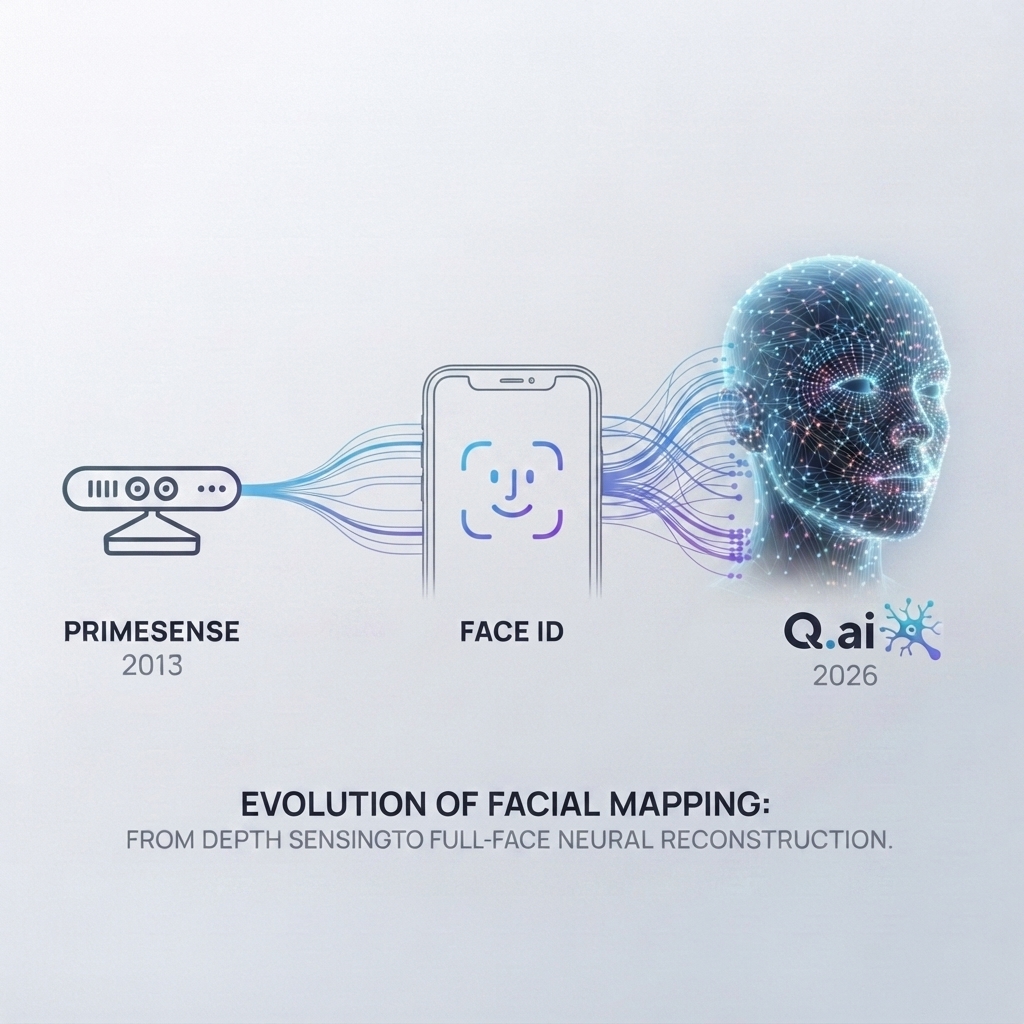
Facial skin micromovement detection. Q.ai’s patent filing describes using subtle, largely invisible movement in facial skin to figure out what words someone is mouthing — even without audible sound — and to estimate biometric signals such as heart rate and respiration. In plain terms: a camera or sensor watching tiny muscle movements around the mouth and face, interpreted by machine learning, could theoretically tell what you’re saying without you making a sound, and pick up some physiological signals along the way.
Put together, these three pieces point toward one consistent goal: letting a device understand you in situations where normal speech recognition falls short — a loud room, a whisper, or no audible sound at all.
PrimeSense to Q.ai: Apple’s Repeat Playbook With Israeli AI Talent
The most concrete signal about where this technology might end up isn’t in anything Apple has said about the future — it’s in Maizels’ own history with the company.
Maizels previously founded PrimeSense, an Israeli firm specializing in 3D sensing technology. Apple acquired PrimeSense in 2013. That acquisition’s technology later became foundational to Face ID, moving Apple away from fingerprint-based unlocking and toward facial recognition as its primary biometric system on iPhone.
That pattern — quiet acquisition of a specialized Israeli sensing startup, followed years later by the technology surfacing in a flagship security or interaction feature — is the strongest available basis for informed speculation about Q.ai’s trajectory. It’s not confirmation of anything specific. But it’s a meaningfully different kind of evidence than pure guesswork, because it’s the same founder and the same acquirer running a similar playbook twice.
What Could Apple Build With This? (Clearly Labeled Speculation)

None of what follows has been confirmed by Apple. It’s a reasonable read of where the technology could apply, based on what Apple has said about the deal and what it’s already shipping.
- Siri and voice interaction. Apple has been steadily improving Siri’s AI capabilities. Technology that understands whispered or near-silent speech could support more private, discreet voice commands — useful in shared spaces where speaking aloud to a device feels awkward.
- AirPods. Apple already shipped real-time speech translation on AirPods. Better noise-environment audio processing and whisper detection are a natural extension of that direction, though Apple hasn’t said Q.ai’s technology is destined for AirPods specifically.
- Vision Pro and future smart glasses. Silent or near-silent input is frequently cited as a missing piece for wearable AI devices generally — competitors and industry analysts have flagged this as a gap across the category, not just for Apple. If Apple is building toward smart glasses, hands-free and voice-free input methods would matter more there than on a phone.
- Accessibility. Technology that can interpret mouthed words or facial-movement cues has an obvious accessibility angle for people who can’t or don’t want to vocalize sound, though again, this is inference rather than an announced feature.
Treat every one of these as “plausible, given the technology and Apple’s history,” not “confirmed.”
Q.ai vs. ChatGPT vs. Gemini: Why the Comparison Doesn’t Quite Work
| Primary purpose | |
|---|---|
| Q.ai | Audio processing, whispered-speech recognition, facial-micromovement analysis |
| ChatGPT | General-purpose generative AI and language |
| Gemini | Multimodal generative AI across text, image, and more |
| Claude | Generative AI and reasoning |
Q.ai isn’t a competitor to any of these, and it isn’t trying to be. It doesn’t generate text or hold conversations. It’s closer to a specialized sensor-and-signal-processing company than a chatbot company — its output feeds into how a device perceives you, not into how it converses with you. If Apple integrates Q.ai’s technology into Siri eventually, it would most likely sit underneath the conversational layer, improving what Siri can hear and interpret, rather than replacing the conversational AI itself.
Is Q.ai the Apple Acquisition the Same as the Q.ai Investing App?
No — and if you landed here searching “Q.ai stock” or “Q.ai investing,” this is almost certainly the mix-up you’re dealing with.
| Apple-acquired Q.ai | Q.ai Invest | |
|---|---|---|
| Founded | Not widely publicized before acquisition | 2017 |
| Backing | Kleiner Perkins, Spark Capital, and others | Forbes |
| Focus | Audio AI, facial-movement sensing | Robo-advisory investing app |
| Publicly traded stock | No — private company, acquired by Apple | No — app itself isn’t publicly traded either |
| Apple connection | Yes, acquired January 2026 | None |
Q.ai Invest is a subscription-based robo-advisor app, positioned as “a hedge fund in your pocket,” offering algorithm-managed portfolios like “Diversify & Thrive” and “The Value Vault.” It has no relationship to the Israeli audio AI startup Apple bought. Neither company has publicly traded stock under the ticker “Q.ai” — if you’re searching for a stock to buy, you’re not going to find one under this name.
Is Q.ai the Same as Amazon Q?
Also no. Amazon Q is AWS’s generative AI assistant for businesses — it helps employees find information across company data, write and debug code, and automate workplace tasks inside the AWS ecosystem. It’s a completely different product from a completely different company, aimed at enterprise software teams rather than consumer hardware. The only thing the two share is the letter “Q.”
Frequently Asked Questions
What is Q.ai? Q.ai is an Israeli AI startup that Apple acquired in January 2026. It builds machine learning technology for audio processing, whispered-speech recognition, and facial-movement-based communication analysis.
Did Apple acquire Q.ai? Yes. Apple confirmed the acquisition on January 29, 2026.
When did Apple acquire Q.ai? The deal was confirmed on January 29, 2026, the same day Apple reported its fiscal Q1 2026 earnings.
How much did Apple pay for Q.ai? Apple hasn’t disclosed a price. Reuters reported approximately $1.6 billion, sourced to a person familiar with the deal; the Financial Times reported a figure closer to $2 billion.
Why did Apple buy Q.ai? Apple hasn’t detailed its plans, but the technology fits its ongoing push into audio AI, wearables, and more private, hands-free ways to interact with devices.
What AI technology does Q.ai use? Machine learning for whispered-speech recognition, audio processing in noisy environments, and facial-skin-micromovement analysis to interpret mouthed words and biometric signals.
Is Q.ai an AI model like ChatGPT? No. It’s not a language model or chatbot — it’s specialized sensing and signal-processing technology.
Who founded Q.ai? CEO Aviad Maizels, alongside co-founders Yonatan Wexler and Avi Barliya. Maizels previously founded PrimeSense, which Apple acquired in 2013.
Will Q.ai technology be used in Siri or AirPods? Not confirmed. It’s a reasonable possibility given Apple’s product direction, but Apple has not announced specific integration plans.
Is Q.ai the same as the Q.ai investing platform? No. The investing app Q.ai Invest is an unrelated, Forbes-backed robo-advisor founded in 2017.
Is Q.ai the same as Amazon Q? No. Amazon Q is AWS’s enterprise generative AI assistant, unrelated to Apple’s acquisition.