
Perplexity is taking its AI agents in a new direction: off the cloud and onto the user’s own hardware.
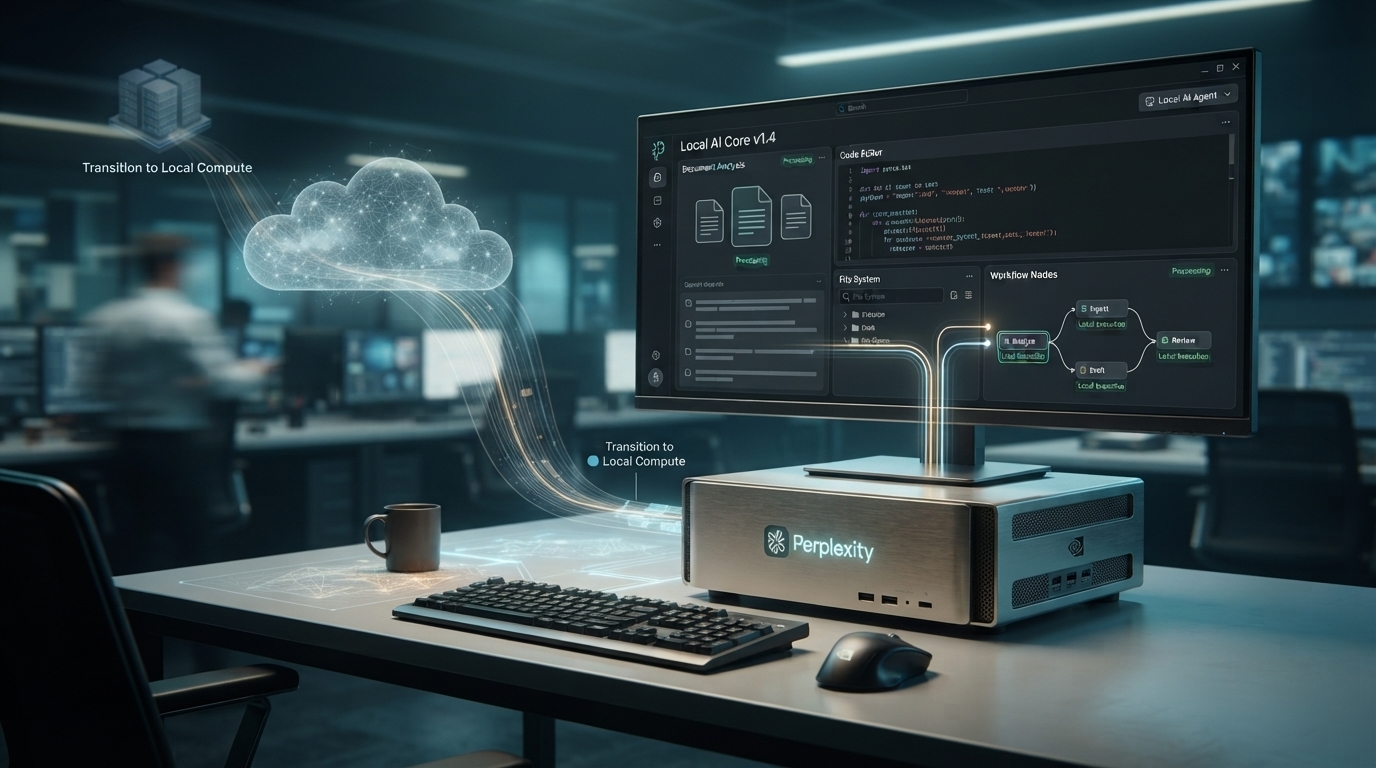
On August 25, 2026, Perplexity introduced Portable Computer, a local-first version of its Computer AI agent built in partnership with NVIDIA. The system is designed to run models, agent orchestration, tools and workflows directly on compatible NVIDIA hardware, starting with the NVIDIA DGX Spark and Linux PCs equipped with supported RTX GPUs.
The move addresses two problems that have become increasingly important as AI agents become more capable: the cost of cloud inference and the privacy risks of sending sensitive information to remote servers.
Portable Computer starts tasks locally. Private files can remain on the user’s machine, and locally completed work does not consume Perplexity’s usage credits. When a task requires more powerful reasoning or cloud capabilities, the system can request permission before escalating that individual step to a cloud model.
That makes this more than another local chatbot.
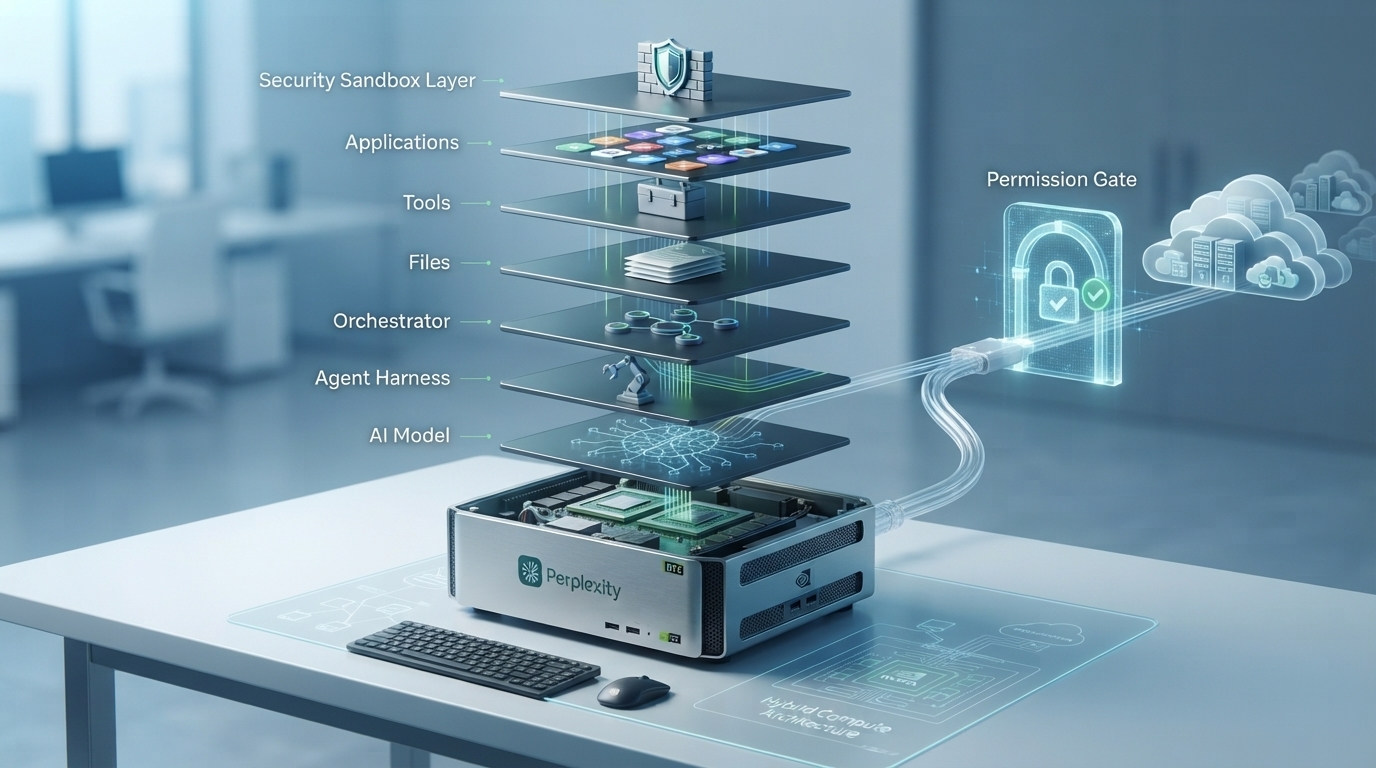
Perplexity is attempting to move the entire AI-agent experience closer to the user, including the model, agent harness, orchestration, tools and security layer.
What Is Perplexity Portable Computer?
Portable Computer is a local version of Perplexity’s Computer agent.
Traditional cloud AI agents rely heavily on remote infrastructure. A user’s prompt, files and task context can be processed by servers operated by the AI provider.
Portable Computer reverses that starting point.
Instead of beginning in the cloud, the system begins on the user’s machine.
Perplexity says Portable Computer can analyze data, synthesize files and execute complex workflows locally. The company built the system with NVIDIA around the DGX Spark and plans to extend support to NVIDIA RTX-powered PCs.
This local-first approach is particularly relevant for people working with information they do not want to routinely upload to an AI service.
That could include:
- Private codebases
- Financial documents
- Internal company files
- Research material
- Proprietary datasets
- Confidential reports
- Sensitive business information
The concept is similar to the broader shift toward agentic AI, where AI systems do more than answer questions and instead plan and execute multi-step workflows.
How Does Portable Computer Work?
The easiest way to understand Portable Computer is as a collection of components working together:
Local model → agent harness → orchestrator → tools → files and apps → optional cloud escalation
The model handles reasoning, while the surrounding software manages the workflow.
This distinction matters.
A local AI model alone can generate text, analyze information or answer questions. An AI agent needs additional infrastructure to turn that model into something capable of completing real work.
Portable Computer brings those components together.
Perplexity says the local system includes the agent harness, inference capabilities and the tools needed to complete workflows on the user’s machine. VentureBeat’s reporting also describes local models, orchestration, app connectors and a security sandbox as part of the packaged system.
Local inference happens on the device
Portable Computer is designed to perform AI inference locally using NVIDIA hardware.
At launch, users can run Qwen 3.8 27B and PPLX 27B, a Perplexity post-trained model. NVIDIA says Perplexity is also working on a fine-tuned Nemotron 3.5 Lightning variant for faster responses.
This gives users a way to handle many AI tasks without sending every request to a remote model.
The agent infrastructure runs locally too
This is one of the most important differences between Portable Computer and a basic local LLM setup.
The system does not simply download model weights and leave users to configure everything else.
Its local environment is designed to manage:
- Task planning
- Tool routing
- File operations
- Agent workflows
- Local search
- Model inference
- Sandboxed execution
- Connected applications
That packaging is intended to make local AI agents considerably easier to deploy.
What Can Perplexity Portable Computer Do?
Portable Computer is designed for knowledge work and multi-step workflows, rather than only conversational questions.
Perplexity says the system can analyze data, synthesize files and execute complex workflows locally. Its integrations also extend the agent beyond the user’s local files.
Potential workflows include:
- Analyzing documents
- Processing PDFs
- Reviewing code
- Working with datasets
- Summarizing files
- Researching information
- Executing local commands
- Preparing reports
- Working with GitHub
- Accessing Google Drive
- Working with Gmail
- Interacting with Slack
The ability to connect with external applications is important because useful AI agents cannot operate entirely in isolation.
NVIDIA highlights integrations with Google Drive, Gmail, Slack and GitHub, allowing Portable Computer to connect local AI processing with existing productivity workflows.
Which AI Models Does Portable Computer Use?
Portable Computer currently focuses on models that are capable enough for agentic work while remaining practical for local hardware.
| Model | Purpose |
|---|---|
| Qwen 3.8 27B | Local AI processing |
| PPLX 27B | Perplexity’s post-trained local model |
| Nemotron 3.5 Lightning | Planned faster local model |
| Cloud models | More demanding tasks when users approve escalation |
NVIDIA says the Qwen 3.8 27B model has been specially post-trained for Perplexity’s local experience, while the company is also working with NVIDIA on a Nemotron 3.5 Lightning variant.
This model strategy is important because local hardware cannot simply replicate the enormous computing resources available in AI data centers.
Instead, Portable Computer combines capable local models with the option to access stronger cloud models when necessary.
What Hardware Does Perplexity Portable Computer Require?
Hardware is probably the biggest limitation of Portable Computer today.
The first release is optimized for NVIDIA DGX Spark, NVIDIA’s desktop-sized AI system. Perplexity says the product will also support NVIDIA RTX GPU PCs.
The current PC requirement is demanding.
VentureBeat reports that supported RTX systems need at least 24GB of VRAM, putting the minimum around GPUs such as the GeForce RTX 3090 or newer.
NVIDIA DGX Spark
The DGX Spark is built around NVIDIA’s Grace Blackwell GB10 platform and includes a 20-core Arm CPU and 128GB of unified memory.
Perplexity says Portable Computer can be installed through a one-click setup on DGX Spark.
This makes the system particularly attractive for developers, researchers and businesses that already have local AI infrastructure.
For ordinary consumers, however, the hardware barrier is significant.
The promise of zero usage credits therefore needs context.
Zero local token costs do not mean zero total cost.
Users still need powerful hardware, electricity, storage and an eligible Perplexity subscription.
Is Portable Computer Really Local?
Yes, but there is an important distinction.
Portable Computer is local-first, not necessarily offline-only.
Perplexity says private data and local work can remain on the device, while users can authorize cloud escalation when a task requires additional capabilities.
This creates a hybrid architecture.
Local AI handles:
- Private files
- Local code
- Document analysis
- Routine reasoning
- Local workflows
- On-device processing
Cloud AI can handle:
- More advanced reasoning
- Tasks requiring greater computing power
- Current information
- Certain external capabilities
This approach gives users a middle ground between completely cloud-based AI and completely offline AI.
What Happens When Portable Computer Needs the Cloud?
When the local system cannot efficiently complete a task, Portable Computer can request cloud assistance.
The key difference is that the cloud does not automatically become the default destination for every task.
Perplexity says users authorize escalation to the cloud when it is needed. The company describes this as a way to maintain local control while still giving users access to more advanced models.
That matters for privacy.
Imagine an employee asking an agent to analyze a folder containing confidential financial documents.
With a cloud-first architecture, sensitive material may need to be processed remotely.
With Portable Computer, the initial analysis can happen locally. If a specific step needs a cloud model, the user can decide whether to allow that escalation.
The result is not perfect isolation, but it provides substantially more control over where processing occurs.
Portable Computer Includes a Security Sandbox
Giving an AI agent access to local files and applications introduces another challenge: what happens if the agent makes a mistake?
Perplexity says Portable Computer uses isolated sandbox environments for code and tool execution, with controlled access to files and connected applications.
This is critical because an agent is fundamentally different from a chatbot.
A chatbot can produce a bad answer.
An agent can potentially:
- Read a file
- Modify a file
- Execute a command
- Access an application
- Send information
- Perform multiple actions
The security boundary therefore becomes part of the product architecture.
Perplexity has also been developing dedicated infrastructure for agent security, including its SPACE sandbox platform, which gives additional context to the company’s broader approach to controlled agent execution. Its own news coverage describes SPACE as a purpose-built sandbox platform for AI agents.
For enterprises, however, local execution should not automatically be treated as a complete security solution. Connected applications, permissions and cloud escalation still need appropriate controls.
What Apps Can Portable Computer Connect To?
Portable Computer is designed to work with common productivity and development tools.
NVIDIA highlights:
- Google Drive
- Gmail
- Slack
- GitHub
The integrations allow the agent to bridge local processing with information stored in external services.
This creates an important distinction:
Local-first does not mean disconnected.
A user can keep sensitive processing on the local machine while still using approved external services when a workflow requires them.
That could make Portable Computer more useful for professional work than an entirely offline local model.
Perplexity Portable Computer vs Cloud AI
Portable Computer’s biggest selling point becomes clearer when compared with traditional cloud AI.
| Feature | Portable Computer | Cloud AI |
|---|---|---|
| Primary processing | Local | Remote |
| Private files | Local by default | Usually processed in cloud |
| Hardware requirement | High | Low |
| Local token usage | No usage credits | Usually usage-based |
| Cloud dependency | Reduced | High |
| Advanced cloud models | Optional | Core experience |
| Best use case | Privacy-sensitive local work | General AI workloads |
Neither approach is universally better.
Cloud AI remains easier to access and does not require users to purchase expensive hardware.
Local AI provides greater control but shifts more responsibility and infrastructure costs to the user.
Portable Computer is attempting to combine both.
Portable Computer vs a Traditional Local LLM
This is where Perplexity’s approach becomes more interesting.
Running a local LLM is already possible through tools and frameworks designed for local inference.
Portable Computer is trying to go further by packaging the agent layer around the model.
That includes:
- Models
- Agent harness
- Orchestration
- Tools
- Local search
- Connectors
- Sandbox
- Cloud escalation
In other words, Perplexity is not simply saying:
“Here is a model you can run locally.”
It is saying:
“Here is an AI agent that can actually work locally.”
That distinction could become important as the AI industry moves from chatbots toward autonomous workflows.
Why Perplexity Is Moving AI Agents Local
The launch reflects a larger shift in the AI industry.
AI companies have spent years building increasingly powerful cloud infrastructure. Now, improvements in models and hardware are making local AI more practical.
There are several reasons for this change.
Privacy
Businesses increasingly want AI systems that can work with sensitive information without automatically transferring it to external infrastructure.
Cost
Repeated cloud inference can become expensive as AI agents perform longer and more complicated tasks.
Latency
Local processing can reduce the round trip between the user’s device and a remote server.
Hardware improvements
Modern GPUs can run increasingly capable models locally.
More capable small models
Models such as Qwen 3.8 27B are making local agentic workflows more practical.
NVIDIA is clearly betting on this trend. Its own coverage positions Portable Computer alongside a wider push toward local AI models and intelligent agents running on RTX systems and DGX Spark.
What Portable Computer Means for the AI Industry
The bigger story is not simply that Perplexity has released another AI product.
The bigger story is that AI infrastructure is moving closer to the user.
For years, accessing advanced AI meant connecting to a remote data center.
Portable Computer suggests another model:
Your own computer becomes part of the AI infrastructure.
That could eventually change how people think about personal computers.
Instead of using a PC mainly to access cloud applications, users could run their own AI agents directly on the machine.
The most likely future may not be completely local or completely cloud-based.
It could be hybrid AI.
Local models handle private, routine and cost-sensitive work.
Cloud models handle tasks that require additional intelligence or computing power.
The user controls when information crosses that boundary.
Who Should Use Perplexity Portable Computer?
Portable Computer is unlikely to be necessary for every AI user.
It makes the most sense for people who have both a reason to run AI locally and the hardware required to do it.
Developers
Developers can work with local codebases and sensitive source files without automatically sending everything to cloud infrastructure.
Researchers
Researchers can analyze local documents and datasets while keeping the underlying material on their machines.
Businesses
Organizations with privacy-sensitive workflows may find local-first AI attractive.
Data professionals
Users working with confidential datasets can benefit from local processing.
AI enthusiasts
Users who already own high-end NVIDIA hardware can experiment with a more complete local AI-agent environment.
For casual users, however, a conventional cloud AI service remains much easier to access.
The Biggest Limitation Is Still Cost
Portable Computer solves one economic problem while creating another.
Local workloads do not consume Perplexity’s usage credits, but running sophisticated AI locally requires serious computing power.
That means users are effectively shifting part of their AI expenditure:
Cloud AI: pay the provider for computing.
Local AI: buy and operate your own computing hardware.
For organizations already investing in GPU infrastructure, that calculation can make sense.
For an average user, spending thousands of dollars on an AI workstation simply to avoid cloud token charges may not.
This is one of the biggest gaps in the “local AI is cheaper” narrative.
Local inference can reduce recurring costs, but only after the hardware investment has been made.
What Could Make Portable Computer More Important?
The current hardware requirements limit the audience, but that could change.
If GPUs become more efficient and local models become smaller while retaining strong reasoning capabilities, more AI agents could run comfortably on ordinary workstations and eventually mainstream PCs.
Perplexity is already preparing to expand Portable Computer beyond its initial setup. NVIDIA says support for GeForce RTX and RTX PRO GPUs, Windows and DGX Station is coming.
That expansion will determine whether Portable Computer remains a specialized product for AI enthusiasts or becomes a broader local-AI platform.
The same trend is visible across the industry.
AI systems are increasingly being designed to work with files, applications, tools and business workflows rather than simply answering prompts.
Final Verdict
Perplexity Portable Computer is an important step in the development of local AI agents.
Its most interesting feature is not simply that it can run an AI model on NVIDIA hardware. The bigger change is that the surrounding agent infrastructure can also run locally.
The model, orchestrator, tools, files and sandbox can work together on the user’s machine, while cloud AI remains available when more powerful capabilities are needed.
That gives users greater control over data and can reduce recurring token costs.
But there is a trade-off.
Portable Computer currently requires powerful NVIDIA hardware, making it much more accessible to developers, enterprises and AI enthusiasts than casual users.
For now, cloud AI remains the simpler choice.
Still, Perplexity is betting on a future in which AI agents do not always need to live in massive data centers.
If local models continue improving and AI hardware becomes more affordable, the personal computer could evolve from a device that merely accesses AI into one that runs its own AI agents. Portable Computer is an early but significant step in that direction.