

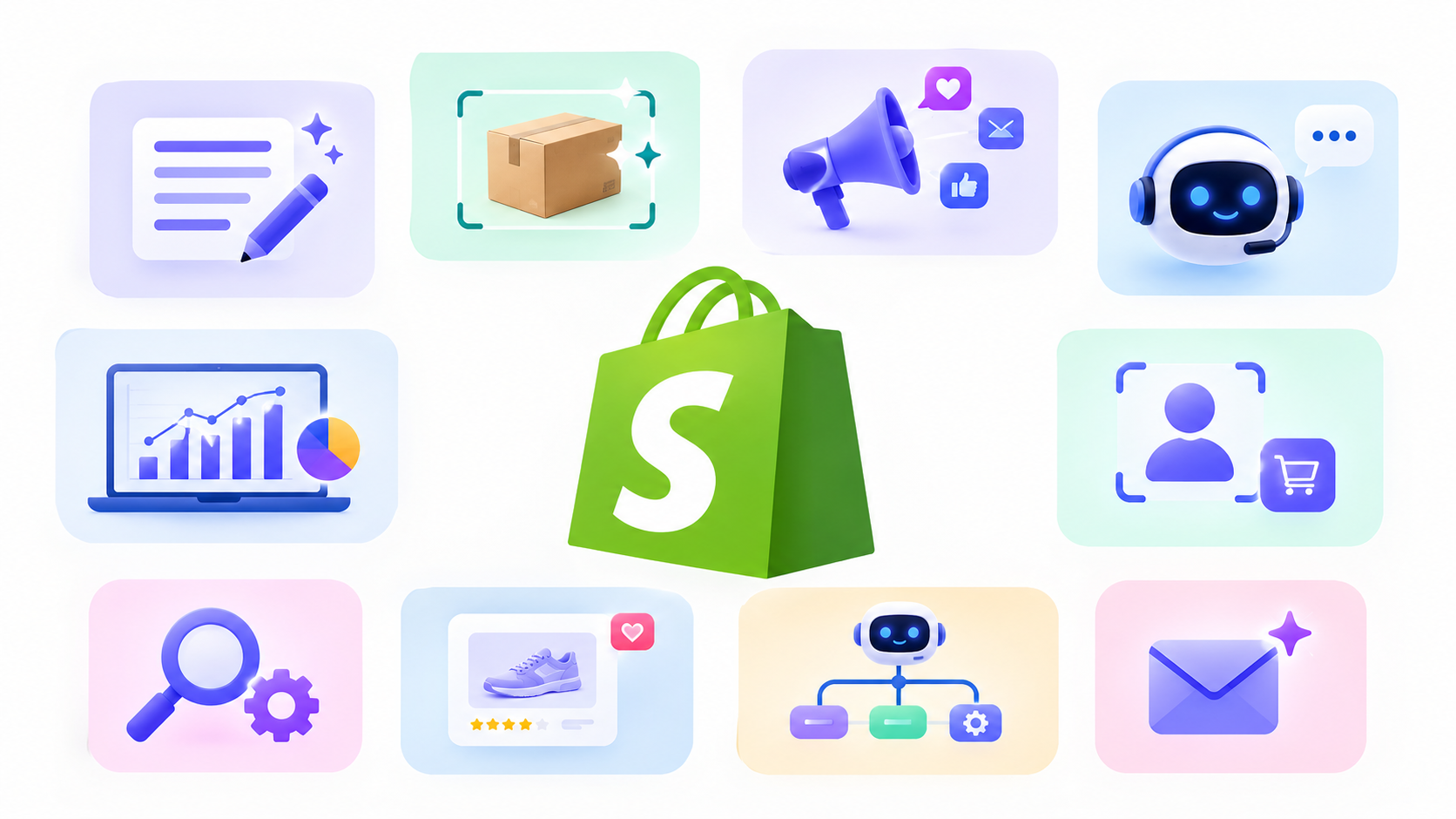
Running a Shopify store involves much more than adding products and processing orders. Store owners also need to write product descriptions, optimize product pages, manage marketing campaigns, create product images, answer customer questions, monitor competitors, and continuously improve conversions.
This is where AI tools for Shopify can make a real difference.
AI can automate repetitive ecommerce tasks, speed up content creation, personalize shopping experiences, improve customer support, support SEO, and help merchants make faster, data-driven decisions.
Shopify has also integrated AI directly into its platform through tools such as Shopify Magic and Shopify Sidekick. Meanwhile, third-party platforms extend AI capabilities across marketing, customer service, product recommendations, advertising, pricing, visual content, and SEO.
Shopify Magic is available across Shopify products and workflows, while Sidekick can help merchants analyze data, create content, manage store tasks, and build workflows.
In this guide, we have selected 20 of the best AI tools for Shopify in 2026, organized by the specific ecommerce tasks they can help you handle.
Quick Comparison: Best AI Tools for Shopify
| AI Tool | Best For |
|---|---|
| Shopify Sidekick | Store management |
| Shopify Magic | Product content |
| ChatGPT | Content and research |
| Jasper | Marketing content |
| Klaviyo AI | Email and SMS marketing |
| Gorgias | Customer support |
| Tidio Lyro | AI customer service |
| Rebuy | Product recommendations |
| Prisync | Competitor pricing |
| Octane AI | Product quizzes |
| Canva Magic Studio | Ecommerce design |
| Adobe Firefly | AI visuals |
| Photoroom | Product photography |
| Predis.ai | Social media |
| AdCreative.ai | Advertising |
| Avada SEO Suite | Shopify SEO |
| Tapita | SEO and site speed |
| SearchPie | SEO automation |
| Plug In SEO | SEO audits |
| SEOAnt | SEO optimization |
1. Shopify Sidekick

Best for: AI-powered Shopify store management
Shopify Sidekick is Shopify’s built-in AI commerce assistant. It works directly inside the Shopify admin and allows merchants to use natural language to ask questions, generate content, analyze information, and complete supported store-related tasks.
Instead of navigating through multiple settings, merchants can describe what they want to accomplish and let Sidekick guide them through the process or perform supported tasks.
Sidekick can help with product descriptions, blog content, images, SEO content, analytics, discounts, collections, store design, and workflow automation. It can also work with third-party apps and use store context to provide more relevant assistance.
Key features
- AI-powered store management
- Content generation
- Store analytics
- Workflow automation
- Product descriptions
- SEO content
- Store design assistance
- Business insights
Best for
Shopify merchants who want an AI assistant that understands their store and can help with everyday ecommerce operations.
Official website: Shopify Sidekick
2. Shopify Magic
Best for: Product descriptions and ecommerce content
Shopify Magic is a collection of AI-powered features integrated into Shopify’s products and workflows.
It can help merchants create product descriptions, email copy, blog content, headings, images, and customer responses. Shopify also provides AI capabilities for media generation, theme-related tasks, and other areas of store management.
For new stores, these features can reduce the amount of repetitive content work required to launch and manage a product catalog.
Merchants can provide basic product information and use AI to create a starting draft. They can then review, edit, and customize the content before publishing.
Key features
- Product description generation
- Blog content
- Email copy
- Image generation and editing
- Theme assistance
- Customer-response suggestions
- Content creation
Best for
Shopify merchants who want built-in AI without installing a separate AI platform.
Official website: Shopify Magic
3. ChatGPT
Best for: General-purpose AI for Shopify businesses
ChatGPT can support almost every part of an ecommerce content and research workflow.
Shopify merchants can use it to create product descriptions, research keywords, develop blog outlines, write email campaigns, create ad copy, answer customer FAQs, generate social media content, conduct market research, and brainstorm new ideas.
It can also help merchants analyze information and turn rough ideas into structured marketing assets.
Key features
- Product copy
- SEO research
- Blog writing
- Email marketing
- Customer FAQs
- Market research
- Content ideation
- Data analysis
Best for
Shopify businesses looking for a flexible AI assistant that can support multiple business, content, and marketing functions.
Official website: ChatGPT
4. Jasper
Best for: Ecommerce marketing content
Jasper is an AI marketing platform designed for businesses that need to create content at scale.
Shopify store owners can use it for product marketing copy, advertising content, email campaigns, landing-page copy, social media content, and other brand-focused materials.
Jasper is particularly useful for businesses that need to maintain a consistent tone and brand voice across multiple marketing channels.
Key features
- Marketing copy
- Product content
- Brand voice
- Email campaigns
- Social media copy
- Advertising content
- Content workflows
Best for
Ecommerce brands producing large volumes of marketing content while maintaining a consistent brand voice.
Official website: Jasper
5. Klaviyo AI
Best for: Email and SMS marketing
Klaviyo is an ecommerce marketing platform focused on customer data, email, SMS, personalization, and automation.
For Shopify merchants, it can turn customer and shopping behavior into more targeted marketing campaigns.
Its AI-assisted capabilities can help marketers create content, personalize campaigns, work with customer segments, and improve engagement.
Key features
- AI-assisted marketing
- Email campaigns
- SMS marketing
- Customer segmentation
- Personalization
- Automated campaigns
- Ecommerce analytics
Best for
Shopify stores that want to build personalized email and SMS campaigns based on customer behavior.
Official website: Klaviyo
6. Gorgias
Best for: AI-powered customer support
Gorgias is an ecommerce helpdesk designed to centralize customer support.
Shopify stores can use it to manage customer conversations and automate repetitive support requests.
This can be especially useful for growing stores that receive frequent questions about shipping, returns, order status, products, and store policies.
Key features
- AI customer support
- Helpdesk management
- Automated responses
- Order support
- Customer conversations
- Shopify integration
Best for
Growing Shopify stores that need to manage a high volume of customer-service requests.
Official website: Gorgias
7. Tidio Lyro

Best for: AI customer-service chatbots
Tidio combines live chat with AI-powered customer service through its Lyro AI Agent.
Lyro can answer common customer questions while allowing human agents to take over when a conversation requires personal attention.
For smaller ecommerce teams, this can reduce the time spent answering repetitive questions.
Key features
- AI chatbot
- Live chat
- Automated customer support
- FAQ responses
- Lead generation
- Human-agent handoff
Best for
Small and medium-sized Shopify stores that want faster, AI-assisted customer conversations.
Official website: Tidio
8. Rebuy

Best for: Product recommendations and upselling
Rebuy focuses on personalization, product recommendations, upselling, and cross-selling.
Its recommendation tools can help merchants display relevant products at different points in the shopping journey, including the cart and post-purchase experience.
For example, a customer buying a laptop could receive recommendations for a laptop bag, mouse, keyboard, or other compatible accessories.
Key features
- Product recommendations
- Upselling
- Cross-selling
- Smart cart
- Product discovery
- Post-purchase offers
- A/B testing
Best for
Shopify stores looking to increase average order value through personalized product recommendations.
Official website: Rebuy
9. Prisync
Best for: Competitor price tracking
Pricing can have a significant impact on ecommerce competitiveness.
Prisync helps businesses monitor competitor prices and product availability, giving merchants better information for pricing decisions.
Instead of manually checking competitor websites, store owners can use automated monitoring to understand how their products compare with competing offers.
Key features
- Competitor price tracking
- Price monitoring
- Product availability tracking
- Pricing intelligence
- Competitor analysis
Best for
Shopify merchants operating in competitive or price-sensitive markets.
Official website: Prisync
10. Octane AI

Best for: Product quizzes and personalization
Octane AI helps Shopify merchants create interactive product quizzes that guide shoppers toward relevant products.
Instead of asking customers to browse an entire catalog, a quiz can ask about their preferences, needs, or goals and then recommend suitable products.
This approach can work particularly well for beauty, skincare, fashion, food, and other categories where customers may need help choosing the right product.
Key features
- Product quizzes
- Personalized recommendations
- Lead generation
- Customer segmentation
- Product discovery
Best for
Shopify stores with large catalogs or products that benefit from personalized recommendations.
Official website: Octane AI
11. Canva Magic Studio

Best for: Ecommerce graphics and marketing designs
Canva Magic Studio brings AI-powered features into Canva’s broader design platform.
Shopify merchants can use Canva to create social media graphics, promotional banners, advertisements, email visuals, product campaigns, and other marketing assets.
It is particularly useful for small businesses that need professional-looking designs without relying on a designer for every campaign.
Key features
- AI-assisted design
- Image generation
- Social media graphics
- Marketing banners
- Ad creatives
- Brand content
Best for
Ecommerce owners who need fast and accessible marketing design tools.
Official website: Canva Magic Studio
12. Adobe Firefly
Best for: AI-generated ecommerce visuals
Adobe Firefly is Adobe’s generative AI platform for creating and editing visual content.
Shopify merchants can use Firefly to develop marketing concepts, promotional imagery, backgrounds, and other creative assets.
It can also help create visual variations for marketing campaigns without requiring a new photoshoot for every concept.
Key features
- Generative image creation
- AI image editing
- Background generation
- Creative variations
- Marketing visuals
Best for
Ecommerce brands that need AI-assisted visual content for marketing campaigns.
Official website: Adobe Firefly
13. Photoroom

Best for: AI product photography
Professional product photography can be expensive, especially for small ecommerce businesses.
Photoroom helps merchants turn basic product photographs into polished ecommerce visuals using AI-powered editing.
You can remove backgrounds, create new backgrounds, improve product presentation, and prepare images for marketing campaigns.
Key features
- Background removal
- AI backgrounds
- Product photography
- Image editing
- Ecommerce templates
- Marketing visuals
Best for
Shopify sellers who want professional-looking product images without investing in a traditional studio setup.
Official website: Photoroom
14. Predis.ai

Best for: Social media content
Predis.ai helps businesses create social media content with AI.
Shopify merchants can use it to generate promotional posts, captions, creative concepts, and other social media assets around their products.
This can make it easier for ecommerce brands to maintain a consistent social media publishing schedule.
Key features
- AI social posts
- Captions
- Creative generation
- Content ideas
- Social media marketing
- Product promotion
Best for
Shopify brands that want to make their social media workflow faster and more efficient.
Official website: Predis.ai
15. AdCreative.ai
Best for: AI advertising creatives
Creating multiple ad variations is important when testing ecommerce campaigns.
AdCreative.ai helps businesses generate advertising creatives and variations for digital campaigns.
For Shopify brands running paid advertising, it can reduce the time required to develop new creative concepts and test different approaches.
Key features
- AI ad creatives
- Creative variations
- Advertising copy
- Campaign testing
- Performance-focused creatives
Best for
Shopify stores running paid advertising campaigns and testing multiple creative concepts.
Official website: AdCreative.ai
16. Avada SEO Suite
Best for: Shopify SEO
Organic search can become an important source of traffic for Shopify stores.
Avada SEO Suite provides Shopify-focused SEO tools that can help merchants identify and address optimization issues across their stores.
It can assist with areas such as metadata, technical SEO, image optimization, and other search-focused improvements.
Key features
- SEO optimization
- Meta titles and descriptions
- Technical SEO
- Image optimization
- SEO analysis
Best for
Shopify merchants looking for an all-in-one SEO solution.
Official website: Avada SEO Suite
17. Tapita SEO & Speed Optimizer

Best for: SEO and website performance
Tapita combines Shopify SEO features with website performance optimization.
It can help merchants work on technical SEO, metadata, image optimization, and page-speed improvements.
This makes it useful for stores that want to improve both organic visibility and website performance.
Key features
- SEO optimization
- Image optimization
- Page-speed optimization
- Metadata
- Technical SEO
Best for
Shopify merchants working on both search visibility and site performance.
Official website: Tapita
18. SearchPie SEO

Best for: Automated Shopify SEO
SearchPie is designed specifically for Shopify SEO.
It helps merchants identify optimization opportunities and manage important SEO elements without manually reviewing every product and page.
Automation becomes particularly valuable for Shopify stores with hundreds or thousands of products.
Key features
- SEO automation
- SEO analysis
- Product optimization
- Technical SEO
- Search visibility improvements
Best for
Large Shopify stores that need to manage SEO across extensive product catalogs.
Official website: SearchPie
19. Plug In SEO

Best for: Shopify SEO audits
Plug In SEO helps Shopify merchants identify SEO issues that could affect organic visibility.
It can be useful for store owners who understand basic SEO but want automated assistance with identifying problems and optimization opportunities.
Key features
- SEO audits
- SEO monitoring
- Optimization recommendations
- Shopify SEO
- Search visibility
Best for
Shopify beginners who want a straightforward way to monitor their store’s SEO.
Official website: Plug In SEO
20. SEOAnt

Best for: Shopify SEO automation
SEOAnt provides Shopify-focused tools for managing and improving organic search performance.
It can help merchants identify technical SEO problems, broken links, redirects, and other issues that can become increasingly difficult to manage as a store grows.
Key features
- SEO analysis
- Technical SEO
- Broken-link monitoring
- Redirect management
- SEO automation
Best for
Shopify stores that want to automate routine SEO maintenance.
Official website: SEOAnt
Are AI Tools Worth Using for Shopify?
Yes, but AI should support your ecommerce strategy rather than replace it.
The most effective approach is to use AI for repetitive, high-volume, and data-heavy tasks while keeping human oversight for important business decisions and customer-facing content.
This creates a practical AI workflow in which every tool has a defined role.
For example, you might use Shopify Sidekick for store management, ChatGPT for research and content, Klaviyo for customer marketing, Gorgias for support, Rebuy for product recommendations, and an SEO platform for ongoing search optimization.
It is also important to review AI-generated content before publishing. AI can produce inaccurate or misleading information, so merchants should verify important claims, product details, pricing, policies, and customer-facing information.
Final Thoughts
The best AI tools for Shopify are not necessarily the platforms with the longest feature lists. The right choice depends on your store’s goals, budget, workflow, and biggest operational challenges.