
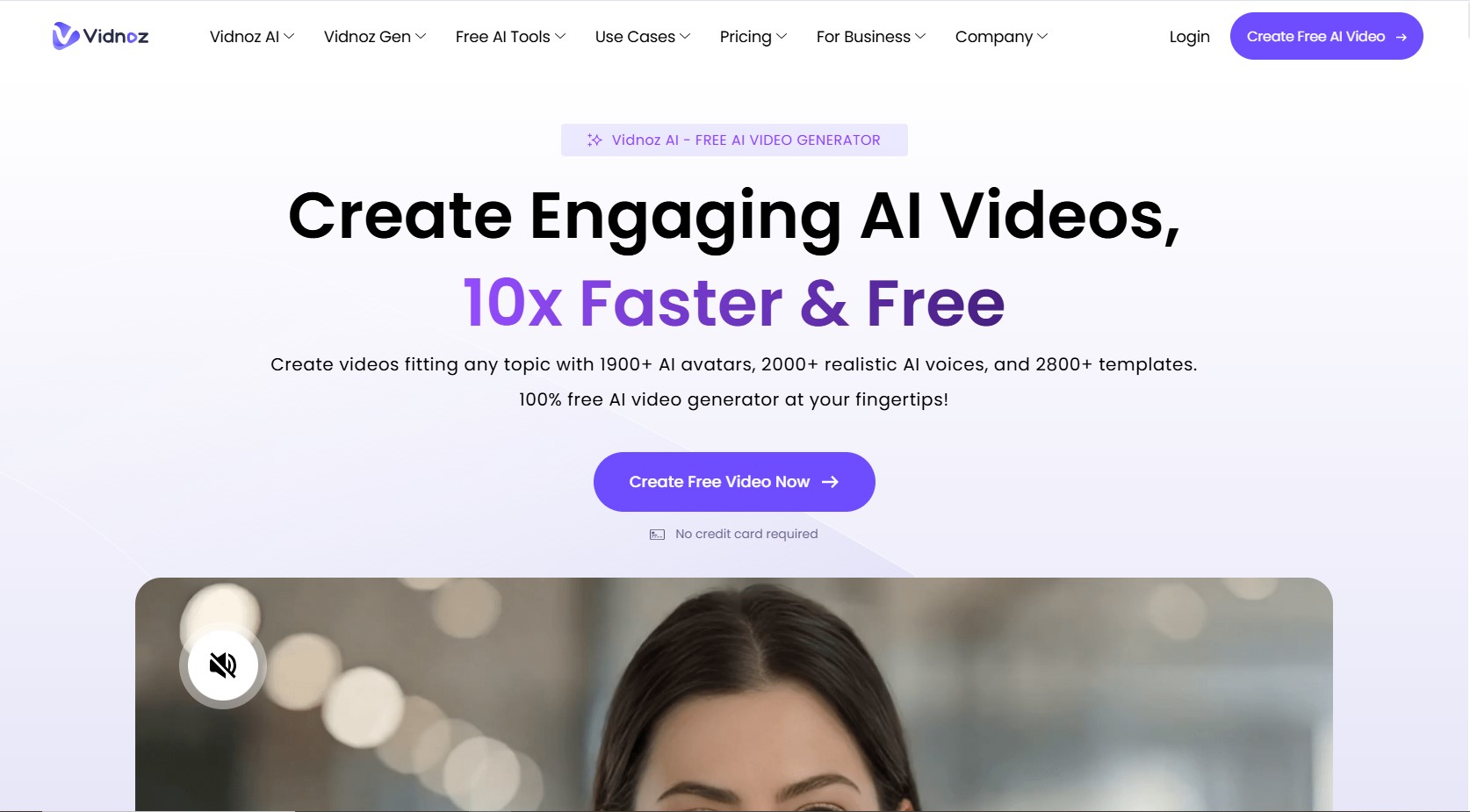

Vidnoz AI is a web-based artificial intelligence video creation platform designed for 2026 that fundamentally changes how individuals and teams produce professional-looking videos. At its core, Vidnoz delivers what many content creators and businesses still struggle with in traditional video workflows: reducing the time, cost, and technical barriers of video production while enabling richly engaging AI-generated content featuring realistic digital avatars, multilingual voiceovers, and ready-to-use templates. Users can transform written scripts into full videos with animated AI speakers, realistic lip sync, and immersive visual elements far faster than filming with real actors or editing with legacy tools. This ability to turn text into broadcast-ready video without cameras, studios, or voice talent addresses a persistent problem in digital media production: meeting the rising demand for scalable video content without proportional investment in resources.
Behind Vidnoz AI is Vidnoz Inc., a privately held software company headquartered in Austin, Texas, that focuses on AI-powered content creation tools. The company has grown since its founding in 2016 by expanding from basic online video utilities into a full-featured AI content platform. Vidnoz remains a mid-sized company with a software development and AI team working on continual product enhancements and enterprise solutions. LinkedIn data indicates Vidnoz operates with roughly 50–200 employees and actively positions itself as an innovator in AI video generation, hosting industry recognition and participating in events like EdTech Taiwan to promote its technology.
Vidnoz works by combining multiple AI technologies into a single cloud-based interface. Users start with a script or text prompt and choose from hundreds of templates and over 1,900 AI avatars — digital presenters with natural motions, gestures, and lip-synced speech. The system then uses text-to-speech and animation engines to generate video scenes, embedding voices, gestures, and transitions based on the selected template. Language support spans more than 140 languages, and voice cloning enables users to create avatars that speak in custom voices. Video generation runs in the cloud, meaning users only need a browser and internet connection; no advanced hardware is required. Vidnoz also integrates script generation, translation tools, captions, and export options to fit workflows from social media to internal training.
Real-world use cases for Vidnoz cover a broad spectrum. Marketing teams use it to produce explainer and promotional videos without scheduling production crews. Educators create interactive lessons and on-boarding materials with virtually no editing skills required. Sales teams embed AI videos into campaigns to increase engagement and conversion rates. Human resources departments generate consistent training content at scale, and startups use Vidnoz to craft founder story videos for fundraising or product launches. Even newsrooms leverage its templates to rapidly convert breaking stories into anchor-style video segments. These applications show how Vidnoz serves both creative and operational needs across industries.
Pricing for Vidnoz AI in 2026 follows a freemium model with paid tiers that scale up in features and usage. A free plan allows basic video creation with limits on resolution and daily credits. Paid subscriptions start with a Starter tier that includes more minutes, higher-resolution exports, and increased voice and template access. A Business plan adds collaboration tools, brand kit support, voice cloning, and analytics. For enterprise teams, custom pricing is available with dedicated support, advanced account management, and API access. Annual billing offers discounts compared with monthly pricing. Add-ons such as advanced custom avatars and additional voice clone capacity are available for specific needs.
Against competitors like Canva, Synthesia, and Pika Labs, Vidnoz’s pricing is competitive, particularly at entry tiers. Its free tier is comparatively robust, and its mid-range plans are often priced lower than equivalent feature sets from larger incumbents. Prospective users should, however, compare based on specific needs such as rendering speeds, number of voice options, and available integrations.
Vidnoz is well suited for content creators, small- to medium-sized businesses, educators, and marketing teams that need an intuitive, affordable way to produce AI-generated video content. It offers significant value where time-to-market and ease of use are priorities. It may be less appropriate for users requiring extremely high-end custom animations, detailed post-production control, or tight offline workflows, where traditional professional editing suites remain more capable.
The platform’s strengths lie in its breadth of ready-made assets, low learning curve, and comprehensive language and avatar support. Its limitations include reliance on a credit-based system that can be confusing to new users, occasional robotic voice nuances, and the fact that its avatar expressions are not as nuanced as real actors in some professional contexts. Public reviews praise ease of use and speed but occasionally note customer support and billing issues, which potential users should factor into purchasing decisions.
In business settings, teams use Vidnoz not only to produce external marketing content but also for internal training, onboarding, and automated communications. Its brand kit features and shareable video pages help maintain consistent visuals and messaging across departments. Enterprises that adopt AI video production into their workflows often report cost and time savings over legacy production pipelines.
Vidnoz matters in the 2026 AI landscape because it reflects a shift toward democratizing video production with generative AI. As demand for video content continues to outpace production resources, tools like Vidnoz lower barriers and allow organizations of all sizes to harness engaging multimedia. It also exemplifies how AI platforms integrate multimodal capabilities — text, voice, animation — into cohesive experiences that can serve both creative and operational functions.
In conclusion, Vidnoz AI is a mature and versatile AI video generation platform that balances ease of use, affordability, and practical output quality. For teams looking to scale video creation without extensive technical overhead, it represents a credible solution in 2026, bridging the gap between simple drag-and-drop editors and fully custom production workflows.