
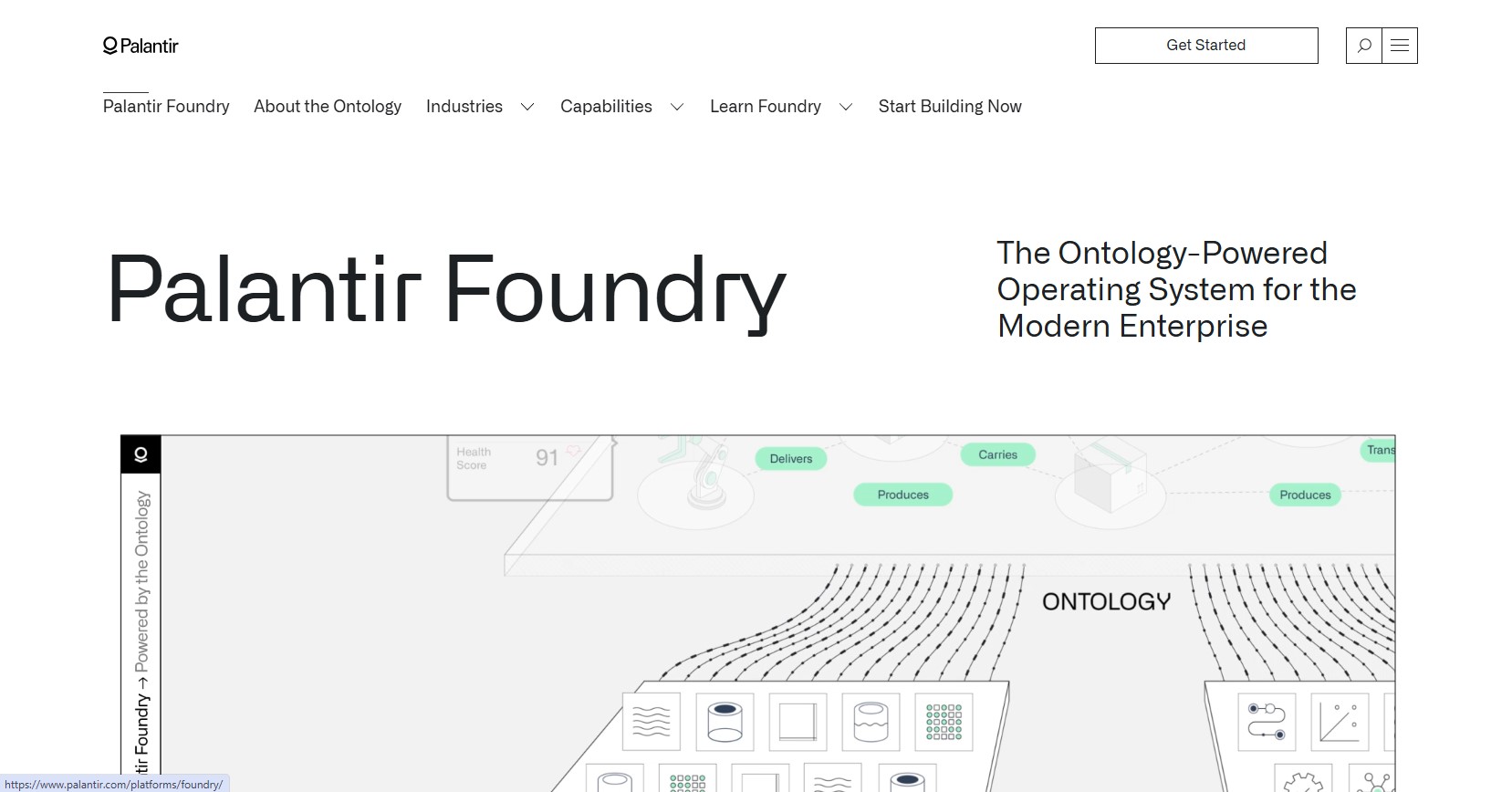

Palantir Foundry AI in 2026 is best understood not as a single tool competing with point‑solution AI products, but as part of Palantir Technologies’ enterprise‑grade AI and data operations platform, where generative AI and machine learning capabilities are embedded deeply into the core Foundry system via the Artificial Intelligence Platform (AIP). This combination is widely adopted by governments and large commercial organizations to drive real‑time decision‑making, complex analytics, and operational workflows at scale.
Palantir Foundry AI refers to the integration of AI technologies, especially large language models (LLMs) and AI agents, into Palantir Foundry, Palantir’s flagship data operations and analytics platform. Foundry itself is a unified enterprise data platform that breaks down data silos, models enterprise data as a structured “ontology,” and enables analytics, governance, and operational applications. Palantir’s AIP layer connects generative AI to data and workflows across Foundry, allowing organizations to build AI‑augmented workflows, interactive AI assistants, and operational applications that leverage both enterprise data and LLMs in secure, governed environments.
In 2026, the central problem Foundry AI solves is the perennial enterprise challenge of turning disparate, complex data into actionable decisions at scale. Traditional BI and analytics tools often leave executives and operators waiting for insights; Foundry AI aims to close that gap by enabling analytic models, real‑time data integration, and AI‑assisted logic to be embedded directly into operational workflows. AIP agents can automate parts of those workflows, generate natural language summaries, support coding tasks, and respond to contextual queries using enterprise data, while governance, security, and compliance remain intact.
Palantir Technologies, the company behind Foundry, is a publicly traded software firm (NYSE: PLTR) founded in 2003 with deep roots in government data analytics and defense, now expanding heavily into commercial enterprise AI and analytics. Its core product suite includes Foundry (enterprise data and operations), Gotham (government/defense analytics), Apollo (software deployment and lifecycle management), and the Artificial Intelligence Platform (AIP) that brings generative AI into these ecosystems. Palantir’s revenue mix in 2025 and 2026 reflects both government and commercial demand, with major long‑term contracts such as a consolidated U.S. Army enterprise agreement potentially worth up to $10 billion over ten years, illustrating how Palantir’s AI‑enabled platforms factor into large public sector digital transformation projects.
Foundry AI actually works by fusing enterprise data, operational logic, and AI capabilities into a single governed platform. At its heart is the Ontology, a semantic model that organizes and relates business concepts, logic, and actions in a way that AI tools and applications can reliably use. AIP integrates generative AI models such as Claude, Grok, and others, enabling developers and business users to create AI‑augmented workflows, AI assistants, and production‑ready functions that are secure, audit‑able, and embedded into the enterprise’s real‑world processes. Capabilities include AIP Agent Studio for building tailored AI agents, AIP Logic for data‑driven automation, and AIP Evals for performance and cost optimization across models. Resource and token usage views allow administrators to manage model load and rate limits.
Real‑world use cases in 2026 span industries and organizational needs. Large banks use Foundry for integrated customer‑centric analytics and cross‑department workflows, reducing friction between sales, risk, and operations. Global energy companies streamline asset and supply chain operations with AI‑augmented forecasting and anomaly detection. Government agencies deploy AI‑enhanced tip processing and investigative workflows to improve case prioritization and language translation at scale. Telecommunications and infrastructure firms explore deep integrations of Palantir’s AI platform with their connectivity fabrics to support secure, enterprise‑wide AI deployments.
Palantir does not publish simple “off‑the‑shelf” pricing for Foundry AI; pricing is enterprise‑level and bespoke, reflecting the platform’s complexity and the tailored nature of deployments. Official and marketplace documents indicate that Foundry & AIP engagements can begin with discovery or pilot packages that range from tens of thousands to hundreds of thousands of pounds/dollars, with organization‑wide licenses commonly reaching multi‑million‑dollar annual terms depending on usage, data scale, and support services. Implementation, support, and ongoing engineering guidance are typically contracted separately. Estimates from public procurement documents show discovery phases at £50,000–£250,000 and core environment licenses valued in the millions, reinforcing the point that traditional enterprise pricing and contractual negotiation are the norm rather than published tiered plans.
Compared with AI and data platforms like Databricks, Microsoft Fabric, or Snowflake, Foundry AI sits at the upper end of the pricing and capability spectrum. Competitors often offer more transparent, consumption‑based pricing and focus primarily on data processing, analytics, or cloud‑native AI services. Palantir’s value proposition is its end‑to‑end, secure, governed platform designed for mission‑critical operations and complex decision workflows, with pricing that typically aligns with larger enterprise budgets rather than SMB or mid‑market consumption models.
Organizations that should consider Foundry AI are large enterprises and government agencies with complex, heterogeneous data estates, stringent governance requirements, and a need to integrate analytics and AI deeply into operational processes. It is especially relevant where decisions are high‑impact, data sources are siloed, and security/compliance cannot be compromised. Smaller businesses or teams without significant data engineering resources and enterprise data management needs may find the platform’s complexity and cost prohibitive.
Foundry AI’s strengths lie in its holistic integration of data, logic, and AI, robust governance and security, and support for real‑time operational workflows. Its ontology‑based approach ensures that AI outputs remain connected to business semantics and rules. However, realistic limitations include a steep learning curve, extensive implementation overhead, and the need for ongoing governance and engineering collaboration. Not every use case requires the depth of integration that Foundry provides; for straightforward analytics or basic AI applications, simpler and more affordable tools may be more appropriate.
In business and team settings, Foundry AI is typically embedded as the backbone of digital transformation programs, with dedicated architect and engineering teams working alongside Palantir deployment specialists to design ontologies, define workflows, and operationalize AI‑driven insights. Cross‑functional teams leverage the platform for scenario analysis, predictive maintenance, compliance reporting, and automated decision support, often linking AI workflows directly into enterprise applications used by frontline staff and executives.
Foundry AI matters in the 2026 AI landscape because it exemplifies the shift from isolated AI experiments to enterprise‑scale, governed AI adoption. Its focus on integrating AI with data operations, while prioritizing security, transparency, and real‑world decision impact, positions it alongside other major platforms that are moving beyond simple model inference to embed AI into core business processes. In an environment where organizations are increasingly accountable for how AI is used operationally, Palantir’s platform addresses both technical and governance challenges head‑on.
In summary, Palantir Foundry AI in 2026 is not a plug‑and‑play chatbot or isolated analytics tool. It is a comprehensive enterprise platform that unifies data, AI, and decision workflows with strong governance and security, tailored through bespoke pricing and deep deployment support. Large organizations that need to drive operational impact with AI at scale will find it compelling, while smaller teams should assess whether their needs and budgets align with the platform’s enterprise focus. Its continued adoption by governments and global corporations underscores its relevance in an era where AI must be trustworthy, integrated, and actionable.