

Here’s a comprehensive, fact‑checked 2026 deep dive on monday.com AI — written with senior technology analyst and SEO strategy principles, based on up‑to‑date pricing pages, product documentation, and official announcements.
monday.com AI in 2026 is not a standalone chatbot or single feature — it is the artificial intelligence backbone embedded throughout the monday.com Work OS designed to help teams automate, analyze, and execute work with less friction. At its core, monday AI addresses the perennial problem of “work about work” — the manual effort spent wrangling tasks, generating reports, maintaining boards, triaging tickets, forecasting risks, and communicating across teams. Instead of forcing users to manually configure every workflow or build automations from scratch, the AI capabilities in monday.com are built to interpret natural language, generate content, summarize status, and even act on users’ behalf within their work environment. These features transform monday.com from a traditional work management platform into a work execution platform where AI helps reduce cognitive load and operational bottlenecks.
monday.com AI is developed and maintained by monday.com Ltd., a publicly traded software company headquartered in Tel Aviv and New York, listed on NASDAQ under the ticker MNDY. The company was founded in 2012 and has grown into a global Work Operating System (Work OS) with over 245,000 customers worldwide across industries such as technology, professional services, and enterprise operations.
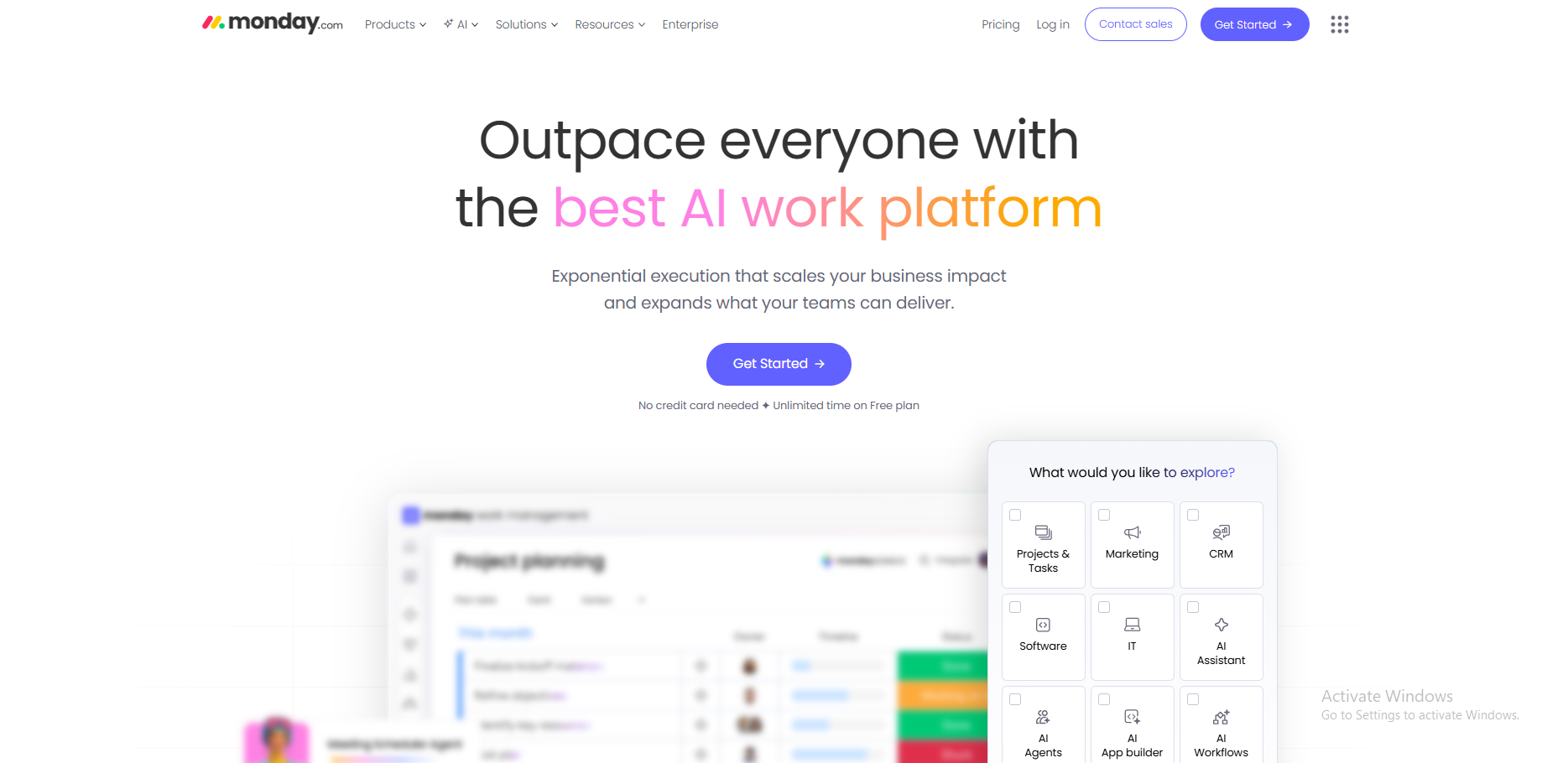
Unlike generic AI add‑ons, monday.com’s AI features are native to the platform. They are organized into several components: monday sidekick, monday magic, monday vibe, and monday agents. monday sidekick is a context‑aware digital assistant that understands a user’s workspace, roles, and responsibilities and can proactively suggest actions or complete tasks. monday magic enables users to describe desired outcomes in plain English and instantly generate boards, automations, and workflows tailored to that description. monday vibe brings natural language querying to boards and reports, allowing users to ask questions in conversational language and receive insights without building charts manually. monday agents — introduced in late 2025 and expanding in 2026 — are customizable AI specialists capable of executing multi‑step, end‑to‑end business processes such as qualifying leads or planning sprints.
Behind these branded capabilities are the AI Blocks and automation engines that run machine learning and generative AI operations. These include summarization of task descriptions, sentiment detection on comments, automatic assignment suggestions, formula generation, and content creation for docs or updates. Many of these AI Blocks run on a credit‑based consumption model that measures usage and charges against a shared pool of credits tied to a user’s subscription.
In real‑world use, monday.com AI is employed by project managers, operations teams, and cross‑functional groups to reduce manual work and speed decision-making. Project teams use monday magic to spin up new project structures instantly, cutting the time to set up complex boards from hours to minutes. Customer support and service teams leverage AI‑powered ticket triage and auto‑responses to handle repetitive inquiries and prioritize critical issues faster. Sales and marketing teams in the CRM suite use agents to enrich lead data, score prospects, and automate follow‑ups based on natural language triggers. Developers and product teams use monday vibe to explore workload distributions, flag bottlenecks, and generate sprint retrospectives without manual reporting. In each case, the AI is employed directly within the user’s existing workflows rather than through a separate interface.
Pricing for monday.com AI in 2026 reflects the platform’s broader subscription model, with AI capabilities included and extended depending on plan tier. The core monday.com Work Management, CRM, Dev, or Service products have tiered pricing from free up to enterprise levels. The free plan provides basic boards and limited work management capabilities without extensive AI usage. Paid plans such as Standard and Pro (beginning around $12–$19 per seat per month when billed annually) include access to AI Sidekick (in a lite form), a base allocation of AI credits, and the ability to run AI Blocks and automations. Enterprise plans add more extensive AI credits, the full version of sidekick, resource and portfolio management, and advanced governance features. Many AI Blocks consume credits, and monday.com sells additional credit buckets for teams that exceed baseline allocations. Enterprise customers can negotiate custom pricing and higher credit usage.
Compared to competitors like Asana, Jira, ClickUp, or Wrike, monday.com’s pricing is in the same general range for basic work management and AI functionality. However, the credit‑based model for AI usage introduces complexity not seen in simpler subscription plans. Competitors that bundle AI features without per‑use credits, or that limit AI to predefined experiences, may appear more straightforward for some teams. monday.com’s model aims to balance flexibility with usage‑based fairness, but teams with heavy AI workloads must plan for credit consumption and potential additional costs.
monday.com AI is best suited for mid‑sized to large teams that need deep integration of AI with complex workflows, cross‑team execution, and customizable automation. Teams that routinely build custom processes, manage dynamic projects, or deploy AI into operational tasks will derive measurable ROI from the platform’s AI. Conversely, very small teams, individual users without a need for automation, or organizations with minimal complexity may find the platform’s pricing and credit model less compelling relative to simpler or more AI‑inclusive alternatives.
Strengths of monday.com AI include its native integration with work data, natural language interfaces, and AI‑driven execution capabilities that go beyond summarization or suggestions. Because the AI works within context — reading board structures, dependencies, and user roles — its outputs tend to be more accurate and actionable than generic AI plugins. Limitations include the credit‑based pricing model, which can be complex to forecast and may lead to variable costs for high AI usage, and the learning curve associated with optimizing AI Blocks and agents effectively. Some users also report that early pricing models for credits were confusing or expensive before recent adjustments.
Across businesses and teams, monday.com’s AI is reshaping how operational work is done. Instead of generating static reports, teams use AI to create and revise workflows dynamically as priorities shift. Enterprise customers embed agents into key functions such as lead engagement, customer support resolution, and product release tracking. Marketing teams automate campaign planning and performance summaries. Service teams dramatically cut ticket resolution times with AI triage. The result is a platform where the AI does not sit on the side; it is central to how work gets done.
In the 2026 AI landscape, monday.com matters because it represents a shift from AI as a feature to AI as an integral component of a workflow ecosystem that moves beyond traditional project management. By embedding AI across product lines and enabling customizable AI agents, monday.com is redefining competitive expectations for work platforms. Its approach signals a broader industry transition toward AI‑enabled work execution systems that not only inform teams but perform structured, multi‑step actions on their behalf.
In summary, monday.com AI in 2026 is a mature, embedded suite of capabilities that turns work management into work execution. It combines natural language understanding, predictive insights, automated actions, and customizable agents within a single platform. Teams that need integrated AI to reduce manual work and accelerate decisions will find substantial value, although the credit‑based pricing and complexity require careful planning. As AI continues to shape enterprise software, monday.com’s investment in native, context‑aware intelligence positions it as a leader in the next generation of workplace automation.