
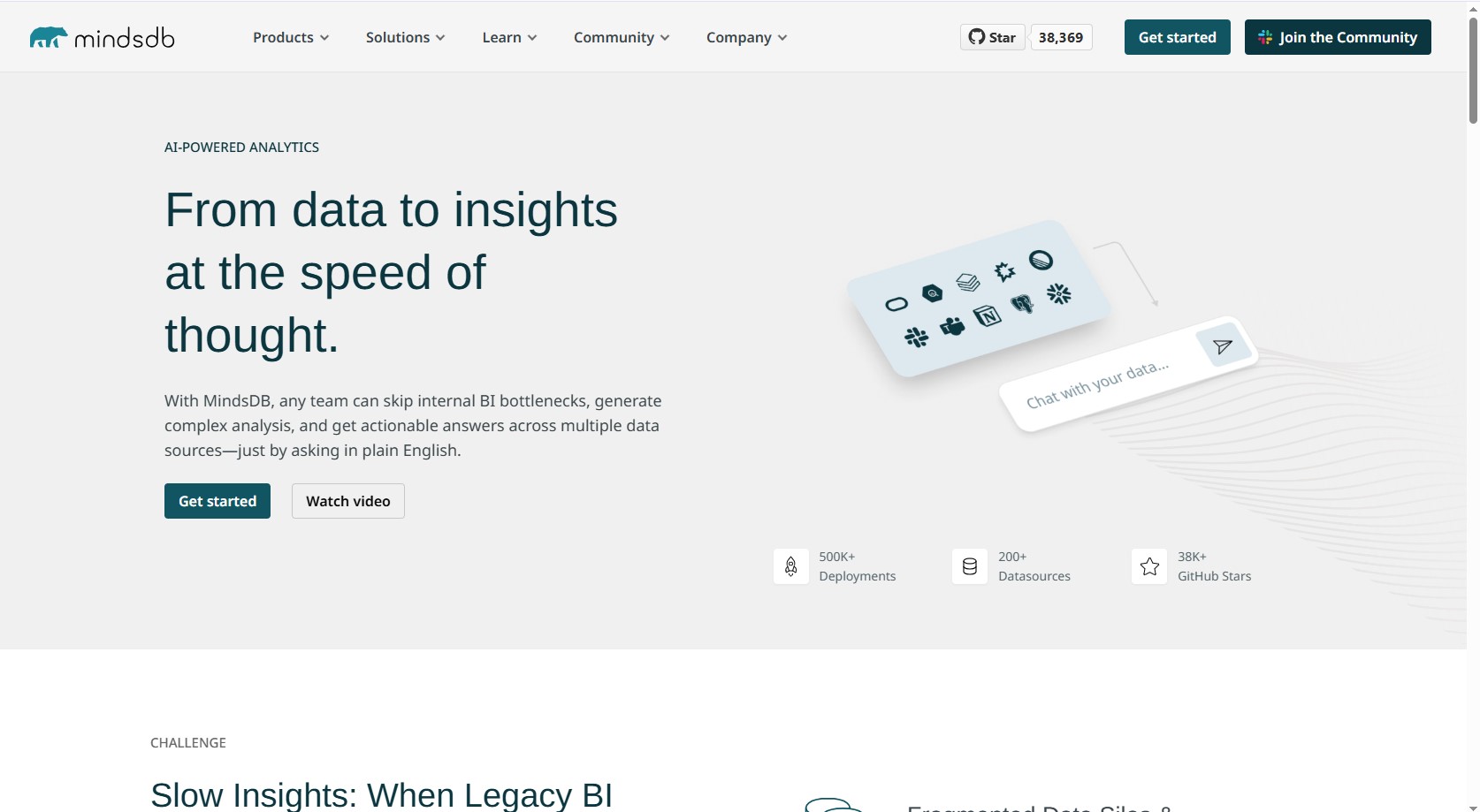

In 2026 MindsDB is recognized as one of the most widely‑adopted AI data platforms that brings real‑time artificial intelligence directly to enterprise data infrastructure. Rather than forcing organizations to build separate machine learning pipelines or move data into specialized systems, MindsDB lets teams analyze, predict, and derive insights from structured and unstructured data where it already lives by using natural language and familiar query languages like SQL. It effectively acts as an AI data layer, enabling both humans and AI agents to get answers, predictions, and analytical insights across fragmented enterprise datasets without heavy engineering overhead.
MindsDB was founded in 2017 by Jorge Torres and Adam Carrigan, and it remains a privately‑held AI software company headquartered in Berkeley, California. From its origins as an open‑source project to democratize machine learning, the company has grown into a platform with hundreds of thousands of deployments and thousands of community contributors, supported by venture funding from notable backers including Benchmark, Mayfield, Y Combinator, and NVIDIA.
At its core, MindsDB works by connecting directly to an organization’s existing data sources—databases, warehouses, SaaS systems, document stores, and more—without requiring data to be copied or transformed into central repositories. The platform uses a federated query engine and its own AI reasoning layer to unify data from 200+ connectors, letting users pose analytical questions in natural language or SQL. MindsDB then orchestrates the appropriate data retrieval, semantic reasoning, and machine learning prediction steps to deliver results, often far faster and more flexibly than traditional BI tools. The platform’s Model Context Protocol (MCP) support allows integration with agents and tools for applications spanning predictive analytics, semantic search, and AI‑powered insights.
In practical terms, developers, data analysts, and business users use MindsDB to build predictive models, generate insights, and automate workflows without needing to engineer complex ML infrastructure. For example, teams can use MindsDB to forecast customer churn or sales directly within their databases, run sentiment analysis on unstructured text, power semantic search over internal documentation, or build AI agents that query business data conversationally. The platform’s ability to embed AI logic as “AI tables” in databases reduces friction for operationalizing machine learning in production systems.
MindsDB’s pricing in 2026 reflects its dual nature as both open‑source software and a managed cloud service. The open‑source version remains free to use and self‑host, giving developers full access to the core engine and integrations under community terms. On the managed side, Minds Enterprise Cloud starts at about $35 per user per month with defined quotas (e.g., 250 questions per month and up to three connected data sources), while larger teams and enterprise customers negotiate annual subscriptions with unlimited users, queries, and custom integrations. On‑premise and private cloud deployments also involve custom pricing.
Compared to competitors in 2026, MindsDB’s pricing and positioning are distinctive because it couples open‑source accessibility with enterprise‑ready cloud offerings. Traditional enterprise analytics platforms and proprietary BI tools often charge per seat with rigid tiering and limited native AI support, whereas MindsDB’s hybrid model allows small teams to start with open source and scale into paid plans as needs grow. Other AI analytics platforms may offer more turnkey dashboards but don’t necessarily match MindsDB’s flexibility in data connectivity and developer‑centric workflows.
MindsDB is especially suitable for data teams, analytics engineers, and software developers who want to integrate AI into existing systems without building bespoke pipelines. Its SQL‑first and natural language interfaces lower barriers for those with database expertise, while the open‑source foundation ensures extensibility and community contribution. It’s less appropriate for organizations seeking purely no‑code, end‑user BI tools without developer involvement, or for teams with minimal data infrastructure where simple spreadsheet analytics suffice.
The platform’s strengths include direct database integration, elimination of heavy ETL pipelines, and the ability to query data conversationally with transparent reasoning. Its open‑source roots attract a large contributor base and allow rapid evolution. Realistic limitations include a learning curve for non‑technical users and the need to architect underlying data sources effectively for best performance, particularly in complex enterprise contexts.
In business settings, MindsDB is increasingly embedded into operational analytics, automated reporting, customer insights, and AI‑driven application layers. Companies leverage it to speed up decision‑making, reduce reliance on specialized ML engineering teams, and deliver predictive capabilities directly within apps and BI workflows. It’s also used in RAG and semantic search applications where users query mixed structured/unstructured data.
MindsDB matters in the 2026 AI landscape because it bridges a persistent gap: democratizing machine learning and AI insights without demanding data migration or specialized skills. Its federated approach reflects a broader shift toward AI‑native data platforms that empower organizations to operationalize insights across platforms while maintaining data governance and privacy.
In expert assessment, MindsDB represents a practical and scalable path to enterprise AI adoption. It combines open‑source innovation with cloud scalability, enabling teams to build, query, and operationalize AI models directly on their data. While it’s not a plug‑and‑play BI dashboard for all business users, its value for analytics engineers and developers who need flexible, explainable AI capabilities makes it a cornerstone technology in data‑centric AI strategies.