

What MarketMuse is and what problem it solves in 2026
MarketMuse is an AI‑driven content strategy and optimization platform built to help SEO professionals, content marketers, agencies, and enterprise teams plan, research, and optimize content with data‑backed insights. Instead of relying on manual keyword lists and intuition, MarketMuse uses proprietary topic modeling, personalized authority scoring, competitive analysis, and automated content briefs to show teams exactly what to write, how to structure it, and why those decisions matter for organic visibility and topical authority. It addresses a major challenge in modern SEO: producing content that is comprehensive, competitive, and aligned with search intent while reducing extensive manual research and guesswork.
Who owns MarketMuse and the company behind it
MarketMuse was founded in 2013 by Aki Balogh as a research‑driven SEO and content intelligence platform, and it has since evolved under a team of SEO experts, engineers, and data scientists dedicated to content optimization. In 2024, MarketMuse was acquired by Siteimprove, bringing it into a broader suite of digital experience and accessibility tools while retaining its core focus on AI‑guided content strategy and optimization. The acquisition enhanced MarketMuse’s ability to integrate strategy with execution across digital channels.
How MarketMuse actually works
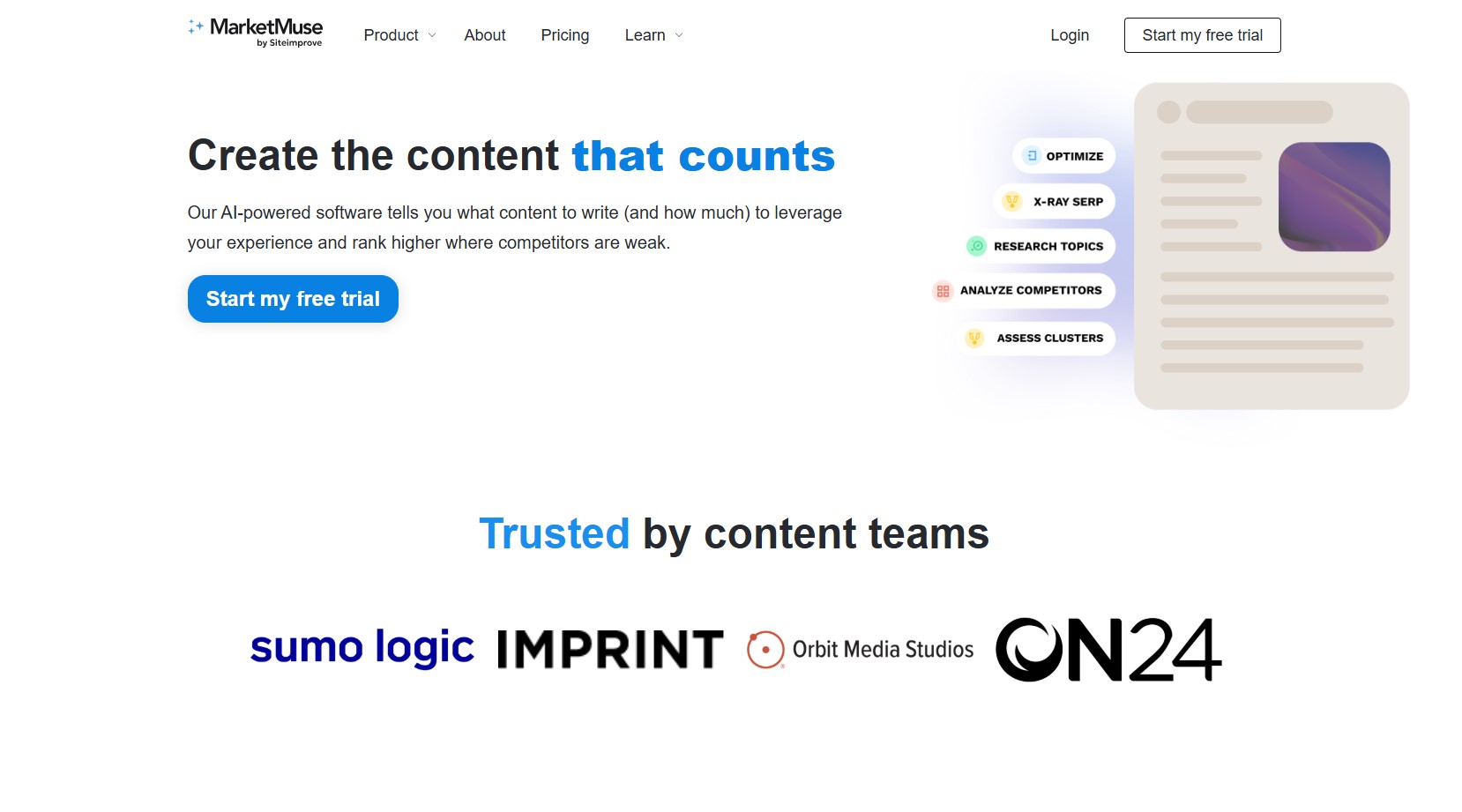
At its core, MarketMuse combines AI, natural language processing, and proprietary topic modeling to analyze massive datasets of search results, competitor content, and your own site inventory. It builds a content inventory of all published pages, identifies gaps and overlaps in topic coverage, and calculates metrics like personalized difficulty and topic authority that estimate how hard it would be for a specific site to rank for a topic. The platform generates content briefs automatically — outlining relevant subtopics, questions to answer, semantic terms, and structural guidance — and provides a real‑time Optimize editor that highlights missing concepts as you draft. Features like SERP X‑Ray, Topic Navigator, and connect internal linking recommendations help teams build comprehensive content that aligns with search intent.
Real‑world use cases and how professionals use it today
Professionals use MarketMuse to streamline multiple SEO and content workflows. Content strategists rely on cluster analysis to identify topic authority gaps and build editorial calendars that prioritize high‑impact opportunities. SEO teams use automated content audits to evaluate existing content quality and identify pages that need optimization or consolidation. Agencies use the platform to produce standardized content briefs for writers and editors, ensuring consistency across large teams and client projects. Marketing teams use quantitative metrics like competitive advantage and personalized difficulty to justify resource allocation and forecast organic growth. Enterprise teams with expansive content libraries use MarketMuse’s inventory tracking to manage thousands of pages and topics continuously.
Current pricing plans in 2026
As of 2026, MarketMuse offers tiered subscription plans plus a free tier for trial and light use. The Free plan provides very limited usage with 10 queries per month for individuals testing the tool. Paid tiers include Optimize, Research, and Strategy plans that scale by tracked topics, content briefs per month, and support for multiple users. For example, the Optimize plan — suitable for individual creators — offers 100 tracked topics and a handful of briefs; Research expands tracked topics and briefs for growing teams; and Strategy supports large teams with tens of thousands of tracked topics and more monthly briefs. Enterprise options and bespoke pricing are available through sales.
How pricing compares to competitors
MarketMuse’s pricing positions it generally above lightweight AI content writers and basic SEO tools, reflecting its focus on strategic planning and inventory‑wide intelligence rather than simple on‑page grading. Its mid‑tier plans compare with enterprise SEO suites in price, and like other comprehensive platforms — such as Clearscope or Surfer SEO — it can be cost‑intensive for smaller teams. The value stems from deeper analysis, automated strategy docs, and AI‑generated briefs rather than just keyword suggestions, but smaller creators may find lower‑priced tools more accessible if they don’t need full content‑planning capabilities.
Who should use MarketMuse and who should not
MarketMuse is best suited for SEO professionals, large content teams, agencies, and enterprise marketing departments that publish content at scale and require deep insight into topic coverage, authority gaps, and competitive analysis. It is particularly useful where multiple contributors collaborate and need consistent, data‑backed guidance. It may be less appropriate for solo bloggers or very small businesses who publish infrequently or need only basic keyword tools, as the platform’s breadth and price point can be more than required for minimal content needs. Tools with lighter pricing and simpler interfaces may serve those use cases better.
Strengths, limitations, and realistic drawbacks
MarketMuse’s strengths lie in its proprietary topic modeling, automated strategy documents, and inventory‑wide analysis that help teams see the bigger strategic picture rather than just isolated ranking signals. Its patented algorithms and AI recommendations reduce hours of manual SEO research. Limitations include a learning curve for users new to deep content strategy, variability in AI brief quality that still requires editorial refinement, and higher pricing compared to entry‑level tools. Smaller operations may find it complex and expensive relative to their needs.
How MarketMuse is being used in businesses and teams
Businesses include MarketMuse in editorial planning and performance workflows where roadmap planning and execution operate hand‑in‑hand. SEO teams run regular content audits and inventory analyses to update evergreen content or retire thin pages. Agencies deploy the platform to standardize briefs across client verticals and ensure consistency in topic coverage. Content ops teams use it to prioritize resource allocation based on topic authority and competitive advantage scores, aligning SEO goals with broader business objectives. Integration with CMS workflows and exports to Google Docs or Word further support team collaboration.
Why MarketMuse matters in the AI landscape in 2026
By 2026, the SEO landscape has shifted toward intent‑based and topic‑centric optimization, where surface‑level keyword counts are insufficient and comprehensive, semantically rich content is favored by search engines and AI discovery systems alike. MarketMuse’s blend of strategic planning, inventory analysis, and AI‑supported brief generation places it at the intersection of traditional SEO and AI‑guided content intelligence. Its ability to help teams prioritize efforts strategically and back decisions with quantitative metrics — rather than guesswork — makes it significant in a market where content quality, topical authority, and measurable ROI drive organic growth.
A concise final verdict written like a human expert
MarketMuse in 2026 remains a high‑end content strategy and optimization platform that excels for organizations serious about scaling content with intention and measurable results. Its proprietary metrics and automated strategy outputs bring clarity to complex content ecosystems and help teams plan with confidence. However, it carries a steep learning curve and cost that may not justify it for casual users or small teams. For mid‑market and enterprise SEO teams, MarketMuse delivers strategic depth and insight that can materially elevate organic performance, but it is most effective when paired with disciplined editorial processes and experienced practitioners.