

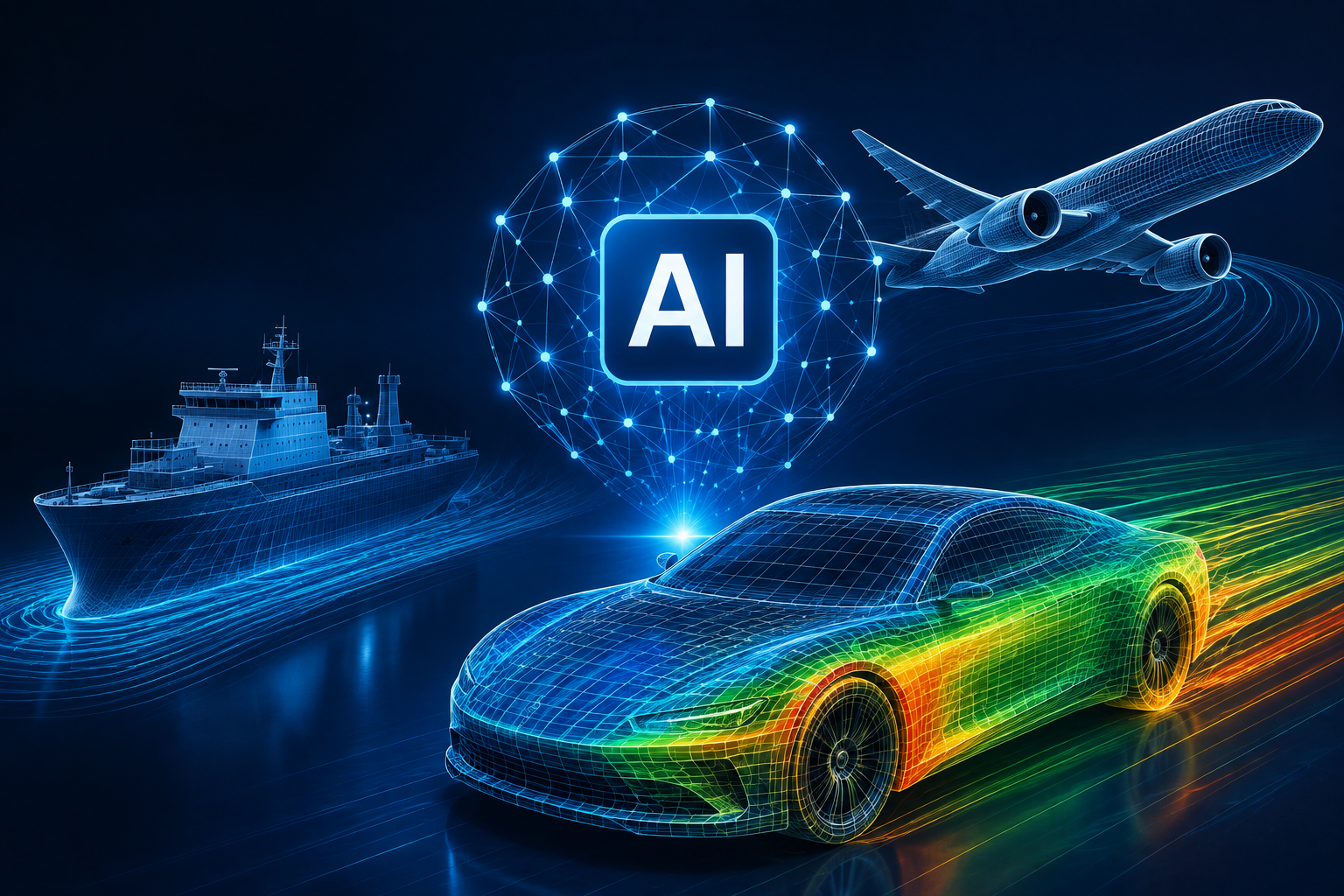
Artificial intelligence is moving beyond language, images and software development into a more difficult domain: physics simulation. This shift is part of a broader expansion of AI into scientific and engineering workflows, where models are increasingly being used for research, simulation and complex technical tasks. Researchers are now exploring whether AI models can learn reusable representations of physical systems and reduce the enormous computational and data costs associated with traditional simulation.
One of the latest approaches is GeoPT AI physics simulation, a unified pre-trained model designed to make neural simulation more scalable and data-efficient.
What Is GeoPT AI Physics Simulation?
GeoPT is a pre-trained model for general physics simulation. Its central objective is to solve one of the biggest challenges facing neural simulators: the high cost of producing high-fidelity physics data.
Traditional engineering simulations can generate highly detailed information about how physical systems behave, but producing this data can require substantial computational resources. Neural simulators offer another possibility. Instead of calculating every physical process directly, they learn relationships from simulation examples and use those learned patterns to make predictions.
The problem is that training a separate neural simulator for every new physics problem can require large quantities of task-specific data.
GeoPT takes a foundation-model-style approach.
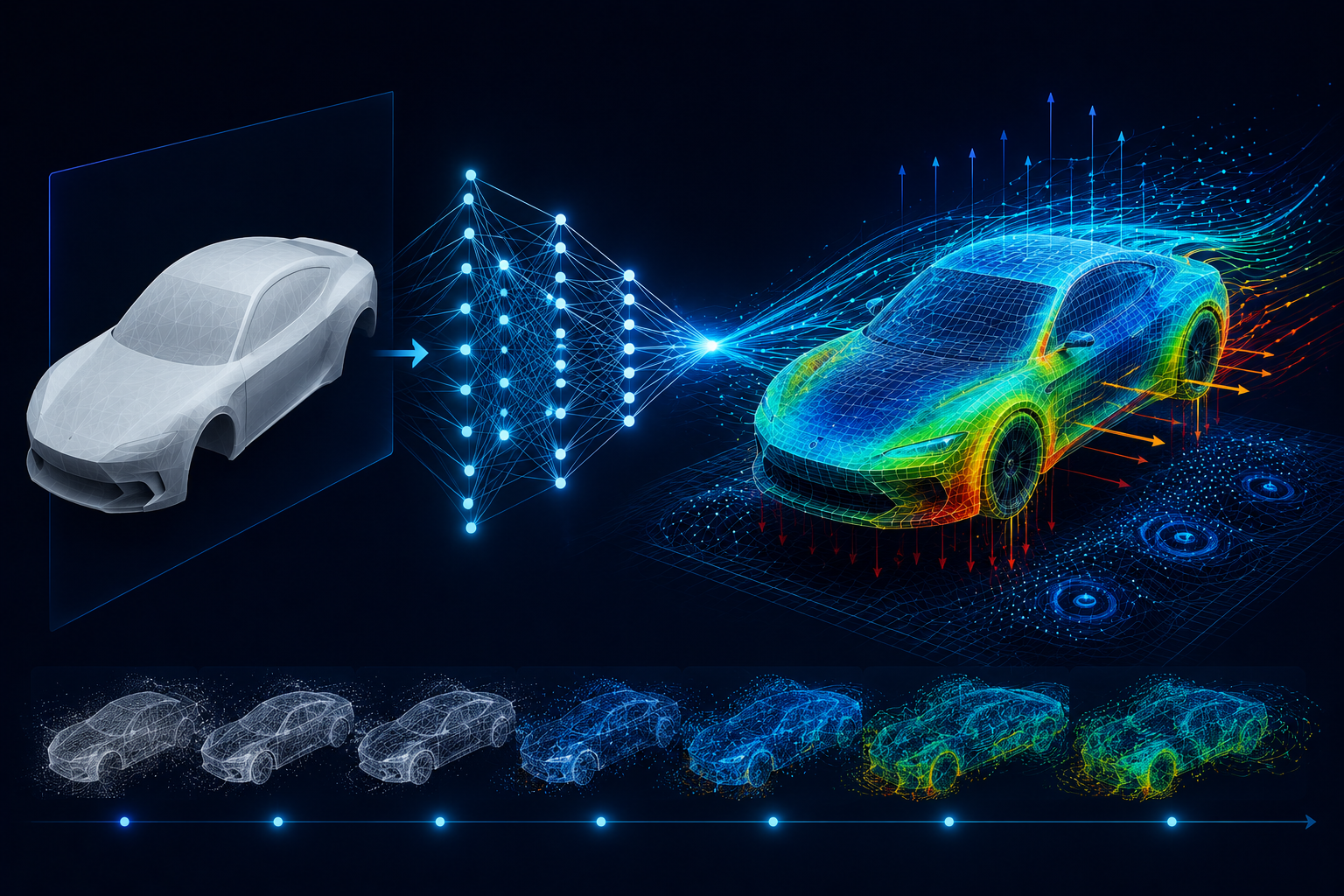
Rather than starting from scratch for every downstream problem, it first learns a reusable representation from large-scale geometric data augmented with synthetic dynamics. The resulting model can then be adapted to different physics tasks.
This makes GeoPT part of a broader movement toward AI foundation models for physical systems, where pre-training is used to transfer knowledge between related engineering problems. A similar direction is emerging in scientific workflows through AI agents for science, which explore how AI can connect research, analysis, simulations and experimentation.
How Does GeoPT Improve Neural Physics Simulation?
The main challenge is the gap between geometry and physics.
A geometric model can learn what an object looks like or how its structure is represented. But knowing an object’s shape does not automatically tell an AI system how that object behaves when exposed to pressure, airflow, forces, deformation or other physical conditions.
The GeoPT researchers describe this as a fundamental limitation of geometry-only pre-training.
Their solution is lifted geometric pre-training.
Instead of treating geometry as static information, GeoPT augments it with synthetic dynamics. This gives the model additional information about how physical systems can evolve while avoiding the need for expensive physics labels during pre-training.
In practical terms, GeoPT attempts to teach an AI model two related concepts:
- what a physical structure looks like;
- how that structure can behave dynamically.
That combination creates a more useful representation for downstream simulation.
What Is Lifted Geometric Pre-Training?
Lifted geometric pre-training is the central idea behind GeoPT.
Traditional geometric pre-training operates primarily in what the researchers call the geometric or native space. The model can learn useful structural information, but static geometry does not directly contain information about physical dynamics.
GeoPT therefore introduces a dynamics-lifted space.
Synthetic dynamics are added to geometric information so that the model can perform dynamics-aware self-supervised learning without requiring expensive physics labels for every pre-training example.
This distinction is important.
Imagine an AI system receiving the three-dimensional geometry of a vehicle. Geometry-only training can help the model understand the vehicle’s structure. But engineering simulation requires much more: airflow, pressure, forces and other dynamic behavior.
By introducing synthetic dynamics during pre-training, GeoPT aims to build representations that are more useful when the model is later fine-tuned for actual physics simulation tasks.
The project’s authors report that their approach can generate millions of training samples in days and describe this process as dramatically faster than conventional physics supervision.
How Much Data Was GeoPT Trained On?
The GeoPT research reports more than one million pre-training samples.
That scale matters because pre-training is only useful when enough diverse information is available for a model to learn reusable patterns.
Physics simulation can involve different geometries, physical conditions, materials and dynamic behaviors. A larger pre-training corpus gives the model more opportunities to encounter structures and relationships that can transfer to downstream tasks.
However, the important innovation is not simply the number of samples.
The researchers’ goal is to generate large quantities of useful pre-training data without requiring every example to come from expensive, high-fidelity physics simulation.
That distinction makes GeoPT’s approach particularly relevant to the economics of AI-based engineering.
How Does GeoPT Compare With Traditional Numerical Solvers?
Traditional numerical solvers and neural simulators approach physics from fundamentally different directions.
Numerical solvers use mathematical equations, discretization methods and numerical algorithms to calculate physical behavior. They remain essential throughout engineering and scientific computing because they provide a principled way to approximate solutions to physical equations.
Neural simulators work differently. They learn patterns from data and attempt to approximate physical behavior through a trained model.
Neither approach automatically replaces the other.
GeoPT is better understood as a complementary AI approach rather than a universal replacement for numerical methods.
A traditional solver may be used to generate reliable simulation data. A neural model can then learn from that information and potentially provide faster predictions for repeated calculations or design exploration.
This is similar to the broader movement toward hybrid AI systems, where machine learning works alongside established computational methods rather than eliminating them entirely.
For a broader view of the technologies shaping practical AI adoption, the top 100 AI tools in 2026 covers models and platforms being used across research, development, productivity and business workflows.
What Did GeoPT Test?
The research evaluated GeoPT across several industrial-fidelity physics simulation benchmarks.
The reported applications include fluid mechanics for cars, aircraft and ships, along with solid mechanics for crash simulation.
This is important because these tasks represent different physical problems.
Vehicle Fluid Mechanics
Vehicle simulation can require detailed modeling of how air moves around a car.
A neural simulator that can provide useful predictions more efficiently could help engineers explore more vehicle designs during early development.
Instead of relying exclusively on expensive high-fidelity calculations for every variation, an AI model could potentially be used to narrow the design space before detailed validation.
Aircraft Simulation
Aircraft aerodynamics presents another demanding fluid-mechanics problem.
Airflow around an aircraft depends heavily on geometry and operating conditions. A reusable physics representation could potentially make it easier to adapt models to different aircraft geometries and simulation settings.
The GeoPT benchmark results suggest that its pre-trained representation can transfer across different industrial fluid-mechanics tasks rather than being limited to one specific object category.
Ship Simulation
Ship geometries create another test for fluid simulation.
The inclusion of ships alongside cars and aircraft is significant because the physical environment and geometry differ substantially. Testing across these domains helps evaluate whether the model is learning broadly useful representations instead of memorizing one narrow simulation task.
Crash Simulation
GeoPT was also evaluated on solid mechanics involving crash simulation.
Crash modeling requires understanding how structures respond to forces and deformation. AI-based approximations could eventually support faster design iteration, allowing engineers to investigate more configurations before conducting detailed validation.
However, safety-critical engineering cannot depend solely on an unvalidated neural prediction. Any practical deployment would still require rigorous comparison with trusted simulation methods and, where appropriate, physical experiments.
Can GeoPT Reduce Physics Simulation Data Requirements?
One of the strongest reported findings is GeoPT’s reduction in downstream labeled-data requirements.
According to the research, GeoPT reduced labeled training-data requirements by 20% to 60% across diverse physics simulation tasks.
This matters because labeled physics data is expensive.
In machine learning, collecting additional examples can sometimes be relatively straightforward. In engineering simulation, however, producing a high-quality example may involve a computationally intensive numerical simulation.
If a pre-trained model can reach similar performance with substantially less labeled data, the overall cost of developing task-specific neural simulators could fall.
The research also reports approximately 2× faster convergence, meaning the downstream model can reach useful performance more quickly during training.
Together, data efficiency and faster convergence are important because they address two major bottlenecks in neural simulation: the amount of expensive supervision required and the time needed to train downstream models.
Why Synthetic Dynamics Matter
The most interesting aspect of GeoPT is arguably not the size of its dataset but how the dataset is created.
Static geometry is relatively abundant compared with high-fidelity physics supervision. Engineers and designers already work with enormous quantities of CAD and geometric information.
The difficulty is converting that geometric information into useful physics knowledge.
GeoPT’s approach is to augment geometry with synthetic dynamics during pre-training.
The model can therefore learn relationships in a dynamics-aware representation without requiring every pre-training example to have expensive ground-truth physics labels.
The project’s official description says this strategy is designed to bridge the geometry-physics gap.
That idea could become increasingly important as researchers attempt to build general-purpose models for physical environments.
What Could GeoPT Mean for Engineering?
The potential impact extends beyond a single benchmark.
Engineering teams frequently need to evaluate many possible designs before choosing a final candidate. Running high-fidelity simulation for every possibility can become a major computational bottleneck.
A sufficiently accurate neural simulator could act as a fast approximation during exploration.
For example, an engineer might use an AI model to evaluate hundreds or thousands of preliminary designs and then apply high-fidelity numerical simulation to a smaller group of finalists.
This does not mean AI eliminates physics-based simulation. Instead, it could change where expensive simulation is used in the workflow.
The same concept could eventually apply to robotics, industrial equipment, materials engineering and other areas where repeated physical prediction is valuable. This also connects with the wider push toward AI research automation, where AI systems are being explored for literature analysis, hypothesis generation, simulations and scientific workflows.
These remain potential applications rather than claims that GeoPT has already solved those domains.
GeoPT and the Rise of Physics Foundation Models
GeoPT reflects a larger shift in AI research.
Early neural simulators were often designed for specific tasks. A model might be trained for one physical system, one geometry family or one type of simulation.
Foundation-model research asks whether a single pre-trained representation can support many downstream applications.
This approach has already transformed language and computer vision. GeoPT explores whether a similar strategy can work for physics simulation.
The model’s reported generalization across fluid and solid mechanics is therefore particularly relevant. The GeoPT model card states that its dynamics condition can be reconfigured as a form of prompt to generalize across different physical systems.
If this direction continues to scale, future physics models could potentially become reusable infrastructure for engineering software rather than isolated neural networks.
What Are GeoPT’s Limitations?
GeoPT is promising, but it should not be treated as a universal physics engine.
A neural simulator is still a learned approximation. Its predictions can be affected by the training distribution, geometry, physical conditions and the degree to which a new problem resembles what the model has seen.
This is especially important for engineering applications.
A model can perform well on benchmark data while still producing errors in unusual conditions. Safety-critical systems require much stronger validation than an ordinary prediction task.
There is also a computational cost associated with pre-training. Although GeoPT is designed to make pre-training more scalable, building large models and generating millions of synthetic training examples still requires computing resources.
The official GeoPT materials make the case for scalability, but they do not imply that numerical solvers have become obsolete.
Is GeoPT Better Than Numerical Solvers?
The better question is whether GeoPT and numerical solvers can work together.
Numerical methods provide the physical foundation and can generate trusted reference data. Neural models can learn from those simulations and potentially accelerate repeated predictions.
A hybrid workflow could therefore look like this:
- Use numerical methods to generate high-quality reference simulations.
- Pre-train an AI model using large-scale geometric and synthetic dynamic data.
- Fine-tune the model using a smaller quantity of task-specific labeled data.
- Use the neural simulator for rapid design exploration.
- Validate important results using high-fidelity numerical simulation or physical testing.
This approach preserves the strengths of both technologies.
It also reflects a realistic path toward AI-assisted engineering: use machine learning where it provides speed and scalability while retaining established simulation methods where accuracy and validation are critical.
Why GeoPT Matters for AI Physics Simulation
GeoPT’s significance comes from its attempt to solve a fundamental scaling problem.
AI physics simulation needs data, but high-quality physics data can be expensive. Simply increasing the amount of supervised simulation data may not be a sustainable strategy.
GeoPT instead asks whether researchers can exploit abundant geometric data and add synthetic dynamics to create useful self-supervised training signals.
The reported results suggest that the strategy can work across multiple industrial-fidelity benchmarks, with 20–60% lower labeled-data requirements and roughly 2× faster convergence.
That does not make GeoPT a finished replacement for traditional computational physics. It does, however, provide evidence that pre-trained models could become an important component of future simulation pipelines.
The project has also released pre-trained models and related resources, making the research more accessible for further experimentation.
The Future of AI-Powered Physics Simulation
The long-term opportunity is larger than faster simulation alone.
If physics foundation models become capable of transferring knowledge between geometries, materials and physical regimes, they could become a new layer inside engineering software. That possibility fits into the larger evolution from standalone models toward AI systems that coordinate multiple capabilities and tools.
Designers could potentially use AI models to explore concepts rapidly, identify promising configurations and determine which candidates deserve expensive high-fidelity simulation.
Researchers could also combine these models with CAD systems, optimization algorithms and conventional numerical solvers.
GeoPT represents an early step in that direction.
Its key contribution is the idea that geometry alone is not enough for physics pre-training. By lifting geometry with synthetic dynamics, the researchers attempt to create a representation that understands not only structure but also physical evolution.
The reported results across cars, aircraft, ships and crash simulation make the approach particularly interesting for engineering AI.
The next challenge will be determining how reliably such models can generalize beyond benchmark conditions and how effectively they can integrate into real engineering workflows.
For now, GeoPT provides a compelling example of how AI research is expanding from generating digital content to learning the behavior of physical systems. It also sits within a wider wave of AI-for-science research, including recent work on automating scientific discovery and building AI agents for research workflows.
As neural simulation develops, the most practical future may not be AI versus numerical physics. It may be AI working with numerical physics to make engineering simulation faster, more scalable and more data-efficient.