

In 2026 Devin AI remains one of the most discussed and controversial AI development tools marketed as an autonomous software engineering assistant capable of planning, coding, debugging, refactoring, and completing engineering tasks with minimal human intervention. The platform positions itself as a next-generation AI “software engineer” designed to relieve developers of routine work and accelerate complex development workflows by interpreting natural language instructions, executing code, and integrating with developer systems.
Devin AI is developed by Cognition Labs, an AI research and development company focused on building advanced autonomous AI agents. The company is privately held and led by a team including founder Scott Wu, and Devin represents their flagship product in the AI software engineering category. Cognition Labs has raised venture funding and positioned Devin AI as a strategic innovation in how software could be built with AI collaboration rather than purely human engineering effort.
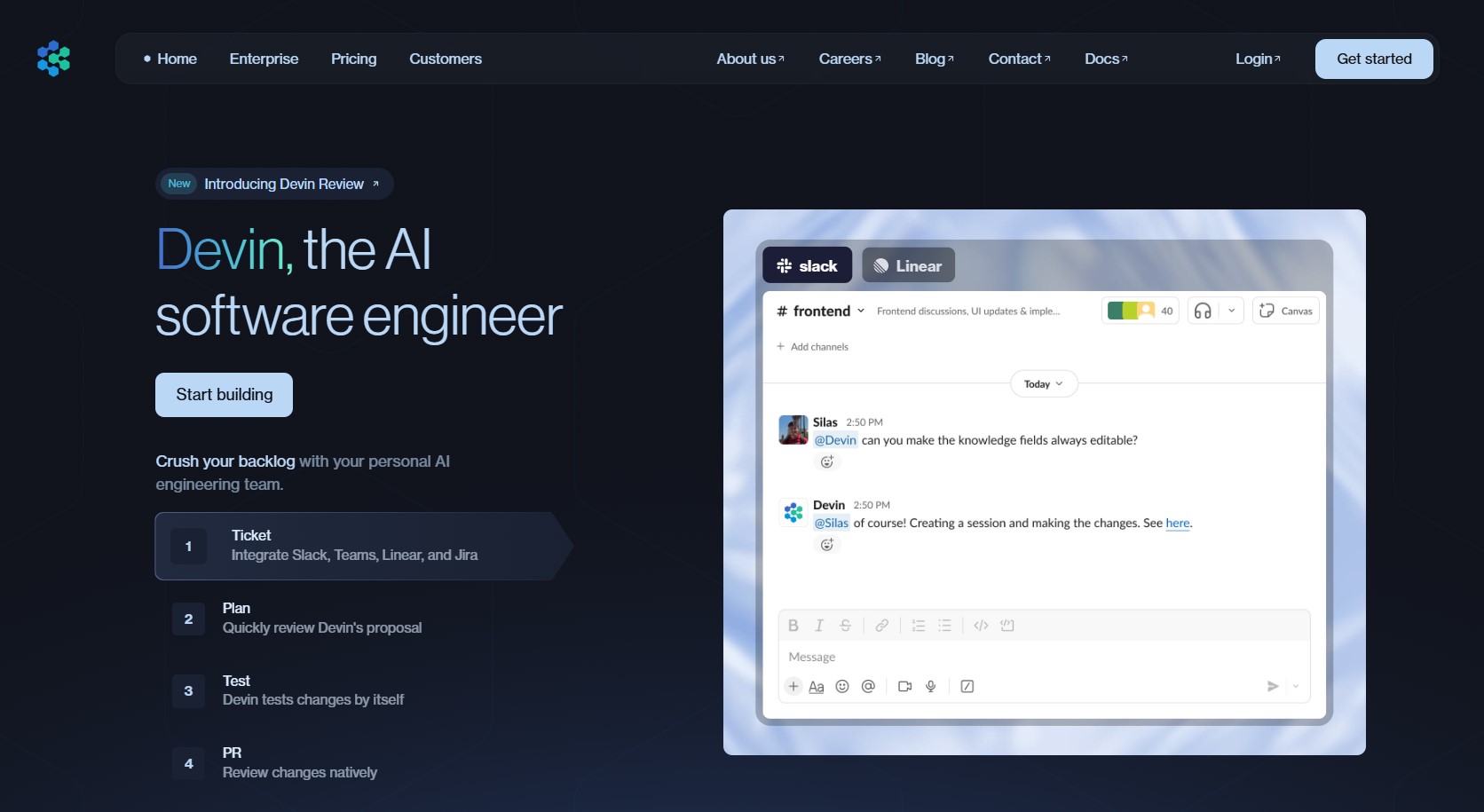
At its core, Devin AI operates as a multi-agent AI system that combines language understanding, code execution environments, autonomous planning, and context retention across complex repositories. Unlike typical AI coding assistants that only suggest snippets or completions, Devin runs within a secure sandbox with its own shell, code editor, and browser, allowing it to parse tasks, read documentation, execute code, interpret errors, and iteratively refine output without constant back-and-forth from users. It integrates with common developer tools such as GitHub, Jira, Slack, and Linear, enabling task assignment, automated pull request creation, debugging workflows, and natural language communication across daily development pipelines.
In practical terms, users give Devin a ticket, bug description, feature request, or repository context, and Devin autonomously breaks the task into actionable steps, implements code, runs tests, identifies failures, and revises until it meets defined goals. Newer versions in 2026 emphasize dynamic re-planning, self-healing code generation, and the ability to migrate legacy codebases to modern languages while preserving business logic — capabilities that mark a significant evolution over early prototype agents.
Real-world use cases in 2026 include automated backlog reduction, codebase refactoring and modernization, feature prototyping from plain language specs, and bug triage with test-driven fixes. Large engineering organizations leverage Devin to cut down repetitive technical debt tasks, accelerate release cycles, and allow senior engineers to focus on architecture, design, and strategic problem-solving rather than routine implementation tasks. Ai tools like Devin are also used in data engineering migrations, ETL restructuring, and integration work where pattern-based modifications are high in volume.
Devin AI’s pricing in 2026 reflects its enterprise orientation and the computational resources required. The platform typically offers a Core plan starting at around $20 per month with pay-as-you-go compute credits called Agent Compute Units (ACUs), which measure the workload for planning, execution, debugging, and context gathering. For teams, a Team plan at about $500 per month includes a fixed pool of ACUs and access to the Devin API for automation and integration. Larger organizations can negotiate Enterprise plans with custom pricing, enterprise-grade security features, single sign-on, VPC deployment, and tailored support. The ACU model means costs scale with usage, and overages are charged per unit beyond the included monthly allotment.
Compared to competitors, Devin AI sits between lightweight AI assistants (like GitHub Copilot or generic LLM-based coding extensions) and heavier enterprise developer automation platforms. GitHub Copilot, Tabnine, and Amazon CodeWhisperer focus on code completions and context-aware suggestions, while Devin aims for autonomy and execution beyond suggestions. This makes Devin more expensive and resource-intensive, but also potentially more powerful for end-to-end tasks. Alternatives like Cursor, Cline, and multi-agent frameworks often outperform Devin in specific workflows or offer more predictable pricing for smaller teams, making Devon’s value proposition stronger for established engineering teams with recurring complex tasks.
Who should use Devin in 2026? The tool is best suited for medium and large engineering teams, software product companies, and organizations with complex codebases or heavy legacy modernization needs. It can accelerate routine developer work, enforce consistency across large repositories, and reduce turnaround time on ticket-based engineering. By contrast, individual developers, hobbyists, or small teams with modest workloads may find simpler AI assistants more cost-effective and easier to adopt, given Devin’s higher costs and learning curve.
Devin’s strengths include its ability to operate autonomously within engineering workflows, integrate deeply with developer ecosystems, plan and execute tasks end-to-end, and manage complex refactors or migrations. Its limitations revolve around predictable cost due to ACU usage, the real-world efficacy on very complex tasks (which can still require substantial human oversight), and variability in output quality reported in community and user discussions. Some engineers note that Devin’s performance on nuanced or highly architectural tasks often falls short of senior human developers and that context management across large, dynamic repositories can be imperfect.
In business and team environments, Devin is increasingly embedded into agile workflows where automation of routine coding tasks and integration with collaboration tools reduces friction in development cycles. Teams set up Devin agents to monitor backlog tickets, automate CI/CD steps, generate initial implementations for common patterns, and maintain documentation in parallel with code updates, enhancing both velocity and traceability.
In the 2026 AI landscape, Devin matters because it exemplifies the push toward autonomous software engineering tools that move beyond suggestion-based coding to actual execution and task completion. Its development illustrates how AI can take on increasingly complex engineering workloads while working alongside teams, even if full autonomy remains aspirational and subject to oversight and refinement.
Final verdict: Devin AI represents a meaningful step toward next-generation AI assistance in software engineering. It offers powerful capabilities for teams managing large or complex codebases and repetitive tasks, with a pricing model and integration suite targeted at professional environments. However, its effectiveness is context-dependent, and prospective users should weigh the costs, the ACU-based consumption model, and the realistic limitations in complex, creative engineering tasks against their specific development needs.