
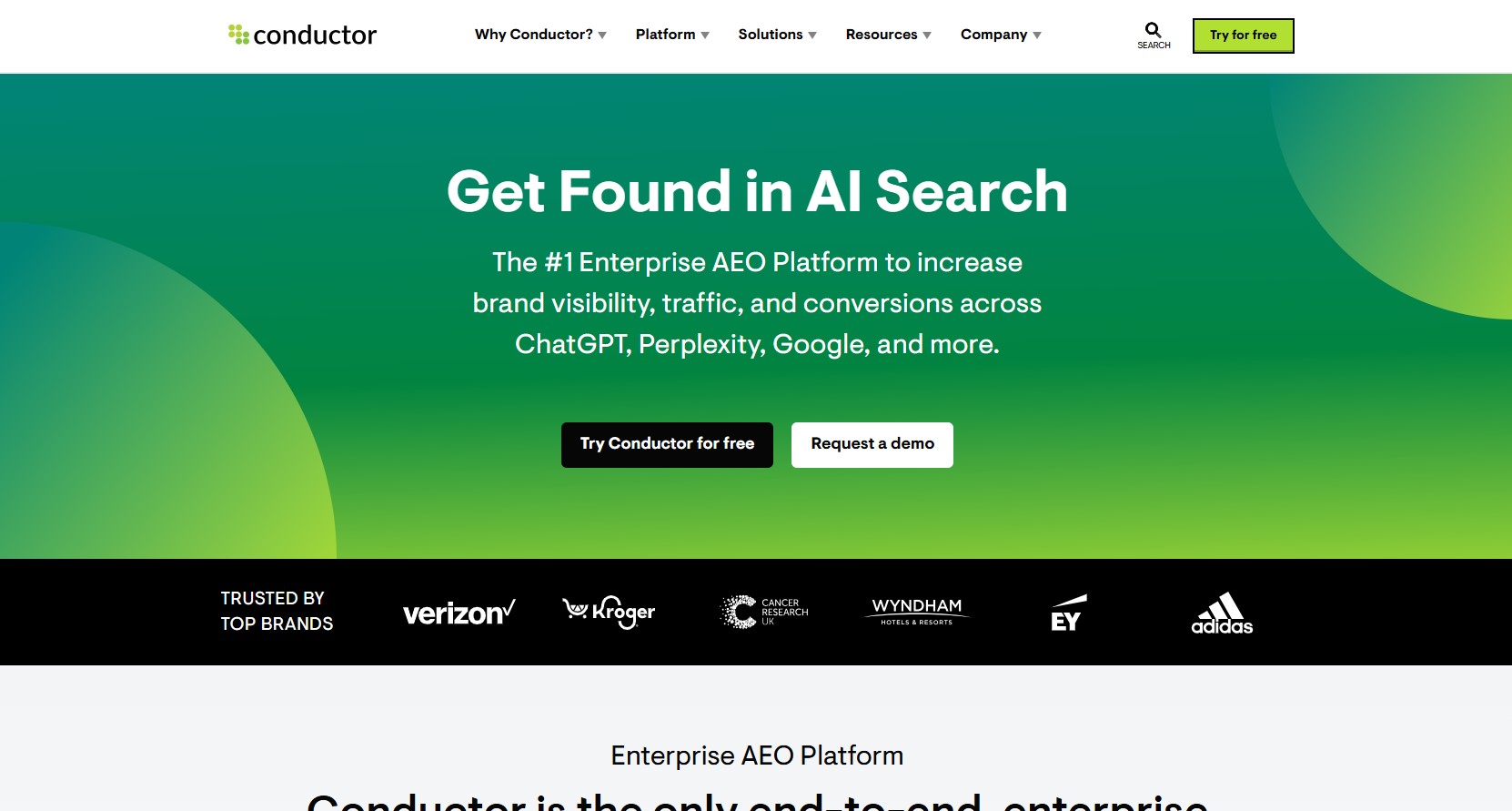

What Conductor AI is and what problem it solves in 2026
Conductor AI is the enterprise-grade artificial intelligence layer within the Conductor digital marketing and organic visibility platform, designed to help large organizations win visibility and engagement across both traditional search engines (SEO) and AI-driven discovery surfaces like generative answer engines (AEO/GEO). Instead of treating search optimization and content production as separate tasks, Conductor AI unifies content strategy, AI visibility tracking, technical performance monitoring, and competitive insights into a single data-driven workflow — critical as discovery moves beyond links and rankings to answer-level surfaces where AI models determine which brands and knowledge sources are surfaced first.
Who owns Conductor AI and the company behind it
Conductor AI is built by Conductor, Inc., a privately held enterprise SEO and organic marketing technology company headquartered in New York with global reach. Conductor has focused on large-scale visibility optimization and digital marketing intelligence for years, and its 2020s strategy centered on owning how enterprises track and grow their presence across both search engine results and AI answer experiences. The platform is widely used by global brands and large marketing teams that need unified data and intelligent workflows across digital discovery channels.
How Conductor AI actually works
Conductor AI uses retrieval-augmented generation (RAG) combined with Conductor’s proprietary dataset of search, audience, content performance, and technical signals to produce contextual insights, automated recommendations, and high-performance content guidance. It builds an AI Topic Map that clusters a brand’s authority across topic spaces, surfaces content gaps, and prioritizes where investment will have the most impact. Conductor’s Writing Assistant generates personalized, SEO-aligned content and outlines based on deep intent and performance data. Content Profiles and Knowledge Sources ground generation in brand-specific voice and expertise. Conductor also measures AI visibility — including mentions, citations, and discoverability in generative answer engines — and provides automated link suggestions and real-time monitoring of AI crawler activity to ensure content can be properly indexed by both traditional bots and AI systems.
Real-world use cases and how professionals use it today
In enterprise environments, Conductor AI is used to map content authority, uncover opportunities for growth, and unify SEO with AEO (Answer Engine Optimization) workflows. Content strategists use it to identify topic gaps and create outlines that target both search rankings and AI answer relevance. SEO teams measure how brands are discovered and cited in ChatGPT, Perplexity, and other LLM-based surfaces and adjust priorities accordingly. Technical teams monitor website health around AI crawler visits, while digital and content teams connect optimization efforts to ROI with built-in performance and visibility reporting. Conductor is increasingly positioned as a system of record for AI visibility and organic growth for large brands.
Current pricing plans in 2026
Conductor AI does not have publicly listed fixed pricing like mainstream SaaS tools; instead, its pricing is enterprise-customized based on scale, data volume (e.g., number of URLs and domains tracked), feature depth, and support needs. Typical enterprise engagements range from tens of thousands to mid-five-figure or higher annual contracts depending on organization size and goals, with value-based pricing aligned to business outcomes rather than rigid quotas. A free trial period (typically a few weeks) is often available to evaluate visibility and insights before a tailored agreement is finalized.
How pricing compares to competitors
Compared with all-in-one marketing suites (e.g., Semrush, Ahrefs), Conductor’s pricing is positioned toward enterprise customers with more complex visibility and reporting demands. Its custom model often results in higher total cost of ownership, but for organizations that need deep AI visibility, cross-channel reporting, and enterprise-grade security and compliance (including ISO 42001 and SOC 2 certifications), the investment is framed around value delivered rather than seat limits. This contrasts with more transparent tiered pricing found in lightweight SEO tools, which may serve smaller teams better but lack deep AI search intelligence and robust enterprise workflows.
Who should use Conductor AI and who should not
Conductor AI is best suited for enterprise SEO teams, global brands, digital marketing leaders, and agencies with multi-domain, multi-market visibility goals and the need to track presence across both traditional search and AI answer engines. It’s ideal where content scale, cross-functional collaboration, advanced reporting, and real-time performance measurement drive ROI decisions. Smaller businesses, startups, or solo content marketers with limited budgets, lighter visibility needs, or a focus strictly on basic SEO may find simpler, lower-cost tools with transparent pricing more appropriate.
Strengths, limitations, and realistic drawbacks
Among Conductor AI’s strengths are its data-driven AI insights grounded in real search and performance signals, personalized content generation that respects brand voice and compliance, and enterprise-grade monitoring and reporting across AI discovery surfaces and traditional search. It also provides strong integration workflows and the ability to measure brand visibility at the answer level. Limitations include complex pricing that requires sales negotiation, a steeper learning curve for teams new to unified visibility platforms, and the fact that its depth is most beneficial only at enterprise scale — smaller teams may not fully leverage its breadth. Some users also note that while AI recommendations are powerful, they still require editorial and strategic oversight to maximize effectiveness.
How Conductor AI is being used in businesses and teams
Conductor AI is woven into quarterly and monthly planning cycles where teams assess performance across search and AI discovery layers, align content production with identified gaps, and adjust technical priorities based on crawler behavior trends. Organizations use its monitoring to preempt issues before they impact visibility, analyze competitive share in generative answer engines, and tie SEO and AEO contributions to traffic, conversions, and revenue metrics. Sales, product, and communications teams also feed Conductor insights into broader digital strategies, making it a central hub for visibility intelligence across departments.
Why Conductor AI matters in the AI landscape in 2026
By 2026, the landscape of discovery has expanded beyond the classic “10 blue links” to include AI-generated answers, conversational interfaces, and generative summaries that shape user behavior before a click occurs. Conductor AI matters because it tackles this shift head-on by offering visibility tracking, topic authority mapping, and performance measurement across both traditional and AI search surfaces, helping brands *understand not just where they rank but where and how they are seen in AI responses. Its unified data engine and enterprise workflows reflect how modern SEO must evolve to influence outcomes across multiple discovery layers rather than singular ranking metrics.
A concise final verdict written like a human expert
Conductor AI in 2026 is a comprehensive enterprise visibility and search intelligence platform built to help organizations succeed in a hybrid discovery world where traditional SEO and AI-driven answer engines intersect. Its strength lies in combining deep data, AI-augmented content strategy, and visibility measurement that spans search and generative AI surfaces. However, its enterprise focus, custom pricing, and complexity make it most appropriate for well-resourced teams with broad visibility goals rather than smaller operations. For enterprises seeking to unify SEO, AI visibility, and content strategy with measurable business impact, Conductor AI offers a powerful, future-ready toolkit that goes beyond standalone point solutions.