
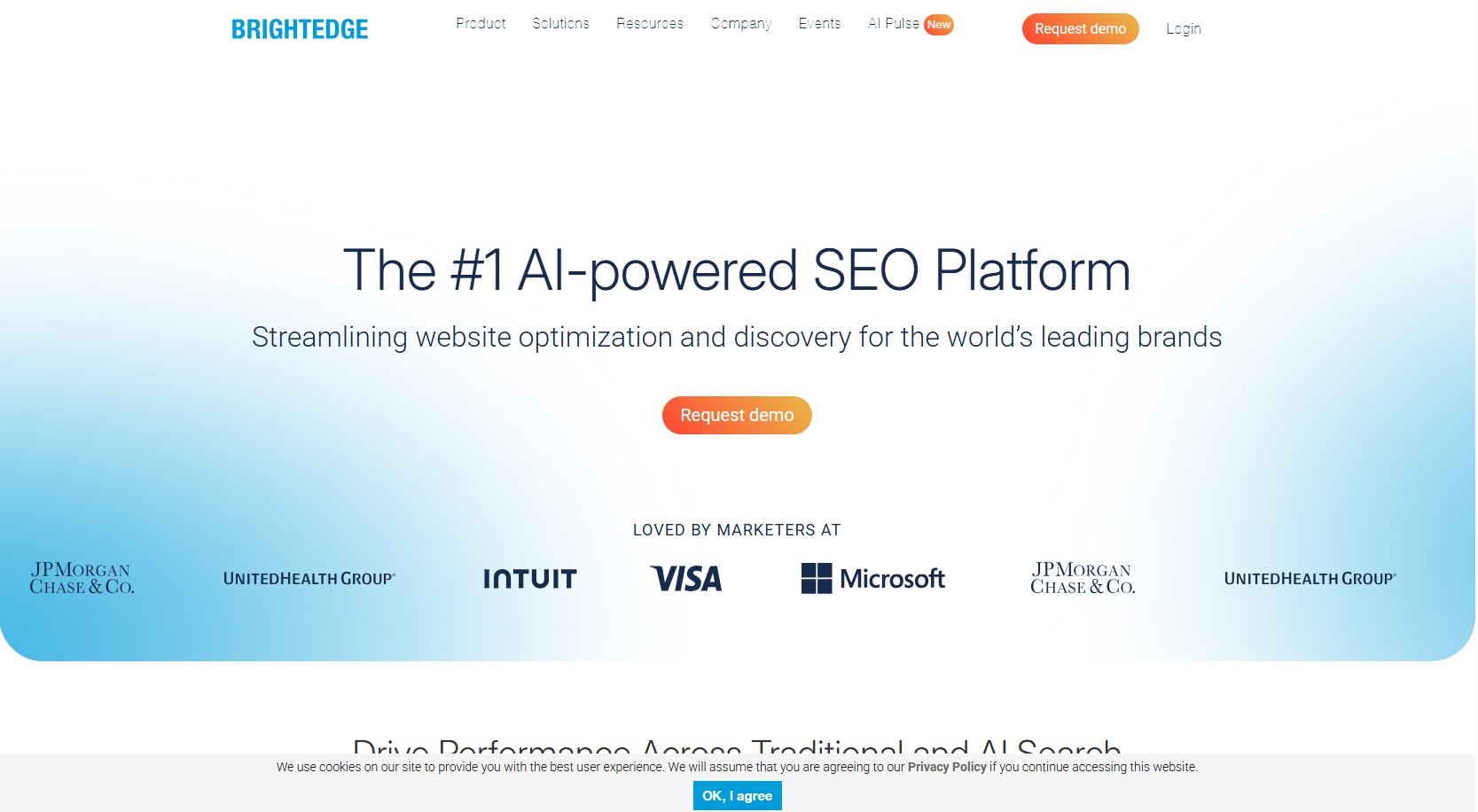

What BrightEdge AI is and what problem it solves in 2026
BrightEdge AI refers to the artificial-intelligence-enhanced features built into the BrightEdge Enterprise SEO and digital visibility platform, designed to help large brands and enterprise marketing teams plan, optimize, and scale organic search and content performance across both traditional search engines and emerging AI-driven discovery channels. Rather than just offering raw data, BrightEdge uses AI to automate analysis, suggest optimization actions, generate SEO-aligned content drafts, forecast performance, and continuously adapt recommendations as search behavior evolves. This matters in 2026 because SEO has expanded beyond simple ranking tracking: teams must now optimize for AI Overviews and generative search surfaces where content relevance, intent alignment, and technical health determine visibility and engagement.
Who owns BrightEdge AI and the company behind it
BrightEdge is developed and marketed by BrightEdge, Inc., a privately held enterprise SEO technology company that has focused on large-scale organic search and content performance since its founding. The platform combines deep data infrastructure with AI-driven modules like Copilot, Autopilot, ContentIQ, and AI Catalyst to support multi-team workflows across technical SEO, content strategy, and competitive analysis. BrightEdge continues to serve hundreds of large global brands and agencies, emphasizing scalability, governance, and integration with enterprise analytics stacks.
How BrightEdge AI actually works
BrightEdge AI is layered throughout the platform. Its Copilot feature uses generative AI to analyze page context, keyword intent, and competitive benchmarks, then propose SEO-optimized title tags, meta descriptions, content outlines, and on-page recommendations based on real search demand and intent patterns. Autopilot goes further: once rules are set, it automates SEO optimizations at scale across large swaths of pages, reducing reliance on manual processes or developer cycles. ContentIQ audits site health at scale and surfaces priority issues, while AI Catalyst tracks how a brand and its content appear across AI search surfaces like generative answer boxes and conversational engines — a signal increasingly crucial in modern discovery. Under the hood, BrightEdge ingests billions of data points, historical context, and real-time SERP behavior to power these AI insights and actions.
Real-world use cases and how professionals use it today
Enterprise SEO teams use BrightEdge AI to streamline cross-functional optimization workflows. Content strategists generate and refine content drafts aligned to user intent and ranking opportunities without exporting data to external tools. Technical SEO specialists run large-scale audits and use prioritized AI recommendations to coordinate fixes across development and editorial teams. Marketing operations groups integrate BrightEdge data into dashboards for executive reporting, linking SEO activity to business outcomes like traffic, leads, or revenue. Many teams deploy Autopilot to continuously optimize hundreds of thousands of pages, reducing time-to-impact and freeing analysts to focus on strategy rather than routine updates.
Current pricing plans in 2026
BrightEdge does not list fixed pricing publicly; it operates on a custom enterprise pricing model tailored to customer size, tracked keywords, domains, data volume, and feature set. Enterprise contracts often include onboarding, strategic support, and access to AI modules. Based on market analyses and real world patterns, typical annual spends range from several thousand dollars per month for smaller enterprise deployments (~$3,000+) to mid-five-figure annual contracts or higher for global, multi-site programs, depending on scale and add-ons. These quotes can escalate significantly for larger keyword volumes, API access, advanced reporting, or international markets.
How pricing compares to competitors
Compared with tools like Semrush, Ahrefs, or Conductor that publish straightforward tiered subscriptions, BrightEdge’s custom enterprise pricing is generally higher and requires sales engagement. Competitors with transparent plans appeal to small and mid-sized teams, whereas BrightEdge targets large organizations that treat SEO as a strategic, cross-channel initiative and require dedicated support, governance, and integration capabilities. The enterprise contracts often include strategic consulting, training, and quarterly business reviews, which justify premium pricing for large teams but place it beyond the budgets of smaller teams.
Who should use BrightEdge AI and who should not
BrightEdge AI is best suited for enterprise marketing teams, global brands, agencies with complex cross-market needs, and organizations with deep SEO investments. It’s particularly valuable where volume, governance, and integration — across CMS, analytics, and reporting stacks — matter. It’s less appropriate for solo SEO practitioners, startups, or small businesses with limited budgets or straightforward SEO needs; tools with simpler pricing and fewer dependencies may offer better ROI for those users.
Strengths, limitations, and realistic drawbacks
Strengths of BrightEdge AI include enterprise-scale data coverage, integrated AI automation (Copilot and Autopilot), large-site auditing (ContentIQ), advanced reporting, and multi-team workflow supports. It helps teams automate repetitive tasks, derive prioritized insights, and act on real-time signals. Limitations include opaque pricing, steep learning curve, and resource intensity — both budgetary and operational — often requiring dedicated SEO analysts and strategic alignment to fully leverage the platform. Some teams report longer procurement and onboarding cycles.
How BrightEdge AI is being used in businesses and teams
In practice, BrightEdge AI is woven into monthly planning and execution cycles. Teams use Copilot to draft SEO changes, Autopilot to apply scaling optimizations, and ContentIQ to monitor site health trends. Cross-functional teams use StoryBuilder and custom dashboards to report SEO impact to executives and align initiatives with broader marketing and revenue goals. Enterprises integrate BrightEdge with analytics platforms (e.g., GA4, Adobe Analytics, Search Console) to unify SEO signals with broader performance metrics. These workflows help teams judge the business impact of SEO actions rather than seeing SEO as a siloed discipline.
Why BrightEdge AI matters in the AI landscape in 2026
By 2026, visibility extends beyond traditional rankings into AI-mediated discovery, where generative answer engines and conversational search surfaces influence user behavior. BrightEdge AI matters because it not only measures traditional search performance but also helps teams understand how their content appears across AI search surfaces — a capability increasingly tied to organic value. Its integration of AI insights, automation, forecasting, and cross-platform reporting reflects the broader evolution of SEO from manual analysis to continuous, data-driven execution.
A concise final verdict written like a human expert
BrightEdge AI in 2026 is a comprehensive enterprise SEO and digital visibility platform that blends deep data, AI-driven insight, automation, and workflow management to help large organizations scale their organic performance across changing search landscapes. Its AI features — spanning content generation, automated optimization, forecasting, and AI search visibility tracking — deliver meaningful efficiency and strategic depth for teams that manage complex, multi-site SEO programs. However, its enterprise pricing, custom contracts, and resource demands make it best suited to seasoned SEO operations with dedicated analysts rather than small-team or budget-constrained use cases.