

What Brandwatch is and what problem it solves in 2026
Brandwatch is an enterprise‑grade social listening, consumer intelligence, and social media analytics platform that helps brands, agencies, and research teams monitor, analyze, and act on conversations happening across digital and social channels. It aggregates data from hundreds of millions of online sources — including social media networks, blogs, news sites, forums, and review platforms — and uses advanced AI to identify sentiment, emerging trends, anomalies, and competitive signals. Brandwatch addresses a core strategic challenge for businesses: how to understand consumer behavior, protect reputation, guide decision‑making, and optimize content and engagement strategies at scale without manually parsing massive amounts of unstructured data.
Who owns Brandwatch and the company behind it
Brandwatch was founded in 2007 by Giles Palmer in the United Kingdom and today is a subsidiary of Cision, a global leader in earned media management and PR software. Headquartered in Brighton, UK, Brandwatch operates across multiple continents with teams dedicated to product innovation, AI development, and global customer success. Its products serve large enterprises, brands, and agencies that need deep insights into public perception and competitive dynamics rather than just basic social scheduling or lightweight listening.
How Brandwatch actually works
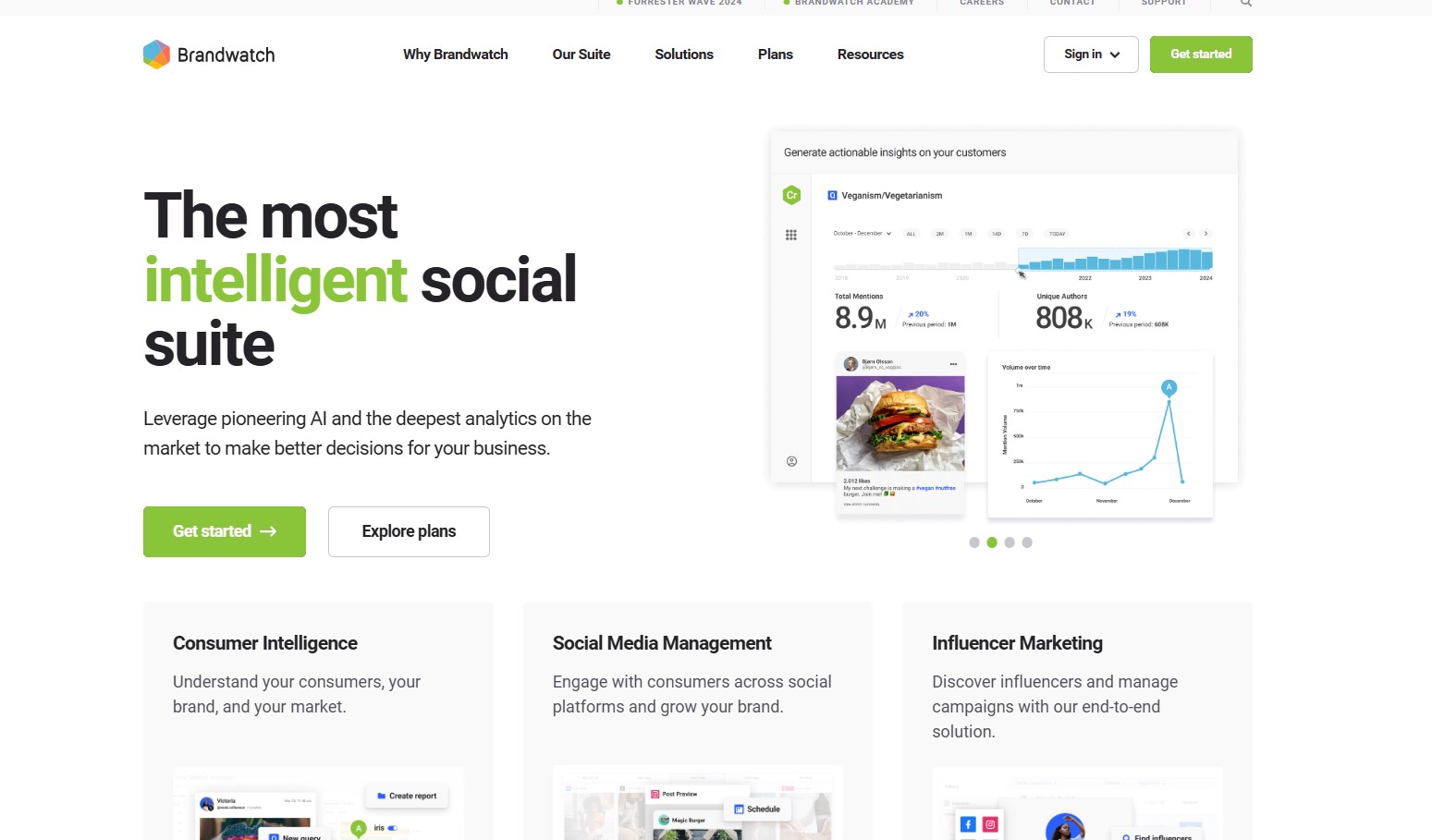
Brandwatch combines proprietary data aggregation, NLP (natural language processing), and large language model (LLM) integrations to collect and analyze signals from millions of sources in real time. Its core AI engine — Iris AI — provides conversational search capabilities, anomaly detection, sentiment breakdowns, topic and entity extraction, and contextual trend analysis. Users can build Boolean searches with automated recommendations, generate dashboards and visualizations, and drill into why spikes or shifts in discussion are happening. The platform also includes tools for predictive trend spotting, brand reputation scoring (e.g., React Score), competitive benchmarking, influencer analysis, and performance reporting. On the content side, Iris can assist with crafting social posts, replies, and campaign text based on brand tone and contextual insight.
Real‑world use cases and how professionals use it today
Teams use Brandwatch for brand reputation and crisis monitoring, detecting early warning signs of negative sentiment before they escalate into broader issues. Consumer insights and market research teams mine conversations to understand preferences, pain points, and emerging cultural trends that inform product strategy and messaging. Marketing and communications teams use it to fine‑tune social campaigns, identify the most resonant topics, and benchmark their performance against competitors. PR professionals leverage influencer and conversation data to guide outreach and measure share of voice, while analysts and executives combine Brandwatch insights with dashboards to inform board‑level strategic decisions.
Current pricing plans in 2026
Brandwatch does not publish fixed pricing on its website; instead, it uses a custom enterprise pricing model tailored to factors such as data volume (mentions and queries), number of users, modules selected (e.g., social listening, publishing, influencer marketing), and level of support required. Typical annual contract costs for mid‑sized teams and enterprises often run into the four‑figure monthly range, with many organizations spending $10,000 to $18,000+ per year depending on their configuration. Some industry benchmarks suggest $800–$5,000+ per month for different tiers, and larger enterprise commitments can scale significantly higher, often requiring negotiation via a sales process. There is no publicly offered free plan or transparent self‑serve pricing list.
How pricing compares to competitors
Compared to lightweight social schedulers and listening tools (e.g., Brand24 or Mention), Brandwatch’s pricing is enterprise‑oriented and substantially higher — reflecting its depth of data access, analytics, AI capabilities, and customization. While smaller platforms may cost tens or hundreds per month, Brandwatch’s value is in providing comprehensive consumer intelligence and 300‑million+ source coverage that is essential for large brands, agencies, and corporate research functions. Mid‑tier competitors like Sprinklr and Meltwater operate in a similar enterprise space, often with comparable costs, while simpler tools are far cheaper but also far less powerful.
Who should use Brandwatch and who should not
Brandwatch is best suited for large enterprises, global brands, PR and communications teams, and research‑oriented organizations that need deep, real‑time insights into consumer conversations, sentiment, and trends. It’s also appropriate where brand protection, crisis response, and competitive intelligence are business priorities. Smaller businesses, startups, or solo marketers with light social scheduling or basic analytics needs will likely find Brandwatch too complex and expensive for their workflows; leaner tools with clearer self‑serve pricing may be better for those use cases.
Strengths, limitations, and realistic drawbacks
Brandwatch’s strengths include massive data coverage, robust AI‑driven insights, integrated dashboards, and the ability to tie social intelligence directly to business outcomes. Iris AI’s conversational search and trend detection help reduce manual analysis time for large datasets. Limitations include a steep learning curve, potential onboarding complexity, and a custom pricing model that makes budgeting opaque for smaller teams. Some reviews point to complex interfaces and the need for longer‑term commitment with enterprise contracts that are harder to adjust month‑to‑month.
How Brandwatch is being used in businesses and teams
Within organizations, Brandwatch typically supports cross‑functional workflows: marketing and social teams use it to inform campaign messaging; customer experience teams monitor sentiment and emerging complaints; PR teams use it for reputation defense; and analytics teams feed insights into broader BI and executive dashboards. Some companies integrate Brandwatch with CRMs, content calendars, and reporting tools to align social insights with broader marketing performance. For global brands, its customizable dashboards and multi‑language support help coordinate consistent strategies across regions.
Why Brandwatch matters in the AI landscape in 2026
By 2026, AI‑augmented social intelligence and consumer analytics are core to competitive digital strategies. Brandwatch matters because it bridges raw data and actionable insights at enterprise scale, combining LLMs and proprietary AI with structured analytic tools that help teams not just see data but understand why trends and sentiment shifts occur. Its focus on real‑time insights, reputational intelligence, and strategic dashboards reflects how modern brands need to respond rapidly to social signals and incorporate them into product, marketing, and risk management decisions.
A concise final verdict written like a human expert
In 2026, Brandwatch remains a market‑leading enterprise social listening and consumer intelligence platform — exceptionally powerful for organizations that need rich, AI‑enhanced insights from massive volumes of unstructured social and web data. While its custom pricing and enterprise focus can make it less accessible for smaller teams, its AI‑driven trend detection, sentiment analysis, and reputation monitoring capabilities are unmatched in scope and depth when compared with simpler social tools. For global brands, agencies, and strategic communication teams, it offers indispensable data intelligence; for lighter social content scheduling or basic monitoring, it’s likely overkill both in features and cost.