

Artificial intelligence tools are becoming part of everyday work, helping people write code, summarize documents, analyze data, and brainstorm ideas. As AI adoption grows, so do concerns about privacy and how sensitive information is handled. Those concerns came into the spotlight after reports revealed that some shared Claude conversations could be found through Google Search, raising questions about whether Anthropic had experienced a security breach.
The discovery quickly spread across social media and technology news outlets, prompting concern among Claude users, developers, and businesses that rely on AI for daily tasks. In response, Anthropic clarified that the conversations appearing in search results were not private chats that had been hacked or leaked. Instead, they were conversations users had intentionally shared using Claude’s public sharing feature, making them eligible for indexing by search engines.
Even so, the incident has sparked a broader debate about AI privacy, user expectations, and whether AI companies should do more to prevent sensitive information from becoming publicly accessible. Here’s what happened, why it matters, and what users can learn from it.
What Happened With Claude Shared Chats?
The controversy began when users noticed that some Claude conversations were appearing in Google search results. By using specific search operators, people discovered publicly accessible Claude conversation pages that contained everything from coding discussions to business planning documents and personal notes.
The findings quickly gained attention on Reddit and other online communities, where users questioned whether Claude had suffered a major security breach.
As reports spread, technology publications investigated the issue. While the headlines suggested that “Claude chats appeared on Google,” the underlying situation turned out to be more nuanced.
Anthropic explained that only conversations deliberately shared through Claude’s sharing feature were capable of appearing in search results. Regular private conversations remained inaccessible.
Although the explanation reduced fears of a traditional data breach, many users argued that they never expected shared conversations to become searchable by anyone using Google.
Anthropic’s Official Response
Anthropic responded by emphasizing that Claude’s private conversations were not exposed.
According to the company:
- Private chats remain private.
- Only conversations shared through public URLs were eligible for indexing.
- Users choose whether to create a public sharing link.
- No hacking or unauthorized database access occurred.
The company also reminded users that public links are designed to be accessible by others, much like publicly shared documents or webpages.
However, critics argued that many users misunderstood the implications of creating a “share link.” They believed the link was intended only for direct collaboration rather than public discovery through search engines.
This misunderstanding became one of the biggest talking points surrounding the incident.
Were Private Claude Chats Actually Leaked?
One of the biggest misconceptions was that hackers had somehow accessed Anthropic’s systems.
There is currently no evidence supporting that claim.
Instead, it’s important to understand the difference between several types of Claude conversations.
| Conversation Type | Visibility |
|---|---|
| Private Chat | Only visible to the account owner |
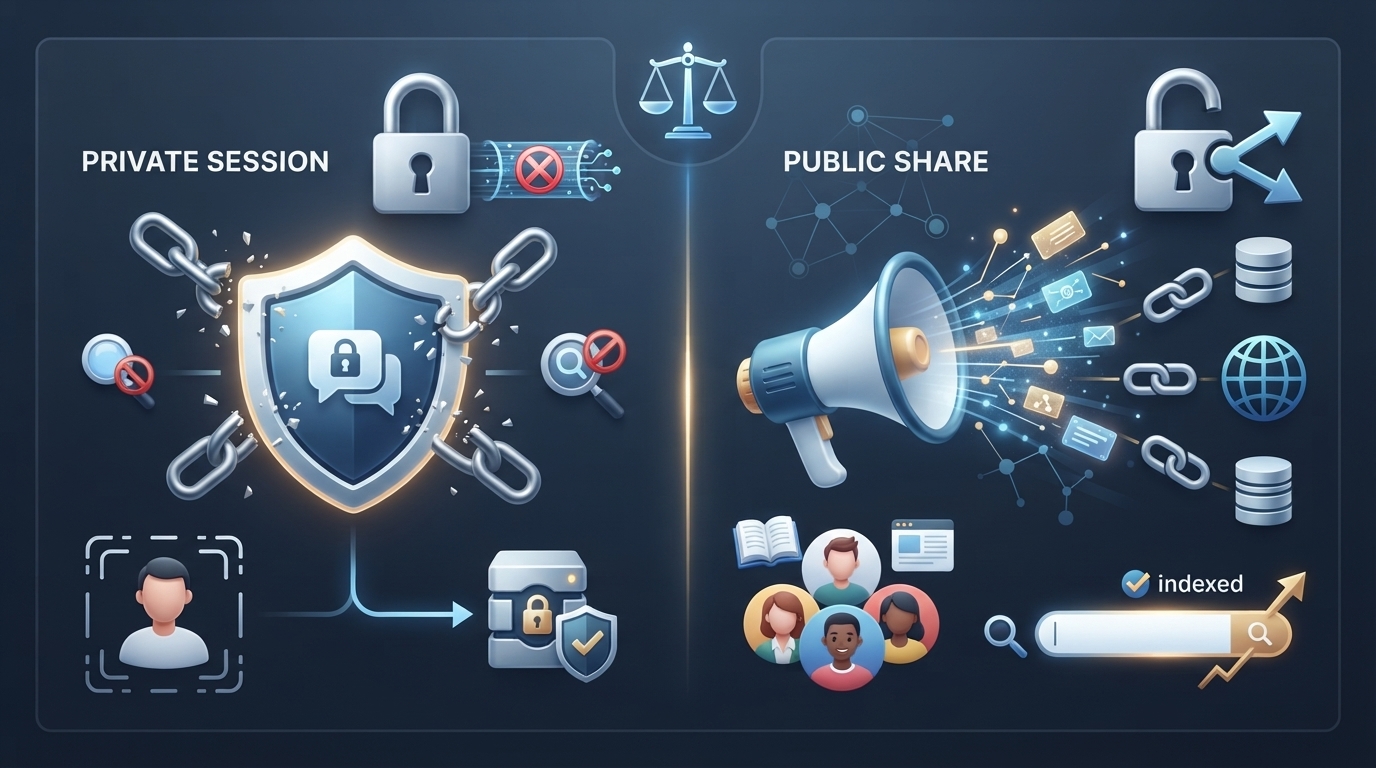
| Shared Chat Link | Accessible to anyone with the link |
| Search Indexed Shared Chat | Publicly discoverable through search engines if indexed |
This distinction matters because a shared conversation is fundamentally different from a private conversation.
Creating a public link changes how that content can be accessed. If search engines are allowed to crawl that page, it may eventually appear in search results.
That process is entirely different from unauthorized access or a cybersecurity breach.
How Did Google Index Shared Claude Conversations?
To understand the situation, it helps to know how search engines work.
Google continuously scans billions of publicly available webpages using automated software known as crawlers or bots. Whenever these bots discover a publicly accessible page, they determine whether it should be added to Google’s search index.
If a webpage:
- Can be accessed without logging in,
- Has no restrictions preventing crawling,
- Is linked from another discoverable page,
there is a possibility that Google may index it.
This appears to be what happened with some Claude shared conversations.
Rather than bypassing security protections, Google’s crawler simply found pages that were already publicly accessible.
The incident highlights an important difference between a page being “unlisted” and a page being “private.”
Many users mistakenly assume those terms mean the same thing.
They do not.
Why This Became a Major Privacy Concern
Although no evidence suggests that private Claude conversations were compromised, the incident still raises legitimate privacy concerns.
People increasingly use AI assistants to handle sensitive work, including:
- Software development
- Business planning
- Marketing strategies
- Legal drafting
- Financial analysis
- Personal journaling
- Research projects
Some publicly shared Claude conversations reportedly contained API keys, cryptocurrency wallet information, resumes, business documents, and other sensitive material.
Whether users intentionally included those details or simply forgot they were sharing publicly, the result demonstrates how easily confidential information can become exposed.
The incident serves as a reminder that AI platforms are becoming repositories of valuable personal and business data.
Understanding Claude’s Share Feature
Claude includes a sharing feature that allows users to create links to conversations.
The feature makes collaboration easier by allowing teams to review prompts, code, research, or AI-generated content without requiring screenshots or copied text.
For developers, educators, researchers, and businesses, this capability offers significant advantages.
Instead of exporting conversations manually, users can simply share a link.
However, convenience also introduces new risks.
Unless users clearly understand that a shared link may become publicly accessible, they may unintentionally expose information they assumed remained semi-private.
This gap between user expectations and technical reality lies at the heart of the controversy.
Why Claude Artifacts Increased Attention
Another aspect of the story involves Claude Artifacts.
Artifacts allow Claude to generate interactive content such as:
- Websites
- Dashboards
- HTML pages
- Documents
- Applications
- Code projects
Unlike simple text conversations, these outputs often contain complete working projects.
If shared publicly, they may reveal significantly more information than a standard AI conversation.
For example, an Artifact could include:
- Business prototypes
- Internal workflows
- Software code
- Client documentation
- Product roadmaps
Because Artifacts often represent finished work rather than casual conversations, their public availability naturally attracted greater attention.

Was This a Security Breach or a Design Issue?
Many cybersecurity experts distinguish between security failures and privacy design issues.
A security breach generally involves unauthorized access.
Examples include:
- Database hacks
- Password theft
- Malware attacks
- Exploited software vulnerabilities
None of those events appear to describe this situation.
Instead, the Claude incident illustrates a privacy design challenge.
When products include sharing features, companies must clearly communicate the consequences of making information public.
Even technically correct designs can produce unintended outcomes if users misunderstand how they work.
This distinction matters because improving user education may be just as important as strengthening technical protections.
Google Search Does Not Mean Data Was Hacked
Search engine indexing often creates confusion.
If a webpage appears on Google, people frequently assume hackers found it first.
That assumption is usually incorrect.
Search engines only index pages they can legitimately access.
If someone intentionally publishes a webpage—or creates a publicly accessible link—that page may eventually become searchable.
The Claude incident follows that pattern.
It reflects the visibility of public content rather than unauthorized access to private systems.
Nevertheless, once sensitive information becomes searchable, the practical impact on affected users can be very similar.
How Does Claude Compare With Other AI Platforms?
Claude is not the first AI platform to face questions about public sharing.
Several AI services now offer collaborative features that let users share conversations, prompts, or generated content.
This reflects a broader shift toward collaborative AI workflows rather than isolated personal assistants.
However, the growth of sharing features also increases the importance of clear privacy controls.
Users increasingly expect AI systems to distinguish between:
- Private work
- Team collaboration
- Public publishing
Future AI products will likely place greater emphasis on helping users understand these differences before information becomes publicly accessible.
Lessons for Individual Users
The incident offers several important lessons.
Before sharing AI-generated content:
- Remove passwords and API keys.
- Delete confidential client information.
- Avoid including financial records.
- Review conversations carefully.
- Verify whether a link is public.
- Assume shared content may eventually become searchable.
These habits reduce the likelihood of accidental exposure.
Just as people think carefully before publishing documents online, they should apply the same caution when sharing AI conversations.
What Businesses Should Learn
Organizations increasingly rely on AI for daily operations.
Employees now use tools like Claude to:
- Draft contracts
- Generate software code
- Analyze customer feedback
- Summarize meetings
- Create marketing campaigns
Without clear governance policies, businesses risk exposing confidential information through accidental sharing.
Companies should establish AI usage guidelines that explain:
- Which information can be entered into AI systems.
- How shared links should be handled.
- Who may publish AI-generated content.
- How confidential data should be protected.
Training employees is often the most effective defense against accidental disclosure.
The Future of AI Privacy
As AI platforms continue evolving, privacy will likely become one of the industry’s defining challenges.
Future systems may introduce additional safeguards such as:
- Expiring share links.
- Password-protected conversations.
- Automatic detection of sensitive information.
- Stronger warnings before creating public links.
- Better search engine controls.
- More granular sharing permissions.
These improvements would help reduce confusion while preserving the collaboration features users value.
Regulators may also pay closer attention to how AI companies communicate privacy settings, especially as businesses and governments adopt AI at larger scales.
Why This Story Matters Beyond Anthropic
The Claude indexing incident is ultimately about more than one company.
It reflects a broader reality that applies to nearly every AI platform.
As artificial intelligence becomes integrated into education, healthcare, finance, software development, and enterprise operations, users are entrusting these systems with increasingly valuable information.
That trust depends not only on technical security but also on transparency.
People need to understand exactly what happens when they click “Share,” who can access that content, and whether search engines might eventually discover it.
The episode serves as a reminder that digital privacy is a shared responsibility. AI companies must design clearer interfaces and stronger safeguards, while users must understand the implications of publishing information online.
Although Anthropic maintains that no private Claude conversations were compromised, the incident has sparked an important conversation about how AI platforms balance openness, collaboration, and privacy. As AI tools continue to evolve, these lessons will influence how companies build future products and how users protect their data in an increasingly connected digital world.