
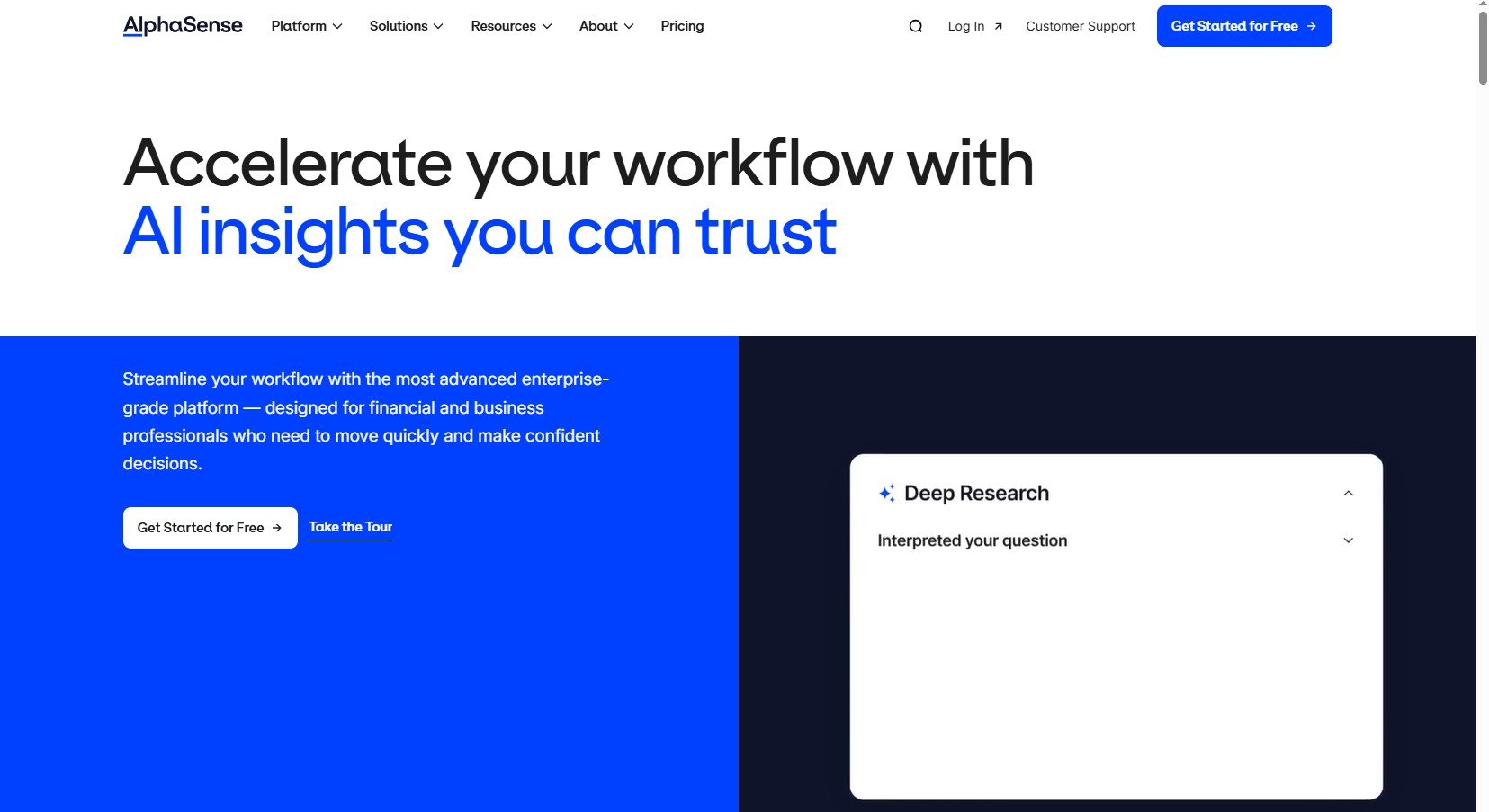

AlphaSense in 2026 stands as one of the most sophisticated and widely adopted AI-powered market intelligence platforms in the world, built for professionals who need accurate, timely, and deep insights into companies, industries, and macroeconomic trends. At its core, AlphaSense solves a clear problem in 2026: the overwhelming volume of business information that decision-makers must sift through daily. The platform uses advanced generative AI and proprietary search technologies to unify disparate structured and unstructured data — including equity research, earnings transcripts, regulatory filings, news, expert interviews, and internal corporate documents — into a consolidated, searchable intelligence workspace that supports faster and more confident strategic decisions.
AlphaSense is owned and operated by AlphaSense Inc., a privately held software company headquartered in New York City. Since its founding in 2011 by Jaakko Kokko and Raj Neervannan, the company has grown rapidly to employ thousands of people across the United States, Europe, and Asia, with offices in New York, London, Helsinki, Mumbai, Singapore, and beyond. The platform is trusted by over 6,000 global enterprises, including most of the S&P 100, major banks, pharmaceutical giants, and consulting firms, making it a de facto standard for enterprise market intelligence. In 2025 and into 2026, AlphaSense has continued expanding both its customer base and product footprint, surpassing $400 million in annual recurring revenue and broadening its suite of AI-driven capabilities.
In practical terms, AlphaSense works by indexing a massive universe of content — hundreds of millions of documents — and applying natural language processing (NLP), semantic search, and generative AI models that are purpose-built for business and financial research. Users enter natural language queries, and the system returns highly relevant results, summarized contextually rather than simply ranked by keyword matches. The platform’s generative search and Deep Research tools synthesize insights, create executive-ready summaries, and connect qualitative narrative with structured data, enabling users to ask complex questions and receive precise, citation-linked answers without manual aggregation. Enterprise deployments extend these capabilities to internal corporate documents, allowing organizations to unify internal and external knowledge in one secure workspace.
AlphaSense’s real-world use cases in 2026 span investment research, competitive intelligence, corporate strategy, consulting, and due diligence. Investment analysts use the platform to validate theses by scanning earnings calls, broker research, and regulatory filings. Corporate strategists track competitor moves, industry shifts, and emerging trends. Consulting teams prepare briefs with rapid access to cross-industry insights. Internal teams embed AlphaSense into workflows to unlock proprietary knowledge from internal memos, reports, and client communications, bridging data silos with GenAI-powered search. Professional use extends to risk monitoring, regulatory compliance tracking, and automated reporting. The generative features enable teams to automate recurring research tasks like trend analysis and slide deck generation, significantly reducing turnaround times on high-stakes deliverables.
As of 2026, AlphaSense’s pricing remains primarily custom and enterprise-focused rather than publicly tiered like many mainstream SaaS tools. The company offers flexible subscription options that scale with seat count, content access, and feature sets, with bespoke quotes issued after consultation with sales. Typical publicly estimated ranges based on industry reporting place costs for small teams starting in the low five-figure annual range, with mid-size teams and larger deployments often falling into the tens of thousands to over a hundred thousand dollars per year depending on content packages and user counts. There is also a free trial available for new customers to evaluate the platform. The absence of transparent flat pricing reflects AlphaSense’s enterprise orientation and tailored deployment models.
Compared with competitors, AlphaSense’s pricing is premium. Alternatives such as Sentieo, CB Insights, PitchBook, and Bloomberg Terminal also serve financial research and intelligence needs, but each differs in focus: Bloomberg emphasizes real-time market data and trading tools, PitchBook focuses on private markets, and CB Insights on startup and innovation intelligence. AlphaSense’s strength lies in its breadth of content and AI-driven synthesis, but for smaller firms or individual users, less expensive or more specialized tools may offer better ROI.
AlphaSense is best suited for large enterprises, investment firms, corporate strategy groups, consultancies, and anyone whose role depends on deep, cited, and timely market data integrated into decision workflows. It is less suitable for individual retail investors, small businesses with modest intelligence needs, or teams looking for a generalist AI search solution, as the depth of content and enterprise focus may not justify the investment for those users.
Among its strengths in 2026, AlphaSense offers unparalleled access to premium content, AI-enhanced semantic search, enterprise-grade security, and the ability to integrate internal documents seamlessly. Its generative AI features transform complex research tasks into more efficient workflows. However, limitations include high cost, a learning curve for new users, and complexity that may overwhelm teams without dedicated research functions. Some users also report that while search quality is strong, it can occasionally return broad results that require careful filtering.
In business contexts, AlphaSense is embedded into strategic decision cycles, from board-level intelligence briefings to frontline analyst research. Teams use it to monitor trends, generate alerts on competitive moves, produce research briefs, and ground strategic hypotheses in empirical data. The platform’s secure enterprise deployments allow sensitive proprietary data to be searched alongside external insights, turning internal knowledge into actionable intelligence without compromising governance.
In the broader AI landscape of 2026, AlphaSense matters because it exemplifies how generative AI can shift business intelligence from manual aggregation to instinctive insight generation. It continues to lead in purpose-built, domain-aware AI for research, contrasting with general-purpose models that lack industry-specific context or vetted proprietary content. For organizations that depend on rigorous, evidence-backed intelligence rather than surface summaries, AlphaSense represents a critical evolution of how knowledge work is conducted.
AlphaSense’s value in 2026 lies in its ability to reduce information overload and accelerate confident decision-making at scale, backed by a combination of vast, curated content and AI tuned to professional inquiry. For enterprises and research-intensive teams, the platform is a strategic asset. For those outside these spheres, simpler tools may suffice.
Final Verdict: AlphaSense is an enterprise-grade market intelligence platform that leverages AI to transform how professionals gather, analyze, and act on business information. Its strength is in unifying massive content sets with generative AI that produces context-rich insights, driving strategic outcomes across finance, corporate strategy, and consulting. The trade-off is cost and complexity, which positions AlphaSense squarely for organizations with deep research needs and the budget to match. In 2026, it stands as a defining solution in the enterprise AI intelligence landscape, not for casual users, but for teams seeking clarity in complexity.