
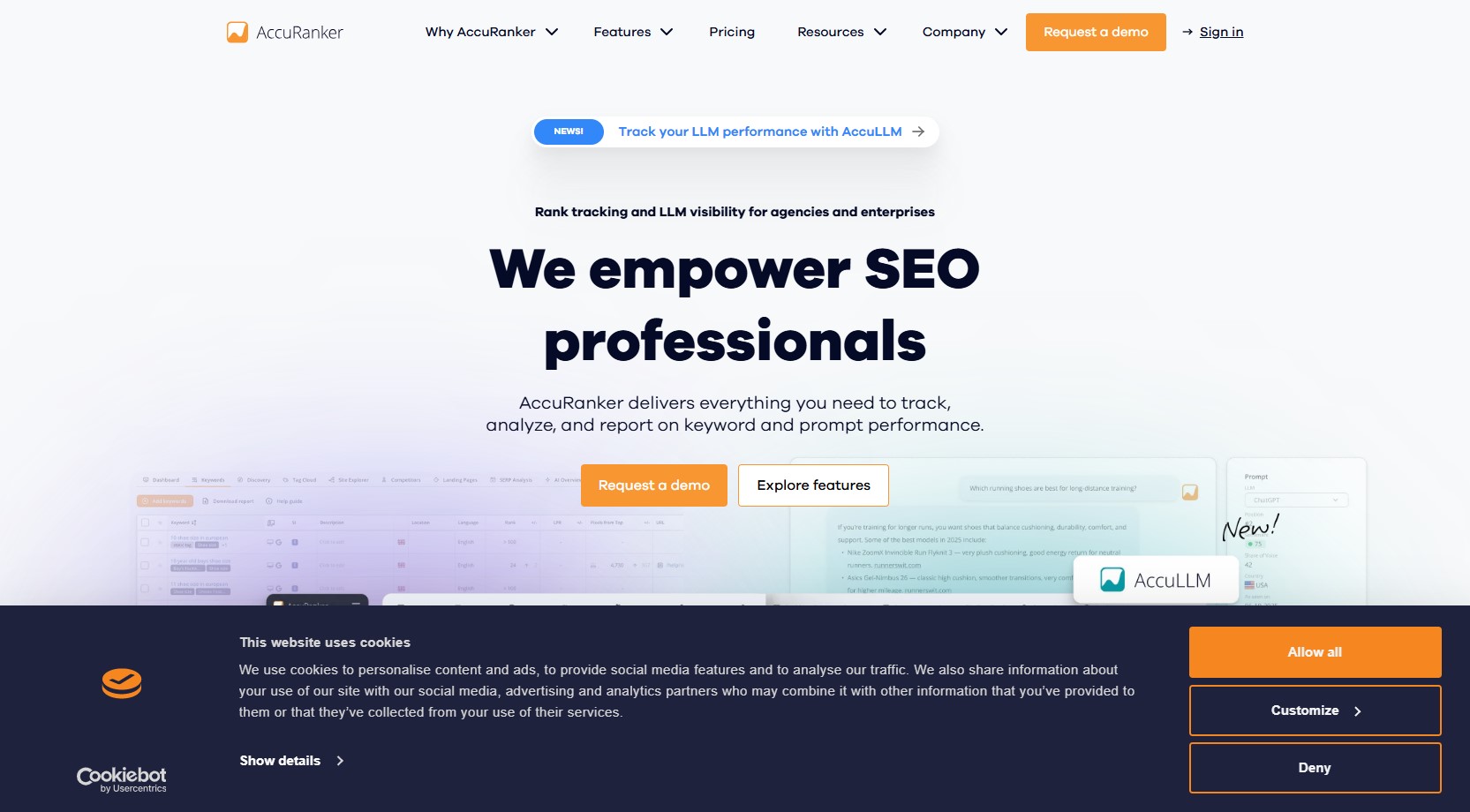

What AccuRanker AI is and what problem it solves in 2026
AccuRanker AI isn’t a separate “AI product” on its own, but rather the AI-enhanced rank tracking and keyword intelligence features built into the AccuRanker SEO platform — a specialist tool focused on high-frequency keyword rank tracking with modern AI-augmented insights. In 2026, SEO professionals use it to go beyond basic keyword position tracking; AccuRanker incorporates AI models for search visibility metrics such as AI-search-volume, AI-click-through-rate (AI-CTR), and AI-share-of-voice that combine multiple data sources and machine learning to provide more realistic, context-aware insights into how keywords and content perform in organic search. These AI signals help teams prioritize keyword investments and measure performance more accurately than static rank numbers alone, addressing the challenge of SEO decision-making under noisy or inconsistent data sources.
Who owns AccuRanker AI and the company behind it
AccuRanker AI is part of the AccuRanker platform, developed by AccuRanker A/S, a SaaS company specializing in keyword rank tracking and visibility analytics. AccuRanker’s technology and artificial intelligence enhancements are proprietary; the platform has been adopted by thousands of SEO professionals, agencies, and in-house teams that require accurate, fast, and detailed ranking insights across search engines and devices.
How AccuRanker AI actually works
At the core, AccuRanker is a cloud-based rank tracker that automatically fetches keyword positions from Google and other engines for mobile, desktop, and local search contexts. On top of that, its AI Models layer interprets and enriches keyword data with derived metrics:
-
AI Search Volume aggregates and reconciles data from Google Keyword Planner, Google Search Console, and Google Trends to deliver more precise, location-aware search volume estimates that avoid inflated or misleading counts.
-
AI CTR leverages models combining positional data, SERP features, and user behavior signals to estimate realistic click-through-rates for tracked keywords.
-
AI Share of Voice synthesizes search volume and rank position into a visibility metric that reflects actual market presence, rather than raw position alone.
These AI components help teams focus on high-impact keywords and visibility opportunities rather than superficially high-volume terms.
Real-world use cases and how professionals use it today
SEO professionals and agencies use AccuRanker AI for multiple purposes in 2026. Daily and on-demand ranking updates help monitor algorithm shifts, campaign results, and SERP volatility in near real time. Marketers segment keyword portfolios with dynamic tagging and use AI-derived metrics to prioritize keywords by business value rather than position alone. Competitor keyword tracking and share-of-voice analytics show visibility relative to peers, and reporters pull automated, white-labeled dashboards for clients or internal stakeholders. In larger deployments, API access links AccuRanker data into internal BI systems and dashboards, serving as the authoritative source of rank and visibility signals for executive reporting and performance assessments.
Current pricing plans in 2026
AccuRanker uses keyword-based subscription pricing with transparent monthly plans that scale by the number of keywords you want to track and the depth of insight you need. In 2026, typical published plans start around $224 per month for a Professional tier (tracking thousands of keywords with daily updates, intent filtering, and reporting). A more robust Expert tier at about $764 per month adds dynamic tagging, AI-CTR, AI Search Volume metrics, Tag Cloud, advanced filtering, and unlimited read API access. For teams tracking more than 25,000 keywords, pricing moves into custom Enterprise plans, which add data export capabilities, BigQuery integration, raw SERP HTML access, unlimited domains and users, and dedicated support.
How pricing compares to competitors
Compared with lightweight rank trackers or all-in-one SEO suites with bundled rank tracking (e.g., tools that price around $30–$150 per month for basic tracking), AccuRanker’s pricing sits in the mid-to-premium segment because it combines rapid, accurate tracking with AI-augmented visibility and analytic layers. While some alternatives may be cheaper, they typically lack AI-enriched search volume estimates and dynamic CTR metrics and often impose tighter limits on users, domains, or refresh frequency. For larger agencies and in-house teams that depend on accurate, business-focused rank data at scale, AccuRanker’s pricing is competitive when weighted against the value of its comprehensive data and AI insights.
Who should use AccuRanker AI and who should not
AccuRanker AI is ideal for SEO professionals, digital marketing agencies, mid-sized in-house search teams, and enterprise SEO operations that require precise ranking data, fast updates, competitor benchmarking, and AI-enhanced visibility insights to support strategic decisions. It’s particularly valuable where keyword performance directly correlates with business outcomes and where share of voice and realistic traffic potential are key metrics. It is less appropriate for solo bloggers, very small businesses, or casual SEO users with limited keyword portfolios or simpler needs — in such cases, budget-oriented tools with basic daily rank updates may be sufficient.
Strengths, limitations, and realistic drawbacks
Strong points for AccuRanker AI include rapid, daily and on-demand ranking updates, precise localized tracking, AI-enriched metrics (CTR, search volume, share of voice) that help teams prioritize meaningful work, and API and integration support for custom workflows. Limitations include its focus on ranking and visibility data only rather than full SEO analytics suites (i.e., it doesn’t provide backlink analysis or content audits), and higher cost at scale, which may be prohibitive for smaller teams. Significant AI features like share of voice and dynamic search volume require some interpretation and strategic context to apply effectively rather than providing prescriptive answers.
How AccuRanker AI is being used in businesses and teams
Teams embed AccuRanker AI into daily monitoring dashboards, where organic performance and competitor movements are tracked with granular precision and AI-derived context. It’s part of weekly SEO reviews, where analysts interpret fluctuations and attribute changes to algorithm updates or content pushes. Agencies use the platform to generate custom client reports that show both ranking positions and visibility metrics that matter to stakeholders. Because of API integrations, rank and visibility data flow into broader BI systems that link SEO performance to traffic, leads, and revenue KPIs.
Why AccuRanker AI matters in the AI landscape in 2026
By 2026, search optimization has expanded beyond simply tracking positions to include visibility metrics, AI-augmented search behavior, and contextual performance signals. AccuRanker AI matters because it equips teams with actionable, data-driven visibility insights — blending traditional rank tracking with machine-learning-enhanced estimations of traffic potential and visibility (e.g., AI Search Volume and AI CTR). This combination helps marketers navigate algorithm shifts, competitive dynamics, and evolving search surfaces more confidently than tools that only report static ranks.
A concise final verdict written like a human expert
AccuRanker AI in 2026 is a focused, high-precision rank tracking platform with meaningful AI enhancements that help SEO teams understand not just where they rank but how valuable those positions are in terms of traffic and competitive presence. Its fast, accurate data and advanced visibility metrics make it an invaluable tool for agencies and teams with robust keyword portfolios, while its pricing and scope reflect its specialization rather than offering a full SEO suite. For organizations that prioritize real-time visibility and data-driven decisions, AccuRanker delivers clear, reliable insights — though those with lighter needs or tighter budgets might find simpler trackers more cost-effective.