
Z.ai has officially revealed the AI model behind the mysterious Ox Alpha release that attracted developers and AI researchers earlier this week.
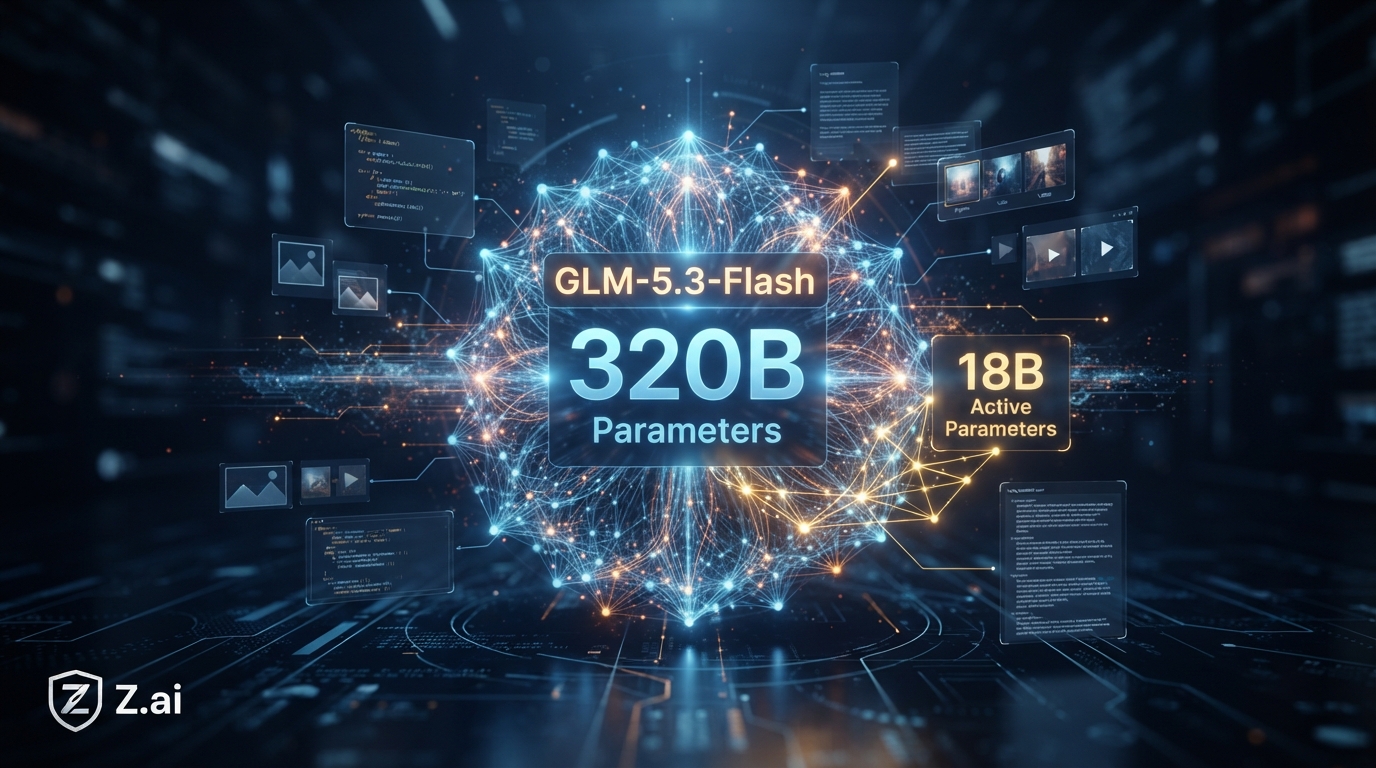
The company confirmed that Ox Alpha was an anonymous preview of GLM-5.3-Flash, its newest model in the GLM-5 family. The model combines a 320-billion-parameter architecture with only 18 billion active parameters, a context window of up to 1 million tokens, native multimodal capabilities, and open weights.
But the most important part of the announcement may be its economics.
Z.ai designed GLM-5.3-Flash to deliver strong performance for coding, AI agents, visual understanding, and professional workflows while using substantially less compute than a conventional model of its size. The company also says the model was served at scale on Chinese-made AI chips.
That puts GLM-5.3-Flash in a different position from many frontier AI models.
It does not have to beat every premium model on every benchmark. Instead, its opportunity is to become the low-cost workhorse for a large volume of everyday AI tasks.
VentureBeat has taken this idea further, estimating that GLM-5.3-Flash could eventually handle about 45% of AI workload volume in a model-routing strategy. That figure is VentureBeat’s analysis, not an official forecast from Z.ai.
What Is GLM-5.3-Flash?
GLM-5.3-Flash is Z.ai’s newest natively multimodal AI model in the GLM-5 series.
Unlike a text-only model, it is designed to work with multiple forms of information, including text, images, video, and files. Z.ai also positions it for coding, agentic workflows, visual understanding, and professional knowledge work.
Its headline specifications include:
| Feature | GLM-5.3-Flash |
|---|---|
| Developer | Z.ai |
| Model family | GLM-5 |
| Total parameters | 320 billion |
| Active parameters | 18 billion |
| Architecture | Mixture of Experts |
| Context window | Up to 1 million tokens |
| Input | Text, images, video and files |
| Primary uses | Coding, agents, multimodal and professional tasks |
| Model availability | API and open weights |
| License | MIT |
The 320B versus 18B distinction is important.
GLM-5.3-Flash contains a very large overall parameter pool, but its Mixture-of-Experts architecture activates only part of that network for each token. That allows Z.ai to pursue a large model capacity without paying the full computational cost of activating all 320 billion parameters on every request.
Ox Alpha: The Mystery Behind the Model
Before Z.ai announced GLM-5.3-Flash, developers discovered a mysterious model called Ox Alpha.
It appeared through platforms including OpenRouter and OpenCode without a clear public identity. Developers quickly began testing it because the model showed strong performance while being unusually inexpensive.
That created speculation about which AI company was behind it.
Z.ai eventually confirmed the answer.
Ox Alpha was an anonymous preview of GLM-5.3-Flash. The company said it intentionally tested the model anonymously on OpenCode and OpenRouter to gather user feedback before its public launch.
The experiment gave Z.ai something traditional benchmark testing cannot provide: real-world usage.
Developers were testing the model without knowing which company had built it. That allowed Z.ai to observe how the system performed in actual coding and agentic workflows.
The result was significant enough for the model to become one of the most talked-about AI releases of the week.
Why GLM-5.3-Flash Uses Less Compute
The model’s biggest technical advantage is not simply its 320-billion parameter count.
It is the architecture behind those parameters.
Z.ai combines Mixture-of-Experts, linear attention, sparse attention, and other efficiency techniques to reduce the cost of processing long contexts and serving the model at scale.
Mixture-of-Experts Architecture
In a traditional dense model, most of the network may be involved in processing each token.
GLM-5.3-Flash takes a different approach.
Its 320 billion parameters are divided into specialized components, while only a smaller portion is activated for individual tokens.
The model therefore gets the capacity of a very large network without requiring all of that capacity to be active at once.
That distinction helps explain why a 320B model can still be positioned as a Flash model focused on speed and cost.
Sparse and Linear Attention
Long-context AI models can become expensive because the model has to process relationships across enormous amounts of information.
GLM-5.3-Flash uses a hybrid approach that combines linear and sparse attention.
The objective is to reduce the amount of computation required when working with very long inputs.
Z.ai says its architecture reduces attention computation by about 3.01 times and KV-cache requirements by about 4.44 times compared with GLM-5.3.
For users, this matters because lower inference overhead can translate into lower operating costs.
The 1 Million-Token Context Window
GLM-5.3-Flash supports a context window of up to 1 million tokens.
That makes it particularly interesting for workloads involving large amounts of information.
Developers could use a long context window to work with:
- Large software repositories
- Documentation
- Logs
- Technical specifications
- Research material
- Long reports
- Contracts
- Financial documents
- Presentations
- Other large files
For AI agents, long context can also reduce the need to repeatedly summarize or retrieve information from a large working environment. This is increasingly important as AI moves from short conversations toward longer autonomous workflows.
GLM-5.3-Flash Is Natively Multimodal
Another major difference is native multimodality.
GLM-5.3-Flash is designed to process text, images, video, and files.
That means the model can be used for more than text generation or coding.
For example, an AI coding agent could write a webpage, render it, inspect the resulting interface, identify visual problems, and then modify the code.
That creates a feedback loop:
Generate → observe → evaluate → revise.
Z.ai specifically highlights visual interaction and computer-use scenarios as part of the model’s capabilities.
This makes GLM-5.3-Flash relevant to AI agents that need to understand what is happening on a screen rather than relying entirely on text-based instructions.
GLM-5.3-Flash Benchmark Performance
Benchmarks show that the model is competitive on several coding and agentic evaluations.
Z.ai reports strong results across software engineering and autonomous task benchmarks, including Terminal-Bench, DeepSWE and other evaluations.
Some reported results include:
| Benchmark | GLM-5.3-Flash |
|---|---|
| Terminal-Bench 2.1 | 84.3 |
| DeepSWE v1.1 | 63.4 |
| AutomationBench | 48.8 |
| Humanity’s Last Exam | 55.3 |
| Z.ai Code Bench | 29.0 |
Z.ai reports that GLM-5.3-Flash significantly improves over GLM-5.2 on several coding and agentic evaluations.
For example, its reported DeepSWE v1.1 score is 63.4, compared with 46.2 for GLM-5.2, while AutomationBench rises from 26.2 to 48.8.
However, benchmark numbers need context.
Different models can be evaluated using different prompts, harnesses, inference settings, and versions. A benchmark result therefore should not automatically be interpreted as proof that one model is universally better.
The more useful takeaway is that GLM-5.3-Flash is competitive on the coding and agentic workloads that Z.ai is targeting.
Why the Price Matters
Performance is only half of GLM-5.3-Flash’s story.
The other half is cost.
VentureBeat’s analysis places GLM-5.3-Flash at about 57 on Artificial Analysis’ Intelligence Index for roughly nine cents per task, compared with substantially higher estimated costs for some U.S. mid-tier and premium alternatives.
That creates an important economic argument.
Suppose two models can complete the same routine coding task successfully, but one costs several times more.
For an occasional user, the difference may be irrelevant.
For an enterprise processing millions of requests, it can become a major operating expense.
This is why AI inference economics may become as important as benchmark leadership.
GLM-5.3-Flash vs Premium AI Models
It is tempting to ask whether GLM-5.3-Flash can replace Claude, GPT, Gemini, or other leading AI models.
That is probably the wrong question.
The more useful question is:
Which model should handle which workload?
| Workload | Likely model strategy |
|---|---|
| Extremely difficult reasoning | Premium frontier model |
| High-value specialized tasks | Premium or mid-tier model |
| Routine coding | GLM-5.3-Flash or similar efficient model |
| High-volume automation | Low-cost model |
| Long documents | Long-context model |
| Multimodal workflows | Multimodal model |
| Open deployment | Open-weight model |
This approach is called model routing.
Instead of sending every request to the most expensive model, an organization can select a model based on task difficulty, latency, cost, context requirements, and reliability.
That is where GLM-5.3-Flash becomes particularly interesting.
The 45% AI Workload Argument
VentureBeat estimates that GLM-5.3-Flash could eventually handle around 45% of AI workload volume.
The figure should not be presented as a Z.ai prediction.
It is an argument about how companies could distribute their AI workloads.
The basic logic is straightforward.
Some tasks require the best available reasoning.
Others simply need a capable model to summarize a document, write code, classify information, generate content, process an image, or execute a routine agent workflow.
Using a premium model for every one of those requests can be unnecessarily expensive.
GLM-5.3-Flash could therefore become the workhorse layer in a larger AI stack.
That does not mean it will actually capture 45% of all AI workloads.
The percentage will vary by company, industry, application, and task complexity.
The more important idea is that AI model selection is moving toward workload-specific routing.
GLM-5.3-Flash and Chinese AI Chips

One of the most consequential aspects of the launch is happening below the model layer.
Z.ai says the anonymous Ox Alpha traffic was served using Chinese-made AI chips.
The company also describes an optimized inference system designed around domestic accelerators and says its optimization work achieved a threefold improvement in end-to-end serving performance over its initial baseline on the same hardware.
This matters because China’s AI industry has been under increasing pressure to develop domestic alternatives to advanced U.S. hardware.
The model therefore demonstrates more than software efficiency.
It highlights the importance of optimizing the entire AI stack:
Model architecture + inference software + accelerators + serving infrastructure.
SCMP described the deployment as a significant test of China’s ability to scale AI inference on domestic hardware.
That gives GLM-5.3-Flash a geopolitical and infrastructure dimension that goes beyond normal AI model launches.
Is GLM-5.3-Flash Open Source?
Z.ai has released the model weights under an MIT license, making GLM-5.3-Flash significantly more accessible to developers and organizations that want greater control over deployment.
The model is also available through Hugging Face.
That creates several possibilities:
- Self-hosting
- Private AI deployments
- Custom inference
- Research
- Developer experimentation
- Integration with open-source AI infrastructure
However, open weights do not mean the model is easy to run on a normal laptop.
A 320-billion-parameter model still requires substantial hardware and infrastructure.
For many businesses, API access will therefore be more practical than operating the model themselves.
This is an important distinction when evaluating any large open-weight AI model.
What Can GLM-5.3-Flash Be Used For?
The model’s capabilities make it relevant to several growing AI categories.
Coding
Developers can use it for:
- Code generation
- Debugging
- Repository analysis
- Software engineering
- Terminal tasks
- Frontend development
- Coding agents
AI Agents
The model can support longer agentic workflows where an AI system needs to reason, use tools, observe results, and continue working.
Multimodal Analysis
Its visual capabilities make it useful for:
- Screenshots
- Documents
- Images
- Video
- Visual interfaces
Business Workflows
Z.ai also highlights professional applications involving financial research, office documents, presentations, spreadsheets, and other knowledge-work tasks.
This positions GLM-5.3-Flash as more than a coding model.
Who Should Consider GLM-5.3-Flash?
GLM-5.3-Flash makes the most sense for organizations where cost, scale, and flexibility are important.
Developers
Developers running frequent coding and agentic requests can benefit from a lower-cost model.
AI Startups
Startups can evaluate the model as an alternative to paying premium prices for every inference.
Enterprises
Businesses handling large request volumes may find the cost-performance ratio more important than a small benchmark advantage.
AI Agent Builders
Teams developing autonomous systems can use its long context, tool-oriented capabilities, and multimodal inputs for more complex workflows.
Open-Weight AI Developers
Organizations that need more control over deployment can explore the model weights instead of relying exclusively on a closed API.
The Biggest Limitation: It Is Not a Universal Replacement
GLM-5.3-Flash has an attractive combination of cost and capability, but that does not make it the best choice for every task.
A premium model may still be preferable when:
- Maximum reasoning quality is critical
- Reliability requirements are extremely high
- A task is unusually complex
- Specialized ecosystem integrations matter
- The cost of an error is greater than the cost of inference
Self-hosting also remains challenging because of the model’s size.
And infrastructure claims about Chinese-chip performance should be treated as Z.ai’s reported results, rather than independently verified industry benchmarks.
The smartest approach is therefore not to replace every model with GLM-5.3-Flash.
It is to test it against the workloads where its economics make the most sense.
Why GLM-5.3-Flash Could Change AI Economics
The biggest lesson from this release is not simply that another Chinese AI company has built a powerful model.
It is that the AI market is increasingly competing on intelligence per dollar.
For years, the main question was:
Which model is smartest?
Now another question is becoming equally important:
Which model is smart enough for this task at the lowest practical cost?
That shift could change how companies build AI systems.
Instead of selecting one model for everything, organizations could create a tiered architecture:
Premium model → difficult tasks
Mid-tier model → normal reasoning
GLM-5.3-Flash-class model → high-volume tasks
That strategy could reduce inference costs without forcing companies to sacrifice AI capabilities across their entire workflow.
Final Takeaway
GLM-5.3-Flash is significant because several trends converge in one model.
It has 320 billion total parameters but only 18 billion active parameters, a 1-million-token context window, native multimodal capabilities, open weights, strong coding and agentic performance, and a focus on efficient inference. Z.ai also says it has demonstrated large-scale serving on Chinese AI hardware.
The Ox Alpha experiment adds another interesting layer.
Z.ai tested the model anonymously before revealing its identity, allowing real developers to evaluate it without the expectations attached to a major model launch.
But the biggest story may be economic.
GLM-5.3-Flash does not need to replace every premium AI model to become important. If it can handle a large share of routine coding, multimodal, agentic, and knowledge-work tasks at a fraction of the cost, it could become a valuable workhorse model inside larger AI systems.
VentureBeat’s 45% workload estimate should therefore be viewed as a market thesis rather than a guaranteed forecast.
The broader trend is easier to see.
As AI models become more capable and inference becomes cheaper, businesses will have more reasons to route different tasks to different models.
And that could make GLM-5.3-Flash important not because it wins every benchmark, but because it represents where the AI market may be heading next: more capable AI, lower inference costs, open-weight alternatives, and smarter model selection for every workload.